Showing posts with label housing. Show all posts

Tuesday, May 18, 2010

"Mental: a History of the Madhouse"

click to go to the show websiteAs a part of a series of documentaries detailing changes in views about mental illness in the last 60 years, BBC4 screened Mental: A History of the Madhouse last night, and it did an admirable job of exploring the spectrum of shades of grey involved in the issue without black-and-white judgement.

For example, there was Maggie, who volunteered for "experimental" brain surgery in the 1960s and who feels that, after 5 years of debilitation that followed the surgery - in which a section of her brain was burned out to stop the fits of violence that would require increasing lengths of hospitalisation - she recovered in spite of and not because of the operation. She has been given awards for campaigning for community causes...but one is left wondering if this would have been possible without the operation.
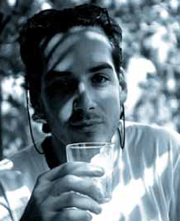
Jonathan Zito RIP: click to go to a statement by the Jonathan Zito TrustI thought of this towards the end of the documentary, when we saw the dark side of the opposite of the asylum model of care. Following a series of murders by people who had been released into the community as beds were closed (so the chance of their being readmitted stadily diminished), the most famous of which was the 1992 murder of Jonathan Zito by Christopher Clunis at Finsbury Park, a psychiatrist briefs a police shift that one of his patients is having increasingly violent urges, and then a dozen riot officers break into his house because both psychiatrist and police have decided that "overwhelming force" is required.

There have, of course, been huge leaps since the days of the asylums, when staff violence towards patients was recalled by a former psychiatric nurse as having been justified, when he was a student, by his charge nurse on the grounds that "if you live among shit you become shit". Although thankfully I missed this period, I felt ashamed to have been a psychiatric nurse.
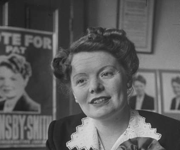
Patricia Hornsby Smith - click to view the whole Time portraitIn 1959, Patricia Hornsby-Smith (in Harold MacMillan's Conservative government) reported on the crippling price of keeping more people in psychiatric institutions than there had ever been, reporting on the "appalling legacy" of the buildings and how maintaining them would take up an increasing portion of the NHS budget; but she also spoke on how an appreciation of mental illness being like "any other disability" was a prerequisite on action that would need to be taken on both pragmatic and humanitarian grounds.

Hornsby-Smith's speech was the prologue that Enoch Powell's 1961 Water-Tower Speech was written to follow:
Enoch Powell: click to go to the text of the Water Tower Speechit is the duty of a Minister of Health and the duty of the National Association for Mental Health, to...choose and to favour wherever they have the choice, the course of more drastic and fundamental change: for we may be pretty sure that even so the progress of medical thought and method will still be well on ahead of our practice.
Powell was, of course right (and it was good to see the BBC admit that the man was more than a controversial 15-minute speech): as the documentary showed, "hope came from the laboratories [in the form of] a new generation of psychiatric drugs". However, Largactil (chlorpromazine) created new problems to replace the ones it solved in the form of simultaneous agitation and sedation, and Parkinson's Disease-like symptoms. Had the resarchers looked further into its genesis, they might have found that it was derived from a dye produced in Victorian England, but wasn't much use. So it was fed to cows to see the effect, which was that the cows calmed down. And died shortly afterwards.

However, the growing voice possessed by mentally ill people and their advocates - who included many mental health workers - drove the phamaceutical search for medications that had maximum effect on symptoms with minimum unwanted effects. The quest still continues.

click to read Boris Johnson's article in the TelegraphBut how did we get from this sense of optomism to a mentally ill man's flat being raided by a dozen riot police? As beds decrease, I worry that the stigma that infested the ageing Victorian structures hasn't disappeared but has rather been absorbed into society, which has become itself an über-asylum wherein, asserts London Mayor Boris Johnson in an exegesis of Eleanor Rigby, too many people "pretty much stay at home and watch TV" with their loneliness acting as a straitjacket - a garment never used once in the history of the crumbling Victorian asylum where I trained.

As politicians struggle to describe how they are going to deal with the deficit, it's obvious that there are goiclick to read more about hte International Clubhouse Movementng to have to be cuts. But this should not blind us to the fact that cuts started some time ago. Fulbourn hospital, the psychiatric hospital serving Cambridge and surrounding areas, lost two rehabilitation units and two acute psychiatric wards in 2007. This could have been ameliorated by better services in the community, but Vocational Services, providing occupational therapy, and Cambridge Clubhouse a range of less structured opportunities of rehabilitation after psychiatric treatment, are long gone. The Clubhouse was replaced by a mental health resource centre that aimed to make ex-patients in the community into trainers, but access is now only by telephone.

I'm not setting out my stall for my territory, having switched from a psychiatric nurse to a psychiatric patient some years ago. I'm merely arguing for common sense: in the absence of dedicated resources people requiring mental health treatment are, at the more severe end, going to keep ricocheting between inpatient wards, police cells and prison and, at the less severe, take up more of the general resources that are available, eg GP appointments, A&E beds, etc.

And the human cost is intertwined with the financial one, something that Patricia Hornsby-Smith and Enoch Powell would have recognised. I met a fellow Clubhouse veteran recently; unable to maintain employment without input but "not ill enough" to warrant a community psychiatric nurse, she spends her time subsisting on benefits - mostly, as Boris Johnson says, at home watching TV. Investing in resources that would help people like my friend both to work and to pay more taxes would, in my opinion, be a win/win situation.

Related posts:

Good taste back on the Horizon: How Mad are You?

Blurred Boundaries, Fine Lines - How Mad are You?

Monday, May 3, 2010

"Bronson" - special charity screening in Cambridge

Since the Willow Walker folded, a lot has been happening behind the scenes to re-estTom Hardy - click to read an interviewablish a written-word service for homeless and vulnerably housed people in Cambridge and the people who serve them.

This culminated earlier in the year with the formation of Flack, a company registered as a social enterprise which aims to launch its first issue next spring. Their patron, Tom Hardy, is coming to the Cambridge Arts Picturehouse on Sunday 9 May to answer questions after a special screeening of his controversial film
Bronson in aid of the charity. I don't think I can do better than give you the press release, with hyperlinks and pics.


click to go through to the Cambridge Arts Picture House homepageHollywood star Tom Hardy will be coming to Cambridge on Sunday, May 9 for a special screening of his film Bronson. The showing, in the Cambridge Arts Picturehouse at 1pm, will be followed by a question-and-answer session with the actor.

The screening is to support the newly-formed charity Flack, which was set up to replace and expand the services to homeless/vulnerably housed people and the agencies who serve them by the magazine Willow Walker. The first editor of the Willow Walker, named after a Cambridge hostel run by English Churches Housing Group, was Alexander Masters, whose book Stuart: A Life Backwards was turned into a film starring Hardy.

click to read a review of both sides of the tracksThe editor of Flack, which hopes to launch its new magazine in Spring 2011, is Kirsten Lavers, whose tenure at the Willow Walker as Alexander Masters’ successor saw the formation of a business called Cambridge Link-Up, run by present and formerly homeless people, and Street Voices, whose double CD Both Sides of the Tracks was released in March 2009 to critical acclaim.

Tom Hardy, patron of Flack, has successfully battled an alcohol and crack addiction he click to go to the star Trek Nemesis websiteacquired after the box-office failure of Star Trek Nemesis, in which he played Praetor Shinzon, an evil clone of Captain Jean Luc Picard; the film was released at the same time as Harry Potter and the Chamber of Secrets, the James Bond film Die another Day and Lord of the Rings: The Two Towers.

Bronson is the story of prisoner Charles Bronson, who changed his name from Michael Peterson to give him a harder image as a bare-knuckle fighter in London. First arrested in 1974 for armed robbery, he has spent just four months as a free man since, and is still imprisoned. He has been called "the most violent prisoner in Britain", and has been moved 120 times. Hardy famously did 2500 press-ups a day for five weeks before filming started to bulk up for the role. His other films include Black Hawk Down, Minotaur and RocknRolla, while he has also starred in TV productions such as Band of Brothers, Wuthering Heights and The Virgin Queen.

click to read the poster for the event

Sunday, April 4, 2010

on the trail in Trumpington

UPDATE: click here if you're looking for "Trumpington Bible"

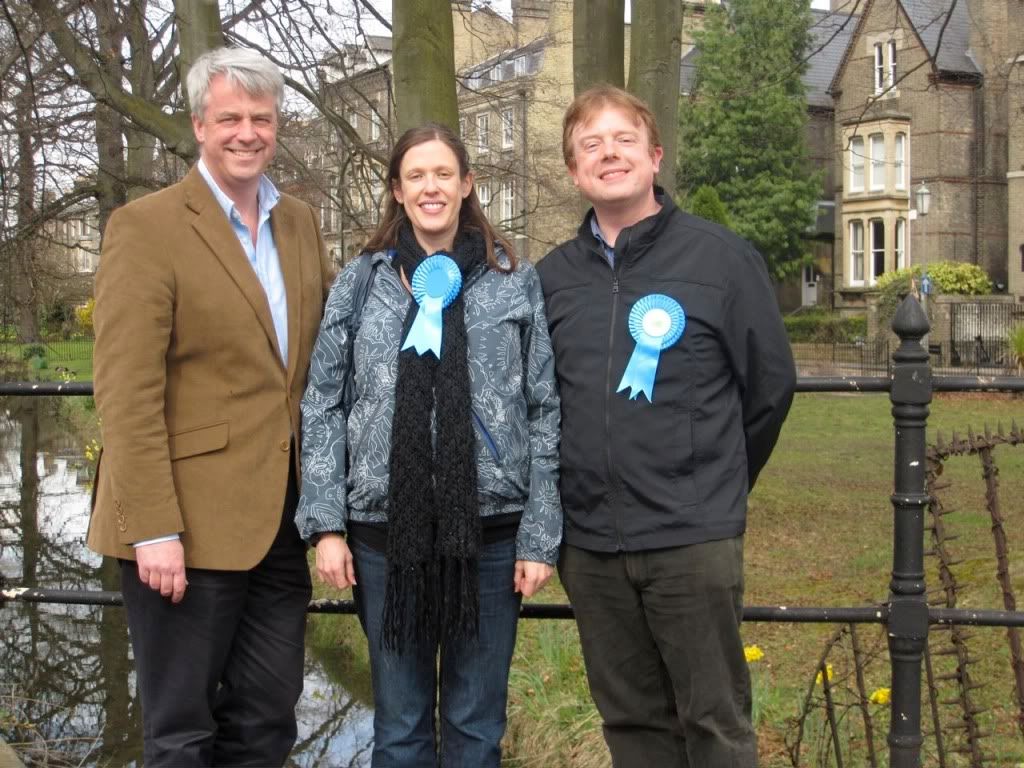
Andrew Lansley, and Nick and Lara Hillman, in Brookside, Cambridge

In the photo above, from left: Andrew Lansley, Shadow Secretary of State for Health, Lara Hillman, candidate for City Councillor for the Abbey Ward in Cambridge, and Nick Hillman, Prospective Parliamentary Candidate for Cambridge; taken in Brookside, in the Trumpington ward of Cambridge.


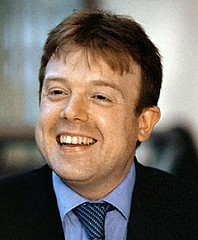
Nick Hillman: click to read an interview on his websiteGoing to Trumpington Waitrose to meet Nick Hillman - Prospective Parliamentary Candidate) for Cambridge - for a letter-drop explaining a boundary change, I was delighted to meet Nick's wife Lara, who is standing to become a Councillor for the city's Abbey ward. I have to admit a stereotypical male reaction on meeting an obviously pregnant woman in asking whether she might need some rests while walking about, which she handled with very good grace, considering the weight I'm carrying myself.

The letter was from Shadow Health Secretary Andrew Lansley, explaining that the village of Trumpington will no longer be part of his South Cambridgeshire Constituency but pass to Cambridge City which, hopefully, will be turned blue by Nick Hillman on Election Day.

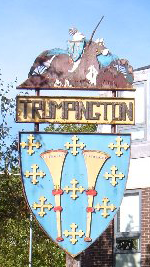
Trumpington village signLook to the panel on the top right to see a countdown to how long we have to wait until that day. Since Gordon Brown bottled out of an autumn 2007 election that he might well have won through the "honeymoon effect" of his just having taken over from Tony Blair, he must be thinking back to 1979, when James Callaghan went right to the wire and lost to Margaret Thatcher after a humiliating vote of no confidence which he lost by one vote.
Mr Lansley had been in the news yesterday criticising the Government for not making vital cancer-treating drugs available on the NHS; but, like any responsible MP, Lansley cares deeply about his constituency andAndrew Lansley - click to go to his home page says in his letter, which he came to Trumpington to hand to the Cambridge team:
[The boundary change] is sad for me. I lived on the High Street in Trumpington for five years. I have been involved in many issues locally and have got to know well many people and organisations. It will be hard to hand over. But, when I do, I hope it will be to Nick Hillman, who is the Conservatives' Prospective Parliamentary Candidate for Cambridge City. I have known Nick for several years. Living in Cambridge, a former teacher at Hills Road Sixth Form College and latterly the Conservatives' leading advisor on policy towards Universities, Nick is brilliantly well qualified to be the Member of Parliament for Cambridge.
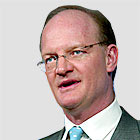
David Willetts: click to go to his homepageAs Andrew Lansley indicates, Nick Hillman works closely with David Willetts, who is the Shadow Minister for Universities and Skills. I hope to see Nick Hillman and David Willetts working closely together with Michael Gove, presently Shadow Secretary of State for Children, Schools and Families - who has challenged a major teaching union to "put its own principles into practice by setting up its own school" - to help us alMichael Gove: read more at the Blue Blogl create a society where, Gove stated at this year's Conservative Party Spring Conference in Brighton, "Education is at the heart of change."

It was interesting to see the cosmopolitan nature of the ward in the streets around the Panton Arms, houses side-to-side with student accommodation and University buildings. I saw a few students going about their business and reflected that Labour had brought education back to the state which prompted James Callaghan to deliver his Ruskin speech in the Oxford University college, one of his first acts upon taking over as Prime Minister in 1976 after the sudden retirement of Harold Wilson, in the middle of the Labour term that mirrors the present one in ending so chaotically. Callaghan wrote about the speech in his 1987 autobiography Time and Chance:
Industry complained that some school-leavers did not have the basic tools to do the job and many of our best-trained students from university and polytechnics had no desire to join industry. Why was this?...Were we sacrificing thoroughness and depth of courses in favour of range and diversity?
Lara was a bundle of energy: the people of Abbey will be well-served should they elect her as their City Counsellor. She and Nick gave me a lift back up to Waitrose so I could pedal frantically back to catch the start of Doctor Who, which I almost managed. Settling down to turkey-roll, and chips, it made me feel slightly guilty to think that Nick and Lara still had their sleeves rolled up and were working hard. I hope, for all our sakes, that they are elected in May.

Sunday, November 22, 2009

top ten songs about times and seasons

10 - Turn, turn, turn

You know it's the 60s when you hear the screaming at the start of this clip from the US music show Shindig that sets the theme for this month's top ten. It's a setting of Ecclesiastes 3:1-8 by Pete Seeger, the man of peace who had to be restrained from taking an axe to Bob Dylan when he went electric at the Newport Folk Festival in 1965, illustrating peaceniks' curious propensity for violence when things they care about get messed with. Seeger reportedly donates 45% of donations from the song to the Israeli Committee against House Demolitions, which opposes houses being built by Jews in the country's so-called "occupied" territories, and has been accused by NGO-Monitor of using "demonization rhetoric that is unrelated to housing issues,...participat[ing] in anti-Israel events" and promoting "a highly politicized narrative of the conflict, falsely accusing Israel of ethnic cleansing and state terrorism". Here's the song:


9 - A time to be born, a time to die

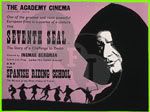
click to see Ian McKellen as The Seventh Seal's Death in Last Action HeroThe Seventh Seal is Ingmar Bergman's masterpiece based on Revelation 8:1, which speaks of a silence in Heaven when the seal of the title is opened by the Lamb of God. The film's influence on cinematography stretches from Arnold Schwarzenneger's soul-searching Last Action Hero to Bill and Ted's Bogus Journey and many points in-between (for example the epic chess game in Harry Potter and the Philosopher's Stone). I first heard Scott Walker's 1969 tribute to it quite recently on Stuart Maconie's BBC Radio 6 show The Freak Zone, in which he showcases progressive rock, psychedelia and the forgotten delights of music that doesn't make it onto more mainstream shows.


8 - A time to kill, a time to heal

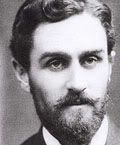
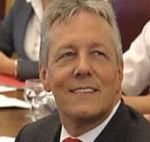
(Sir) Roger CasementLondoner Arnold Bax, who loved to holiday in the West of Ireland, composed Elegiac Trio in 1916 about the failed Easter rising, the elegy being for the chocolate-box Ireland of his imagination as much as the dead. What was arguably more tragic than what happened was what didn't - Roger Casement was picked up by British forces shortly after landing on Banna Strand in Kerry, having been taken there by U-Boat. Casement was trying to get the message to Irish rebels to abort the operation, as the German promise of help - on the basis of "my enemy's enemy" - was, like the French promise of help during the 1798 rising, composed of little more than words. PPeter Robinson, DUP leader - click to read moreerhaps the over-riding tragedy is that the relatively inclusive United Irishmen of 1798 were progressively sidelined by more sectarian organisations which spent as much energy on internal rifts as on anything else, but like the rest of the world I pray that Democratic Unionist Party leader Peter Robinson can manage to keep his party on-side with the power-sharing arrangement in the context of that arrangement having been set up by politicians who wanted Loyalists to give up more than they were perhaps ready to. Unfortunately not quite the whole piece is on this clip (I can't find it in one piece), but I hope you get the taste of the gentle Irish breeze.


7 - A time to plant, a time to reap

I was initially going to put this one under "a time to laugh, a time to weep", as we've all been to weddings that start with joyous reunions surrounding the joyous union before Auntie Betty gets maudlin over a sherry too many, then chose this heading because one of the many things weddings indicate is the maturing of the human harvest, an allegory that deepens my enjoyment of each year's Harvest Festival at St Gallicus. Harnick's lyrics say it all in perfect harmony with Bock's music on Sunrise, Sunset from Fiddler on the Roof.


6 - A time to build up, a time to break down

a burning coffin at the Death of Hippy ceremony in Haight Ashbury - click to read the original speechThis is archetypal psychedelia recorded in 1967, the year in which the "Death of Hippy" was proclaimed by, er, hippies. Three years afterwards, it appeared on the soundtrack of an atrocious piece of trash called Beyond the Valley of the Dolls, which was about the section of the generation that thought it invented sexual liberation, but which was reaping the harvest sown by its parents who were fighting a war that some thought might end civilisation. A lot of good stuff happened in the 60s - you can't diss the decade that saw Gillian Anderson's conception - but a lot of people, often women who were being conditioned by fashionable feminists to become cannon-fodder for the exploitation rodeo, were broken; witness novelist Martin Amis' contention that "the sexual revolution killed my sister Sally". Click on the clip, and immerse yourself in the strangeness.


5 - A time you may embrace, a time to refrain from embracing

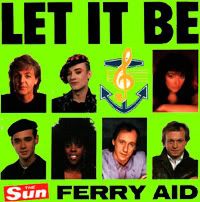
the Sun's recording of Let it BeNever somebody to let a song away with only one meaning, Paul McCartney combined the faith of his childhood with memories of his mother in Let it Be. The middle verse seems to be a meditation on a verse of a Prayer to Our Lady of Lourdes, which I've only ever seen in French, which enjoins the Virgin priez pour ceux qui aiment et sont partis - "pray for those who love and are parted". There are many ways in which one can experience the heartbreak of being parted, so I thought that in was appropriate to post this video by Ferry Aid, produced by Hit Factory team Stock, Aitken and Waterman and starring Macca, which was released in 1987 in the aftermath of the sinking of the Herald of Free Enterprise near Zeebruge in Belgium. Parental advisory: contains shoulderpads and Big Hair.



4 - A time of war, a time of peace

Edith PiafThis was sung by Edith Piaf, "the sparrow", about les Grognards, an elite unit - essentially a special forces regiment - who were sent to Russia in the ill-fated campaign defeated by Generals January and February. In the song, the soldiers' shades march through Paris, a city they never had a chance to see during their brief lives and whose citizens' freedoms were won by their sacrifices. Its a song about our duty of remembrance towards the glorious fallen, summed up by Herodotus with Simonides' epitaph for the slain Spartans in his Histories -
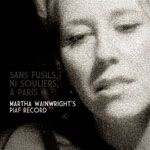
Go tell the Spartans, stranger passing by, Martha Wainwright's Piaf album: click to read a review
that here, obedient to their law, we lie.
- and recited at the start and end of every Royal British Legion meeting: "at the going down of the sun, we will remember them". Here it's performed by Martha Wainwright, who's just released an album of Piaf songs.


3 - A time for every purpose under Heaven

It was a very good year is a fitting humanistic summary of the Ecclesiastes passage. It was made famous by Frank Sinatra, but here's Ervin Drake's song covered by Ray Charles duetting with Willie Nelson.


2 - Chanukah

(Or Hanukkah song, I'm not sure about the translitteration.) How can I write a post about times and seasons and not get seasonal for the last couple? Adam Sandler wrote this for kids who felt they were the only ones in their streets not to have a Christmas tree. The irony is that, here in East Anglia, a lot of people have plastic Chanukah candleabra in their windows thinking that they're Christmas decorations. Adam Sandler performs his original (and best, I think) Chanukah Song on Youtube, but in the only clips I can find he's so busy being Adam Sandler he doesn't give the song a chance. So here it is performed by Oy Capella, Syracuse University's mixed Jewish a capella outfit.


1 - O Come O Come Emmanuael

Enya performs this classic Advent hymn, mixing English with Irish, that voices a longing for reconciliation for God that Christians believe came in the person of Jesus Christ. More Christmas music coming soon.


If you enjoyed this, click here for some more Top ten songs about...

Tuesday, November 17, 2009

counting the cost of creating our future

click to go to the Alzheimer's Society homepageOne phrase that has stuck in my head since training for my stint in geriatrics as a student nurse is that "when we create the care that older people receive, we define our own future".

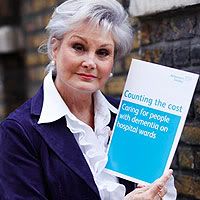
Newsreader, broadcaster and dancer Angela Rippon has been appointed Alzheimer's Society Ambassador alongside businessman John Hughes, and both appeared on ITV1's This Morning to mark the launch of an AS report called Counting the Cost. This looks at the reasons why people with dementia tend to be kept in hospital longer than peAngela Rippon holding 'Counting the Cost' - click to read moreople who are not suffering from a dementing process, and at the costs to both individual and Health Service of this.

It's not uncommon for somebody to show first symptoms of dementia only when they spend some time in an unfamiliar environment - for example if away on holiday or visiting friends. Thereafter, the environment should change as little as possible: in other words, hospital stays should be as short as possible.

I'm not trying to make carers feel guilty for going off for a much-needed break and putting their loved-one in respite-care, as this would be a nursing home specialising in the care of older people, some with dementia. What the report's saying is that hospital stays should be as short as possible, so that the person with dementia can then recover from their hospital stay in familiar surroundings, whether that be the family home or a nursing home.

The report's findings are compelling: while 97% of nursing staff and nurse managers report that "they always or sometimes care for someone with dementia", "47% of carer respondents said that being in hospital had a significant negative effect on the general physical health of the person with dementia, which wasn’t a direct result of the medical condition" and "54% of carer respondents said that being in hospital had a significant negative effect on the symptoms of dementia, such as becoming more confused and less independent".

is it really necessary? Click to read moreThe best-known example of this is inappropriate prescription of medications, predominantly antipsychotics, but also others. On my second night as a patient in a psychiatric ward, I found I'd been prescribed a sleeping tablet because, I think, my tossing and turning on a clanky hospital bed had been quite loud: the prescription had no bearing on my condition. How much more would people with dementia, who might not be able to tell the difference between night and day, be vulnerable to inappropriate prescription? (I'm on an antipsychotic, appropriately prescribed for manic depression, that can knock me out - I wouldn't like to see its effect on a frail older person who wasn't alert to all the cues warning of danger of falls, etc.)

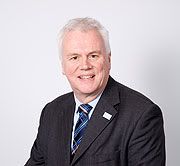
I've got a lot of time for the Alzheimer's Society, as when Baroness Warnock, former chairman of the Committee of Inquiry into Human Fertilisation and Embryology, proclaimed that "dementia sufferers should consider ending their lives through euthanasia because of the strain they put on their families and public services", the Society's president, Neil Hunt, expressed his horror that someboNeil Hunt, Chief Executive of the Alzheimer's Society - click to read moredy in a public position could "disregard the value of the lives of people with dementia so callously...that they should feel that they have some sort of duty to kill themselves is nothing short of barbaric".

The Society, in its paper, gives a powerful incentive for NHS trusts to consider giving dementia patients as short a stay as possible - the bottom line. The full report goes into detail what savings could be made in which circumstances, but the executive summary delivers the money-shot:

This report finds that supporting people with dementia to leave hospital one week sooner than they currently do could result in savings of at least £80 million a year...It would not be unreasonable to assume that there are savings to be made in care for peoplclick to read Angela Rippon's biography - thanks tp Z Design & Print for the pic.e with dementia running into hundreds of millions of pounds, which could be more effectively reinvested.
And, as Angela Rippon, proof (if it were needed) that one can be 65 and glamorous, said on This Morning of the art and science of caring for older people: "We're all going there".

Sunday, November 15, 2009

social enterprise and homeless needs: the autumn issue

Politicians of all parties are looking hopefully at the phenomenon of social entrepreneurship, and Spark provides some statistics that surprised me:

click to go to the Spark websiteThere are at least 55,000 social enterprises in the UK with a combined turnover of £27billion per year. They account for 5% of all businesses with employees and contribute £8.4billion per year to the UK economy - almost 1% of annual GDP.
The reason Spark attracted my attention is that they support social entrepreneurship in the field of homelessness, and a trailblazing Cambridge social enterprise which serves homeless people, their friends and the agencies who serve them in a unique way is trying to identify funds to keep going. In short, it's fighting for its existence.

In the Autumn edition of the Willow Walker magazine Gary Barrett, who has been rock-solid in overcoming his addiction and encouraging others to do the same, describes the difficulty in getting people together to plan a magazine when they're simultaneously struggling to recover:
Gary BarrettAfter the Relapse Prevention Course I came up with the idea of a magazine. We got together a few of us ex-addicts, some of them are on meth [methadone], some of them are off...We had a magazine meeting this morning and I was the only one who turned up because the others have floated off because it's just taken too long.

I can sympathise with Mr Barrett because, taking over as as acting editor of a village magazine, I've seen some things move at speeds that make paint drying look hurried. But the case he makes illustrates precisely the case for a means of communication to tie together the members of disparate communities of homeless and vulnerably-housed people in Cambridge that isn't going to evaporate because things go too slowly for people who have recently been involved in lifestyles wherein gratification, when obtained, is instant.

That means of communication is the Willow Walker itself, and its prominence in the homeless community and the agencies serving it is recognised in Cambridge City Council's Single Homeless and Rough Sleepers Strategy 2006-09, where, in the section on User Involvement, the Council sets as a "medium" priority (the highest in that strand)that "results must be fed back to users via the Willow Walker or alternative communication mediums".

The Willow Walker's funding has been cut off because, as Chris Havergal writes in the Cambridge News, the the Council "'have concluded we are not going to support Willow Walker. We support a range of projects, including a contract we have with WinterComfort, and we don’t want to duplicate'." It was only possible to bring out the Autumn edition of the Willow Walker because of a generous donation from Cambridge University Press and the gift of professional photographer Suzanne Middlemass's time and considerable talents.

Overstream House, where Wintercomfort is based: click to go to their websiteWintercomfort, based in the city's Overstream House, supports those who are homeless or at risk of losing their accomodation and provides valuable services: for example, it's developing a weaving business based on social enterprise lines and using, ironically enough, willow. But it doesn't duplicate the vital role as a communications hub that is filled solely by the Willow Walker whose editor, social entrepreneur and community artist Kirsten Lavers, stands at the centre to stop things evaporating.

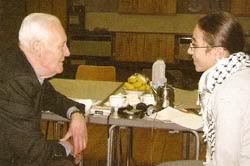
One of the many interesting and commanding articles in the Autumn edition was written by Dr Christine Hugh-Jones, who is the doctor in charge of Cambridge's Access Surgery, which takes on homeless clients. She was writing about the pioneering Joint Strategic Needs Assessment for Homeless produced for Cambridgeshire NHS by Drs Jeremiah Ngondi and Fay Haffenden. Click on the link in the last sentence to view this important document as a PowerPoint file. Here's a whistlestop tour of it:


Analysing anonymised statistics from the Access Surgery, one of their many grim findings was that the average age at death of homeless people in Cambridge is 44, which the press managed to garble into "life expectancy of homeless people in Cambridge is half that of the rest of the population of Cambridgeshire". Through the Willow Walker, Dr Hugh-Jones was able to explain to its readers that the Access Surgery's clients had, on Ngondi and Haffenden's analysis, a 2-3% chance of dying in the next year - "This is still much too high but it does not mean that if you are forty you have only four years to live". (Although the four obituaries at the end of the magazine are a sobering reminder of mortality on the streets.)

click to go to the Homeless Truths websiteThe projects that have budded from the Willow Walker have taken the Big Issue slogan of "a hand up, not a handout" and put it to work. I've already written about the radio show Homeless Truth's getting the police's point of view into the heart of the homeless community: in the latest Willow Walker there's a brilliant picture of one of the show's broadcasters, Laila Antoun, interviewing Tony Benn.

Dr Hugh-Jones' comment about the misquoted survey could apply to a range of issues affecting hard-to-reach communities in Cambridge: "What a pity no-one except the Willow Walker has bothered to report this".

click to go to the Willow Walker website

Other posts related to the Willow Walker:

Homeless not hopeless

Catching Street Voices

Both Sides of the Tracks

Save the Willow Walker

The Willow Walker looks for a funder

Top Ten songs about Thomas

Saturday, October 24, 2009

top ten songs about thomas

click to go to the THOMAS siteThere's a charity in North-East England called Thomas, which stands for those on the margins of a society, that works "at the cutting edge of social exclusion providing therapuetic and practical support to the drug addict, ex-offender, homeless and others suffering various kinds of social exclusion". I think the acronym says it all - please click the link to the right and have a look at their page; I'd like to concentrate in this post on people who are socially excluded in Cambridge, and who are about to lose an invaluable service which has blossomed into a whole system offering people who are or have been homeless, in the words of the Big Issue motto, "a hand up, not a handout".

In Cambridge we have a magazine produced for and by presently and formerly homeless people called the Willow Walker which is under threat because its funding has been removed; an Autumn issue is forthcoming thanks to the good graces of Cambridge University Press, and editor Kirsten Lavers is presently raising funds through justgiving.com to produce the annual calendar.

The Willow Walker provides the unique service of getting the voices of homeless people into the services which commission and provide services for them. It speaks not only about needs and tragedies, but about aspirations and successes. Cambridge City Council seems to think at the moment that other services duplicate this, but I'm not aware of any.

I thought, as my monthly "top ten", I'd post ten songs about homelessness and responses from within and outwith the communities of people who are excluded in some way. There are as many songs that I could have posted as there are pathways into exclusion, so here are my choices, which are arranged without the usual numbers.

Witnessing and abuse

click to go to the Fish website lyrics pageFish voices the distress a neighbour feels when listening to a neighbour and her children get beaten by her partner - and the temptation to escape from that distress through fantasizing about being a "rescuer", literally a knight in shining armour, which leaves him in a guilt-walled cell where "I become an accessory/and I don't have an alibi".

click to go to the International Directory of Domestic Violence AgenciesThis is a very harrowing song at the best of times; if you're feeling vulnerable because of domestic violence issues, please click the link to the left.


Violence

Nick Dominguez - click to read moreIn the Autumn 2006 edition of the Willow Walker, Big Issue founder John Bird told Nick Dominguez, who is one of my favourite blues singers as well as a great writer, that - in the time of the infamous London landlord Peter Rachman - he was trying not only to survive a violent father but an "ideology of failure" imposed upon certain families by Social Services. Here is No Son of Mine by Genesis:


Relationships

While one hopes that one's relationship is forever, poet Cate Wiliams wrote for the Willow Walker of the sad truth that some go to hell in a handcart with the lines:

The loser and the winner
Are playing the same game
And the hopeless young beginner
Will do it all the same.

However, she finishes her verse in the hope the downwards is not the only motion:

At the foot of every mountain
The path tells us to go
To keep on climbing upward
And never answer no.

This is Abba's song about about "the loser and the winner" from the film Mamma Mia, where Meryl Streep plays a woman who has lost in love in every sense - but suspects little the reparative action that life has in store for her.


Labelling

Sometimes when homeless people become housed, they face criticisms of still forming part of the street community that is spoken of in negative tones. This legendary song by the Shangri-Las encapsulates the difficulty of getting the streets out of one's mind once one has bodily emerged from them.


Illness

Many people on the streets have an illness, but some would say that this reflects the prevalence of mental illness in society as a whole - ie more than some quarters would like to admit: in Cambridge alone, we've seen the closure of two acute psychiatric wards; and the Cambridge Clubhouse, part of the Clubhouse movement, which helps people rehabilitate themselves from chronic illness and the effects of hospitalisation, was closed down and replaced by the Cambridge Mental Health Rclick for Torvill & Dean's Dancing on Ice Tour siteesource Centre, which itself is now to be closed. As a fellow Clubhouse alumnus told me, more folks than should be the case will end up being ping-ponged between prison and the wards as each argues the case for the other to be responsible.


Here's Jane Torville and Christopher Dean skating to Olympic gold to to Ravel's Bolero, which - it has been asserted - reflected his incipient manic-depression in the repeated phrasings.


Horace speaks from the past

One of the tracks on the critically-lauded album Both Sides of the Tracks by Street Voices is Horace Odes Book 3 Verse 29 recited by Geoff Coombe. It contains the lines written by the 1st century BC Roman poet:

Though storms around my vessel rave,
I will not fall to craven prayers,
Nor bargain by my vows to save
My Cyprian and Sidonian wares,
Else added to the insatiate main.
Then through the wild Aegean roar
The breezes and the Brethren Twain
Shall waft my little boat ashore.

The best song I can think of to represent Horace's maritime metaphor for life is Paul Simon's Bridge over Troubled Water: here it is sung by Eva Cassidy.


Hope

Lee Jay wrote his first poem in custody, and his stanzas take no prisoners. His poem Regrets, published in the Willow Walker, begins:

Lee JayHe sits alone, on his own
In a lonely place
As he wipes a tear from his eye
As he looks life in the face.
And he wonders why he lived his life!
The way he lived his life,
And he wipes another tear from his eye.

In Madness' hard-hitting and symphonic One Better Day, we hear of the hope that many people in the street community have that things will get better - getting out of that lonely place one day at a time.


Exclusion

This poem was written by a former alcoholic who had recovered but seemed to feel imprisoned by others' assumptions. It begins:

I am put away
I am discounted
I'm unwanted, don't fit,
I have no "house", of my "own",
Outside the city I sit, homeless.

Rejected, as I pay no tax, a social leper I,
A great assumption made.
That I am of no value...

click to go to the Nelson Mandela FoundationWhen I read these lines, the first thing I thought of was Labi Siffre's Something Inside So Strong with its video based on Nelson Mandela's imprisonment, because of Mandela's refusal to remove himself from the consciousness of those to whom his existence was an embarrassment.


Building Oneself

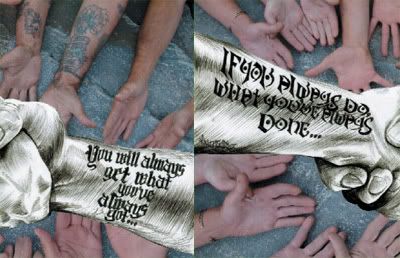
The Willow Walker, with the English Churches Housing Group, sponsored a scheme in 2007 shrewdly called "the self-build": it both highlighted the breadth of talent languishing on the streets and in hostels at this time when we need as many people working as possible, and provided a parable in wood and nails of building oneself up as a person. The Self-Build motto is you'll always get what you've always got if you always do what you've always done:

click to go to the Willow Walker Self-Build issue

On a constructional theme, here's The Who singing Pete Townshend's Dig.


Beatitudes: turning things upside down

click to see the video on Revd Bosco Peters' Liturgy websiteI found this beautiful video on Revd Bosco Peters' Liturgy blog - it's the monks of the Russian Orthodox Valaam monastery singing the phrases from Matthew 5:3-12, helping us to try to identify that hardest of questions, who is the neighbour that Moses' book of Leviticus tells us we should love as ourselves, a task Rabbi Akiva called "the greatest principle of the Torah. I hope the present and future bodies looking at funding the Willow Walker will see that helping presently and formerly homeless people both fits in seamlessly with the Judaeo-Christian principles upon which our country is built, and makes sound econonomic, social, political and humanitarian sense.

(Update: the original video has been taken down, so here's the Beatitudes from Bishop Hilarion Alfeyev's St Matthew's Passion.


Click here to view and download issues of the Willow Walker.


Other posts related to the Willow Walker:

Homeless not hopeless

Catching Street Voices

Both Sides of the Tracks

Save the Willow Walker

The Willow Walker looks for a funder


click to go to the Willow Walker website and find out what you can do

Related posts on music: click here for more top ten songs about...

Sunday, October 4, 2009

pictures from my mother

My Mum used to keep her most treaured memories in a battered brown case which her Dad had given her on her first day of school, and which she'd been as proud of all her life as she had been that first day.

There was a time after her death that I found it difficult to open the case because, I guess, the presence of her treasures accentuated her absence. But I've found it easier of late as old man time does God's work. I'd like to take you through some of them.

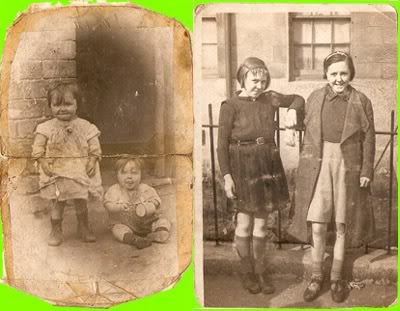
Her first house was a tenement in the Townhead area of Glasgow, Scotland. Once, she was snapped by a breed of photographer who would go round taking pictures of children from poorer areas which they would present as proof of the effects of deprivation upon the people of Scotland. Apparently her Mum exploded when she heard of the photo - of two kids having fun in a dirty street - and, having tracked down the photographer, demanded a copy. This was with another photo, taken ten years later on the eve of the war, when they'd moved to the city's Garngad area, now called Royston. Her Dad had borrowed a horse and cart from a fellow Independent Labour Party member who was a coalman. To the horror of her Mum, a Conservative voter, the cart would only move if it heard the strains of The Red Flag. I wouldn't like to have been a fly on the wall of their new flat that evening. (My Mum's on the right in the first pic and the left in the second.)


Mum and her sister


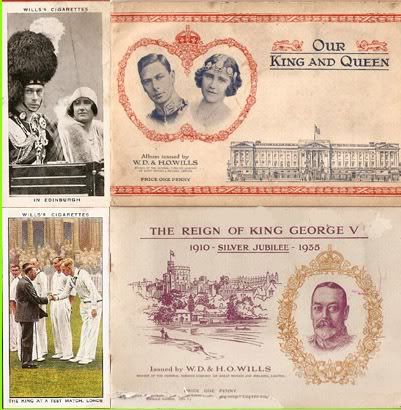
She was delighted by cigarette cards in her youth, made by Wills, who'd had a factory in Glasgow's Dennistoun area. In her case I found two full albums, on on the reign of King George V, and the other entitled "Our King and Queen", of King George VI, who came to the throne after his brother resigned to be with Wallis Simpson in 1936, the "year of three kings", and his bride Queen Elizabeth, who as the Queen Mother lived happily into the 21st century.

cigarette card albums from 1935 and 1937

Hospitals played a big part in her life - in 1939, balancing on the huge sink to put up a blackout curtain in her kitchen, she fell and landed on her back. It must have been some fall, because she ended up with TB in her spine. She spent a lot of time in Mearskirk hospital, a sanitorium for younger people (then known as children). She would recall how Danny Kaye once visited, presumably on his way to entertain the troops after America's entry into the war, and had to be asked to tone down his jokes as patients who'd had operations were laughing so much their stitches were bursting. Soldiers in training would patrol the grounds - she once heard a terrified private wail to his Sergeant that he'd gotten his finger trapped in his gun's muzzle: goodness knows what he'd been thinking.


click to read The Spirit of the G.R.I. by Dr John FergusAfter the war, she volunteered as a Red Cross Auxiliary in the Royal Infirmary, where she worked in casualty. She'd spent some time in a children's ward, but had to ask to be moved as their suffering and deaths upset her terribly. It was a time when auxiliaries could be "made up" to enrolled nurses without training, and she was later offered the chance to train as a state-registered nurse, but demurred as she was scared of taking the exams.


notice of Mum's brother's death, from the minutes of Greater Glasgow City CouncilAn unhappier association with hospitals occurred early in childhood when her brother James, when in Ruchill Hospital - then a fever hospital - was left alone in a bath. He'd somehow managed to twist about and turn on the hot tap, and was scalded to death. Her Dad saw the nurse who'd been responsible later in the Royal Infirmary, and had to be restrained. The only newspaper to record the event, in December 1928, was Forward, the house journal of the Independent Labour Party. In later years she tried to locate the article in the city's reference library, the Mitchell, but the relevant page had been torn out.
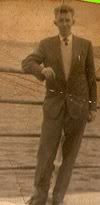
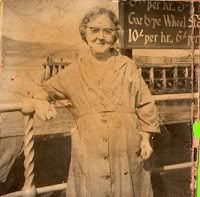

Dad posing with ever-present cigarette in RothesayGran in RothesayGlasow was then a port, and a world-class shipyard industry burgeoned on the shores of the Clyde. Water featured in her life in a major way, whether it was holidays in Blackpool, to where much of Glasgow decamped during the Fair Fortnight, or, more usually, "Doon the Watter" to the the holiday resorts and islands in the Firth of Clyde. Rothesay was her favourite place, and in her case were photos of her Mum and my Dad there - and one of herself before leaving for New York for two years, possibly to clear her head and decide whether or not to go.
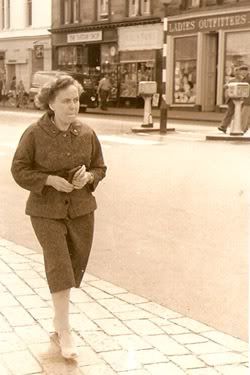

Mum in RothesayI'm not sure why Mum went to America - possibly she was entranced by the films from over there she'd been watching all her life, perhaps she just wanted a change of scenery. But she loved it, and would tell me of all the great films she'd seen in Radio City Music Hall - The Flower Drum Song comes to mind - preceeded by huge live dance numbers. The programmes she'd kept of many years of theatre- and cinema- going included one from Radio City, as well as another from Jimmy Logan's Metropole Theatre in Glasgow that featured one of her favourite acts, The Alexander Brothers.
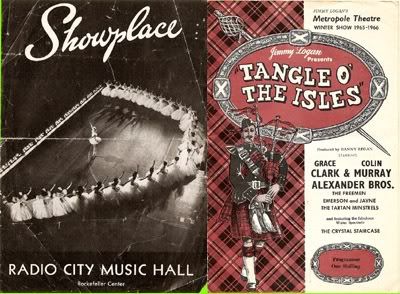

theatre programmes
St Patrick's Cathedral bulletinMy Mum had a bit of a renaissance in NY; I still have her Longfellow anthology, and her love of poetry even inspired her to write a song, regarding which she signed a contract with the Songwriters' Contact Co. I'd thought the song lost, but it slipped out of a book. I'd last seen it when I'd barely made double figures, and was quite taken aback by the power of remorse in the song, which ends with talk of "emptiness, loneliness and fear" as the result of a decision. Maybe it's just a song, or maybe she'd went to America because she'd had an argument with somebody? I don't know.

In New York she worked in the Rectory of the Sacred Heart church, and made an Irish friend called Rose who worked in St Patrick's cathedral. They would go to films and shows together, and compare notes of potential boyfriends. It was Cardinal Spellman's time at St Pat's - Rose once wangled an appointment for Mum to have tea with America's Papabile.

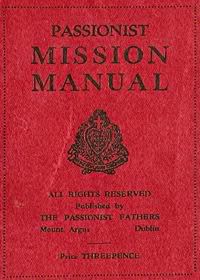
She returned to Scotland after hearing her mother was unwell and specifically after watching Breakfast at Tiffany's. I don't know what part of the bittersweetI have only one soul to save: Passionist Mission manual cover tale of lost souls spoke to her, but she broke her boyfriend's heart and returned home.

Before, during and after her stay in America the rich life of the Roman Catholic Church was the thread holding together the fabric of her existence. She'd often talk of missions to St Roch's run by the Passionists, who would tell her "I have only one soul to save", and which would end with a solemn procession to look into a coffin which turned out to have a mirror in it so that you were looking at your own face in the coffin.

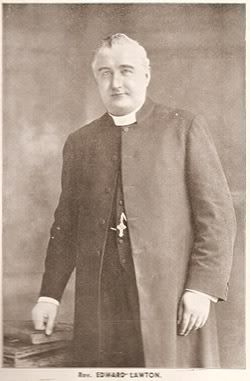
please pray for the soul of Canon LawtonI found three pictures of past priests of St Roch's in her case. The first was the church's first pastor, which was founded in 1907 as a satellite for the nearby St Mungo's, and is, I think, the city's seventh church to bear the name of the Languedoc-born plague saint since Mungo himself founded Glasgow by a stream in the Kingdom of Strathclyde. His name was Father (later Canon) Edward Lawton, and he was a Justice of the Peace who was unafraid of giving abusive men an object lesson with his famous and feared umbrella.
click to see reverse side of cardThe second is of Canon Boyle - I remember Mum telling one of his relatives, also a priest, about a time when Fr Boyle came into the chapel hall during a dance and, observing a conga-line, switched off the record-player and ordered that the wicked gyrations cease IMMEDIATELY!

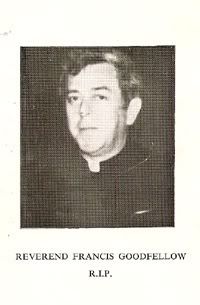
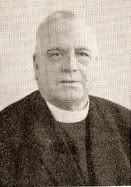
click to see the reverse side of the cardThe first two were before my time; the third picture was of a priest I remember with affection as a kind, gentle man who always thought of others before himself. He had been tortured while on the missions in Africa and, once while saying Mass, the microphone fed back: he went pale and his eyes seemed to be looking through the altar into unimagineable depths. He'd come back to Scotland to die and the church seemed to be missing something for a long while after he'd completed the great work.

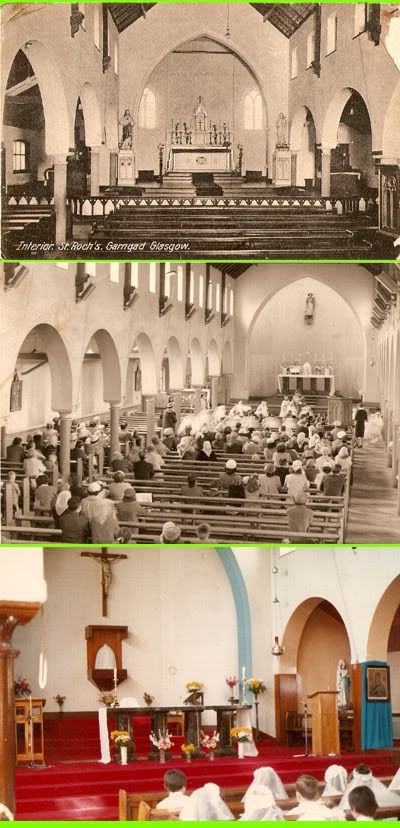
Something that left Mum nonplussed was the speed with which the Novus Ordo Mass - the Mass said in the vernacular with changed words and gestures, and with the priest facing the people, instead of in the same direction of the people and (usually) in Latin - was introduced. She liked to keep track of the changing appearance of St Roch's:

click to see the webpage for St Roch, Glasgow
The last picture in the series above is how I remember St Roch's, having had many happy memories there. My Mum would tell me about local changes generally, and I remember the M8 being built not far from the church, cutting Royston off from Dennistoun except for underpasses which were sometimes only for the brave as areas were planned by people who would not have to live there. But she still had friends who, like friends everywhere and at all times, would reminisce about the old days and tell each other there was once a better time.

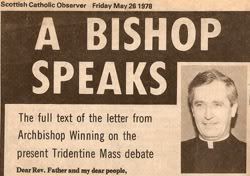
click to see the full text of Archbishop (later Cardinal) Winning's letterWere they right? What caused my Mum most pain were changes that were not made pragmatically in relation to changing circumstances. The Second World War, for example, brought tremendous changes, but events in Europe made it unavoidable - and shortly before the war the failing tailor's she worked as an overlocker in, in the city's Candleriggs, started producing soldiers' uniforms, which granted it several years' grace. On the other hand, the bulldozer-led massacre of many communities on a promise of a better Glasgow that never quite materialised is still causing consequences. And she never quite understood why changes in the Mass, that were perhaps unfairly laid at the door of the Second Vatican Council, were made so quickly and seemingly so irreversibly, causing another dislocation from the safer place of her younger days.

Happily, with the introduction of Housing Associations people who live in rented accomodation have a greater say than ever on some issues affecting their environment, and the Tridentine Mass is returning as sabres are carefully sheathed. But I don't think my Mum would have recognised, say, tenants that turned streets into no-go areas put into houses replacing crumbling tenements as progress against antisocial behaviour, or the release of the Lockerbie bomber on humanitarian grounds as justice. But the world turns, and in turning sometimes brings us somewhere that starts to look like home - somewhere that we recognise the rules of the game; where tradition matters and memory and experience are respected.

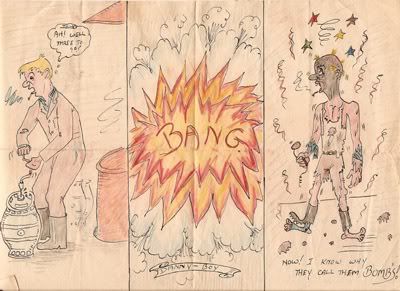
And my Dad? He's the subject of one of my favourite documents in my Mum's case. He once had a job as a porter in Tennent's Brewery (now Tennent-Caledonian) in 1960s Dennistoun, and a workmate drew the following cartoon of him:
Dad, again with ever-present cigarette

I hope you enjoyed my Mum's memories. Please spare a thought and whisper a prayer for the ghosts you've met.


related post: the rhythms of lives