I've changed jobs recently due to a restructuring in my former workplace. I've got a job that I enjoy, but am working more hours in a different shift pattern, which doesn't leave me with the time I need to devote to the Draughty Old Fen.
I'd been planning to write this post later in the month, but realised when Linda from Don't Poke the Baby contacted me via a mutual friend, Pam, that there are folk out there who care about me in just the same way as I do about them. I'm sorry to have neglected you.
Since I don't want to leave blogging totally, I've started a blog attached to the local village magazine that I edit, that'll be officially launched at the start of August. If any of you want to stop by sometime and say hello, that would be great.
Showing posts with label draughty old fen. Show all posts
Showing posts with label draughty old fen. Show all posts
Wednesday, July 14, 2010


Saturday, June 12, 2010
England/USA draw: a metaphor for another football game?
At work we've all participated in a sweepstake, with everybody selecting a World Cup team. There were the usual comments for some folk - for example, a colleague who chose Switzerland was told to cheer up because "they're rubbish at football - but boy can they yodel!"
 As for me, a friend circulated an email asking how I, a Scot, was going to deal with having picked England. I replied that I respected the traditions and supported the national teams when I lived in Italy and France, and it was the same now (finishing with "cricket test? What cricket test?")
 As it happened, we tried watching the games in the Draughty Old Fen, then put on the radio for the commentary, but had to switch over both times because of those blessed Vuvuzela horns; but I can remember my Mum making similar criticisms of Irvine Meadow fans and their rattles after matches when we lived in the Ayrshire town (behind the stadium).
 With its customary patriotism, the BBC has published a report saying that England were forced to settle for a disappointing draw. What rubbish: a defeat is disappointing, a draw isn't.
The draw possibly also served as a metaphor for the political football game being played by Barack Obama and David Cameron over the BP oil slick in the Gulf of Mexico off the coast of Louisiana, to which the company's chief executive added insult to injury with his comment "I'd like my life back".
 Obama's constant references to "British Petroleum", however, perhaps indicate a failure to grasp the interpenetration of liabilities and responsibilities, which are as mixed as USA midfielder Stuart Holden's Scottish and English parentage: a situation, like so many pertaining to Anglo-American relations, best depicted by Wes Wilson's adaptation of the Yin/Yang theme in his poster for the Beatles' concert at San Francisco's Candlestick Park.
Obama's half-hour phone-call with the Prime Minister, in which he told Cameron that his handling of the crisis had "nothing to do with national identity", may indicate that somebody's told him of the likely consequences of his demands that BP not pay dividends until the spill is cleaned up: that American investors and pension funds, which make up 40% of BP's shareholder constituency, will want him to explain to them why their returns have fallen. Unfortunately this isn't going to be over quickly - the gulf-stream is set to move contaminants to the coasts of the Carolinas, and eventually over to those of western Ireland and north-west Scotland.
Both England and the US gave a good account of themselves in this first game for either team. I wish us well against Algeria, and them good luck against Slovenia, both on Friday. I'll try to catch the games...maybe with the volume off?

Related posts:
World Cup: Top Ten songs about Football
Top Ten Songs about England
As for me, a friend circulated an email asking how I, a Scot, was going to deal with having picked England. I replied that I respected the traditions and supported the national teams when I lived in Italy and France, and it was the same now (finishing with "cricket test? What cricket test?")As it happened, we tried watching the games in the Draughty Old Fen, then put on the radio for the commentary, but had to switch over both times because of those blessed Vuvuzela horns; but I can remember my Mum making similar criticisms of Irvine Meadow fans and their rattles after matches when we lived in the Ayrshire town (behind the stadium).With its customary patriotism, the BBC has published a report saying that England were forced to settle for a disappointing draw. What rubbish: a defeat is disappointing, a draw isn't.The draw possibly also served as a metaphor for the political football game being played by Barack Obama and David Cameron over the BP oil slick in the Gulf of Mexico off the coast of Louisiana, to which the company's chief executive added insult to injury with his comment "I'd like my life back".
Obama's constant references to "British Petroleum", however, perhaps indicate a failure to grasp the interpenetration of liabilities and responsibilities, which are as mixed as USA midfielder Stuart Holden's Scottish and English parentage: a situation, like so many pertaining to Anglo-American relations, best depicted by Wes Wilson's adaptation of the Yin/Yang theme in his poster for the Beatles' concert at San Francisco's Candlestick Park.Obama's half-hour phone-call with the Prime Minister, in which he told Cameron that his handling of the crisis had "nothing to do with national identity", may indicate that somebody's told him of the likely consequences of his demands that BP not pay dividends until the spill is cleaned up: that American investors and pension funds, which make up 40% of BP's shareholder constituency, will want him to explain to them why their returns have fallen. Unfortunately this isn't going to be over quickly - the gulf-stream is set to move contaminants to the coasts of the Carolinas, and eventually over to those of western Ireland and north-west Scotland.
Both England and the US gave a good account of themselves in this first game for either team. I wish us well against Algeria, and them good luck against Slovenia, both on Friday. I'll try to catch the games...maybe with the volume off?
Related posts:
World Cup: Top Ten songs about Football
Top Ten Songs about England
Saturday, May 29, 2010
blogosphere "thank-you's"
 Risa from Isramom has been kind enough to tip me in an internet meme that was started on Adventures in Mamaland. I enjoy Risa's blog because she presents life in Israel as a series of everyday occurences in a religious Jewish family in the Holy Land, free from the accretions of gentiles like me who can write a blogpost then go to work in a Merry England wherein one can still perform the basic tasks of living without risk to life and limb. Thanks for the kind words, Risa; much appreciated.

These are the rules of the meme:
- Thank the person who gave you this award.
- Share one thing about yourself readers might not know otherwise.
- List six (6) bloggers you think are fantastic, and say why.
- Contact the bloggers you've picked, and let them know about the award.
One thing about me that regulars to the Draughty Old Fen might not know is that I'm addicted to cheese. So much so that last night, I NEEDED cheese so much that I stole some of Maxima's white stilton with bits of fruit in it, which she buys because nobody else in the house likes it. She confronted me and asked me why I took it. I replied that I took it because it was the only cheese in the house. I'm still on probation.
Here are six bloggers I think are fantastic: Firstly, Naomi Litvin. The author of We Never Lost Hope: a Holocaust Memoir and Love Story, she critiques antisemitism and the contradictions of modern society in a manner that is no less forensic for being literary. I like her because, as the father of girls, I am grateful for the spotlight she shines - with David Appletree of the Jewish Internet Defence Force - upon Facebook.

My second choice is Linda, an American home-schooling Mom and photographer who writes passionately and frankly about the joys and miseries of life, love and standing her ground as a staunchly pro-life Roman Catholic. Her blog, Don't Poke the Baby, is as unmissable for her lyrical wisdom as it is for her photography.
 Ellee Seymour is a Press Consultant and journalist who blogs about both national affairs and the minutiae of her beloved East of England. The reason she's my third choice is that I admire the inner security that allows her to praise people with whose views she disagrees when she feels praise is due. Another reason I admire her is that she's a supporter of Headway, a charity that helps people get over head injuries.
 John Smeaton, SPUC Director is the blog of the head of the Society for the Protection of Unborn Children. He writes for people from all political and religious backgrounds and none who are concerned for members of groups vulnerable to Establishment anti-life prejudices - the unborn, pregnant women, people suffering from after-effects of abortion that aren't recognised as existing, the terminally ill, people with chronic physical/mental illnesses,older people - to name just a few. I chose him because I have uneding admiration for the tightrope he walks by praising members of the Establishment who are brave enough to defend members of these groups, while critiquing enemies of the vulnerable, who are often members of the same Establishment groups.
 Lorena lives on a ranch in Texas, and on Lorena's Blog you can find photos of the most exquisite quality. Her blogs, centred on family and animals with the occasional review, are well worth the read.
 Lastly, but by no means leastly, I first heard of Naomi Litvin's blog through David Appletree's world-famous blog, The Jewish Internet Defense Force, which provides a voice for Jews in the US and worldwide at a time when many vested interests would have this voice extinguished. More than this, though, if you're not Jewish and/or haven't heard of David, keep an ear open: as Facebook falls, I think you'll hear his name as one of the brave who spoke out against the exploitative network when it could do no wrong in the eyes of the Mainstream Media.
Again, a big thank-you to Risa. It's one thing to get a badge for political blogging, but to be tipped by somebody who likes to read what you have to say is on an entirely different level. And, as the time when I can only blog occasionally as other things demand my time fast approaches, it's something I'll never forget.
Wednesday, May 19, 2010
search: "trumpington bible"
UPDATE: If you are looking for "Trumpington Bible", please look at the three comments to this post by ernest green, patrick of bath and anonymous, and all will be revealed!
UPDATE 2: for an erudite discussion of the Trumpington Bible, click here to go to Bishop's Blog, the blog of Dr David Thomson, Bishop of Huntingdon.
This blog has had a lot of hits recently, which is never something to complain about, but I regret that many readers find themselves unsatisfied. Since yesterday, I've had a huge amount of people being led to my blog after googling the terms "Trumpington Bible". I've spoken about a General Election campaign in Trumpington, a village to the south-east of Cambridge, and list the Bible on the sidebar as one of my favourite books. But I've never mentioned the two words together and - strangely, given the number of hits googling the terms - Google can't find any document mentioning the two words side by side.
I wonder what's going on, what news is breaking? Can anybody enlighten us?
Thursday, April 15, 2010
moving pictures: journeying to and from Spring Harvest
In my late teens, having decided to terminate my studies in Italy, I returned home by train and boat and found myself drawn to conversation with a variety of people, as if we souls in transit - in more ways than one - were drawn to each other.
I found myself reflecting on this last week while travelling by train to Spring Harvest, an annual Christian festival of lectures and worship based in two Butlins camps - Minehead and Skegness - of which I went to the latter. As it happened, I spent the first half of the week feeling a little sedated due to unexpected side-effects from my meds, but experienced yet again, in going and coming home, the discovery predicated by Dickens of David Copperfield that the stages on the journey contribute to its object.
 Due to an urgent meeting at work I'd been unable to travel with the family. Not having the opportunity to partake of a radical fast in the tradition of Lough Derg in Ireland, one of Europe's most ancient sites of pilgrimage, as a blogger I'd decided to fast from the news. This left me looking out of the train windows and realising that I hadn't done so for many years, such had been the pull of having my head stuck in a book or paper when travelling.
Perhaps a meeting at work at which the probabililty of downsizing was discussed had taken my eye off the ball (as well as ensuring I couldn't travel with my family), or maybe I was a little too calmed by the smell of freshly-mown hay from the field opposite Ely station; anyway, when my train arrived simultaneously with another on the other side of the island-platform, I got on the wrong one and found myself heading back to Cambridge. An anticipated sulk was swept away by the discovery that I could get straight on another train to Ely, and I wasn't held back all that much.
 On the journey to from Ely to Grantham I watched the waterlogged Fen landscape roll past with a sense of wonder at how much dry land had been reclaimed by the heroic efforts of Sir Cornelius Vermuyden, whose travails are commemorated in the legend beneath South Cambridgeshire District Council's coat of arms - Niet Zonder Arbyt (nothing without work) - which is the only Dutch motto in British civic heraldry.
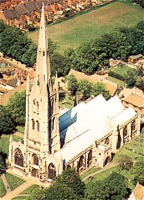 I got off at Grantham to join the Poacher Line to Skegness. The East Midlands town was instantly recognisable by the skyscraping spire of St Wulfram's Church, built to commemorate the 7th century Frankish missionary in the early 1300s, and a striking contrast to the many Norman church towers, arising from parish churches of villages mentioned in the Domesday Book, punctuating the horizon during the journey. As we drew out of the expanding East Midlands town I got a glimpse down St Peter's Hill before another new shopping centre went by. I pity people trying to get onto the property ladder here, as prices rocketed after the discovery that, at a pinch, one could commute to London from it.

Soon after Grantham the train stopped at Rauceby, once the site of a major psychiatric hospital that was closed in 1997, after which we were once again in the fens proper. I was delighted to catch a glimpse of two great crested grebe perform a mating dance before arriving at Boston, where a group of pilgrims known as the English Separatists left firstly for the Netherlands to try to practice their faith in freedom, before finally and famously fleeing the religiously-riven continent on the Mayflower to land on Plymouth Rock, and found a namesake of their hometown in Massachussetts in 1620.
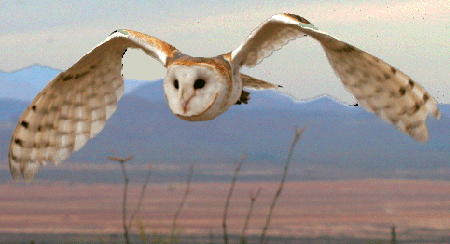 It was getting darker as the train drew towards Skegness - known as "skeggy" to its many admirers - and I saw a Barn Owl swoop low over a field in the gathering gloom. For somebody who's still a city-boy at heart, it felt like winning a prize.
On the bus from the station at Skeggy I felt a squirt of adrenaline at catching the sea just as I've always done since boyhood, although it was good to get into our caravan in the site opposite Butlins at last. Spring Harvest was good, although I was dismayed at the lack of any opportunity for traditional worship. I attended some good lectures, but will have to review my notes and do some digging before posting an appraisal.
Spring Harvest finishes on a Sunday which, if you don't have a car, is hellish, because only one train runs, but at least this year it had an extra carriage. We met one lovely woman from the north-east, who suggested that next year she might spend the Sunday night in a bed-and-breakfast and leave on the Monday - or else not come if she can't afford the extra expense. The situation regarding the trains is a crying shame, because Butlins is full-up during the two Spring Harvest week-long sessions, which help it provide such a vital economic and jobs boost to Skegness.
 Passing Boston again, I saw a row of terraced houses that, like unbraced teeth, had grown organically, with the Unicorn Bar and Andy's Fish and Chip Shop, while St Botolph's unique spire (The Stump) played hide-and-seek in the backg
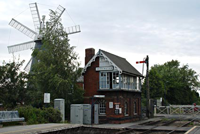 round. Another station, Heckington, was beautifully trimmed and displayed a poster advertising a "Railway and Heritage Museum". beside the station was a huge windmill, and I wondered if this might be one of the originals deployed by Sir Cornelius to drain the Fens. Wainfleet was also beautifully kept, with flowers growing from cut-down beer barrels: an addendum to each railway sign identified it as "the home of Bateman's Brewery".
As good as it was to get back to the Draughty Old Fen, it was a beautiful, if crowded, journey. Despite large green spaces being built into the Fen drainage system by Vermuyden as an integral part, whether or not those places in the Fens I saw will be built on depends upon the result of the next election. I hope I get a chance to see them again soon.
I found myself reflecting on this last week while travelling by train to Spring Harvest, an annual Christian festival of lectures and worship based in two Butlins camps - Minehead and Skegness - of which I went to the latter. As it happened, I spent the first half of the week feeling a little sedated due to unexpected side-effects from my meds, but experienced yet again, in going and coming home, the discovery predicated by Dickens of David Copperfield that the stages on the journey contribute to its object.
Due to an urgent meeting at work I'd been unable to travel with the family. Not having the opportunity to partake of a radical fast in the tradition of Lough Derg in Ireland, one of Europe's most ancient sites of pilgrimage, as a blogger I'd decided to fast from the news. This left me looking out of the train windows and realising that I hadn't done so for many years, such had been the pull of having my head stuck in a book or paper when travelling.Perhaps a meeting at work at which the probabililty of downsizing was discussed had taken my eye off the ball (as well as ensuring I couldn't travel with my family), or maybe I was a little too calmed by the smell of freshly-mown hay from the field opposite Ely station; anyway, when my train arrived simultaneously with another on the other side of the island-platform, I got on the wrong one and found myself heading back to Cambridge. An anticipated sulk was swept away by the discovery that I could get straight on another train to Ely, and I wasn't held back all that much.
On the journey to from Ely to Grantham I watched the waterlogged Fen landscape roll past with a sense of wonder at how much dry land had been reclaimed by the heroic efforts of Sir Cornelius Vermuyden, whose travails are commemorated in the legend beneath South Cambridgeshire District Council's coat of arms - Niet Zonder Arbyt (nothing without work) - which is the only Dutch motto in British civic heraldry.I got off at Grantham to join the Poacher Line to Skegness. The East Midlands town was instantly recognisable by the skyscraping spire of St Wulfram's Church, built to commemorate the 7th century Frankish missionary in the early 1300s, and a striking contrast to the many Norman church towers, arising from parish churches of villages mentioned in the Domesday Book, punctuating the horizon during the journey. As we drew out of the expanding East Midlands town I got a glimpse down St Peter's Hill before another new shopping centre went by. I pity people trying to get onto the property ladder here, as prices rocketed after the discovery that, at a pinch, one could commute to London from it.Soon after Grantham the train stopped at Rauceby, once the site of a major psychiatric hospital that was closed in 1997, after which we were once again in the fens proper. I was delighted to catch a glimpse of two great crested grebe perform a mating dance before arriving at Boston, where a group of pilgrims known as the English Separatists left firstly for the Netherlands to try to practice their faith in freedom, before finally and famously fleeing the religiously-riven continent on the Mayflower to land on Plymouth Rock, and found a namesake of their hometown in Massachussetts in 1620.
It was getting darker as the train drew towards Skegness - known as "skeggy" to its many admirers - and I saw a Barn Owl swoop low over a field in the gathering gloom. For somebody who's still a city-boy at heart, it felt like winning a prize.On the bus from the station at Skeggy I felt a squirt of adrenaline at catching the sea just as I've always done since boyhood, although it was good to get into our caravan in the site opposite Butlins at last. Spring Harvest was good, although I was dismayed at the lack of any opportunity for traditional worship. I attended some good lectures, but will have to review my notes and do some digging before posting an appraisal.
Spring Harvest finishes on a Sunday which, if you don't have a car, is hellish, because only one train runs, but at least this year it had an extra carriage. We met one lovely woman from the north-east, who suggested that next year she might spend the Sunday night in a bed-and-breakfast and leave on the Monday - or else not come if she can't afford the extra expense. The situation regarding the trains is a crying shame, because Butlins is full-up during the two Spring Harvest week-long sessions, which help it provide such a vital economic and jobs boost to Skegness.
Passing Boston again, I saw a row of terraced houses that, like unbraced teeth, had grown organically, with the Unicorn Bar and Andy's Fish and Chip Shop, while St Botolph's unique spire (The Stump) played hide-and-seek in the background. Another station, Heckington, was beautifully trimmed and displayed a poster advertising a "Railway and Heritage Museum". beside the station was a huge windmill, and I wondered if this might be one of the originals deployed by Sir Cornelius to drain the Fens. Wainfleet was also beautifully kept, with flowers growing from cut-down beer barrels: an addendum to each railway sign identified it as "the home of Bateman's Brewery".As good as it was to get back to the Draughty Old Fen, it was a beautiful, if crowded, journey. Despite large green spaces being built into the Fen drainage system by Vermuyden as an integral part, whether or not those places in the Fens I saw will be built on depends upon the result of the next election. I hope I get a chance to see them again soon.
Friday, April 2, 2010
coast: natural history of a man-made environment
 I once wisited The Wash. I was staying with a friend who worked in a hotel in Holbeach, in the South Lincolnshire area of Little Holland, and we drove up to see this seemingly unspoilt area of the Fens.
I say "seemingly" because the Fens compete with the Netherlands as constituting arguably one of the most modified areas in the world. Mostly below sea level, they were once a vast flooded area with bits of land poking up, on which settlements were built: Ely Cathedral in its various forms has been called "the ship of the Fens" for over a thousand years, and it's not a metaphor.
On last night's episode of the BBC2 10-minute documentary season Coast, focu
 ssing on The Wash, local archaeologist Maisie Taylor summed up how the Fens have been seen in Britain in the past: "they were wonderful for people who lived here, but for outsiders it was an evil place". Former Professor of History and Head of Trinity College at Cambridge University (and head of the British Red Cross during World War I) G.M. Trevelyan provides a case in point in his 1944 masterpiece English Social History by quoting Elizabethan historian William Camden:
The upper and north part of Cambridgeshire is all over divided into river isles, which all summer long afford a most delightful green prospect, but in winter are almost all laid under water, and in sIsolation, however, can have its advantages: I don't know if it's an urban myth that many churchyards dating from medieval times have mounds owing to mass graves dug to inter victims of the Black Death, but most churchyards in the Fens are flat, because they were cut off from the rest of England and often only reachable by boat.ome sort resembling the sea itself. The inhabitants of this and the rest of the fenny country (which reaches 68 miles from the borders of Suffolk to Wainfleet in Lincolnshire) are a sort of people (much like the place) of brutish, uncivilized tempers, envious of all others, whom they call Upland men; and usually walking aloft upon a sort of stilts they all keep the business of grazing, fishing and fowling.
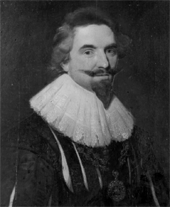 As Trevelyan notes, there had been plans to drain the Fens and make them more widely habitable since Elizabeth (I)'s time, with jealous eyes cast across the North Sea to Holland, whose modern name, Nederland, means "the lowland". It was eventually achieved by Dutchman Sir Cornelius Vermuyden, who was commissioned by King Charles I on the basis of his work in reclaiming parts of Essex from the sea. He oversaw the creation of artificial waterways - from ditches (one runs outside our house) to rivers - to channel water to the Wash, into which water was pumped through a series of windmills, although the job is now done electronically.
One principle Vermuyden insisted on was that large areas of land should not be built on; they might be cultivated (Taylor refers to the Fens in Coast as "a huge growbag"), but they needed to be free from buildings so that they could absorb precipitation, so it's disturbing to learn that politicians who either dont know, or don't care about, this country's history demanding that Cambridgeshire greenbelt land be built on. Some of this land is next to us, and higher than us - even with the fields there, we sometimes get floods: should the soil and grass be replaced by concrete, we'd better buy life-jac
 kets! We were all relieved to hear the Conservatives' plans to scrap national plans and promote local decision-making in the area of house-building, as reported by Richard Normington - not due to party-political considerations, merely because not all of us can swim!
 I'm a birdwatcher - albeit not a twitcher, I'm not into ticking boxes - so it was gratifying to see Coast deal with the half-million feathered friends who use The Wash as a stopping-off place each year during long migrations; I was surprised that oystercatchers, one of my favourite birds, sometimes travel from the Arctic to Africa. It was interesting to see how pla
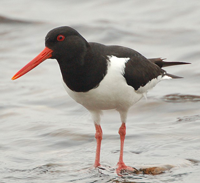 cid the birds were when caught by a cannon-net for purposes of ringing, with ornitholigist Miranda Krestovnikoff explaining that this made the job of the Wash Wader Ringing Group so much easier.
Presenter Mark Horton finished the show by saying that, due to rising sea levels, a decision would have to be made regarding whether to fight for the land around The Wash, or give it up to the sea. Businessman Peter Dawe proposed a controversial Wash tidal barrier in 2008 but it seems to have sunk without trace, although I wouldn't be surprised if it were refloated given that we now have near-idle windfarms that are killing bats and eagles.
If any of you reading this can access the BBC, I thoroughly recommend Coast as a compelling and informative series on the natural history of these islands, which at the moment do not have borders but rather coasts.
Sunday, March 28, 2010
lights on: don't let earth hour usher in a dark age
 In the Draughty Old Fen last night, I didn't see many more houses in the dark than the number of people who are usually out on a Saturday evening leave behind. The reason I was looking was that Earth Hour took place from 8.30-9.30, during which people who believe the theory that the activities of humankind are causing our climate to change were told to leave their lights off to make "a call to stand up, to take responsibility, to get involved and lead the way towards a sustainable future".
If so, Earth Hour fell at the first hurdle. In the words of the Daily Telegraph:
Even if power stations are turned off, the upsurge in turning the lights back on one hour later will require power stations that can fire up quickly like oil and coal.Any chess player understands the principle of making an immediate sacrifice for a future gain, but if the WWF (World Wildlife Foundation) and its Green fellow-travellers were really into long-term thinking, they wouldn't have campaigned for decades against the cleanest proven source of large amounts of energy around: nuclear power. Because the protests of a tiny minority of vocal vested interests were heeded, Great Britain now has only 19 nuclear reactors, and the new generation, commissioned only last year, won't be ready to fire up until 2020, if there aren't yet more objections.
Energy experts said it could therefore result in an increase in carbon emissions "rendering all good intentions useless at a flick of a switch".
But WWF said the campaign was about raising awareness and saving energy in the long term, rather than a short-term fix.
I was interested to see a night-time satellite image of South Korea taken du
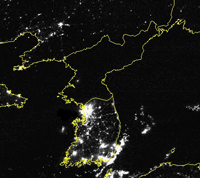 ring Earth Hour on Anthony Watts' Watts up with That blog, showing the country's towns as lit up as on any other night, while on the north of the border a Communist dark age still exists.
I am concerned that in our still-free societies there are those who would like to lead us into such a dark age and, although little that justice-and-peace types say surprises me, I was shocked last year to be invited to "fast" from the lights in my house from Ash Wednesday so that I and my family would appreciate God's gift of light on Easter Sunday. Was it coincidence that this was also the time of the changeover from real lightbulbs that have served us well from Edison's time to the pathetically poor energy-saving bulbs that don't even light up when you switch them on?
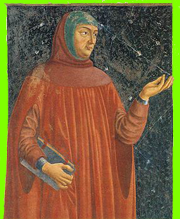 Suite 101's Paula Stiles identifies the term Dark Ages as having originally been coined by the Italian Renaissance poet Petrarch, who "appears to have used the term to describe the 5th to 14th centuries in protest at the relentless denigration of ancient pagan religion by Christian writers during this period."
Bertrand Russell, in his A History of Western Philosophy, doesn't link Petrarch with the phrase, but places the conception of the modern era at the Renaissance (in a chapter entitled The eclipse of the Papacy), and vents his anger on the Fathers of the Church, with special bile reserved for St Augustine, whose death was roughly contemporaneous with the final decomposition of the Roman Empire:
It is strange that the last men of intellectual eminence before the dark ages were concerned, not with saving civilization or expelling the barbarians or reforming the abuses of the administration, but with preaching the merit of virginity and the damnation of unbaptized infants. Seeing that these were the preoccupations that the Church handed on to the converted barbarians, it is no wonder that the succeeding age surpassed almost all other fully historical periods in cruelty and superstition.(It should be said that Russell lets his prejudice - and western ethnocentrism - trump his erudition here: one could say that the rump Roman Empire, as the Byzantine civilisation centred on Constantinople, survived happily into mid-Renaissance times until destroyed by Sultan Mehmed's Ottoman army in 1453).
But how dark were the dark ages? If the past is another country, we would be ethnocentric ourselves to blame other civilisations for not undergoing the explosion of progress that has marked ours since, say, the invention of the steam locomotive by William Murdoch and James Watt in the late 18th century. But the early medieval period was not short of eureka moments in many fields.
In 1150, for example, the Knights Templar sowed the seeds of modern capitalism by inventing the "letter of credit" - which would evolve into the cheque - that allowed a
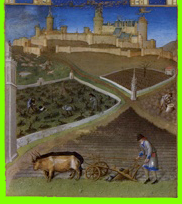 pilgim to deposit funds in one place and redeem them in another far away.
Shortly afterwards, the arbitrary power of absolute monarchs was dealt a fatal blow by the Magna Carta, signed in England in 1215. Around the same time, Franciscan Friar Roger Bacon would initiate the scientific method by making a hypothesis, testing it and then refining it further if it passed the test; if not, moving on to another hypothesis - one of his experiments was on the ancient remedy of ground willow bark to treat fever and pain, which would be built on by French chemist Charles Frederic Gerhardt to synthesize Aspirin in 1853.
Underpinning both of these - and much else - was the novel addition of wheels to the plough in the 6th century (abo
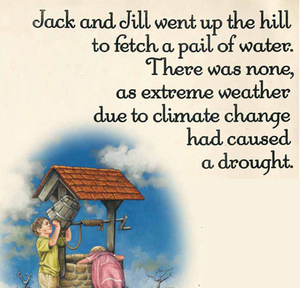 ve), allowing it to increase in weight and till more and heavier soil, allowing populations to increase and create more pressure for innovation.
But now we have a movement of groups of activists, supposedly informed by science, to stifle any innovation that they do not approve of, and allow only research that saves the appearances of anthropogenic climate change/global warming, which is being shoved down the throats of our children and young people in education and leisure. Case in point: energy secretary Ed Milliband commissioned adverts promoting the theory of anthropogenic climate change as fact and using nursery-rhymes to do so, only (thank God) to have them banned by the Advertising St
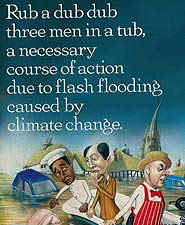 andards Authority on he grounds that the clear implications of the ads weren't supported by science. Milliband had obviously studied his Jesuit educational theory: "give me the child for his first seven years..."; but at least the lights are still on in the ASA.
The Telegraph's Murray Wardrop reports that earth is said to be entering a new period of geological time due to the acts of humankind having an indelible effect on old Gaia. Eugene F Stoermer of the University of Michigan's Center for Great Lakes and Aquatic Sciences places the handover from the present Holocene era to the putative Anthropocene at the end of the 18th century and "James Watt's invention of the steam engine" - William Murdoch obviously having gone the same way as Alfred Wallace, Friedrich Engels and woogie.
Last night I marked Earth Hour by having every light in the house switched on - except Maxima's room, as our cat Magus was curled up sleeping on her duvet. It was no mere excercise in contrarianism - we need a symbol of our desire to keep the lights on in science, and in our hard-won freedoms of conscience and expression.
To allow a Dark Age of fluffy earth-worship to be imposed would necessitate abuses of knowledge and wisdom that would have horrified the followers of the Old Religions whose torches were finally extinguished by the so-called Enlightenment's genteel patrician oppression; and the population control measures needed for proposed swingeing cuts in carbon dioxide (a gas necessary for all life on earth) would make the Holocaust look like a practice session. And guess what? It woul
 dn't be the lives of hand-wringing liberal intellectuals that were demanded.
Come next Earth Hour, my electricity meter will be working as hard as ever and for a good cause. When the time comes, I heartily commend Damian Thompson's advice to you: "Beat the 'Earth Hour' fascists and turn on your lights NOW!"
Monday, March 22, 2010
spring of hope: an update in pictures
I'm not doing too well this Lent. Last year, I gave up a couple of pints a we ek and gave the money to charity. This Lent I've had to learn editing from scratch to publish the village magazine - although I was priveleged to learn from somebody who'd done the job in professional and voluntary roles for decades.
 So it was good to be sent a photo-update of a charity I was made aware of soon after moving to the Draughty Old Fen: the Spring of Hope foundation (part of the Youth with a Mission group) which helps disabled children in Uganda - much are in their clinic in Wabwoko, which is in the Kayunga District of Uganda, shaded orange in the map to the left. I'd like to share some of these photos with you, with the original comments.
The last pic really struck a chord with me because I remember the sense of wonder and getting bigger exuded by both my children when they started school, something I think one can see on the face of little Zachariah as he starts on his own incredible journey of education, thanks to Spring of Hope.

ek and gave the money to charity. This Lent I've had to learn editing from scratch to publish the village magazine - although I was priveleged to learn from somebody who'd done the job in professional and voluntary roles for decades.So it was good to be sent a photo-update of a charity I was made aware of soon after moving to the Draughty Old Fen: the Spring of Hope foundation (part of the Youth with a Mission group) which helps disabled children in Uganda - much are in their clinic in Wabwoko, which is in the Kayunga District of Uganda, shaded orange in the map to the left. I'd like to share some of these photos with you, with the original comments.Click here to go to the Spring of Hope blog
 Emily (volunteer) and Victor (OT student ) on a home visit!! Feb 2010, we saw our first Uganda OT students come from Mulago training hospital!! |
 Our deaf children from both schools were able to visit the zoo in Entebbe thanks to Roxy fundraising!! |
 We bought our 2nd bike, after a previous volunteer Melanie fundraised. Moses is now out and about in the community. Children in Wabwoko are at last receiving weekly home visits!! Bought Feb. 11th!! |
 Carolyn(volunteer) and Moses counting medications at the end of a very busy clinic,. At this clinic in Wabwoko we received 96 epileptic patients!! Feb 12th!! |
 Children and parents at the clinic in Wabwoko. Feb 12th!! |
The last pic really struck a chord with me because I remember the sense of wonder and getting bigger exuded by both my children when they started school, something I think one can see on the face of little Zachariah as he starts on his own incredible journey of education, thanks to Spring of Hope.
Sunday, March 14, 2010
mothers' day: comfort and pain

The nomenclature of the feast of mothers leaves me confused. I'm not sure if the difference between Mothers' Day and Mothering Sunday is that one is American and the other British, or one secular and the other religious.
Anybody who has had the privilege of knowing members of the Filipino
 community in Cambridge (the city's St Philip Howard's church has been called Little Manila) will know that they celebrate Mother's Day as religiously as any Holiday of Obligation. It leaves you with a renewed appreciation of the feast; but it's a time of year that can bring as much upset as it can peace.
Mothers' Day at St Gallicus was a happy affair that saw the first reading subsequently dramatis
 ed preceded by the children, which ended up with the teenage daughter of a two-year-old Pharaoh rescuing a plastic Moses from a basket. At the close of ther service all the mothers in the congregation were presented with little potted primroses, with enough left over so that everybody was abe to leave with one.
At home, Minora had put a lamb joint in the oven, and Minima prepared the veg while I divested the table of a week's accretion of books, homework and other things we'd decided we needed to keep but couldn't quite remember why.
A sobering note came during dinner when we heard on the radio news of Children's Commissioner Dr Maggie Atkinson's cynically-timed announcement that murdered toddler Jamie Bulger's killers Jon Venables and Robert Thomson, both 10 at the time of the slaughter, would never have stood trial today under the change she wishes to implement to the minimum age of criminal responsibility, raising it from 10 to 12.
Calling Dr Atkinson's comments twisted and insensitive, Jamie's mother, Denise Fergus, called for an apology to be followed by her either jumping or being pushed from the post. Doubtlessly we'll hear more of the affair, as Mrs Fergus is due to meet Justice Secretary Jack Straw this week to discuss Venables' arrest, rumoured to be connected with child pornography.
Minima volunteered to wash up, while Maxima and I listened to Johnny Walker's Sounds of the 70s show on Radio 2, then we got the laptop out for something that, to be honest, I
 think we'd been avoiding.
Aled Jones came to fame as a choirboy singing most famously Walking in the Air from The Snowman, and now, as well as pursuing a singing career, presents Christian programmes on TV and radio. On this morning's Good Morning Sunday Mothers' Day special, he'd interviewed Kate McCann, whose daughter Madeleine was taken from the family's holiday apartment in Portugal.
 At times her voice seemed on the verge of cracking - and we were close to tears - as Kate told how she thinks of Madeleine every day and prays for her captors: her Parish Priest has given her a key to the church. She said that "every day is the same without Madeleine", so Mothers' Day brings both comfort and pain. When Jones asked her if she could forgive the people who took her daughter, she paused then said "I don't know". It was, I think, the most searingly honest point in an excoriating interview.
I was pleasantly surprised that the programme emphasized the religious aspect of Mothers' Day - Jones played Taverner's Hymn to the Mother of God, performed by the Choir of St George's Chapel, and an unexpected treat: Hymn to Mary by Beth Nielsen Chapman. It was interesting that Taverner composed his hymn in remembrance of his mother: this was the motivation for Paul McCartney's Let it Be, with the meditation on a line of the Prayer to Our Lady of Lourdes - priez pour ceux qui aiment et sont partis (pray for those who love and are parted) - in the middle two verses.
And the best prayer that I can send up to the mother of God on this day for Denise Fergus and Kate McCann and their families concerns the situation which many mothers have to face as regards their children, albeit hopefully in happier circumstances: pray for those who love and are parted.

Click the picture above to spend a "minute for Madeleine", or click here to listen to Good Morning Sunday featuring Kate McCann (until Saturday 20 March)
Monday, March 1, 2010
eggs, pesto and Tolkein: my bachelor weekend
 I'm a big fan of The Lord of the Rings, but must admit to my shame that I find the films more accessible than the book - I'm on my third attempt to get to the finish and, being halfway through The Two Towers, am further than I managed to get to either as a schoolboy or ten years ago.
A few months ago I bought a book - the first of a series called The Wheel of Time - that offered to "mine the world Tolkein hinted at"; I got through a few hundred pages then came to a phrase "slowly he began to breathe slowly". (Minora calls me a pedant, which really annoys me, because she puts the stress on the wrong syllable.)
As I threw it in the bin, I resolved to spend my weekend alone - Maxima having taken the girls to the other end of the Fens to visit her parents - reacquainting myself with the films, which have helped me power through the book no end.
As usual with one of my "bachelor weekends", I raided the "reduced to clear" section of the local supermarket to make one of my experimental meals that the women in my life tend to frown on.
The goal, I decided, would be something meatball-ish. So I emptied three cans of mince and onions into bowl, and grated two big wodges of blue cheese into it. I'd come home with a pack of eight factory eggs which had been going for a song because there should have been ten. I'm not overly chuffed at the concept of factory farming, but it beats me how people can look virtuous when buying their free-range eggs laid by hens bred to produce the extra-large ones, either not thinking or not caring why the shells have blood on them. Anyway, I couldn't decide how many eggs to use, so in went the lot. Then the best part of a jar of pesto went in. I like pesto. It's the nearest you'll get to a culinary proof of a deity other than an epiphany in your pantry, especially at times when you find yourself wondering why a loving God would create something like carrots.
Anyway, I grated a chunk of parmesan into the concoction, mixing while some penne bubbled away, then dropped teaspoonfuls of it onto a hot frying-pan with plenty of oil. (Helping make pancak
 es at the Rectory on Shrove Tuesday, Rector Pellegrina asked me to reduce the amount of oil in my pan. When I did, people grumbled that my pancakes suddenly weren't as nice.) They ended up more like flat coins than balls, but tasted sublime in a sauce of blue cheese, mushroom soup and eggs.
It was, in fact, a meal suitably epic to accompany a marathon session of all three videos from which I emerged square-eyed but happy. I have the book with Tolkein's Foreword to the Second Edition, in which he tries to dispel speculation that the work is a religious analogy. I accept that, but it was also a labour of love for the author and expert on the Anglo-Saxon and early English languages, and as such I believe that the childhood convert to Roman Catholicism dug deep into the mines of his spirituality to inform the ethics of his morality-tale. What's really becoming
 clear to me as I read The Lord of the Rings this time is that his first-hand experience of the horrors of the Great War wedded to frustration with the politics of appeasement directed towards Hitler - despite Tolkein's denial - come through in the backstory of the powers of Middle Earth standing back while the treacherous Sauron consolidates his hold on Mordor, to use it as a base for launching his bid to enslave the fantastic world.
And my cooking? I enthusiastically showed the remainder of the panful to Maxima on her return, at which she winced and told me to go get everybody a Chinese. Was it the eggs?

Subscribe to:
Posts (Atom)