Showing posts with label steroids. Show all posts

Saturday, February 13, 2010

body image isn't all it looks like

Cavete: discusses and links to material some people may find disturbing

When I was in my mid-teens I developed acne. Never having been one to do things by halves, mine was in the form of angry boils flowering luxuriantly over my fizzog. I didn't have much of a problem with it, and didn't get more hassle than one might have expected in a working-class Glaswegian housing estate.

Then I went to university in Italy, and the head of my college decided he did have a problem with my acne, and at his insistence I set out on courses of antibiotics and various other pills and potions - one of which, as I remember, turned my first wee of the morning bright red, which was quite a thing if you weren't prepared for it.

During my first year at uni I fell into a deep depression, and I wonder if the head's effective declaration that my appearance was undesirable contributed to the mix of being away from home from the first time and studying like I'd never done before. But the past can be a dangerous place to form assumptions about, so who knows?
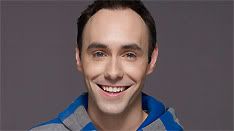
Aled Jones - click to go to the SurgeryI found myself thinking about this period of my life for the first time in a while after an advert directed me to BBC Radio 1's listen-again feature, where Aled Jones from the Chris Moyles show (me neither) had hosted a "surgery" about body-image, when a young man called in to speak about his desperation that nothing his doctor gave him was touching his acne. I felt for him.

An American psychotherapist called Aaron Haydn Jones explained the process of filtering, whereby we might ignore 100 positive comments and dwell on one negative one. I can't argue with that - Richard Carpenter attributed one journalist's comments about his sister's weight in the early 1970s to her tortured death in 1983.

The show, however, wasn't exclusively about anorexia and bulimia as such but about unhappinesses with one's body (which might admittedly feed the pathogenesis of one of these terrible illnesses). I started to wonder about the direction of the show when one chap rang in to complain about the shape of one of his eyebrows, but then a young woman said that she'd had problems with her mum after she (filia) had a breast reduction: Aaron was running with the ball immediately, and wondered if the girl had had cosmetic surgery for what was a relational problem, and spoke of feelings of jealousy - or at least displacement - that can sometimes occur between mother and daughter, father and son. Then, of course, another young woman rang in to complain that her breasts were too small.

Fearne Cotton: click to see which is the real oneSomething that's been in the news recently is airbrushing - a case in point being a photo of model Phillipa Hamilton where her waist appears smaller than her head, an image that made fashion house advertisers Ralph Lauren regret their use of Photoshop and ultimately issue a reluctant apology. To indicate the power of the program, some Radio 1 figures allowed their images to be retouched and posted on the website.

Where things started to get interesting was when Emma Ledger, deputy editor of More clebrity magazine, came on the show briefly to say that the publication had no policy as to the sizes of models whose photos it published, and that it only airbrushed to get rid of zits or tidy up hair. "Who wants to see a zit on the cover of a magazine?" she moaned, and suddenly I realised that perhaps punk had a point after all.

The first thing I did was to reflect that if a mag is publishing pics of clothes that are supplied to it, its in-house policies on model sizes are meaningless if the sample garments supplied toAbigail Blackburn - click to read more about pregorexia and celebrity magazines it only fit "size-zero" models; something which caused (British) Vogue editor Alexandra Schulman to fire off an angry letter to designers.

The second thing I did was to buy a copy of More, and try not to look too embarrassed as I payed for it. This is something I did when suspicious about Now editor Abigail Blackburn's protestations of innocence to Louise Redknapp, who had accused her magazine of triggering "pregorexia; the issue of Nowclick to go to tesco.com and make up your own mind brought out to coincide with Redknapp's crusading documentary was a celebrity pregnancy special, but the devil was in the detail, and the detail turned out to be in the back issues.

I have no back issues of More, but on flicking through the magazine did find an advert for Tesco Clothing Online featuring a photo of a woman who looked as though she had other priorities than eating. Had the magazine been supplied with the pic, or with clothes that would only fit somebody of her dimensions?

What caught Maxima's eyes made a bee in her bonnet buzz furoiusly: she pointed to a photo of Sarah Harding of Girls Aloud with (I think) Tom Crane, and, pointing to Crane's form (which compared to mine looks skeletal), demanded to know why men could look any way they wanted while women had to look like Barbie. At least she let up quite soon - one Hogmanay she went on and on about male performers looking like they'd been dragged through a hedge while female ones were expected to exude glamour. At least sKellan Lutzhe had a point. But I hope the bloke who phoned in to complain about his eyebrow never had a look at the "More man of the week" (Kellan Lutz from vampire flick Twilight); no wonder illicit steroid sales are booming, as vulnerable young men think they have to "get ripped". It's not for me to contradict Emma Ledger and say that the photo was digitally manipulated, but Radio 1 DJ Vis showed that it could be done (see pic below).

Radio 1 Xtra DJ Vis - click to see the full-size picsLedger did stress that her magazine was for 18-26-year-olds ("of all shapes and sizes"), but the feature that gave me most cause for concern was nothing to do with body-image, rather "position of the week", demonstrated with Barbie and Ken dolls. I thought of the poor girl who texted Jones' show to say that she only felt good about herself if a boy told her she was pretty, and felt furthermore that the only way to bring this about was to sleep with said boy. I remembered sadly the travellers' tales of former colleagues in drugs work, who had given talks to schoolchildren and reported back that girls said that some boys threatened to spread the word that they were "frigid" if they refused to have sex. Sometimes we fellows are unconscionably nasty people, and moreover, while More is by no means the worst offender, I'm also not sure what Ms Ledger thinks happens to somebody on their 18th birthday to make them less vulnerable to masculine con-tricks than they were at 17 years and 364 days old.

Now I only look in the mirror on those occasions when I have no choice but to shave and comb my hair; but I remember a strange young man who would examine his image, although I'm no longer sure what he was looking for or even at. Young people today are not the means to enrichment of the staff of celebrity magazines and/or the shareholders of companies that own them. It's no cliché that children are the future: young people will father and bear our grandchildren, will work in supermarkets and universities and, among a milion other things, will hopefully enjoy life enough to convince the grumpier among us that there's a point to it all.

And, on a personal note, I'd like to send a message to the young man with acne. Nothing worked for me either - but it faded in every way as I got older.

Related posts:

Abigail Blackburn and the truth about pregorexia

Claire Sweeney's big fat...

Tuesday, September 9, 2008

enhancement: changing the meaning of disability

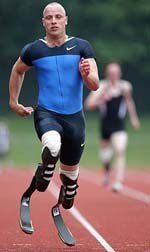
Oscar pistorius sprinting to victory in the 100 metres

The victory of Oscar Pistorius in the 100 metres at the Paralympic Games in Beijing yesterday was a triumphal performance by an athlete at the top of his game. It is raising a lot of questions about enhancement in sport that have implications for the meaning of disability as a whole.

Pistorius, whoOscar Pistorius: redefining abilityse lower legs were amputated as a baby because he was born without fibulas, originally applied to represent South Africa in the Olympics, but the "cheetah blades" he uses to run put him at the unusual disadvantage of being, as the New York Times put it, not disabled but too-abled. After a long legal battle to prove that his blades did not confer an unfair advantage upon him - which all but obliterated his 2007 winter training schedule - he was allowed to compete but, perhaps because of the time spent in court, just failed to make South Africa's Olympic team.

The question of enhancement in sports is a fraught one. Steroids have definitely turned what should have been a level playing field into a quagmire, one in which arguably athletes need to be protected from their own ambition, which is so necessary to make it towards the finishing tape.

But then there's erythropoietin, a hormone which prevents breakdown of red blood cells, increasing their number and therefore their ability to carry oxygen to the muscles. If better technology is developed to detect its use, which is illegal, do athletes switch to hypoxic training in an "altitude chamber", which would have the same effect? And if this is banned, what of athletes from countries such as Bolivia, Columbia and Ecuador, who may have no choice but to train at high altitude - do they then have an unfair advantage against which athletes from lower countries are not allowed to compete?

That's just one train of thought, based on the volume of oxygen-bearing haemoglobin contained in the body's red blood cells. Andy Miah of the University of the West of Scotland considers another scenario:

A swimmer, impossibly long arms swinging at his side, takes to the starting block. He has trained for this moment for months. Keeping up with the latest developments, he has endured surgical enhancements to enlarge the webbing in his fingers and toes. He's wearing the ultimate in sharkskin swimsuit technology. He inhales deeply through nasal passages surgically widened to optimize his breathing efficiency -- and dives in.
This may seem an unlikely situation, but surgical enhancement is already upon us. In 1974, US baseball Tommy Johnpitcher Tommy John damaged an elbow ligament in his pitching arm, an injury that until then was the death-knell for a professional career. After revolutionary surgery grafting part of the corresponding ligament from the opposite elbow to replace the injured one, he returned to baseball following a long recovery. The operation, now called "Tommy John surgery", is popular now, with pitchers (and also American football players) saying that the best performances in their careers occur after the surgery. At what point do authorities decide that surgery is required, or that no surgery-requiring injury exists, meaning that the procedure would be an enhancement bestowing unfair advantage?

Alternatively, Arthur Caplan, Director of the Center for Bioethics at the University of Pennsylvania, was not sure if letting Pistorius run for the Olympics might be the right decision, comparing his blades with Tiger Woods' corrective eye surgery - without which, Caplan admits, the golfer was "almost legally blind" - which has left him with better than 20/20 vision.

Miah continues:

another vision [exists] at sports' highest levels. It is rooted in the democratization of technology -- in a world where high-tech training regimens exist even at the junior-varsity level -- and is part of a broader transition we are all making: using technology to improve everything, at every level.
This may be true as regards "able-bodied" athletes - whatever that means whenever enhancements are a possibility - but where disability is concerned any democracy depends largely upon the willingness of the state to empower and enfranchise disabled individuals, including willingness to listen to us, or even recognise our existence.

For example, in China, the country hosting the Paralympics, Townhall News quotes Chinese President Hu Jintao as saying on his country's state TV that "China's people and government have always attached great importance to the cause of the disabled...We insist on putting people first, carrying forward a humanitarian spirit and advocating equality and opposing discrimination." The Telegraph, however, reports the discrimination that disabled people have in accessing education, jobs and healthcare, and Townhall goes on to note that:

The government has long advocated sterilizing mentally handicapped people. In the early 1990s, a draft law was presented to the legislature to reduce the number of disabled through abortion and sterilization, a move that unleashed international criticism...In 1994, China ratified a law calling for the abortion of fetuses carrying hereditary diseases and restrictions on marriages among people suffering mental problems or contagious diseases.Margaret Sanger, founder of Planned Parenthood.  Listen to their racist agenda - discrimination on grounds of disability is just the same
This is an example of the eugenic madness that gripped the West from the end of the 19th century until the Holocaust forced eugenic organisations to change names and tactics. Or, at least, some of them: when Maxima was expecting Minora, a chart planted square on the centre of the examination-room wall laid out the increasing chance of having a baby with Down's syndrome as maternal age increased.

Pistorius, thankfully, receives the support of his country in sending him to the Paralympics. Cambodia is another proposition entirely. It is a country that has allowed the UNFPA - United Nations Family Planning Association - which cooperated with China's forced sterilization programme aimed at, but not limited to, drastically reducing the number of disabled people, to push reproductive health services, including abortion, in collaboration with the EU.

So Cambodia's contender, Vanna Kim, received no help from his country, having got to Beijing through the largesse of private donors, North Korea and the Games organisers; I don't deny the possibility of philanthropy on the part of Beijing, but they are also desperate to show a good image to the world, in a land where image is almost totally divorced from reality.

For all that, Pistorius' victory displays an example of a "disabled" person outperforming the "able-bodied" to a degree that may require renegotiation of the two terms' significance. Everybody has the same right to hope, to aspire, and to be all they can be regardless of the establishment's prescriptions of what their abilities will be.

Modern technology has an ability to equalise many of the odds that can affect the differently-abled: all that is required is the will and the humility to empower talented people who are "different" to do as well, and sometimes better, than the crowd. The problem for our rulers is that this would prompt swathes of their populations beyond the realm of knowledge, and into that of realisation, of what is being done in their name.


be all you can be

Thursday, August 7, 2008

As the Olympics begin

Retaining an interest anabolic steroids as a former drugs-worker, I felt an alarm ringing in my noggin as I read a First Post report on things that could go wrong with the Beijing Olympics. It concludes:


Last year a caterer working for the United States Olympic Committee visited China and was shocked to discover why portions of chicken being sold in supermarkets were so huge: "We had it tested and it was so full of steroids that we never could have given it to athletes," he said. "They all would have tested positive."
This could create some confusion should Olympians fail "dope" tests by testing positive for anabolic steroids, which are all artificial - and strong - versions of testosterone. Add concerns that testing for banned substances is tainted by the "prosecutor's fallacy" (which is an assumption that - in this context - producing a false positive for a dope test is unlikely, therefore innocence is unlikely), and it looks like the process of moving an investigation forward from a failed banned substance test could be fraught with counter-accusations and even litigation.

click to read BeijingAirblog.comThere are, of course, many other considerations surrounding the Olympics which arise merely from the fact that they are being held in China. It's a famously polluted city, even by the standards of China's measurement of clean air being up to an Air Pollution Index of 100 - twice World Health Organisation's measurement. The API has been pushed down to 95 by the closure of 100 factories and 56 power-plants in the city, the capital of a country whose average hourly wage is $0.57 (29 pence). I don't know if the workers will be paid for their enforced holiday - perhaps one of the 600-plus British public servants who will be attending at a cost of £7m to the taxpayer will think to pose the question. One lives in hope. Sometimes.

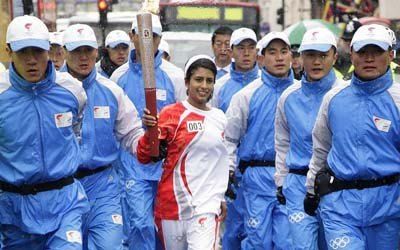
The thorny issue of human rights is a thistle that seems not to be getting grasped with any alacrity by any the major TV stations covering the Olympics despitethe demonstrations that greeted the Olympic Torch - first carried in Adolph Hitler's 1936 Olympics in another totalitarian nation - as it was carried, surrounded by Chinese élite police, through the nation's capitals. In our own capital, the Chinese officers clashed at points with British bobbies. Take, for just one of many examples, the case of Alimujiang Yimiti, who is currently detained for the crime of being a Christian. Not that visiting journalists in Beijing are guaranteed to find it easy to get details about Yamiti or others on the internet - despite promises to the contrary, which helped Beijing secure the games, the Chinese are now cracking down on freedom to access international websites reporting human rights abuses there by reinstating the great firewall of China. (As it happens, access to Amnesty International has at present been restored to China, but using the verification tool at the bottom of this post confirms that many Falun Gong sites are still banned. I should note, however, that another site has stopped verifiying sites as the increasing complexity of censorship measures make it difficult to give a definite result.)


note the second Chinese policeman on the left forcing Connie Huq to hold the torch higher - click to read coverage
Possibly the most egregious abuse of human rights in China is their government's throwaway - literally - attittude to children. The one child rule doesn't just lead to enforced abortions and infanticide in maternity hospitals, but an undesirable child - often so for merely being a girl - will often end up in an orphanage so that the parents can try for a boy and still be within the one-child rule. One report states:


Child-care workers reportedly selected unwanted infants and children for death by intentional deprivation of food and water a process known among the workers as the “summary resolution” of childrens’ alleged medical problems. When an click to read the Human Rights Watch report on China's orphansorphan chosen in this manner was visibly on the point of death from starvation or medical neglect, orphanage doctors were then asked to perform medical “consultations” which served as a ritual marking the child for subsequent termination of care, nutrition, and other life-saving intervention. Deaths from acute malnutrition were then, in many cases, falsely recorded as having resulted from other causes, often entirely spurious or irrelevant conditions such as “mental deficiency” and “cleft palate.”

I remember at school I was once a member of a chess club. One boy, known for cheating, tried to get onto the "game ladder" without much success until one day somebody felt sorry for him. The teacher supervising watched the game closely but was inevitably called away, at which point the boy "accidentally" knocked over a piece and replaced it in a more advantageous position. He won the game and got onto the match ladder, which gave him the right to demand a game with anybody three places or less above him. he never lost, and soon the chess club had fallen apart.

If China decides that objective necessity dictate a good showing on the gold medal front to show the superiority of the Chinese way, then it will have a good showing on the gold medal front, and the Olympic games will slowly fade into irrelevance because any use of banned substances discovered will be justified by "it didn't stop the Chinese athlete so and so..." Unless the International Olympic Committee stands up for itself, China will use it as a doormat. And the resulting humble pie won't taste like chicken, with or without added steroids.


Related posts:

Sport isn't worth that much - Yimiti's olympic struggle
at the close of the Olympics

Sunday, February 17, 2008

Victor Conte and Dwain Chambers' secrets

It appears that Dwain Chambers is the latest athlete to fall foul of the temptation to take an undetectable performance enhancement drug.

This drug - THG (tetrahydrogestrinone) - has been found to be more potent than the most powerful natural androgen (anabolic steroid), dihydrotestosterone, which - like high doses of any form of testosterone - has been linked to aggression in males.

It wasn't a test that rumbled Chambers, it was the desperate manipulations of his candyman, Victor Conte, to minimise sanctions after he'd been exposed. In other words, he squealed on his clients to epic proportions, which was perhaps not the best business move for somebody selling illegal substances. As the Express reports,

"Today Conte...sell[s] legal performance-enhancing vitamins and minerals while the young athletes to whom he supplied his sinister offerings are left trying to pick up the pieces of their shattered careers."

"Sinister offerings" is the right phrase. Although ingestion of substances which the athlete believed would lead to enhanced performance has been known since the original Olympic Games began in 776BC, athletes now take more steroids in one cycle than athletes in the 1960's would take throughout their careers. It's about being in first place, and if I may be a little cynical, it's about pulling an ambitious athlete's strings to get the shirt emblazoned with sponsors' insignias on the world's sports pages breaching the finishing line.

There are several versions of the history of the phrase,"There's no such thing as a free lunch". Whoever said it, it's true. Anabolic steroids can give gains in strength, muscle mass, stamina or adonisation - but at a price. Steroids, if they are anabolic, share one characteristic: they are analogues of testosterone, but much stronger. It is not unknown for the male body to cope with massive amounts of exogenous testosterone by converting the excess to oestrogen, the female sex-hormone, a process called aromatisation. Most needle-exchanges worth their salt will inform body builders that, should they ever need the service, Marks & Sparks provides free bra-fittings.

A very popular performance-enhancing drug that is not a steroid is HGH, or human growth hormone. The problem is, a lot of the people who take it assume that it does what it says on the tin, is makes your muscles grow. That it does, but not directly. It causes various tissues in the body, but predominantly in the liver, to secrete insulin-like growth factor (IGF1). The science regarding the effect of IGF1 on the body isn't all in yet. One way to inject (pun unintended) cognitive dissonance into an HGH-user's mind is to ask him if he's sure his supply was made in a laboratory. Then to explain that some of us remember how HGH used to be obtained, ie drilling through the back of a corpse's head and harvesting it from the pituitary gland, and the subsequent relation to the risk of cjd-like viruses which might be present in the "donor" brain. If I want to have to twist sideways to get through a doorway I'll go to a car boot sale and buy shoulderpads left over from the 1980's - compared with the prospect of a lingering descent into dementia and paralysis, looking like a cross between Joan Collins and Margaret Thatcher suddenly doesn't seem that unattractive. Besides, although I don't generally howl about animal rights (although I like cats), the way anabolic steroids' effects are quantified leaves me cold.

The standard argument in favour of steroids has been that there has only been one known death, an Italian footballer in the 1960's. However, an Italian judge is now investigating the death of around 70 football stars from the steroids their football clubs gave them. Perhaps, after a nasty tackle, a player should choose to change places with a substitute rather than submit to the tender mercies of the magic sponge.

Steroids - or "roids" are, in the US, the drug of choice in the youngest and the oldest groups of drug users. Drugs worker Pat Lenahan, head of the drug and sport advisory service at John Moores University, Liverpool, whose book Anabolic Steroids is the most recent authoritative study of British steroid use, once did an exercise in a British primary school where children were shown an archetypal picture of a burglar carrying his "swag" bag, telling the children to write down what was in the bag. Beside the usual suspects of videos, DVD's, laptops, etc, a significant minority of the children wrote "steroids".

Steroids have been known to be used by doormen in clubs. A subset of these also use cocaine to stay awake. This is alarming, as cocaine can sensitise the heart to the effects of adrenalin for up to an hour after administration, possibly leading to a heart attack after the surge of adrenalin related to roid rage; and of course, if the paramedics don't know that the casualty's taken cocaine, it's not impossible that should the cardiac arrest be unresponsive to defibrillation, adrenaline will be administered, although cocaine involvement in cardiac arrest, possibly with steroid use, is becoming so common that medical teams are now becoming reticent as regards the administration of adrenaline.

Perhaps the villain here is not steroids or any other drug, but the notion that it is acceptable to stretch human performance by introducing exogenous factors to the human body, ie enhancements, a favourite concept of Professor John Harris, whose aquarian theories I've sat in the draughty old fen and chewed over before. I can envisage a world within my crusty old lifetime where athletes who do not partake of performance enhancing substances will be banned from the contest not because they will lose, but because if they win the purveyors of dangerous dreams will have a lot of questions to face.

Related post: The real predator hides behind the Tiger

Friday, January 11, 2008

silly season for addled idiots

So here we go again, some eejit with nothing better to do thinks it's time to legalise all drugs, because Welsh chief constable Richard Brunstrom has called for legalisation and regulation of all drugs, describing the Misuse of Drugs Act 1971 as 'not fit for purpose' and 'immoral', urging its repeal."

There is a very good case to be made for decriminalising heroin under some conditions and prescribing it to people who are already addicted. It would vastly reduce the misery suffered by the victims of burglary and dealing, and moreover would make great inroads into reducing street-prostitution, as well as taking the most vulnerable (predominantly) women and girls out of situations where they might fall prey to the sort of scum who profit from their abuse at the hands of scum who use street prostitutes.

But what about stimulants?

This is the point at which pedants jump up and protest that caffeine's a stimulant. So it is, but caffeine never dissolved a nasal septum, bled calcium from bones, nails and teeth, induced impulsive crime and aggression or was to blame for unintended or even non-consensual sex. Cocaine does the first, amphetamines the second, both of them (and also methamphetamine) the third, and all three plus ecstasy the last - although a skinful can do the last two for less layout. Ecstasy, moreover, carries the perverse risk of death by drinking too much water due to its well-known effect of dehydration. Nobody in their right mind drinks a lethal amount of water, but if you have a roomful of people who have dropped E's then you will find nobody in their right mind.

Steroids turn the level playing field that sport should be played upon into a quagmire, lead to aggression and baldness (ever wondered why slapheads are moody buggers?), but on the upside, M&S will give any man brave enough to enter the lingerie section a free bra-fitting. And they shrink testicles to the dimensions of peanuts. Talking of which, as they are illicit and therefore not regulated, the carrier-oil can be anything...like peanut oil. Ouch.

And then there's the last refuge of the warm fuzzy liberal, cannabis. You know, the stuff that Bill Clinton put in the reefer that he tried to play the flute with. Trendy politicians push each other out of the way to offload that they did inhale once upon a time, and do not take it into account that cannabis has been selectively bred in the last two decades to maximise the amount of THC, the main one of the 60 or so psychoactive ingredients. Kids are ending up in psychiatric wards because they never had a chance in the face of huge amounts of psychosis-causing chemicals and of the collusion of their elders.

If the 1971 Act is not fit for purpose, it is precisely because it has been chipped away at by the cool, if unintended, products of middle-class upbringings stirring up sub-working-class sentiments to satisfy their need for publicity and controversy. Nothing wrong with being middle-class, of course (some of my best friends have fondue sets!), but when somebody with the means to spread their articulate attention-seeking propaganda among the fuddled masses pulls strings, we get the sort of Greek tragedies that have been inflicted upon the world by Marx, Lenin, Franco, Mosely, and not to forget St Clayre-Rayner, patron of professional victims.

In the draughty old fen, our hard-working sergeant is at pains to point out that recent drugs seizures don't mean we have an entrenched drug problem. Which is a good thing, as the tender mercies of John Barleycorn Esq upon some of our young folk keep the police busy. Mr Brunstrom should listen to his police officers and PCSO's on the ground before he gives the green light for the nation to get high.