In the wake of the terrible massacre in Norway, UK Prime Minister David Cameron has ordered a review of the far-right, which is apparently to include the English Defence League.
Things had been going so well: the Daily Mail and Daily Telegraph had dropped the "far" tag and started referring to the EDL merely as "right-wing" (although given its predominabtly blue-collar membership a survey of union membership among EDL members might be instructive). The organisation has been steadily winning a better reputation among the police-forces with whom it consults and cooperates before and during demos; and, almost alone, it has shone a searchlight into the shadier corners of Blackpool, where 14-year old Cheryl Downes was groomed for sex, murdered and disemboweled by kebab-shop owners.
Describing other people's politics is often relative to where you are standing. Remember the fall of the Soviet empire, when Russian communists suddenly became right-wingers, in a clear indication that the term was indication of disapproval as opposed to marking a sea-change in Politburo direction?
I am not against having a debate about the role of right-wing politics in Europe, because debate is necessary for a healthy democracy. I just wonder how we will fare at the hands of, say, the BBC, which at its most centrist is the cultural wing of the Labour Party and extends leftwards from there, to depths from where anywhere to the right of Ed Balls must seem an awfully long way away.
For the record, I wish to quote what Anders Breivik said about the English Defence League. It would turn my stomach to provide a link to the maniac's document - if you need to find it, you can hardly avoid it. On page 1436, he states:
The EDL are in fact anti-racist, anti-fascist and anti-Nazi. They even have many members and leaders with non-European background (African and Asian). They have worked so hard, and continue to work hard, to keep National Socialists out of the organization, but yet they are strategically labeled as racist-fascist-Nazi-monsters by the multiculturalist authorities. The EDL, although having noble intentions are in fact dangerously naïve. EDL and KT [the murderer's putative organisation] principles can never be reconciled as we are miles apart ideologically AND organizationally. The EDL even rejects taking a stand against multiculturalism which proves that they are even more naïve than Sarkozy, Merkel and Cameron who have all admitted that multiculturalism has been a failure and a disaster for Europe.
...The EDL, on the other hand, IS a democratic movement. They STILL believe that the democratic system can solve Britain’s problems… This is why the EDL harshly condemns any and all revolutionary conservative movements that employ terror as a tool, such as the KT. And this is why, we, the KT view the EDL as naïve fools, wasting all their energy monkeyscreaming to deaf ears while they should instead have focused on means and methods that are meaningful in regards to achieving true political change, in regards to tearing down the multiculturalist regime known as Britain.
I feel sullied for just having quoted him - join the dots yourself. And while you do, if you are in any way counter-hegemonic - a member of the EDL, perhaps, or a home-schooling parent, or a maverick trades-union member who won't tow the party line - keep listening for the midnight knock on the door.
May God be with those who died in Norway, and those left behind.
In the UK we have a political gossip-blogger and cartoonist called Guido Fawkes, occasionally also known as former City trader Paul Staines.
Basically a political version of Hedda Hopper, Fawkes has excelled even himself in poor taste with a cartoon of Conservative MP David Ruffley who, apparently having become depressed in the wake of the expenses scandal, fell in front of a train on Thursday 17 June, in what the police described as a "non-suspicious incident". The cartoon depicts Mr Ruffley telling a doctor that the cause of the incident was because "they wouldn't let me claim for rope or pills".
I don't care what party Ruffley belongs to, and this is not the time to discuss what he may or may not stand accused of. Some years ago I was lucky enough to survive a suicide attempt, and can recognise Staines' scratchings as an attention-junkie waving histrionically as he kicks against a sea of apathy.
Hollywood Actress Joan Fontaine once sent Hedda Hopper a dead skunk with the note "I stink, and so do you". Staines stinks like a dead dog. I must ask political columnists and bloggers to give him the attention he has indicated that he deserves: none.
And I hope better days lie ahead for David Ruffley.
I've just finished watching the Eurovision Song Contest, held in Norway's Telenor Stadium in Bærum, a suburb of its capital, Oslo. My own predictions panned - the Netherlands never made it through to the final, and Spain ended fifteenth, despite having the opportunity to play twice due to a stage-invasion during their first attempt that I'd thought was part of the act.
It was very enjoyable, and I'd like to bring you what I thought was the best of the music - while looking at shadows that sometimes seemed to be lurking behind the industrial joy of what I'd hoped would be an uncomplicated night.
I don't think I'm applying for a stay in the Tower of London for saying that Britain's entry in this year's Eurovision was even a bigger turkey than Turkey (who did field one of their biggest bands, but disappointed with the absence of the usual belly-dancing act).
Manga (the band) is big in Turkey, and other countries were fielding artists who had written songs, recorded albums, and one even owned a recording studio. It would be churlish to suggest that the ten points given to Josh Debovie - landing us in 25th place out of 25 - it has to be said that the song is something I'd expect to hear Redcoats welcoming holidaymakers to Butlins with, or in a quondam Gang Show; I suspect it's not even sophisticated enough to make it into a franchise movie of the High School Musical genre. Maxima said it all when she commented that Jedward would have made a better job.
Last year's show in Russia was, it seems in a different world where lavish productions were possible - although news broke today that the expense may have put paid to Russia's chances of televising the World Cup. Given that the Russian show pulled Eurovision back from death by public apathy due to a tainted voting system, it was sad to hear booing when Russia was awarded points for Peter Nalitch and Friends' Lost and Forgotten, as the tale of lost love with a penitential streak was a really good piece and, like many songs this year, of an above average standard. Here they are at the finals of the contest to find a song for Russia:
Not that we were the only turkey, and this was when one started to see shadows. Giorgos Alkaios and Friends did a taverna-style dance routine that was pretty minimalistic in terms of costumes and background. Perhaps this was at the best as denizens of the northern Euro area, not least Germans, might have ended up asking their politicians what exactly they were contemplating mortgaging their future to. Likewise, the Serbian entry's chorus was "Balkan, Balkan, the Balkans!" and I wondered if the singer realised he was singing about the land the generation above him had gone a-slaughtering through.
On the other hand, Ukraine's Alyosha was much more demure live than in her video. An environmentalist from the land of Ukraine, she made no fatuous references to polar bears or ice but looked (in part) at the relationship between video games and the violence sweeping the world. This is from an earlier BBC recording showcasing the songs for Europe:
There was certainly no shortage of songs in English - but if this is an indication of the language's global ascendancy, in Eurovision terms the victory is a pyrrhic one. The cultural diversity that the European Broadcasting Union was set up to celebrate has lost out. Interestingly, however, Armenia's Eva Rivas got round this by sining, in English, a song themed around the country's national symbol, the apricot, which gives its colour to the flag's lower bar. There was a flurry of protest in Turkey about possible references to its genocide of Armenians in 1915, but it's not clear that the lyrics bear that out, and in any case Turkey gave Armenia 6 points. Rivas performs the song here in the second semi-final - note Jivan Gasparyan playing duduk (traditional Armenian flute) - at 83, he's the oldest musician to accompany a Eurovision act on stage.
Not to be outdone in the field of eminent musicians, Albania's Juliana Pasha was accompanied by Italian violinist Olen Cesari, who had recently played for the Pope, in It's all about you. Like a cross between Debbie Harry and Maddy Prior, she perhaps hoped that by going barefoot on stage she could emulate Sandy Shaw's winning performance with Puppet on a String in 1967. But even Cesari's heroic efforts couldn't rescue the song from its own mediocrity, which might have been disguised somewhat had it been sung in Albanian: so, as a hint of this was featured in the introduction to Oslo 10, I feel unashamed of bringing you Ms Shaw!
Later that year, Israel would launch a pre-emptive attack on Egypt fuelled by proof that the country was, with the help of all Israels neighbours and Arab lands from further afield, going to do the dirty first. If, in gaining Gaza, Israel is an occupying country, then it's probably the most benign occupier since Cyrus the Great. The burden of this is apparent in much of modern Israeli culture, and its 2010 Eurovision entry - sung, refreshingly, in the country's own language - is no exception: I think it'll take a while to unravel all the meanings contained, onion-like, in Milim, a love-song sung by Harel Skaat:
Belarus' entry, Butterflies, again sung in English, could have been a bit more rehearsed for pronunciation, and given that Eurovision posts translations of every song online would have lost nothing fron being sung in Belarusian or Russian. But they had an innovation towards the end of the song that announcer Graham Norton said would have every girl under eight shouting "I want one!" The video was great, but seeing how they represented the special effects live was sublime:
Ireland must have been another country watching Greece very closely, because my Irish friends tell me that back home they're not pleased that, after making such sacrifices in personal and work terms to mitigate the financial crisis in Europe, they are having to watch richer countries prepare to bail out Greece, which helped found the EU's instability by cooking the books in the first place. But Niamh Kavanagh, who won Eurovision for the Emerald Isle in 1993 - again an established star singing a song strong enough to storm any hit parade - gave a first-class performance with It's for You, another song this year looking beyond the precarious value of things to deeper truths.
Given that Belgium's French- and Flemish-speaking populations could be on the track for a messy divorce, it was perhaps wise of Tom Dice to sing Me and My Guitar in English. More than this, however, it was significant that a man alone on the stage with a guitar, helped just a little by strings on a backing track, should come 6th. Is this an indication that Europeans are rejecting showiness, or even setting their faces towards a new austerity?
Poor old Portugal has never won the contest despite, like Ireland, consistently sending great singers with great songs: this year Filipa Azevedo with a sentiment I know well: Há Dias Assim - It's One of those Days.
http://www.youtube.com/watch?v=vQI4X4BL4Qw
Germany's Lena was this year's Eurovision, with a throwaway pop tune that will be sung by young girls across the continent because it will annoy parents, especially Dads. Consider: "I went everywhere for you/I even did my hair for you/I bought new underwear that’s blue...I even painted my toenails for you..." 'Nuff said. The 19-year-old's enthusiastically-applied lipstick reminded me of what we used to call in quondam Glasgow "Jubilee lips" after the colour the ghastly iced concoction of that name, composed mostly of deep red food-colouring, would leave one's kisser.
The scoring was interesting: after French premier Nicholas Sarkozy humiliated Germany's Angela Merkel with a table-thumping tantrum over differences in how to overcome the crisis precipitated by Greece, the two countries awarded each other a lukewarm 3 points in the scoring; while Greece, having vented its spleen at having been found out in its own murderous tantrum, gave Germany, its potential financial saviour, 2 points in return for 8.
That said, the result was that a delighted girl won a prestigious contest, and this was her night. Here she is receiving the trophy:
Risa from Isramom has been kind enough to tip me in an internet meme that was started on Adventures in Mamaland. I enjoy Risa's blog because she presents life in Israel as a series of everyday occurences in a religious Jewish family in the Holy Land, free from the accretions of gentiles like me who can write a blogpost then go to work in a Merry England wherein one can still perform the basic tasks of living without risk to life and limb. Thanks for the kind words, Risa; much appreciated.
These are the rules of the meme:
Thank the person who gave you this award.
Share one thing about yourself readers might not know otherwise.
List six (6) bloggers you think are fantastic, and say why.
Contact the bloggers you've picked, and let them know about the award.
One thing about me that regulars to the Draughty Old Fen might not know is that I'm addicted to cheese. So much so that last night, I NEEDED cheese so much that I stole some of Maxima's white stilton with bits of fruit in it, which she buys because nobody else in the house likes it. She confronted me and asked me why I took it. I replied that I took it because it was the only cheese in the house. I'm still on probation.
My second choice is Linda, an American home-schooling Mom and photographer who writes passionately and frankly about the joys and miseries of life, love and standing her ground as a staunchly pro-life Roman Catholic. Her blog, Don't Poke the Baby, is as unmissable for her lyrical wisdom as it is for her photography.
Ellee Seymour is a Press Consultant and journalist who blogs about both national affairs and the minutiae of her beloved East of England. The reason she's my third choice is that I admire the inner security that allows her to praise people with whose views she disagrees when she feels praise is due. Another reason I admire her is that she's a supporter of Headway, a charity that helps people get over head injuries.
John Smeaton, SPUC Director is the blog of the head of the Society for the Protection of Unborn Children. He writes for people from all political and religious backgrounds and none who are concerned for members of groups vulnerable to Establishment anti-life prejudices - the unborn, pregnant women, people suffering from after-effects of abortion that aren't recognised as existing, the terminally ill, people with chronic physical/mental illnesses,older people - to name just a few. I chose him because I have uneding admiration for the tightrope he walks by praising members of the Establishment who are brave enough to defend members of these groups, while critiquing enemies of the vulnerable, who are often members of the same Establishment groups.
Lorena lives on a ranch in Texas, and on Lorena's Blog you can find photos of the most exquisite quality. Her blogs, centred on family and animals with the occasional review, are well worth the read.
Lastly, but by no means leastly, I first heard of Naomi Litvin's blog through David Appletree's world-famous blog, The Jewish Internet Defense Force, which provides a voice for Jews in the US and worldwide at a time when many vested interests would have this voice extinguished. More than this, though, if you're not Jewish and/or haven't heard of David, keep an ear open: as Facebook falls, I think you'll hear his name as one of the brave who spoke out against the exploitative network when it could do no wrong in the eyes of the Mainstream Media.
Again, a big thank-you to Risa. It's one thing to get a badge for political blogging, but to be tipped by somebody who likes to read what you have to say is on an entirely different level. And, as the time when I can only blog occasionally as other things demand my time fast approaches, it's something I'll never forget.
As a part of a series of documentaries detailing changes in views about mental illness in the last 60 years, BBC4 screened Mental: A History of the Madhouse last night, and it did an admirable job of exploring the spectrum of shades of grey involved in the issue without black-and-white judgement.
For example, there was Maggie, who volunteered for "experimental" brain surgery in the 1960s and who feels that, after 5 years of debilitation that followed the surgery - in which a section of her brain was burned out to stop the fits of violence that would require increasing lengths of hospitalisation - she recovered in spite of and not because of the operation. She has been given awards for campaigning for community causes...but one is left wondering if this would have been possible without the operation.
I thought of this towards the end of the documentary, when we saw the dark side of the opposite of the asylum model of care. Following a series of murders by people who had been released into the community as beds were closed (so the chance of their being readmitted stadily diminished), the most famous of which was the 1992 murder of Jonathan Zito by Christopher Clunis at Finsbury Park, a psychiatrist briefs a police shift that one of his patients is having increasingly violent urges, and then a dozen riot officers break into his house because both psychiatrist and police have decided that "overwhelming force" is required.
There have, of course, been huge leaps since the days of the asylums, when staff violence towards patients was recalled by a former psychiatric nurse as having been justified, when he was a student, by his charge nurse on the grounds that "if you live among shit you become shit". Although thankfully I missed this period, I felt ashamed to have been a psychiatric nurse.
In 1959, Patricia Hornsby-Smith (in Harold MacMillan's Conservative government) reported on the crippling price of keeping more people in psychiatric institutions than there had ever been, reporting on the "appalling legacy" of the buildings and how maintaining them would take up an increasing portion of the NHS budget; but she also spoke on how an appreciation of mental illness being like "any other disability" was a prerequisite on action that would need to be taken on both pragmatic and humanitarian grounds.
it is the duty of a Minister of Health and the duty of the National Association for Mental Health, to...choose and to favour wherever they have the choice, the course of more drastic and fundamental change: for we may be pretty sure that even so the progress of medical thought and method will still be well on ahead of our practice.
Powell was, of course right (and it was good to see the BBC admit that the man was more than a controversial 15-minute speech): as the documentary showed, "hope came from the laboratories [in the form of] a new generation of psychiatric drugs". However, Largactil (chlorpromazine) created new problems to replace the ones it solved in the form of simultaneous agitation and sedation, and Parkinson's Disease-like symptoms. Had the resarchers looked further into its genesis, they might have found that it was derived from a dye produced in Victorian England, but wasn't much use. So it was fed to cows to see the effect, which was that the cows calmed down. And died shortly afterwards.
However, the growing voice possessed by mentally ill people and their advocates - who included many mental health workers - drove the phamaceutical search for medications that had maximum effect on symptoms with minimum unwanted effects. The quest still continues.
But how did we get from this sense of optomism to a mentally ill man's flat being raided by a dozen riot police? As beds decrease, I worry that the stigma that infested the ageing Victorian structures hasn't disappeared but has rather been absorbed into society, which has become itself an über-asylum wherein, asserts London Mayor Boris Johnson in an exegesis of Eleanor Rigby, too many people "pretty much stay at home and watch TV" with their loneliness acting as a straitjacket - a garment never used once in the history of the crumbling Victorian asylum where I trained.
As politicians struggle to describe how they are going to deal with the deficit, it's obvious that there are going to have to be cuts. But this should not blind us to the fact that cuts started some time ago. Fulbourn hospital, the psychiatric hospital serving Cambridge and surrounding areas, lost two rehabilitation units and two acute psychiatric wards in 2007. This could have been ameliorated by better services in the community, but Vocational Services, providing occupational therapy, and Cambridge Clubhouse a range of less structured opportunities of rehabilitation after psychiatric treatment, are long gone. The Clubhouse was replaced by a mental health resource centre that aimed to make ex-patients in the community into trainers, but access is now only by telephone.
I'm not setting out my stall for my territory, having switched from a psychiatric nurse to a psychiatric patient some years ago. I'm merely arguing for common sense: in the absence of dedicated resources people requiring mental health treatment are, at the more severe end, going to keep ricocheting between inpatient wards, police cells and prison and, at the less severe, take up more of the general resources that are available, eg GP appointments, A&E beds, etc.
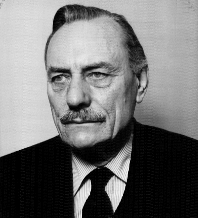
And the human cost is intertwined with the financial one, something that Patricia Hornsby-Smith and Enoch Powell would have recognised. I met a fellow Clubhouse veteran recently; unable to maintain employment without input but "not ill enough" to warrant a community psychiatric nurse, she spends her time subsisting on benefits - mostly, as Boris Johnson says, at home watching TV. Investing in resources that would help people like my friend both to work and to pay more taxes would, in my opinion, be a win/win situation.
When I first heard of Eyjafjallajökull, I was of the same opinion as Richard Normington, in that it seemed more like a keyboard malfunction than anything else. But things started to look sinister when continent-sized areas in the course of the volcanic cloud, containing putative glass fragments that could cause high-flying jet engines to close down, were declared no-fly areas on the basis of computer models that are as diconnected from reality as the politicians who made decisions solely on their predictions, without reference to reality.
Thankfully, we can fly again. As it happens, I don't fly that often, but even in the circumference of the world I inhabit the no-fly orders had consequences, from a colleague who couldn't make it to work, through a fellow worshipper whose presence had been required to validate church accounts, to a friend who had been badly injured abroad and whose family was deprived even longer of her presence.
I thought that I'd like to dedicate this month's Top Ten to the theme of flying, because the cooling of Eyjafjallajökull's ire coincides with a crucial time in our country's history, when we decide which political parties will suppress the innate instinct to fly as high as we can, and which will not only nurture it but ensure that we lift up our peers in so doing.
10 - Would you like to fly?
The 5th Dimension, who were inducted into the Vocal Group Hall of Fame in 2002, are famous for taking the song Age of Aquarius from Hair to the top spot. My favourite song of theirs is Jimmy Webb's Up, Up and Away which, whenever I hear it, brings memories of childhood awakenings to the song being played on the ever-present radio.
9 - Wild Swan
In my opinion, Tony Clarkin - the bearded guitarist in the video - deserves to be hailed alongside Pete Townshend as arranger par excellence of his own lyrics with insight and sensitivity worthy of Berlioz. The video, telling the story of a son who simultaneously hero-worships his crusading father and feels the overarching need for his presence beside him, comes to mind because of a wild swan that's been making the news in Cambridge. Called Mr Asbo, he's been accused of harassing and even overturning boats on Cambridge's river Cam. A recent film aired on BBC 1's The One Show displayed the swan at his most aggressive - but the BBC has been accused - in a video that I recommend you watch - of goading the swan's mate into leaving her nest in order to see off a canoe that was ordered to go dangerously close to it for the sake of "car-crach TV". Given that Asbo, according to vet and Telegraph blogger Pete Wedderburn, has actually had his cygnets killed by "passers by", I'm not surprised he's mardy. The state hasn't killed my children, but arrogates to itself ever greater powers to brainwash them according to abusive agendas that seem to have no other purpose than to "rub the Right's nose in diversity". I feel as angry as Mr Asbo.
8 - Volare
In February 1991, I had an interview in London and arranged to stay with a friend in Brixton. The interview went well but later in the day came the news that 10 Downing Street had been attacked by an IRA mortar. Mobile phones being as rare as they were huge in those days, I found myself having to wait in one of the lines that trailed from every phone box. My friend explained, "I think everybody's phoning home to say they're ok". That evening, he. I and another friend went to his flat in the middle of Brixton High Street, kicking up the snow that had emptied the thoroughfare of cars. Since all of us had lived for some time in Italy, this is the song we sung:
7 - Flying machines in pieces
This is such a video of James Taylor's Fire and Rain, which is about, in part, the suicide of his fried Suzanne Schnerr, whom he'd met while both of them were hospitalised for addiction to heroin. "Flying Machine" was the name of his first band; but the line "flying machines in pieces on the ground" is about more than the breakup of a musical unit, but I wonder if. when Taylor sings "Susanne the plans they made put an end to you" (my italics) he's running from the couple's co-dependency. But. counterintuitively, I can see a better case for the use of prescribed pharmaceutical diamorphine (heroin) under strictly controlled than for legalisation of cannabis, because we cannot halt supply of heroin within our own borders. The thing is, cannabis-legalisation site UKCIA (offline at the moment) has made a case for legalisation of weed as a gateway to legalisation of just about every illegal drug. Having been a drugs-worker, I hope this never happens; I'd hate the misery I saw in the needle-exchange to become commonplace.
In 2002, Nick Clegg, now leader of the Liberal Democrats, wrote an article about a school trip to Germany:
A boy called Adrian started it. He shouted from the back of the coach, "we own your country, we won the war". Other boys tittered. One put a finger to his upper lip - the traditional British schoolyard designation for Hitler's moustache - threw his arm out in a Nazi salute, and goose-stepped down the bus aisle. Soon there was a cascade of sneering jokes, most delivered in 'Allo 'Allo German accents.
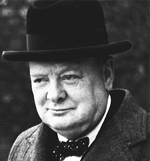
I was shocked by his ignorance. Britain was indeed on the winning side of WWII and was a major and heroic player, but to baldly assert that "Britain won the war" is as disingenuous as is baldly asserting that Germany lost it. We must never forget the key role that Britain played in defeating the Nazis (who were by no means synonymous with Germany), but it is salutary to remember that, on the eve of the Pearl Harbour attacks on December 7, 1941, Britain was losing, and Winston Churchill had authorised the distribution of bayonets with a poster campaign saying "at least you can take one with you".
As it happens, historian Colin Heaton concluded in Night Fighters that had Britain been conquered, America would have eventually had confront Hitler's contagious monomania - but Britain would have been a much changed place. Thank God that never happened.
Rector Pellegrina wasn't quite convinced when I confessed a guilty pleasure in heavy metal. I hope this video about the Battle of Britain - by an RAF composed of 10% Polish pilotry - will give her cause to reconsider.
5 - Flying Sorcery
Al Stewart merged his twin loves of flying and history for this song from his classic Year of the Cat album. An article on his website explains the context of the lyrics, from Amy Johnson, to the biplanes called Faith, Hope and Charity which defended the George Cross island of Malta and the double meaning of the Flying Circus. Enjoy this footage of him singing in Cambridge's namesake town in Massachussetts.
4 - Flying for me
John Denver was a founder of the "citizen in space" project and was even considered for the honour, but was pipped at the post by Christa McAuliffe, a secondary/high school teacher who had worked in Washington DC before moving to Concord in New Hampshire. Denver recollected that on the morning of January 28 1986 his adopted son Zac phoned him and told him to put the TV on, any station: there was the Challenger disaster, inspiring him to write:
She was flying for me She was flying for every one She was flying to see a brighter day for each and every one She gave us her light She gave us her spirit and all she can be She was flying for me
3 - Abide in His shadow for life
We had a discussion on hymns at our annual church meeting recently - you know the sort, that can quickly degenerate into an "old=Good" vs "New=Better" argument all too quickly. It was left to our venerable and classically-trained organist to point out that while traditions need maintaining, some new hymns are beautiful. One of these, I think, is Fr Michael Joncas' On Eagles' Wings, based on Psalm 91 and Isaiah 40:31. Given that John Smeaton, director of the Society for the Protection of Unborn Children, has been correcting misleading Government advice on sexual education and abortion, I think it's appropriate that this video of the song performed by Angela Birkhead-Flight is dedicated to "all babies who have died prematurely due to abortion, miscarriage or other means".
2 - Icarus
Although Kansas sung a song specifically about Icarus, another one - Carry On my Wayward son - seems to be a more meditative take on the sublime fall of the son of Daedalus, the craftsman who gave a ball of yarn to Ariadne so she could guide herself and Theseus out of the Minotaur's labyrinth, although there appear to be elements of Plato's allegory of the cave threaded through. Father and son, of course, strapped on wings of wax and feathers in order to escape the wrath of King Minos of Crete, but Icarus ignored a warning from Daedalus not to fly too high, and plunged into the sea when the heat melted the wax. It's often taken as a cautionary tale warning those who are over-ambitious of the danger of flying too high on constructions that should have been kept closer to earth. Just so, blogger Benedict White tells us that Gordon Brown was warned when Labour took power in 1997 that his proposed financial reforms would lead to a systemic banking failure. But he flew too high...
1 - The final attack
In the film The Dambusters we see a disconsolate crew looking back at the Möhne Dam on the Ruhr, feeling they have failed: then, suddenly, under the attacks that have been visited upon it, the dam's wall collapses and water floods out.
In reality, the crew pulling away was the fourth wave: a fifth Lancaster dropped its bouncing bomb upon the already-disintegrating wall to consolidate the damage.
This election has been a long, unpredictable slog. The Conservative party's first wave of attacks upon Gordon Brown, who is damming up the British people in a politically-correct prison where the silent majority of law-abiding people are punished the most, might be said to have happened shortly after his unelected accession to the Labour throne in June 2007, when he bottled out of an election he might have won when the David Cameron and George Osborne announced that only millionaires would pay inheritance tax. The second wave was a tsunami of activism, fuelled by both shoe-leather and blogs, cat-herding organised by the long-suffering Eric Pickles, the third a series of defeats inflicted upon the Prime Minister,Chancellor of the Exchequer and miscellaneous Ministers by David Cameron, George Osbourne and the Shadow front-bench team. The fourth is happening now, as candidates, activists and supporters work like Trojans to bring about change necessary for national survival.
The fifth wave is coming shortly, even as the dam walls crumble - illustrated by Gordon Brown's disastrous labelling of his own supporter, Gillian Duffy, as a "bigot" because she challenged the prevailing orthodoxy on immigration, imposed on people like her by rich ideologues who do not have to live in areas like hers. The fifth wave of attacks upon Labour's walls of infamy will come on May 6 and be inflicted by the voters, and I pray that the power-houses of willful negligence are swept away by the resulting inundation.
My friends are sometimes surprised to hear that I'm a John Denver fan. I disagree with some of - actually most of - his political views, but then again I like some of John Lennon's early 1970s music, even though the man was by then an even nuttier fruitcake than he was in the Beatles.
What I admire is Denver's adherence to his principles, and one of the first things I point out when talking about him is that while rock and pop oligarchs were recording their histrionic singles Do they Know it's Christmas? and We are the World, Denver was frequently in African countries with his sleeves rolled up. Denver had wanted to be on We are the World, but the single's producer, Ken Kragen, who also managed Harry Chapin and Kenny Rogers, commented that "several [un-named] people felt his image would hurt the credibility of the recording as a pop/rock anthem. I didn't agree".
Similarly, while Earth Day, instituted in 1970, is a once-a-year "awareness-raising exercise" for some, the title of Denver's 1990 song for the occasion summed up his typically uncompromising view: Celebrate Earth day (Every Day).
In other words, if you think that the activities of humankind are causing global warming, you can use your God-given free will to give up your car, stop flying in aeroplanes (admittedly not hard to do recently with the help of Icelandic volcanoes) and power your household entirely with wind-turbines. Every day.
"Between 75 and 85 percent of all the species of living animals will be extinct" by 1995 - Earth Day founder, the late Gaylord Nelson.
The world will be "…eleven degrees colder in the year 2000. This is about twice what it would take to put us into an ice age," Kenneth Watt, speaking at Swarthmore University, April 19, 1970.
"By 1985, air pollution will have reduced the amount of sunlight reaching earth by one half…" Life magazine, January 1970.
Gaylord Nelson, aside from founding Earth Day, is also famous for instituting hearings as a Senator on the safety of the contraceptive pill which required US manufacturers to place a statement as to the Pill's safety on its boxes, the first time in the country that an adverse effect had to be listed on a pharmaceutical product, and I can't fault him for that. But I think it gives an insight into the way his mind worked that no women were invited to testify, and this gave "reproductive rights" advocate Alice Wolfson a chance to stake her place in the dimming light.
Another peek into his psyche is given by his insistence that Earth Day should be held on April 22. This was against the likes of, say, anthropologist Margaret Mead, who called Earth Day "the first holy day which transcends all national borders", that the feast should be held on the Spring Equinox, which falls around a month earlier. Students of history will note, therefore, the significance of the first Earth Day being held on 22 April 1970: it was, according to the Grergorian Calendar, the hundredth anniversary of the birth of Vladimir Ilyich Ulyanov - Lenin.
Sadly, in the aftermath of John Denver's last flight, I am not aware of eminent left-leaning figures who believe in showing what they think about the environment at least as much through how they live as what they say. I suspect they were sidelined from public life by the same sort of ideologues who decided Denver was not appropriate for We are the World.
So we are left with a holyday of obligation for a monster who murdered and oppressed his own people before directing his baleful gaze towards Russia's neighbours, thence to the rest of the world both in his own right and through his unintended heir Stalin, who muscled in on his legacy the same way that Alice Wolfson piggybacked on the unsuspecting Gaylord Nelson. Thus do each generation's self-elected prophets hand a Pandora's box to those who will empty its contents upon the silent majority of the next.
In my late teens, having decided to terminate my studies in Italy, I returned home by train and boat and found myself drawn to conversation with a variety of people, as if we souls in transit - in more ways than one - were drawn to each other.
I found myself reflecting on this last week while travelling by train to Spring Harvest, an annual Christian festival of lectures and worship based in two Butlins camps - Minehead and Skegness - of which I went to the latter. As it happened, I spent the first half of the week feeling a little sedated due to unexpected side-effects from my meds, but experienced yet again, in going and coming home, the discovery predicated by Dickens of David Copperfield that the stages on the journey contribute to its object.
Due to an urgent meeting at work I'd been unable to travel with the family. Not having the opportunity to partake of a radical fast in the tradition of Lough Derg in Ireland, one of Europe's most ancient sites of pilgrimage, as a blogger I'd decided to fast from the news. This left me looking out of the train windows and realising that I hadn't done so for many years, such had been the pull of having my head stuck in a book or paper when travelling.
Perhaps a meeting at work at which the probabililty of downsizing was discussed had taken my eye off the ball (as well as ensuring I couldn't travel with my family), or maybe I was a little too calmed by the smell of freshly-mown hay from the field opposite Ely station; anyway, when my train arrived simultaneously with another on the other side of the island-platform, I got on the wrong one and found myself heading back to Cambridge. An anticipated sulk was swept away by the discovery that I could get straight on another train to Ely, and I wasn't held back all that much.
On the journey to from Ely to Grantham I watched the waterlogged Fen landscape roll past with a sense of wonder at how much dry land had been reclaimed by the heroic efforts of Sir Cornelius Vermuyden, whose travails are commemorated in the legend beneath South Cambridgeshire District Council's coat of arms - Niet Zonder Arbyt (nothing without work) - which is the only Dutch motto in British civic heraldry.
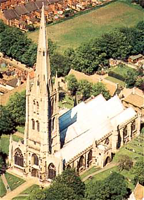
I got off at Grantham to join the Poacher Line to Skegness. The East Midlands town was instantly recognisable by the skyscraping spire of St Wulfram's Church, built to commemorate the 7th century Frankish missionary in the early 1300s, and a striking contrast to the many Norman church towers, arising from parish churches of villages mentioned in the Domesday Book, punctuating the horizon during the journey. As we drew out of the expanding East Midlands town I got a glimpse down St Peter's Hill before another new shopping centre went by. I pity people trying to get onto the property ladder here, as prices rocketed after the discovery that, at a pinch, one could commute to London from it.
Soon after Grantham the train stopped at Rauceby, once the site of a major psychiatric hospital that was closed in 1997, after which we were once again in the fens proper. I was delighted to catch a glimpse of two great crested grebe perform a mating dance before arriving at Boston, where a group of pilgrims known as the English Separatists left firstly for the Netherlands to try to practice their faith in freedom, before finally and famously fleeing the religiously-riven continent on the Mayflower to land on Plymouth Rock, and found a namesake of their hometown in Massachussetts in 1620.
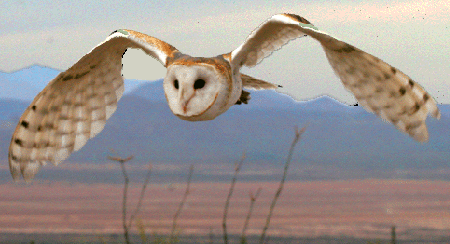
It was getting darker as the train drew towards Skegness - known as "skeggy" to its many admirers - and I saw a Barn Owl swoop low over a field in the gathering gloom. For somebody who's still a city-boy at heart, it felt like winning a prize.
On the bus from the station at Skeggy I felt a squirt of adrenaline at catching the sea just as I've always done since boyhood, although it was good to get into our caravan in the site opposite Butlins at last. Spring Harvest was good, although I was dismayed at the lack of any opportunity for traditional worship. I attended some good lectures, but will have to review my notes and do some digging before posting an appraisal.
Spring Harvest finishes on a Sunday which, if you don't have a car, is hellish, because only one train runs, but at least this year it had an extra carriage. We met one lovely woman from the north-east, who suggested that next year she might spend the Sunday night in a bed-and-breakfast and leave on the Monday - or else not come if she can't afford the extra expense. The situation regarding the trains is a crying shame, because Butlins is full-up during the two Spring Harvest week-long sessions, which help it provide such a vital economic and jobs boost to Skegness.
Passing Boston again, I saw a row of terraced houses that, like unbraced teeth, had grown organically, with the Unicorn Bar and Andy's Fish and Chip Shop, while St Botolph's unique spire (The Stump) played hide-and-seek in the background. Another station, Heckington, was beautifully trimmed and displayed a poster advertising a "Railway and Heritage Museum". beside the station was a huge windmill, and I wondered if this might be one of the originals deployed by Sir Cornelius to drain the Fens. Wainfleet was also beautifully kept, with flowers growing from cut-down beer barrels: an addendum to each railway sign identified it as "the home of Bateman's Brewery".
As good as it was to get back to the Draughty Old Fen, it was a beautiful, if crowded, journey. Despite large green spaces being built into the Fen drainage system by Vermuyden as an integral part, whether or not those places in the Fens I saw will be built on depends upon the result of the next election. I hope I get a chance to see them again soon.
At this vital time in the General Election timetable I've returned from holiday to find that my computer has chosen to go wobbly - I'm sure it was made by a sicialist - and I can't launch Photoshop. My daughter, who - like many children - is the resident computer expert is visiting Granny on the other side of the Fens; so, apart from pics I already have on Photobucket, I'll have to leave you to the tender mercy of Blogger's in-house image hosting program...
Suddenly blogging as the General Election approaches looks much more interesting...and dangerous. In the wake of a report by Iain Dale on a judgement against a Labour blogger sued regarding a comment he left on his site, barrister James Tumbridge (right) posts a gust blog on Ellie Seymour's site on What bloggers need to know about defamation. Watch out for the most thought-provoking conclusion to a blog that I've seen for a long time.
Nick Hillman, Conservative PPC for Cambridge, posts on the meeting to save the city's Strawberry Fair, which has been opposed this year by police on drug-taking and disorder grounds. As a historian he shares his views on the prospect of losing this festival, which began in the early 1970s.
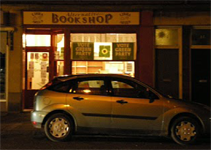
If a picture speaks a thousand words, then this snap taken by Phil Salway of the Coleridge Conservative team in Cambridge, of the Green Party's electoral campaign headquarters in the Alternative Bookshop on the city's Mill Road, speaks volumes about what the Green Party really thinks about the commitments it wants us to take on energy conservation. Be sure to click the link or the pic to go to Andrew Bower's (Cambridge City Council Conservative Candidate) to have a look and read an analysis.
Canadian newspaper website The Gazette looks at the Vatican reaction to Richard Dawkins' and Christopher Hitchins' histrionic plan to have the Pope arrested on his forthcoming State visit to Great Britain in September.
David Appletree of the Jewish Internet Defence Force reproduces a letter from Rabbi Dov Coder complaining to YouTube about hate material posted by David Dukes, notorious antisemite, racist and Ku Klux Klan member...
...while There is nothing British about the BNP looks at a racist group joined by BNP vice-chairman Simon Darby that's hosted by Facebook, a site Appletree warns about repeatedly.
And finally, here's a treat: Open Music Archive, "a collaborative project, initiated by artists Eileen Simpson & Ben White, to source, digitise and distribute out-of-copyright sound recordings. The archive is open for anyone to use and contribute to.".
I can't pinpoint when I became an Anglophile; my Mum and I would go to Blackpool frequently when I was young, but during the traditional "fair fortnight" holiday the Lancashire coastal resort would essentially turn Scottish in what remains of Scotland's support for the House of Lancaster during the Wars of the Roses, the price of cooperation having been Berwick (which soon returned to England).
I first lived in England after marrying Maxima, who comes from the other end of the Fens. After a spell we went and lived in Glasgow as my mother was very ill and, after her death, came to the Draughty Old Fen when offered a temprorary job here; when it became permanent the family moved down - it was a good move.
Although Maxima was regularly sent to coventry in Scotland because she's English, the situation has never been reciprocated here. I find the English warm-hearted, supportive and generous, despite their having laboured under an administration that for twelve years has tried its best to chip away at its best-loved traditions, the latest victim having been Pooh sticks, ostensibly cancelled for health and safety reasons.
I will always retain a level of affection for Scotland, but my guttering loyalty to the country was finally extinguished when the Lockerbie bomber, Abdelbaset Ali Mohmed Al Megrahi, was released for political reasons. Remembering TV pictures of the approaches to the Borders town choked with ambulances that would return empty, I felt sick.
Having deconstructed the notion of "race" to the level that, the Establishment says, your race is what you decide it is, one might make a good case for "English" to be a race, although in the diversity-ridden alternative universe presently prevalent in the corridors of power I suspect that one would be a non-starter. But if I called myself English, my accent would betray me the moment I opened my mouth. However, I definitely feel more British than Scottish, and will continue to do so should Scotland go its own way to make the United Kingdom into, says Alex Salmond of the Scottish National Party, the United Kingdoms.
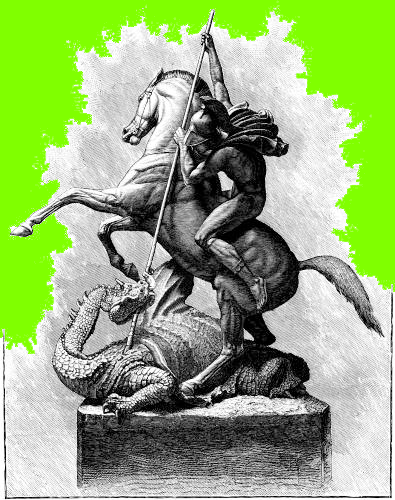
I love England. And so, in the month when we celebrate the Feast of St George, I would like to offer you a Top Ten about this wonderful, kind race: the English.
"In England, where my heart lies..."
Paul Simon toured England in the early-mid 1960's, and famously spoke of his wish to voyage Homeward Bound, which he wrote while stranded at Widnes train station. "Home", of course, meant America, but it also referred to Kathy Kitty, the English girl he'd fallen in love with (hence the line "Kathy I'm lost" in America). Like many before and after he also fell in love with England - see the reference to "Cathedral bells" etc in To Emily, wherever I may find her. Here's the late Eva Cassidy singing the song live, including the classic reference to "England, where my heart lies".
Dirty Old Town
Lancashire songwriter Ewan MacColl, father of Kirsty, wrote Dirty Old Town about Salford, near Manchester, where he was born. Written in 1949, it was immediately adopted and made famous by the Dubliners, and subsequently by bands all over the English-speaking world in an example of the way English-speaking culture can go international in a heartbeat, although the socialist songwriter may not have liked to think of it that way. Luke Kelly, Dubliners founder member, sings it with his band here, displaying the English-Irish cross-pollination that has enriched both countries for centuries.
Zadok the priest
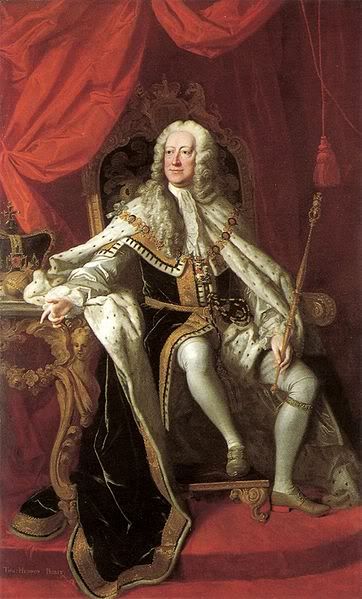
This great anthem was written by Handel for the coronation of George II in 1727. Since the union of he Crowns of England and Scotland was in 1603, and the Act of Unions uniting the two countries' Parliaments in 1707, one could say that this is a British anthem. But should Scotland secede from the Union, it will be up to them what heritage from the Union they take: I hope that Zadok the Priest - based on 1 Kings 1:38-40 - is retained by England, even if it should be duplicated elsewhere.
From Brixton to another place
Electric Avenue is a thoroughfare in Brixton linking two roads full of stalls, just like you might see in Eastenders. As cosmopolitan as it is, the video of Eddy Grant singing about the street suggests that its inhabitants and patrons might like, maybe just once in a while, something else.
Preotecting the old ways...
Yorkshire folk singer Kate Rusby covers the Kinks' 1968 hit The Village Green Preservation Society for a series called Jam and Jerusalem, which was modelled on the Womens' Institute, formed in 1915 to revitalise rural communities, but which now has a vital message for women and girls everywhere.
Burn them down?
The Jarrow Crusade was a heroic peregrination from Jarrow, near Newcastle, to the Houses of Parliament, to protest against the unemployment, poverty and even starvation that followed the collapse of the US stock exchange in 1929. In Alan Price's song about the event we hear him put himself into the song in a deconstructionist manner; but, more than that, while the majority of marchers wanted a job, we hear him echoing the cries of the vocal minority to "burn them down" - which prefigured the minority in the Miners' Strike of 1984-85 for whom a settlement of better pay and conditions would have been a disaster, because they wanted nothing but régime change.
Cricket
It was sad to see that Cambridge University's Emmanuel College was forced to desist from holding a May Ball in praise of the British Empire. Nobody's going to support the Amritsar Massacre, but Britain - and England - spread abroad a culture that continues to refer back to the English way of life where, as poet Rupert Brooke asked, stands the church clock at ten to three? A sign of this culture, visible in India, Pakistan, the West Indies, Australia and New Zealand, is cricket: and here is the tune that has accompanied English cricket on TV for decades - Soul Limbo by Booker T and the MGs.
Queen of Bollywood
Before the (modern) Suez Canal was opened in 1856, civil servants and administrators working in India would often marry Indian wives, because of the unworkability of having a wife "back home" due to the long passage time. Thus began a new race, called Anglo-Indians or Eurasians, who are still very popular in the Bollywood film industry. This is Asha Bhosle singing for the BBC - enjoy.
The seaside
The fascination for seaside resorts grew exponentially during Queen Victoria's reign, and still remains. As well as Blackpool, there were Skegness, Brighton, Torquay and many other resorts. After a fallow period, English seaside resorts are becoming more popular due to the recession, as it becomes relatively more expensive to go abroad. (Study the video below and you'll see Brian May.)
Fisherman's Friends
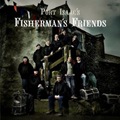
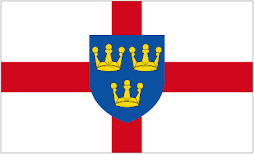
The Fisherman's friends, of Port Isaac in Cornwall, were founded to support the Royal National Lifeboat Institution in a part of Britain where it's all too easy for boats to go missing. If you like what you hear, please think of the men and women who give so much to bring us fish, and of the men and women who are ready to sacrifice everything when something goes wrong. Click on the flag to find out more about the RNLI, or on the image of the Fisherman's Friends' latest album on the left to find out more about the band.
The Draughty Old Fen, Cambridgeshire, United Kingdom
An incurable old cyber-grumpy, I like good music, cats, bacon sarnies and anything to do with Terry Wogan. Raining on ideological parades is the cream in the coffee.
Latest 50 educational institutions accessing Tales From a Draughty Old Fen:
No endorsement by the institutions listed below of the website or any post is intended to be inferred. Click an organisation's link to go to its website.



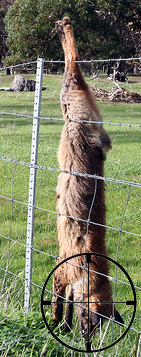 Basically a political version of Hedda Hopper, Fawkes has excelled even himself in poor taste with a cartoon of Conservative MP David Ruffley who, apparently having become depressed in the wake of the expenses scandal,
  Hollywood Actress Joan Fontaine once sent Hedda Hopper a dead skunk with the note "I stink, and so do you". Staines stinks like a dead dog. I must ask political columnists and bloggers to give him the attention he has indicated that he deserves: none.




































 I can't pinpoint when I became an Anglophile; my Mum and I would go to Blackpool frequently when I was young, but during the traditional "fair fortnight" holiday the Lancashire coastal resort would essentially turn Scottish in what remains of Scotland's support for the House of Lancaster during the
  econstructed the notion of "race" to the level that, the Establishment says, your race is what you decide it is, one might make a good case for "English" to be a race, although in the diversity-ridden alternative universe presently prevalent in the corridors of power I suspect that one would be a non-starter. But if I called myself English, my accent would betray me the moment I opened my mouth. However, I definitely feel more British than Scottish, and will continue to do so should Scotland go its own way to make the United Kingdom into, says Alex Salmond of the Scottish National Party, the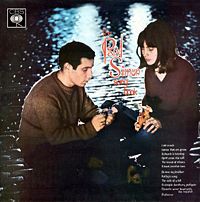
 The Jarrow Crusade was a heroic peregrination from Jarrow, near Newcastle, to the Houses of Parliament, to protest against the unemployment, poverty and even starvation that followed the collapse of the US stock exchange in 1929. In Alan Price's song about the event we hear him put himself into the song in a deconstructionist manner; but, more than that, while the majority of marchers wanted a job, we hear him echoing the cries of the vocal minority to "burn them down" - which prefigured the minority in the Miners' Strike of 1984-85 for whom a settlement of better pay and conditions would have been a disaster, because they wanted nothing but régime change.