As a part of a series of documentaries detailing changes in views about mental illness in the last 60 years, BBC4 screened Mental: A History of the Madhouse last night, and it did an admirable job of exploring the spectrum of shades of grey involved in the issue without black-and-white judgement.
For example, there was Maggie, who volunteered for "experimental" brain surgery in the 1960s and who feels that, after 5 years of debilitation that followed the surgery - in which a section of her brain was burned out to stop the fits of violence that would require increasing lengths of hospitalisation - she recovered in spite of and not because of the operation. She has been given awards for campaigning for community causes...but one is left wondering if this would have been possible without the operation.
I thought of this towards the end of the documentary, when we saw the dark side of the opposite of the asylum model of care. Following a series of murders by people who had been released into the community as beds were closed (so the chance of their being readmitted stadily diminished), the most famous of which was the 1992 murder of Jonathan Zito by Christopher Clunis at Finsbury Park, a psychiatrist briefs a police shift that one of his patients is having increasingly violent urges, and then a dozen riot officers break into his house because both psychiatrist and police have decided that "overwhelming force" is required.
There have, of course, been huge leaps since the days of the asylums, when staff violence towards patients was recalled by a former psychiatric nurse as having been justified, when he was a student, by his charge nurse on the grounds that "if you live among shit you become shit". Although thankfully I missed this period, I felt ashamed to have been a psychiatric nurse.
In 1959, Patricia Hornsby-Smith (in Harold MacMillan's Conservative government) reported on the crippling price of keeping more people in psychiatric institutions than there had ever been, reporting on the "appalling legacy" of the buildings and how maintaining them would take up an increasing portion of the NHS budget; but she also spoke on how an appreciation of mental illness being like "any other disability" was a prerequisite on action that would need to be taken on both pragmatic and humanitarian grounds.
it is the duty of a Minister of Health and the duty of the National Association for Mental Health, to...choose and to favour wherever they have the choice, the course of more drastic and fundamental change: for we may be pretty sure that even so the progress of medical thought and method will still be well on ahead of our practice.
Powell was, of course right (and it was good to see the BBC admit that the man was more than a controversial 15-minute speech): as the documentary showed, "hope came from the laboratories [in the form of] a new generation of psychiatric drugs". However, Largactil (chlorpromazine) created new problems to replace the ones it solved in the form of simultaneous agitation and sedation, and Parkinson's Disease-like symptoms. Had the resarchers looked further into its genesis, they might have found that it was derived from a dye produced in Victorian England, but wasn't much use. So it was fed to cows to see the effect, which was that the cows calmed down. And died shortly afterwards.
However, the growing voice possessed by mentally ill people and their advocates - who included many mental health workers - drove the phamaceutical search for medications that had maximum effect on symptoms with minimum unwanted effects. The quest still continues.
But how did we get from this sense of optomism to a mentally ill man's flat being raided by a dozen riot police? As beds decrease, I worry that the stigma that infested the ageing Victorian structures hasn't disappeared but has rather been absorbed into society, which has become itself an über-asylum wherein, asserts London Mayor Boris Johnson in an exegesis of Eleanor Rigby, too many people "pretty much stay at home and watch TV" with their loneliness acting as a straitjacket - a garment never used once in the history of the crumbling Victorian asylum where I trained.
As politicians struggle to describe how they are going to deal with the deficit, it's obvious that there are going to have to be cuts. But this should not blind us to the fact that cuts started some time ago. Fulbourn hospital, the psychiatric hospital serving Cambridge and surrounding areas, lost two rehabilitation units and two acute psychiatric wards in 2007. This could have been ameliorated by better services in the community, but Vocational Services, providing occupational therapy, and Cambridge Clubhouse a range of less structured opportunities of rehabilitation after psychiatric treatment, are long gone. The Clubhouse was replaced by a mental health resource centre that aimed to make ex-patients in the community into trainers, but access is now only by telephone.
I'm not setting out my stall for my territory, having switched from a psychiatric nurse to a psychiatric patient some years ago. I'm merely arguing for common sense: in the absence of dedicated resources people requiring mental health treatment are, at the more severe end, going to keep ricocheting between inpatient wards, police cells and prison and, at the less severe, take up more of the general resources that are available, eg GP appointments, A&E beds, etc.
And the human cost is intertwined with the financial one, something that Patricia Hornsby-Smith and Enoch Powell would have recognised. I met a fellow Clubhouse veteran recently; unable to maintain employment without input but "not ill enough" to warrant a community psychiatric nurse, she spends her time subsisting on benefits - mostly, as Boris Johnson says, at home watching TV. Investing in resources that would help people like my friend both to work and to pay more taxes would, in my opinion, be a win/win situation.
Chris Evans has taken over Terry Wogan's place at the helm of the BBC Radio 2 Breakfast Show slot, and very well he did too on his first day. It was small change that he defied the bookies to start the programme with All You Need is Love, but far more significant that the show was preceeded by veteran newsreader Moira Stewart, who had previously been progressively sidelined by the BBC until she left in October 2007 in a row about ageism.
But for me the best part was when the mother of a girl called Emilia Copp texted in to ask for a request for her daughter, who had given up a hired clarinet for a bought one as a birthday present, the delivery having been delayed due to our sudden attack of winter: Evans got her on the phone and arranged for Philip Mercer, accomplished clarinet player and teacher, to play "happy birthday" to her.
However, Sir Terry's retirement and Evans' occupancy of the keystone breakfast slot has eclipsed an arguably more momentous event: the return of Mark Lamarr.
Perhaps a little recent history is germane here.
In October 2008, unstable shock-jocks Jonathan Ross and Russell Brand were due to interview actor Andrew Sachs on the latter's show. When he failed to answer and an answerphone kicked in, Ross shouted "He's [expletive deleted] your grand-daughter!" and various rephrasings thereof down the phone. (The grandchild in question being Georgina Baillie, a burlesque performer also known as Voluptua.)
Over the next couple of weeks the BBC went into lockdown and even resorted to telling the lie that Sachs had not made a complaint, until Daily Mail columnist Melanie Philips penned an explosive article that blew the whole affair open.
Where Lamarr comes in is that when controller Lesley Thomas was fired for giving the pre-recorded Ross-Brand show her approval despite not having listened to it, Bob Shennan - whose strength lay in talk radio - replaced her at the helm of this specialist music station. One of his first acts was to axe the inoffensive Lamarr's three shows, which covered rockabilly, alternative 60's music and a show comprised of his pick of the last 70 years of popular music called God's Jukebox. He is a dedicated hunter-gatherer of the best not-well-known sounds and, as one music blogger says, expends a vast amount of time and effort hunting down music that is not heard anywhere else. The only complaint I ever heard about him was that he played too much reggae.
And there's the irony of the diversity-ridden alternative universe in which the BBC lives, moves and has its being. Lamarr, like DJ legend Alan Freed, is a white enthusiast for black musical culture, although unlike Freed his favoured ground is ska/rocksteady/reggae as opposed to rhythm'n'blues. He seems to have come under the same suspicion as Madness, a ska/rocksteady band (and favourite of Maxima's) who were accused of being racists because they were all-white, a charge not levelled at the Beatles, the Rolling Stones, Queen, Oasis and all the other white bands who reap fields sown by Leadbelly, Robert Johnson, Chuck Berry et al. When Mark Lamarr was sent packing, Radio 2 lost a whole lot of its black music output, probably over half, while the chances that you'd get two white blokes talking when tuning into this specialist music station rose exponentially.
Two of those blokes are musician and DJ Mark Radcliffe and music journalist-turned-DJ Stuart Maconie, who jointly present a 2-hour show on four weekday evenings per week. Great things were promised and great things delivered, initially; now, apart from the odd coup like a recent interview with Danny Thompson, bass-player for Nick Drake, they play ping-pong with memories for longer and longer, and one wonders at what point they will find the cupboard empty.
Lamarr is returning, and not a moment too soon, and in another twist of irony is placed as favourite to take over from Jonathan Ross on his Saturday morning talk-show, whose contract involving astronomical amounts of license-payers' money is not being renewed. I wonder if, given Lamarr's already-proven prowess at interviewing (he's covered Ross's absences more than once), Lamarr's departure was insisted on by Ross? It fits the timescale at both ends.
Whatever, I will enjoy listening to Mark Lamarr, and hope that this specialist music station gives us the rest of our music back.
If you put on a general music radio station at any point in the day, the chance is that if you listen for long enough you'll hear a song by the Beatles, and a song by Elvis Presley.
I was a belated Beatlemaniac while my Mum liked strictly Elvis; they both had 17 #1's in the UK - until A Little Less Conversation took the top spot in 2002, by which time Mum, please God, had gone to meet her idol as well as her God. But Elvis' musical influence extends far beyond his own corpus - hence nods to his vocal style in John Lennon's (Just Like) Starting Over, released barely a month beofre his own death, REM's Man in the Moon and countless others between and beyond.
We've recently had the 75th anniversary of Elvis' birth, so I decided I'd like to look at songs that might not be by Elvis but, given the the adulation accorded to him only grows as the years go by, I thought I'd do a top ten about Elvis.
10 - Real Good Lookin' Boy
This is the Who's guitarist Pete Townshend eulogising vocalist Roger Daltrey's 11-year-old epiphany upon seeing Elvis perform live. Already showing the rebellious streak that would hake him a perfect frontman for the band, , Songfacts quotes him as saying: "I loved him because everybody under the age of 20 thought they were Elvis and dressed like him. Everybody over 20 hated them and that was good enough for me."
9 - King's Call
Thin Lizzy's Phil Lynott enlists Mark Knopfler's help to put into words the desolation shared by many upon hearing of the death of Elvis. Listen out for the excerpt from Are you lonesome tonight.
8 - Boy from Tupelo
Here Emmy Lou Harris sings about the legend who originated from this Mississippi town before his family moved to Memphis in Tennessee when he'd just achieved double figures.
7 - Move it
Cliff Richard performs one of his first hits with the Shadows. I don't think I need gild the lily as to the influence of Elvis on this quintessentially Engish pop star, just watch!
6 - Walking in Memphis
Cher perfectly covers Mark Cohn's salute to the culture of Memphis, prominently featuring the city's prodigious Beale St, and also WC Handy, "Father of the Blues". Elvis would make both internationally famous.
5 - Plaisir d'Amour
Writing Can't Help Falling in Love, which was a huge hit for Elvis, George Weiss, Hugo Peretti and Luigi Creatori put English words to Jean Paul Egide Martini's (right) 1780 song Plaisir d'Amour (The Joy of Love). Here's Nana Mouscouri singing the bittersweet words in their original French.
4- Always on my Mind
When in 1987 camp band the Pet Shop Boys recorded a video - not always perfectly lip-synched - of the classic made famous by Elvis (among many others, notably Willie Nelson - there was a degree of scepticism if not consternation at their electronica treatment. But due to the unexpected level of interest it was then released as a single which reached the top ten in the US and Australia, and reached the pole position in the UK, Canada and Germany. Suddenly, renewed interest in Elvis was injected into this decade that maistream music and fashion forgot.
3 - Elvis Presley Boulevard
I'd tried to find Billy Joel singing Chris Trapper's 2002 song as the two men are linked by the drummer Ronnie Tutt, who played for the King from 1969 on, but most prominently with the Aloha from Hawaii concert; Tutt also played on Joel's 1973 Piano Man album. Here's Illinois singer-songwriter Tommy Neal performing the song, warning those who would seek a sort of salvation in the minutiae of Elvis' life, with his wife Breann.
2 - Black Velvet
Elvis' face depicted on velvet, often black, is so widespread that evangelist preacher and writer Rob Bell called his book on "repainting the Christian faith" Velvet Elvis. Likewise, David Tyson and Christopher Ward's paean to influences (like Jimmy Rogers) upon Elvis when he was growing up in Mississippi and Tennessee is called Black Velvet. Here's the best-known version by Allanah Miles.
1 - If I can dream
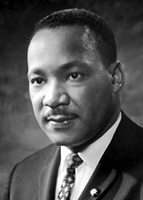
Elvis was always a deeply religious person and read many books on the subject while on tour or at Vegas. Upon his passing there was a rumour of a deathbed conversion to Catholicism, but unfortunately I can't find any info proving this or otherwise. One of my favourite of his songs is If I can dream, whose powerful lyrics both referenced Martin Luther King, who had been assassinated shortly before the release, and posed the question asked by many religious people abuot why God gives us the ability to wish for something better when those wishes come true at best slowly - the conclusion being that he trusts "somehow things are gonne be alright". Enjoy.
My good online pal Pam from Texas pointed out that if you have a 56k modem (or, I guess, a slow broadband connection) you have to wait for all the videos to load on one of these top tens before you can listen to any, which was something that hadn't occured to me. So in a spirit of contrition I offer the Top Ten songs about Elvis for bloggees with a 56k modem!
If you put on a general music radio station at any point in the day, the chance is that if you listen for long enough you'll hear a song by the Beatles, and a song by Elvis Presley.
I was a belated Beatlemaniac while my Mum liked strictly Elvis; they both had 17 #1's in the UK - until A Little Less Conversation took the top spot in 2002, by which time Mum, please God, had gone to meet her idol as well as her God. But Elvis' musical influence extends far beyond his own corpus - hence nods to his vocal style in John Lennon's (Just Like) Starting Over, released barely a month beofre his own death, REM's Man in the Moon and countless others between and beyond.
We've recently had the 75th anniversary of Elvis' birth, so I decided I'd like to look at songs that might not be by Elvis but, given the the adulation accorded to him only grows as the years go by, I thought I'd do a top ten about Elvis.
10 - Real Good Lookin' Boy
This is the Who's guitarist Pete Townshend eulogising vocalist Roger Daltrey's 11-year-old epiphany upon seeing Elvis perform live. Already showing the rebellious streak that would hake him a perfect frontman for the band, , Songfacts quotes him as saying: "I loved him because everybody under the age of 20 thought they were Elvis and dressed like him. Everybody over 20 hated them and that was good enough for me."
Thin Lizzy's Phil Lynott enlists Mark Knopfler's help to put into words the desolation shared by many upon hearing of the death of Elvis. Listen out for the excerpt from Are you lonesome tonight.
Here Emmy Lou Harris sings about the legend who originated from this Mississippi town before his family moved to Memphis in Tennessee when he'd just achieved double figures.
Cliff Richard performs one of his first hits with the Shadows. I don't think I need gild the lily as to the influence of Elvis on this quintessentially Engish pop star, just watch!
Cher perfectly covers Mark Cohn's salute to the culture of Memphis, prominently featuring the city's prodigious Beale St, and also WC Handy, "Father of the Blues". Elvis would make both internationally famous.
Writing Can't Help Falling in Love, which was a huge hit for Elvis, George Weiss, Hugo Peretti and Luigi Creatori put English words to Jean Paul Egide Martini's (right) 1780 song Plaisir d'Amour (The Joy of Love). Here's Nana Mouscouri singing the bittersweet words in their original French.
When in 1987 camp band the Pet Shop Boys recorded a video - not always perfectly lip-synched - of the classic made famous by Elvis (among many others, notably Willie Nelson - there was a degree of scepticism if not consternation at their electronica treatment. But due to the unexpected level of interest it was then released as a single which reached the top ten in the US and Australia, and reached the pole position in the UK, Canada and Germany. Suddenly, renewed interest in Elvis was injected into this decade that maistream music and fashion forgot.
I'd tried to find Billy Joel singing Chris Trapper's 2002 song as the two men are linked by the drummer Ronnie Tutt, who played for the King from 1969 on, but most prominently with the Aloha from Hawaii concert; Tutt also played on Joel's 1973 Piano Man album. Here's Illinois singer-songwriter Tommy Neal performing the song, warning those who would seek a sort of salvation in the minutiae of Elvis' life, with his wife Breann.
Elvis' face depicted on velvet, often black, is so widespread that evangelist preacher and writer Rob Bell called his book on "repainting the Christian faith" Velvet Elvis. Likewise, David Tyson and Christopher Ward's paean to influences (like Jimmy Rogers) upon Elvis when he was growing up in Mississippi and Tennessee is called Black Velvet. Here's the best-known version by Allanah Miles.
Elvis was always a deeply religious person and read many books on the subject while on tour or at Vegas. Upon his passing there was a rumour of a deathbed conversion to Catholicism, but unfortunately I can't find any info proving this or otherwise. One of my favourite of his songs is If I can dream, whose powerful lyrics both referenced Martin Luther King, who had been assassinated shortly before the release, and posed the question asked by many religious people abuot why God gives us the ability to wish for something better when those wishes come true at best slowly - the conclusion being that he trusts "somehow things are gonne be alright". Enjoy.
The first time I saw an Elvis impersonator was in Joseph and the Amazing Technicolor Dreamcoat when one jumped out of a Sarcophagus in the role of Pharoah to delighted screams from the crowd - he'd just been dead two or three years.
The lasting cultural impact of Elvis can't be underestimated. In Roland Emmerich's 1998 remake of Godzilla, Jean Reno, playing a French intelligent agent, gets through a US security barrier by saying the classic line "thang-you very much!", and in Men in Black, when the cvar is speeding upside-down through a tunnel to the accompaniment of Elvis singing Promised Land, Tommy Lee Jones' character remarks to Will Smith's that "Elvis didin't die, he just went home". My favourite, though, is in the film of John Grisham's novel The Firm. In the book, main character Mitchell McDeere, in fleeing, hitches a ride with a lorry-driver who is an Elvis impersonator; whereas in the firm we see Tom Cruise, playing the part, in the passenger's seat beside a driver who looks just like Elvis - a nod, no doubt, to the enduring rumours that Elvis is alive.
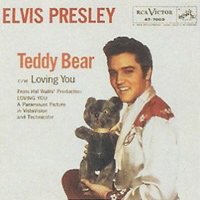
I remember when he died in 1977 because my Mum, a huge fan, came into my room weeping to tell me the news. She'd been hooked since she'd first heard one of his singles on Radio Luxembourg - which, by chance, was the first European station to announce his death. She related to me how the only of his songs she couldn't listen to was Teddy Bear, because when she was a young woman with TB in Mearnskirk Hospital near Glasgow, a wardmate had played it continuously on a wind-up record-player until, to the guilty relief of all those around her, the object of her infatuation decided to call things off in a letter.
I think two things in particular attracted Mum and her peers to Elvis. Firstly, living in poverty in Tupelo, Mississippi before moving to Tennessee's Memphis, he was a true working-class hero long before John Lennon coined the term in song while living in the lap of luxury, and - again unlike Lennon - he never forgot where he came from.
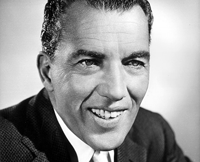
Secondly, his performances exuded sexuality in a "safe" way that was not only due to his distance from Scotland. The Southern laws of deference and politeness that his generation were instructed to observe almost religiously led Ed Sullivan to extemporise a paean to his decency, telling the audience at a time when Presley was being attacked with all the might of the Establishment machine that he was "a fine, decent boy" and called everybody "Sir".
Another side of "Elvis the Pelvis" was a fierce love for his mother, something well understood in Celtic countries, so the rumour being disseminated in the late 1950's that he had killed her must have really hurt. The late Elaine Dundy, who wrote a book on this relationship called Elvis and Gladys, captured the more extreme devotion that still surrounds the star:
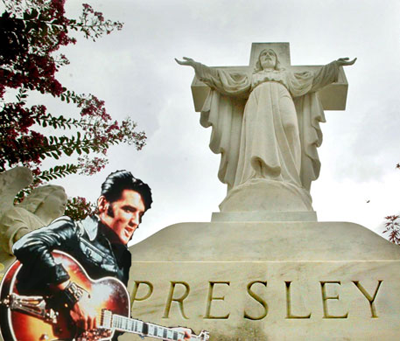
Here and now I feel sure that in the next millennium, excavations on the site of what was once Memphis, Tennessee, will uncover artifacts which lead archeologists to conclude there was once a god called Elvis who resided in the sacred temple "Graceland" where his followers gathered twice every year to worship: on the day of his birth, and on the day of his death.
Elvis popularised a "black" style of music because of the musicians he jammed with and, like them, had long(ish) hair that migrated into the "duck's tail" (to give it a more polite name) hairstyle that was sported by, for example, Chuck Berry; unlike his black co-musicians, his hair was longer because he couldn't afford to get it cut so often. So, unlike singers of sanitized pop that were being given airtime with Establishment blessings, when he burst onto the scene he was rough and ready to rock, popularising real rhythm'n'blues that let black performers start to take their rightful place in mainstream music on his coat-tails.
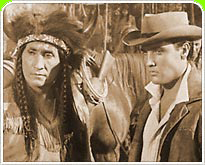
His ancestry was patchwork - Scottish, Irish, French, Jewish - and Native American (Cherokee ) - the latter perhaps informing his perfromance as a half-Kiowa frontiersman in Flaming Star, which was remarkably free of melting-pot fuzziness right up to its bleak conclusion. Like George Harrison, Van Morrison and Beverley Knight - andf arguably the majority of artists - he was haunted by a need to pursue a more numinous reality than that which informed his life as a touring and recording artist, dogged by the necessity of feeding the financial appetites of Colonel Parker, both who manipulated him and suppressed many of his talents in favour of what printed money.
As Elaine Dundy said, "prior to '77...it was possible to get through a day without hearing Elvis' name". At this time of year - and particularly this year, when had he lived he'd have turned 75, sometimes it seems that one hears little else. And, given the incredible generosity of this phenomenal man who gave joy to millions, that's fine with me.
My cycle having frozen solid - brakes, gears and wheels, I've taken to walking to work and elsewhere, although - unlike Ellee Seymour (right), I haven't done a twenty-mile hike for many years, and that was because we took the wrong path descending from a Highlands hill.
It gave one time to think walking to the Draughty Old Fen's St Gallicus, though, for its annual tradition of a Service of Carols and Lessons by Candlelight, which was only possible because, as an old building, the church has lots of niches and architectural whimsies on which candles could be placed. It was good both to celebrate the joy of Christmas in the present and revisit the past and, if you can't make it home for Christmas, or like carols, or are just curious, I'd like to try to recreate the Order of Service for you. (Apologies to Pam and others who find it difficult to access YouTube videos.)
Rector Pellegrina processed up through the altar rails with Ludus, a Licensed Lay Minister, and the fourth candle on the Advent wreath was lit.
I'm told Cambridge has more choirs per square mile than anywhere else in the world, and can certainly believe it. For the Introit, we had the choir singing Rejoice and Sing, which I've had trouble finding, but I think it may have been a fragment of Bach's motet Singet Dem Herrn Ein Neues Leid - hopefully Pellegrina (or Editio, the choirmaster) will correct me if I'm wrong.
Pellegrina welcomed us in from the cold and remarked that it was good to see St Gallicus full to bursting point on such a night. The "O" antiphons - explained by Revd Bosco Peters in his Liturgy blog - have begun, so for the carol service she chose the O Emmanuel:
O Emmanuel, our King and Lawgiver, hope of the nations and their saviour: come and save us, O Lord our God. Amen. Come, Lord Jesus.
The first carol was Once in Royal David's City - here it is from Carols from King's, the annual Carol Concert from the Cambridge University college:
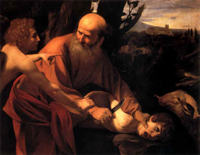
The first Lesson was Genesis 22:15-18, on God's promise to Abraham upon the latter's not holding back from being prepared to sacrifice his son Isaac:
The angel of the Lord called to Abraham a second time from heaven, and said, ‘By myself I have sworn, says the Lord: Because you have done this, and have not withheld your son, your only son, I will indeed bless you, and I will make your offspring as numerous as the stars of heaven and as the sand that is on the seashore. And your offspring shall possess the gate of their enemies, and by your offspring shall all the nations of the earth gain blessing for themselves, because you have obeyed my voice.’
Our next carol was a new one for me - A Great and Mighty Wonder. I never heard this in Scotland; obviously some carols are famous the world over, but I wonder if others are favoured in some regions and unknown in others?
I've heard Isaiah described as "a poet of genius" by friends who were able to read Hebrew and, looking at the beauty of sections of the compilation in English, I can believe it. Ludus read the second Lesson, Isaiah 2,6,7 about the Prince of Peace to come:
The people who walked in darkness have seen a great light; those who lived in a land of deep darkness – on them light has shined. For a child has been born for us, a son given to us; authority rests upon his shoulders; and he is named Wonderful Counsellor, Mighty God, Everlasting Father, Prince of Peace. His authority shall grow continually, and there shall be endless peace for the throne of David and his kingdom. He will establish and uphold it with justice and with righteousness from this time onwards and for evermore. The zeal of the LORD of hosts will do this.
The choir sang Goldschmidt's A Tender Shoot, and here it is, again, by the choristers of King's College.
The following carol was Of the Father's Heart begotten. Here it is sung by senior students of a US school, but unfortunately I don't know which one:
Lesson 3 was read by Peripatetica, who helps with Pastoral Care, and is the passage which deals with what Christians call the Tree of Jesse, and contains the famous lines about the lion and the lamb lying together in peace:
A shoot shall come out from the stock of Jesse, and a branch shall grow out of his roots. The spirit of the LORD shall rest on him, the spirit of wisdom and understanding, the spirit of counsel and might, the spirit of knowledge and the fear of the LORD. His delight shall be in the fear of the LORD.
He shall not judge by what his eyes see, or decide by what his ears hear; but with righteousness he shall judge the poor, and decide with equity for the meek of the earth; he shall strike the earth with the rod of his mouth, and with the breath of his lips he shall kill the wicked. Righteousness shall be the belt around his waist, and faithfulness the belt around his loins. The wolf shall live with the lamb, the leopard shall lie down with the kid, the calf and the lion and the fatling together, and a little child shall lead them. The cow and the bear shall graze, their young shall lie down together; and the lion shall eat straw like the ox. The nursing child shall play over the hole of the asp, and the weaned child shall put its hand on the adder’s den. They will not hurt or destroy on all my holy mountain; for the earth will be full of the knowledge of the LORD as the waters cover the sea.
The next carol was It came upon the midnight clear, sung here by Christian band Kutless:
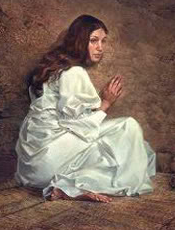
The fourth lesson, dealing with the fruit of the Jesse Tree, was Luke 1:26-35,38, telling of the Annunciation. Not being sure how to depict an angel, in modern times - since 1977's Jesus of Nazareth, commissioned by Lew Grade to honour a promise made to his friend, Pope Paul VI - films have shown Mary responding to an agency we neither see nor hear, the only sign that something extraordinary's going on being a restlessness in the night outside.
In the sixth month, God sent the angel Gabriel to Nazareth, a town in Galilee, to a virgin pledged to be married to a man named Joseph, a descendant of David. The virgin’s name was Mary. The angel went to her and said, “Greetings, you who are highly favoured! The Lord is with you.” Mary was greatly troubled at his words and wondered what kind of greeting this might be. But the angel said to her, “Do not be afraid, Mary, you have found favour with God. You will be with child and give birth to a son, and you are to give him the name Jesus. He will be great and will be called the Son of the Most High. The Lord God will give him the throne of his father David, and he will reign over the house of Jacob for ever; his kingdom will never end.” “How will this be,” Mary asked the angel, “since I am a virgin?” The angel answered, “The Holy Spirit will come upon you, and the power of the Most High will overshadow you. So the holy one to be born will be called the Son of God. “I am the Lord’s servant,” Mary answered. “May it be to me as you have said.” Then the angel left her.
My favourite version of O Little Town of Bethlehem is by Boxcar Willie - really! - but I couldn't find it on YouTube; so here's Aled Jones of Walking in the Air fame singing it with Libera. The lines The hopes and fears of all these years/Are met in thee tonight still give me goosebumps.
Amicus, who coordinates efforts to raise funds for St Gallicus in spite of dungeon, fire and sword (as Terry Wogan would say), read the fifth lesson, Luke 2:1,3-7, the Nativity, the appearance in flesh of what "the hopes and fears of all the years" are about:
In those days a decree went out from Emperor Augustus that all the world should be registered. All went to their own towns to be registered. Joseph also went from the town of Nazareth in Galilee to Judea, to the city of David called Bethlehem, because he was descended from the house and family of David. He went to be registered with Mary, to whom he was engaged and who was expecting a child. While they were there, the time came for her to deliver her child. And she gave birth to her firstborn son and wrapped him in bands of cloth, and laid him in a manger, because there was no place for them in the inn.
Now we had the choir again, with Rutter's Nativity Carol. Here it is performed by the Chancel Choir of the First Presbyterian Church of Conway, Arkansas.
This was followed by a worldwide favourite - Hark the Herald Angels Sing! Here's Nat King Cole:
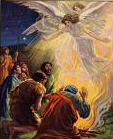
Lesson number six was read by a young member of the congregation and was Luke 2:8-20, the angels appearing to the shepherds in a great host within a shining light and saying "do not be afraid", which the shepherds might have been forgiven for thinking was a somewhat incongruous statement.
And there were shepherds living out in the fields nearby, keeping watch over their flocks at night. An angel of the Lord appeared to them, and the glory of the Lord shone around them, and they were terrified. But the angel said to them, "Do not be afraid. I bring you good news of great joy that will be for all the people. Today in the town of David a Savior has been born to you; he is Christ the Lord. This will be a sign to you: You will find a baby wrapped in cloths and lying in a manger." Suddenly a great company of the heavenly host appeared with the angel, praising God and saying, "Glory to God in the highest, and on earth peace to men on whom his favor rests."
When the angels had left them and gone into heaven, the shepherds said to one another, "Let's go to Bethlehem and see this thing that has happened, which the Lord has told us about."
So they hurried off and found Mary and Joseph, and the baby, who was lying in the manger. When they had seen him, they spread the word concerning what had been told them about this child, and all who heard it were amazed at what the shepherds said to them. But Mary treasured up all these things and pondered them in her heart. The shepherds returned, glorifying and praising God for all the things they had heard and seen, which were just as they had been told.
There followed the choir again with Joubert's anthem, Torches.
Then another classic carol, While Shepherds watched, accompanied by the pictures from Christmas cards. While we were singing this, a collection was taking place. Please give to a cause this Christmas - to your church, or to the local soup kitchen, or else to a charity that you've seen on TV that has moved you. If you don't have the money to give, how about spending some time getting shopping for somebody who has difficulty getting out, say, or helping out at a local scheme that gives folk a first step onto a ladder that will see them climb out of a bad place?
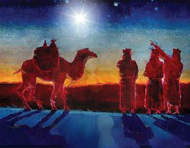
The penultimate reading came from Famula, who read the story of the Wise Men in Matthew 2:1-12. I remember Rector Pellegrina delivering a sermon about the Magi last year, describing how while the shepherds were comfortable in their own skin, the oriental astrologers' need for attention and recognition may have sparked a wave of infanticide. Among the Christian communities within the pro-life community, the Feast of the Holy Innocents on December 28 is traditionally a time when we remember the victims of abortion.
After Jesus was born in Bethlehem in Judea, during the time of King Herod, Magi from the east came to Jerusalem and asked, "Where is the one who has been born king of the Jews? We saw his star in the east and have come to worship him."
When King Herod heard this he was disturbed, and all Jerusalem with him. When he had called together all the people's chief priests and teachers of the law, he asked them where the Christ was to be born. "In Bethlehem in Judea," they replied, "for this is what the prophet has written: " 'But you, Bethlehem, in the land of Judah, are by no means least among the rulers of Judah; for out of you will come a ruler who will be the shepherd of my people Israel.'"
Then Herod called the Magi secretly and found out from them the exact time the star had appeared. He sent them to Bethlehem and said, "Go and make a careful search for the child. As soon as you find him, report to me, so that I too may go and worship him."
After they had heard the king, they went on their way, and the star they had seen in the east went ahead of them until it stopped over the place where the child was. When they saw the star, they were overjoyed. On coming to the house, they saw the child with his mother Mary, and they bowed down and worshiped him. Then they opened their treasures and presented him with gifts of gold and of incense and of myrrh. And having been warned in a dream not to go back to Herod, they returned to their country by another route.
The choir sang the anthem The Three Kings by Cornelius - here it's performed in St John's Cathedral in Portsmouth, the young man being accompanied by the Cantores Michaelis choir.
And the carol, As With Gladness, performed here by the Royal Choral Society in the Albert Hall, where Britain's Royal British Legion's Festival of Remembrance is held every year.
The last Lesson was read by Rector Pellegrina: the most powerful passage, I think, in the Christian Bible, detailing the mystery of the Incarnation in John 1:1-14. This is a passage Ive turned to many times in my life, most recently when I went to hospital to visit Professor Calculus of blessed memory and found an empty bed: I went to the hospital chapel, located a Gideon's Bible and sat and read the passage. It was the Good News translation, not my favourite, but it did the trick.
In the beginning was the Word, and the Word was with God, and the Word was God. He was in the beginning with God. All things came into being through him, and without him not one thing came into being. What has come into being in him was life, and the life was the light of all people. The light shines in the darkness, and the darkness did not overcome it. There was a man sent from God, whose name was John. He came as a witness to testify to the light, so that all might believe through him. He himself was not the light, but he came to testify to the light. The true light, which enlightens everyone, was coming into the world. He was in the world, and the world came into being through him; yet the world did not know him. He came to what was his own, and his own people did not accept him. But to all who received him, who believed in his name, he gave power to become children of God, who were born, not of blood or of the will of the flesh or of the will of man, but of God.
Rector Pellegrina then gave a wonderful Address on the mystery of God's wiping the slate clean through Christ, which I think is something Calculus couldn't accept: not that Jesus came to redeem us, but that it is a mystery. The last carol was O Come, All ye Faithful. I hope you will indulge me in letting me post a video of the carol in the language in which I sung it in a distant boyhood, although none of us could hope to have touched the hem of Andrea Bocelli's ability:
We finished with the choir singing Bach's Break Forth O Beauteous Heavenly Light, which is sung here by a choir in Tyler, Texas.
Pellegrina gave us a blessing, then made sure she was available to anybody who wanted to talk to her - aware, no doubt, that this can be a difficult time of year for a lot of people. She made sure that everybody left with something more than they'd come in with.
Personally I prefer to watch dancing on the TV and listen to music on the radio, as it doesn't work so well the other way round. So I tend to prefer Strictly Come Dancing (called this here instead of Dancing with the Stars because in the UK we had a programme called Come Dancing that ran from the 1940s to the late 90s) to X-Factor.
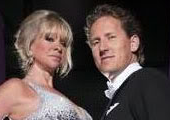
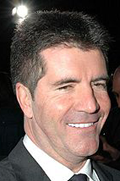
But the BBC seems unable to do anything without introducing a degree of the bullying that is institutionalised within the organisation as it exists today. Last year's Strictly was marred by the judges' campaign against John Sergeant for his crime of consistently being the public's favourite, and this year Craig Revel-Horwood homed right in on Jo Wood, who was so vulnerable as her marriage to the spectacularly adulterous Ronnie Wood deteriorated that her partner Brendan Cole admitted he didn't know how to move ahead. I stopped watching at these points. However, there's much more chattering about the challenging manner of Simon Cowell on ITV's X-Factor, which a Brit would have to be Rip Van Winkle with extra somnolence on the side not to have heard about, and which has just finished in Britain.
Cowell is a hard-nosed businessman but not a bully: there's a difference. He puts his charges under pressure deliberately because the business side of showbusiness is not known for its touchy-feeliness. But he will accept the mitigations of his often kinder co-judges Louis Walsh, Danni Minogue and Cheryl Cole - and, crucially, he accepts the public's votes, not least as regarded atonal Irish teenagers Jedward (John and Edward Grimes) whose style I would find difficult to describe.
Jedward were interesting. Had they won the X-factor every adult in the land would have been annoyed to bewilderment; but it's happened before, that's what punk was about. For a brief and - for them - shining moment they had the sort of notoriety I haven't seen a TV programme bestow since we all ran about buying stickers saying that we'd killed JR. Both the Labour and Conservative parties brought out eve-of-war posters casting each other as the surreally-coiffed pair, which is certainly something the lads can show their grandchildren. (Click on the two pics below to read more on Iain Dale's Diary)
Which is something good. There seems to be a perception that Simon Cowell is depriving his protegés of something by not guaranteeing them a cast-iron contract that will ensure decades of success. It's not like that, because the entertainment industry remains one where talent will out: and it's notable that Hear'Say, who won a 2001 talent-show programme called Popstars, contained classically-trained pianist Mylene Klass, while Britain's Got Talent, another of Cowell's vehicles, was won in 2007 by a tenor called Paul Potts who'd been winning smaller-scale competitions for years, and this year's runner up in the competition, Susan Boyle, has famously been singing in clubs for decades. Talent shows, whether they be on the end of a pier of in front of a TV audience, don't create talent, they merely give it a platform.
I wish winner Joe McElderry well. For as long as Cowell keeps him on his label he won't go far wrong, because people who are good at making a lot of money generally don't set themselves or their money-makers up to fail, which is perhaps why much of the commentary has a jealous edge to it. And if McElderry's single The Climb makes number one - which despite highbrow harrumphing is a big "if" given competition from George Michael and the Children in Need single - it'll be for no other reason than that people choose to buy it. He may prove to have staying power like Myleene Klass, but if he doesn't he'll have a pile of stories to tell his grandchildren. And, thank heavens, he isn't Jedward.
You know it's the 60s when you hear the screaming at the start of this clip from the US music show Shindig that sets the theme for this month's top ten. It's a setting of Ecclesiastes 3:1-8 by Pete Seeger, the man of peace who had to be restrained from taking an axe to Bob Dylan when he went electric at the Newport Folk Festival in 1965, illustrating peaceniks' curious propensity for violence when things they care about get messed with. Seeger reportedly donates 45% of donations from the song to the Israeli Committee against House Demolitions, which opposes houses being built by Jews in the country's so-called "occupied" territories, and has been accused by NGO-Monitor of using "demonization rhetoric that is unrelated to housing issues,...participat[ing] in anti-Israel events" and promoting "a highly politicized narrative of the conflict, falsely accusing Israel of ethnic cleansing and state terrorism". Here's the song:
9 - A time to be born, a time to die
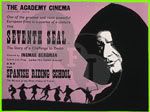
The Seventh Seal is Ingmar Bergman's masterpiece based on Revelation 8:1, which speaks of a silence in Heaven when the seal of the title is opened by the Lamb of God. The film's influence on cinematography stretches from Arnold Schwarzenneger's soul-searching Last Action Hero to Bill and Ted's Bogus Journey and many points in-between (for example the epic chess game in Harry Potter and the Philosopher's Stone). I first heard Scott Walker's 1969 tribute to it quite recently on Stuart Maconie's BBC Radio 6 show The Freak Zone, in which he showcases progressive rock, psychedelia and the forgotten delights of music that doesn't make it onto more mainstream shows.
8 - A time to kill, a time to heal
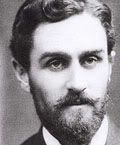
Londoner Arnold Bax, who loved to holiday in the West of Ireland, composed Elegiac Trio in 1916 about the failed Easter rising, the elegy being for the chocolate-box Ireland of his imagination as much as the dead. What was arguably more tragic than what happened was what didn't - Roger Casement was picked up by British forces shortly after landing on Banna Strand in Kerry, having been taken there by U-Boat. Casement was trying to get the message to Irish rebels to abort the operation, as the German promise of help - on the basis of "my enemy's enemy" - was, like the French promise of help during the 1798 rising, composed of little more than words. Perhaps the over-riding tragedy is that the relatively inclusive United Irishmen of 1798 were progressively sidelined by more sectarian organisations which spent as much energy on internal rifts as on anything else, but like the rest of the world I pray that Democratic Unionist Party leader Peter Robinson can manage to keep his party on-side with the power-sharing arrangement in the context of that arrangement having been set up by politicians who wanted Loyalists to give up more than they were perhaps ready to. Unfortunately not quite the whole piece is on this clip (I can't find it in one piece), but I hope you get the taste of the gentle Irish breeze.
7 - A time to plant, a time to reap
I was initially going to put this one under "a time to laugh, a time to weep", as we've all been to weddings that start with joyous reunions surrounding the joyous union before Auntie Betty gets maudlin over a sherry too many, then chose this heading because one of the many things weddings indicate is the maturing of the human harvest, an allegory that deepens my enjoyment of each year's Harvest Festival at St Gallicus. Harnick's lyrics say it all in perfect harmony with Bock's music on Sunrise, Sunset from Fiddler on the Roof.
6 - A time to build up, a time to break down
This is archetypal psychedelia recorded in 1967, the year in which the "Death of Hippy" was proclaimed by, er, hippies. Three years afterwards, it appeared on the soundtrack of an atrocious piece of trash called Beyond the Valley of the Dolls, which was about the section of the generation that thought it invented sexual liberation, but which was reaping the harvest sown by its parents who were fighting a war that some thought might end civilisation. A lot of good stuff happened in the 60s - you can't diss the decade that saw Gillian Anderson's conception - but a lot of people, often women who were being conditioned by fashionable feminists to become cannon-fodder for the exploitation rodeo, were broken; witness novelist Martin Amis' contention that "the sexual revolution killed my sister Sally". Click on the clip, and immerse yourself in the strangeness.
5 - A time you may embrace, a time to refrain from embracing
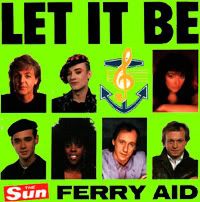
Never somebody to let a song away with only one meaning, Paul McCartney combined the faith of his childhood with memories of his mother in Let it Be. The middle verse seems to be a meditation on a verse of a Prayer to Our Lady of Lourdes, which I've only ever seen in French, which enjoins the Virgin priez pour ceux qui aiment et sont partis - "pray for those who love and are parted". There are many ways in which one can experience the heartbreak of being parted, so I thought that in was appropriate to post this video by Ferry Aid, produced by Hit Factory team Stock, Aitken and Waterman and starring Macca, which was released in 1987 in the aftermath of the sinking of the Herald of Free Enterprise near Zeebruge in Belgium. Parental advisory: contains shoulderpads and Big Hair.
4 - A time of war, a time of peace
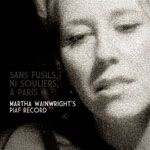
This was sung by Edith Piaf, "the sparrow", about les Grognards, an elite unit - essentially a special forces regiment - who were sent to Russia in the ill-fated campaign defeated by Generals January and February. In the song, the soldiers' shades march through Paris, a city they never had a chance to see during their brief lives and whose citizens' freedoms were won by their sacrifices. Its a song about our duty of remembrance towards the glorious fallen, summed up by Herodotus with Simonides' epitaph for the slain Spartans in his Histories -
Go tell the Spartans, stranger passing by, that here, obedient to their law, we lie.
- and recited at the start and end of every Royal British Legion meeting: "at the going down of the sun, we will remember them". Here it's performed by Martha Wainwright, who's just released an album of Piaf songs.
3 - A time for every purpose under Heaven
It was a very good year is a fitting humanistic summary of the Ecclesiastes passage. It was made famous by Frank Sinatra, but here's Ervin Drake's song covered by Ray Charles duetting with Willie Nelson.
2 - Chanukah
(Or Hanukkah song, I'm not sure about the translitteration.) How can I write a post about times and seasons and not get seasonal for the last couple? Adam Sandler wrote this for kids who felt they were the only ones in their streets not to have a Christmas tree. The irony is that, here in East Anglia, a lot of people have plastic Chanukah candleabra in their windows thinking that they're Christmas decorations. Adam Sandler performs his original (and best, I think) Chanukah Song on Youtube, but in the only clips I can find he's so busy being Adam Sandler he doesn't give the song a chance. So here it is performed by Oy Capella, Syracuse University's mixed Jewish a capella outfit.
1 - O Come O Come Emmanuael
Enya performs this classic Advent hymn, mixing English with Irish, that voices a longing for reconciliation for God that Christians believe came in the person of Jesus Christ. More Christmas music coming soon.
The Draughty Old Fen, Cambridgeshire, United Kingdom
An incurable old cyber-grumpy, I like good music, cats, bacon sarnies and anything to do with Terry Wogan. Raining on ideological parades is the cream in the coffee.
Latest 50 educational institutions accessing Tales From a Draughty Old Fen:
No endorsement by the institutions listed below of the website or any post is intended to be inferred. Click an organisation's link to go to its website.
 As a part of a series of documentaries detailing changes in views about mental illness in the last 60 years, BBC4 screened Mental: A History of the Madhouse last night, and it did an admirable job of exploring the spectrum of shades of grey involved in the issue without black-and-white judgement.
 I thought of this towards the end of the documentary, when we saw the dark side of the opposite of the asylum model of care. Following a series of murders by people who had been released into the community as beds were closed (so the chance of their being readmitted stadily diminished), the most famous of which was the 1992 murder of Jonathan Zito by Christopher Clunis at Finsbury Park, a psychiatrist briefs a police shift that one of his patients is having increasingly violent urges, and then a dozen riot officers break into his house because both psychiatrist and police have decided that "overwhelming force" is required.
 In 1959, Patricia Hornsby-Smith (in Harold MacMillan's Conservative government) reported on the crippling price of keeping more people in psychiatric institutions than there had ever been, reporting on the "appalling legacy" of the buildings and how maintaining them would take up an increasing portion of the NHS budget; but she also spoke on how an appreciation of mental illness being like "any other disability" was a prerequisite on action that would need to be taken on both pragmatic and humanitarian grounds.
it is the duty of a Minister of Health and the duty of the National Association for Mental Health, to...choose and to favour wherever they have the choice, the course of more drastic and fundamental change: for we may be pretty sure that even so the progress of medical thought and method will still be well on ahead of our practice.
 But how did we get from this sense of optomism to a mentally ill man's flat being raided by a dozen riot police? As beds decrease, I worry that the stigma that infested the ageing Victorian structures hasn't disappeared but has rather been absorbed into society, which has become itself an über-asylum wherein, asserts London Mayor Boris Johnson in an exegesis of Eleanor Rigby, too many people "pretty much stay at home and watch TV" with their loneliness acting as a straitjacket - a garment never used once in the history of the crumbling Victorian asylum where I trained.
 ng to have to be cuts. But this should not blind us to the fact that cuts started some time ago. Fulbourn hospital, the psychiatric hospital serving Cambridge and surrounding areas, lost two rehabilitation units and two acute psychiatric wards in 2007. This could have been ameliorated by better services in the community, but Vocational Services, providing occupational therapy, and Cambridge Clubhouse a range of less structured opportunities of rehabilitation after psychiatric treatment, are long gone. The Clubhouse was replaced by a mental health resource centre that aimed to make ex-patients in the community into trainers, but access is now only by telephone.


 show was preceeded by veteran newsreader Moira Stewart, who had previously been progressively sidelined by the BBC until she left in October 2007 in a


 half, while the chances that you'd get two white blokes talking when tuning into this specialist music station rose exponentially.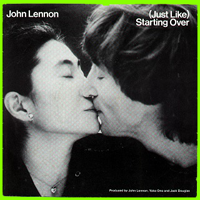

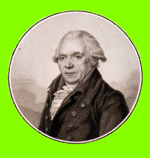 Writing Can't Help Falling in Love, which was a huge hit for Elvis, George Weiss, Hugo Peretti and Luigi Creatori put English words to Jean Paul Egide Martini's (right) 1780 song Plaisir d'Amour (The Joy of Love). Here's Nana Mouscouri singing the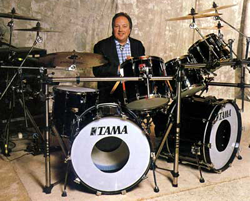

 Secondly, his performances exuded sexuality in a "safe" way that was not only due to his distance from Scotland. The Southern laws of deference and politeness that his generation were instructed to observe almost religiously led Ed Sullivan to extemporise a paean to his decency, telling the audience at a time when Presley w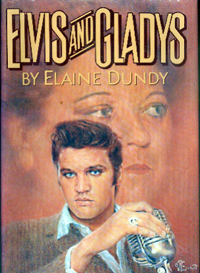

 The angel of the Lord called to Abraham a second time from heaven, and said, ‘By myself I have sworn, says the Lord: Because you have done this, and have not withheld your son, your only son, I will indeed bless you, and I will make your offspring as numerous as the stars of heaven and as the sand that is on the seashore. And your offspring shall possess the gate of their enemies, and by your offspring shall all the nations of the earth gain blessing for themselves, because you have obeyed my voice.’
 And there were shepherds living out in the fields nearby, keeping watch over their flocks at night. An angel of the Lord appeared to them, and the glory of the Lord shone around them, and they were terrified. But the angel said to them, "Do not be afraid. I bring you good news of great joy that will be for all the people. Today in the town of David a Savior has been born to you; he is Christ the Lord. This will be a sign to you: You will find a baby wrapped in cloths and lying in a manger."
 alled together all the people's chief priests and teachers of the law, he asked them where the Christ was to be born. "In Bethlehem in Judea," they replied, "for this is what the prophet has written:





 Londoner Arnold Bax, who loved to holiday in the West of Ireland, composed Elegiac Trio in 1916 about the failed Easter rising, the elegy being for the chocolate-box Ireland of his imagination as much as the dead. What was arguably more tragic than what happened was what didn't - Roger Casement was picked up by British forces shortly after landing on Banna Strand in Kerry, having been taken there by U-Boat. Casement was trying to get the message to Irish rebels to abort the operation, as the German promise of help - on the basis of "my enemy's enemy" - was, like the French promise of help during the
 Never somebody to let a song away with only one meaning, Paul McCartney combined the faith of his childhood with memories of his mother in Let it Be. The
  This was sung by Edith Piaf, "the sparrow", about les Grognards, an elite unit - essentially a special forces regiment - who were sent to Russia in the ill-fated campaign defeated by Generals January and February.