Showing posts with label boris johnson. Show all posts

Tuesday, May 18, 2010

"Mental: a History of the Madhouse"

click to go to the show websiteAs a part of a series of documentaries detailing changes in views about mental illness in the last 60 years, BBC4 screened Mental: A History of the Madhouse last night, and it did an admirable job of exploring the spectrum of shades of grey involved in the issue without black-and-white judgement.

For example, there was Maggie, who volunteered for "experimental" brain surgery in the 1960s and who feels that, after 5 years of debilitation that followed the surgery - in which a section of her brain was burned out to stop the fits of violence that would require increasing lengths of hospitalisation - she recovered in spite of and not because of the operation. She has been given awards for campaigning for community causes...but one is left wondering if this would have been possible without the operation.
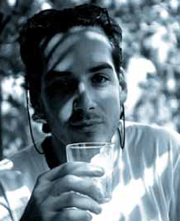
Jonathan Zito RIP: click to go to a statement by the Jonathan Zito TrustI thought of this towards the end of the documentary, when we saw the dark side of the opposite of the asylum model of care. Following a series of murders by people who had been released into the community as beds were closed (so the chance of their being readmitted stadily diminished), the most famous of which was the 1992 murder of Jonathan Zito by Christopher Clunis at Finsbury Park, a psychiatrist briefs a police shift that one of his patients is having increasingly violent urges, and then a dozen riot officers break into his house because both psychiatrist and police have decided that "overwhelming force" is required.

There have, of course, been huge leaps since the days of the asylums, when staff violence towards patients was recalled by a former psychiatric nurse as having been justified, when he was a student, by his charge nurse on the grounds that "if you live among shit you become shit". Although thankfully I missed this period, I felt ashamed to have been a psychiatric nurse.
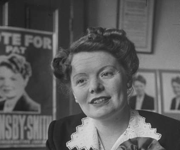
Patricia Hornsby Smith - click to view the whole Time portraitIn 1959, Patricia Hornsby-Smith (in Harold MacMillan's Conservative government) reported on the crippling price of keeping more people in psychiatric institutions than there had ever been, reporting on the "appalling legacy" of the buildings and how maintaining them would take up an increasing portion of the NHS budget; but she also spoke on how an appreciation of mental illness being like "any other disability" was a prerequisite on action that would need to be taken on both pragmatic and humanitarian grounds.

Hornsby-Smith's speech was the prologue that Enoch Powell's 1961 Water-Tower Speech was written to follow:
Enoch Powell: click to go to the text of the Water Tower Speechit is the duty of a Minister of Health and the duty of the National Association for Mental Health, to...choose and to favour wherever they have the choice, the course of more drastic and fundamental change: for we may be pretty sure that even so the progress of medical thought and method will still be well on ahead of our practice.
Powell was, of course right (and it was good to see the BBC admit that the man was more than a controversial 15-minute speech): as the documentary showed, "hope came from the laboratories [in the form of] a new generation of psychiatric drugs". However, Largactil (chlorpromazine) created new problems to replace the ones it solved in the form of simultaneous agitation and sedation, and Parkinson's Disease-like symptoms. Had the resarchers looked further into its genesis, they might have found that it was derived from a dye produced in Victorian England, but wasn't much use. So it was fed to cows to see the effect, which was that the cows calmed down. And died shortly afterwards.

However, the growing voice possessed by mentally ill people and their advocates - who included many mental health workers - drove the phamaceutical search for medications that had maximum effect on symptoms with minimum unwanted effects. The quest still continues.

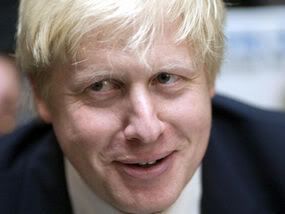
click to read Boris Johnson's article in the TelegraphBut how did we get from this sense of optomism to a mentally ill man's flat being raided by a dozen riot police? As beds decrease, I worry that the stigma that infested the ageing Victorian structures hasn't disappeared but has rather been absorbed into society, which has become itself an über-asylum wherein, asserts London Mayor Boris Johnson in an exegesis of Eleanor Rigby, too many people "pretty much stay at home and watch TV" with their loneliness acting as a straitjacket - a garment never used once in the history of the crumbling Victorian asylum where I trained.

As politicians struggle to describe how they are going to deal with the deficit, it's obvious that there are goiclick to read more about hte International Clubhouse Movementng to have to be cuts. But this should not blind us to the fact that cuts started some time ago. Fulbourn hospital, the psychiatric hospital serving Cambridge and surrounding areas, lost two rehabilitation units and two acute psychiatric wards in 2007. This could have been ameliorated by better services in the community, but Vocational Services, providing occupational therapy, and Cambridge Clubhouse a range of less structured opportunities of rehabilitation after psychiatric treatment, are long gone. The Clubhouse was replaced by a mental health resource centre that aimed to make ex-patients in the community into trainers, but access is now only by telephone.

I'm not setting out my stall for my territory, having switched from a psychiatric nurse to a psychiatric patient some years ago. I'm merely arguing for common sense: in the absence of dedicated resources people requiring mental health treatment are, at the more severe end, going to keep ricocheting between inpatient wards, police cells and prison and, at the less severe, take up more of the general resources that are available, eg GP appointments, A&E beds, etc.

And the human cost is intertwined with the financial one, something that Patricia Hornsby-Smith and Enoch Powell would have recognised. I met a fellow Clubhouse veteran recently; unable to maintain employment without input but "not ill enough" to warrant a community psychiatric nurse, she spends her time subsisting on benefits - mostly, as Boris Johnson says, at home watching TV. Investing in resources that would help people like my friend both to work and to pay more taxes would, in my opinion, be a win/win situation.

Related posts:

Good taste back on the Horizon: How Mad are You?

Blurred Boundaries, Fine Lines - How Mad are You?

Thursday, September 17, 2009

women and children first

click to read the Cambridge Rape Crisis Centre Information PackI was privileged (if that's the right word) to be invited to a seminar on responses to rape and domestic violence in Cambridgeshire recently, which was addressed by two speakers.

The first speaker was from the Cambridge Rape Crisis Centre, which is the only rape crisis service in the UK to have shut down due to funding issues then reopened, due to the dedication and hard work of several Cambridge women in making small amounts from local sources (like the Cambridge University RAG) before the Government instituted a million-pound fund in 2008 to stop any more Rape Crisis Centres from closing. This fund was re-established in 2009, enabling a a £33,000 grant from the Government Equalities Office Special Fund in the face of "indifference" from Cambridge City Council to a request for funding.

Although prepared to believe that we have a long way to go as regards taking rape seriously, I was still surprised to learn that 17% of women over 16 are estimated to experience some sort of sexual victimisation.

Every rape is reckoned to cost the state around £76,000 in physical and mental health care, police and courts, and the long-term effects of self-harming behaviour such as eating disorders and/or substance abuse. Yet the monies it has received, which will keep it open until April 2010, boil down to £2.50 per caller. A wish-list for CRCC would include a budget big enough to allow a face-to-face service, and possibly also a befriending scheme, including accompanying clients to courts.

The second speaker was from the Cambridgeshire Constabulary Domestic Violence Unit, and had some hard truths to tell us.

Cambridgeshire Constabulary receives reports of 11,000 domestic violence incidents per year - which is 27% of all violent offences - the scary bit being that, on average, a woman will have been at the wrong end of abuse 35 times before she picks up the phone (and 80% of domestic violence incidents comprise a woman being victimised by a male perpetrator, although the Cambridge Rape Crisis Centre links to a website for male survivors of sexual abuse).

Every Police Force in England has a positive action policy on domestic violence: they will arrest an abuser found to be committing a criminal offence regardless of the victim's wishes, in order to lessen the likelihood of threats by the perpetrator.

An arrest will also be made if drugs are found on the premises; and although I am in favour of robust policing on drugs, in the area of domestic violence, including rape, one finds situations where women rely on drugs to block out the pain of what they are going through - possibly even being encouraged to do so. And sometimes it can be difficult to paint a picture of a habitual drug user in court with which a jury can feel sympathy. I felt I was bogged down in the quagmire of grey areas and hard decisions the police must be faced with every day.

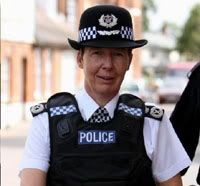
Julie Spence, Cambridgeshire Constabulary Chief ConstableAnother difficult area can be attitudes to women who stay with their abusers; the speaker related asking one police officer who questioned why abused women didn't up and go, "how would you put your life in a bag to leave forever in five minutes?" The officer addressing us was an energetic advocate of continuing training and reminding of the force in general and specially trained officers in particular. As Cambridgeshire Constabulary Chief Constable Julie Spence said earlier this year, "whilst I cannot guarantee that there has never been a time in any police force when an individual claim was not treated seriously, I know of no police officer worthy of their position who would treat [an allegation of rape] with less than absolute gravity".

click to go to 'together we can end violence against women and girlsGoing beyond the seminar, I was interested to look through the Government consultation paper of March this year, due to report back to its stakeholders imminently, Together we can end violence against women and girls, which referred to the many positive achievements which have taken place in the last
ten years, but stated early on that "Government alone cannot be the answer" to the questions we must ask about the continuing unacceptable rates of domestic violence in Britain.

But Government takes it on itself to provide answers; and in the case of the 32 rape crisis, survivors' and healing services to whom the Equalities Office Special Fund gave over £1,330,000 (€1,475,000/$2,175,000), thank God for it. London Mayor Boris Johnson looked to be leading the way in demonstrating the duty of councils to care for the most vulnerable in their areas by delivering on his manifesto commitment to increase the number of rape crisis centres in London, but unfortunately only two-thirds of the £2.23m in his manifesto commitment has been delivered. I can only hope for a rethink on this. Although the help given by these centres is and must be non-directional, it would be nice toclick to read the story of the closing women's refuge on thisisdorset.net see some Equalities Office monies going to charities who help women who wish to avoid abortion after rape, or deal with compounded trauma after abortion.

What I can't understand, though, is the disconnect sometimes apparent between promises and actions, even in this area that demands congruence between the two.

For example, the Dorset Echo's Miriam Phillips reports that a women's refuge is being closed by a quango called Supporting People on the basis that it doesn't also care for men, and women can be helped to live at home by outreach services. (The Cambridgeshire Constabulary website, like many other agencies, advises women on planning to leave.)
click to go to the Supporting People in Dorset web directory

Alternatively, the ending violence consultation paper states, in a section called "next steps", that the government has taken a measure called the Gender Equality Duty (GED - one of 72 "Key achievements since 1997" listed in annex 3 of the documents) which "requires all public bodies in England, Wales and Scotland to take steps to promote equality of opportunity between women and men and eliminate unlawful discrimination and harassment in all their functions". So, what was the Trades Union Conference that's just finished all about - did delegates representing the highly-unionised public sector perhaps get their priorities wrong?

Harriet Harman, Minister for Women and Equality - click to go to her websiteLastly, concerning Harriet Harman, who is among other roles the Minister for Women and Equality (and who, to her credit, is supporting the protests in Dorset against losing the women's refuge): while standing in for Gordon Brown during his holiday at the start of August, she spent more time defending ideological positions about the superiority of women to men (a concept I woulddn't argue about) that she never had time to dot i's and cross t's with Justice Minister Jack Straw and Home Secretary Alan Johnson on proposals to raise the percentage of successful prosecutions for rape.

What we need is governmental interference where it is warranted, for example keeping women's refuge open in the face of hypertrophied quangocracy or forcing councils to shoulder their responsibilities towards vulnerable people, and minimal interference with police in terms of targets, tickboxes and form-filling, so that they can do the jobs they so manifestly want to do, among which are preventing future domestic violence and rape by showing the perpetrators of these heinous acts that there are less and less places to hide.

When clashes of egos and agendas are at risk of turning everything around into a sticky mess, we must never lose sight the Dorset campaign's assertion that in the vast majority of domestic violence cases its "women and children first".

Related post: It's a dog's life...

Wednesday, April 22, 2009

this blessed plot, this earth, this realm, this England

a traditional view of St George and the DragonEngland can't claim such a high-profile patron saint as, say, the US, which is represented by the Immaculate Conception. (The New York Times complained in 1871 that Jay Gould wanted to make St Patrick the country's patron saint, but I suspect that's a different story.)

But St George is patron saint of this great country, and I look forward to celebrating his feastday tomorrow. Unfortunately, there's not that much going on in Cambridgeshire, at an official level at least: the Cambridge News's Jack Grove reports that Waterbeach's Beach Social Club will celebrate the great British banger with butchers entering their sausages in a competition, and Ely and District Scouts will fly their colours in a St George's Day parade on Sunday. (And in London, Boris Johnson's administration is putting on a free concert in honour of the saint on Friday.)

As a fellow exile living in England - though from not nearly as far away - I liked the introduction to the Archbishop of York Dr John Sentamu's speech on Englishness at the Sunday Times Literary Festival in Oxford earlier this month. It was a quote from a piece reputed to have been written by a Frenchman:
Dr John Sentamu: click to go to the Archbishop of York's website
There are four kinds of people in the UK -

First, there were the Scots who kept the Sabbath - and everything else they could lay their hands on;

Then there were the Welsh - who prayed on their knees and their neighbours;

Thirdly there were the Irish who never knew what they wanted - but were willing to fight for it anyway.

Lastly there were the English who considered themselves self-made men, - thus relieving the Almighty of a terrible responsibility
The last sentence, as the Archbishop points out, represents the heresy of Pelagianism, but the peice describes exactly both the self-confidence and self-deprecating humour that are part and parcel of the archtypal English character, and his "tentative conclusion" that "Englishness is back on the agenda" was reassuring.

It was concerning, however, to be directed by Damian Thompson, in his Holy Smoke blog for the Telegraph, to an article by the left-wing Christian think-tank Ekklesia which complains that


just as he was co-opted by the crusaders, so St George’s misappropriation as an excluding or dominating figure has continued in recent history. And it is not just the BNP who have done this. His elevation has happened in the political mainstream, too. In parliament, he sits over the exit from the Central Lobby of the House of Lords, lending presiding authority to the vestiges of an unelected, top-down social order.
Having laboured under a socialist government for 12 years, I don't have any problems with their objection to a "top-down social order". But the organisation continues: "We say that it is high time St George was reclaimed from the dragon, from past associations with racism and the far right, from religious crusades, from inward-looking nationalism, and from images of arrogant flag-waving."

I'm not saying that we should be complacent about "far-right" organisations (who want blanket nationalisations and micromanagement? Go figure) and we should certainly heed the warning of the Archbishop of Canterbury that the recession may fuel social unrest and xDeve Kumarasiri - thanks to Matt Alexander and the Nottingham Post for the picenophobia. But the aspect of multiculturalism that warms my heart most is that represented by Sri Lankan-born postmaster Deva Kumarasiri who, Lucy Cockcroft reports, turned away five people for "wasting time and holding up the queue" because they didn't speak English - he believes that immigrants should learn English and love their adopted country.
I can understand this. When I lived in Italy and France, I learned the languages, bought local, and grew to appreciate the many strong points of those countries. Unfortunately, the local Muslim community presented owner Rizwan Raja with a petition objecting to being told to speak English in England, and he was told not to turn in for work. I say "unfortunately" because if yoNorman Tebbitt - click to read his article on 'What England means to me'u've seen a bus driver who can't speak great English trying to speak to a prospective customer who has the same problem, then you'll understand that the problems caused by not speaking English in a country where that is the language are not confined to any one group.

Norman Tebbit, MP and Minister in Margaret Thatcher's government and now Lord Tebbit, proposed a "cricket-test" as one measure of integration of immigrants into England. He said that, say, Pakistanis would pass this test if they supported England against Pakistan at the game of cricket. (When attacked for his "far-right" views on a political discussion programme, Question Time, soon afterwards, he replied that he'd be just as happy for immigrants to vote Labour as Conservative.) Once again, Lord Tebbit brought good sense to the vexed topic of integration earlier this year when he wrote, in the context of councillors in Oxford beSt George and the Dragon - a more modern interpretationing unwilling to turn down applications for a loudspeaker-system in a Mosque, that Muslims be invited to turn their minds to Allah by bells within the Mosque - it would be in character with the area, and the Koran comes down in favour of neither.
Tomorrow I dare say I'll have a pint at the Tintinnabula - not with far-right racist flag-wavers, but with decent, hard-working flag-wavers of all political (and other) hues. Trying to slay the dragon that tempts us to be defined by our differences, I'll wish them, as I wish Deva Kumarasiri, Lord Tebbit, Archbishop Sentamu, and you: happy St George's Day!

This being also the anniversary of William Shakespeare's death in 1616, I think this is the best I can leave you with:

This earth of majesty, this seat of Mars,
This other Eden, demi-paradise,
This fortress built by Nature for herself
Against infection and the hand of war,
This happy breed of men, this little world,
This precious stone set in the silver sea,
Which serves it in the office of a wall,
Or as a moat defensive to a house,
Against the envy of less happier lands,
This blessed plot, this earth, this realm, this England


Richard II, Act 2, Scene I

Related post: let England stand free

top ten songs about England

Happy St George's Day!

Wednesday, January 28, 2009

Congestion Charging: coming to your place soon

Richard Normington - click to go to his homepageThere's a problem with traffic, at times, in Cambridge. When I take the bus to work because my bike's in the shop, it can take up to fifteen minutes to get from one side of the Hills Road railway bridge to the other - half the time it takes to cycle to work in the first place.

I picked up the Cambridge News today to see that Richard Normington, Cambridge's parliamentary spokesman for the Conservatives, speaking on a local issue which may be replayed widely over Great Britain and spread to other countries like the US. He's claimed that an investigation into whether Cambridge should have a congestion charge (like London) will be a "stitch-up", on the grounds that the Cambridgeshire Transport Commission's chairman, Sir Brian Briscoe, had previously come down in favour of a congestion charge for Reading, a town to the west of London.

Part of Richard's statement, reported in the News, was:
Sir Brian has a credibility problem. As part of a transport commission looking into the future of Reading, he proposed introducing a congestion charge and signing up to the Government's Transport Innovation Fund - which makes charging compulsory for local authorities. His previous support for Labour's flagship policy puts his neutrality on the subject into question...now, more than ever, is not the time to impose greater financial burdens on Cambridge businesses and residents.
Sir Brian has responded that what he suggested was "a package of measures...with the possibility of a congestion charge in the long term". However, what the Independent Transport Commission Report for Reading Borough Council, co-authored by him, says is,
We think the Council should, with its sub-regional neighbours, urgently examine the case for managing demand by road pricing to influence driver behaviour...We are satisfied that the technical means exist to introduce more sophisticated charging regimes and we recommend that the Council examine how it might devise a scheme with the object of maximising economic use of road space [italics and bold in the original]
Another member of Reading's Transport Commission, Professor Tony Travers, published an essay in 2004 in the left-wing New Statesman in which he breathlessly and rather embarrassingly pours praise on the then Mayor of London Ken Livingstone (known as "Red Ken") for putting Congestion Charging in place.

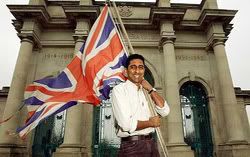
I don'Alok Sharma, with thanks to getreading.co.uk - click to go to Reading West Conservativest know whether Travers still believes in socialism or not - obviously people change and we have to allow them to. But the fact remains that transport charging is highly politicised, as it is in effect a form of taxation on a group of people - drivers - who are already taxed up to the hilt with road tax and duty on petrol. For example, back in Reading, prospective Conservative parliamentary candidate Alok Sharma has been accused of "lying" by opining that town dwellers would have to pay the charge (this has always been on the table in Cambridge); and the present Mayor of London, Boris Johnston, has been accused of "turning his back on carbon emission reductions and turning 'petrol blue'" (blue being the colour of the Conservative Party in the UK) by announcing that he would scrap an extension to the capital's Congestion Charge.

But to be tough on congestion requires us to be tough fancy building a house here?on the causes of congestion. A study commissioned by Cambridgeshire County Council states that 56,000 new dwellings will be required in this largely rural county by 2016. We just don't have the roads to support this, no more than the market towns and villages who are being pressured to accept new housing have the facilities and infrastructure. Not to mention that most rural areas are rural for a reason - the fens are very low-lying, and floods are common.

Travers makes a very interesting point in his essay: "no other city in Britain has anything like London's extensive public transport system. Less than 15 per cent of people working in central London commute by car. The political and economic risk would be far greater in a city where 65 or 75 per cent of workers travel by car." Stagecoach, which has a virtual monopoly on providing buses in and around Cambridge, must be congratulated for bringing in more and better stock. But to drive them they're hiring a lot of drivers for whom English is not a first language. If a prospective passenger doesn't speak good English either, it's a sight to behold.

If you live in or around Cambridge, please give your views online on this vital issue.

If you're from elsewhere, watch this space, because there's a very good chance that Congestion Charging and its ideological fellow-travellers are coming to a town near you soon.

Sunday, October 26, 2008

Hairspray

click to read the Telegraph story on how this dress, worn by Vanessa Hudgens in High School Musical 3, has sold out at Asda's.  Oh joy.The first time I became aware of the concept of "tweenagers", which is apparently the name for children between infancy and the teens, was when Minima bothered us so much about the DVD for High School Musical that we bought her it, and I've been regretting it ever since. As if that weren't bad enough, Maxima, the turncoat, has come to like the damn thing and, having taken Minima to the third movie, now plans to see it again with her. Infamy, infamy, they've all got it in for me! (Sorry, I don't think it works in a US accent.)

So it was with some trepidation that I sat down with Minima to watch the 2007 version of Hairspray, starring John Travolta as the main character played by Divine in the 1988 original.

Although the transvestite actor - real name Harris Glenn Milstead - had shorn much of the camp aggression from his stage persona for the original, I still felt some discomfort at my daughters watching him and perhaps thinking his other films might be "safe". So we got the 2007 DVD and, to my amazement, I saw that there was a difference between this and the High School Musical franchise: this was good.

The songs were great, so much so I wouldn't object to Minima getting the album and playing it every hour that God sends, as she does at the moment with the HSM soundtracks. (Although the chorus of Welcome to the Sixties reminded me slightly of that of Heatwave, sung in 1965 by Martha Reeves and the Vandellas.)

The plot of Hairspray is far more complex than that of the typical fare served up for tweenies. First of all there's the standard girl-falls-for-boy mechanism, but the movie - like the original and the stage play - also deals with discrimination. There's racial discrimination, which is at the centre of the film; the struggle to desegregate a teen dance show hosted by Corny Collins, a local celebrity who also opposes segregation on the basis of race but is opposed by former Miss Baltimore, Velma von Tussle (Michelle Pfeifer), an out-and-out racist who opposes integration, and is determined to experience her ambitions vicariously in the dancing career of her spoilt daughter Amber.

The film gave me an opportunity to relate to the girls a story my Mum told me about when she was living in New York in around the same time as the film is set. She was in Woolworths and went to the restaurant; one part being packed, she went to the emptier section - and was told to move, as this was reserved for coloured people. I don't know if this was before or after an incident on 1960 when four black people - Franklin McCain, David Richmond, Joseph McNeil and Ezell Blair - ordered coffee in the same restaurant at 4pm and remained unserved until it closed at 5pm. This developed into a sit-in and, although there were attacks on the protesters, they stayed true to Martin Luther King's doctrine of non-violent protest.

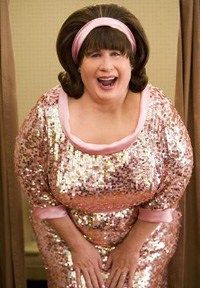
John Travolta in Hairspray  - he might call this fat, I'd just say big-bonedThere was also a sub-plot concerning discrimination on the grounds of obesity. John Travolta wore a fat-suit for the film to play protagonist Tracy's mother, who I gather lost her figure after having Tracy. Travolta brings all his considerable acting talent to the fore to make his character believable, but the thing is, I don't think the characters of Edna and Tracy Turnblad are all that fat.

Possibly my own girth plays a part in this judgement - I remember a job on buses that were converted into moving hospital wards where I was once referred to as "the wee thin guy from Glasgow", but that was many years ago. When Maxima put on a few pounds after having the girls, I came out in sympathy. Big time.

Or maybe US singer/songwriter John Mellencamp got it right when he said on Bob Harris' country show on BBC Radio 2 that the first time he came to Great Britain, he thought the people looked fitter, then added "now you all look like us".

Mellencamp was on the show to promote his new album, Life, Death, Love and Freedom. One of the songs on it is called Jena, after a town in Louisiana where in 2006 racial tensions at a secondary school spilled over when empty nooses were hung from a tree, a situation which culminated in a group of black youths being charged with assaulting a white youth. I looked it up on Wikipedia and just got more confused, although last year Townhall's Larry Elder tried to unravel what was going on.

In the UK, we had the awful murder of Stephen Lawrence by a group of white teenagers in 1993, regarding which nobody has been successfully prosecuted. At the time the Daily Mail took the unusual step of accusing five teenagers of the murder before any prosecution, including the Acourt brothers - which may have contributed to their acquittal. The subsequent investigation into the incident and its investigation, chaired by retired High Court Judge Sir William MacPherson, led to the production of a report which claimed to identify a culture of institutional racism in the Metropolitan Police Force (the "Met") which polices London and whose Commissioner is the most senior police officer in Britain.

In a recent letter to the Spectator, however, Norman Dennis, Director of Community Studies of the think-tank Civitas, criticised the "uncritical reception" of the report and it's "pernicious influence on policing". There certainly appears to be a "civil war" based on race lines at the Met right now, with Assistant Commissioner Tarique Ghaffur having been suspended after he accused the Commissioner, Sir Ian Blair, of racism in a press conference; Commander Dr Ali Dizaei has also been suspended while several claims against him are investigated.

After Dr Dizaei's suspension, the Metropolitan Black Police Association severed links with senior managers, and as London's Mayor Boris Johnson launches an enquiry into racism in the force, the MBPA stated it would no longer be encouraging black and Asian people to join the Met. It's a shame to see it opposing the Met in this way, and a greater shame that if you are white and heterosexual in certain settings, then you have nobody to speak for you.

One thing the MacPherson Report stated was that the approach of affecting to be "colour blind" was "flawed". Which brings me back to Hairspray, in particular a line sung by Tracy's friend Seaweed in Run and Tell That:
I can't see
Why people look at me
And only see the color of my face
yes they do

And then there's those
That try to help, god knows
But have to always put me in my place

Now I won't ask you to be color blind...
It was good to see that the concept of the "melting pot" is fading from the minds of both judges and lyricists. It's still present in education, however, so perhaps it's not as surprising as it is depressing to see a statement on the MBPA website informing the world that the old socialist concept of being "politically black" is still alive and well: "The term black does not relate to skin colour but is used to describe all people of African, African Caribbean or Asian origin."

Eh? So are/were Freddy Mercury, Ian Smith, Kim Jong-Il, Deng Xiaoping and the Dalai Lama black? Clarence Sholé Johnson, Professor of Philosophy in the Middle Tennessee State University, summarises the concept in an essay entitled (Re)Conceptualising Blackness and Making Race Obsolescent:
there is no incongruity in the idea of a person being pigmentationally white and politically black, or of a person being pigmentationally black and politically white. All that it means to say that a person is politically black is that the person is anti-status quo; that she or he is ideologically committed to de-centering whiteness; that she or he is oppositional or counterhegemonic.
I'm reminded of Barack Obama's claim to be moving towards post-racial politics, but he was monumentally undermined by some of his supporters who called him a lightworker -Queen Latifah - 'Motormouth' Maybelle in Hairspray somebody who can "usher in a new way of being on the planet", seemingly because they can't conceive that an ordinary black bloke could run for President.



Anyway, as Seaweed's Mum (Queen Latifah) states in the show-stopping spectacular finale, "it's time to wrap this mutha up!" It's good to see that such rich seams of discussion can be mined through watching Hairspray, as well as having a thoroughly good time. Hilarity is a wonderful initial strategy to disarm discrimination, far better than a thousand sociopathic soap-operas; and if Minima and Minora accuse me of going against the grain of received opinion that being equal is equivalent to being the same, well then, "Tosh!" I shall reply - "in my counterhegemonic stance I'm just being politically black." Or is that ideologically obese?

Monday, August 25, 2008

at the close of the Olympics

Peter Foster, Telegraph bloggerIt's all over now; two weeks of fevered sporting madness, during which some of our acquaintances appear to have forgotten resolutions not to watch the Olympics. Personally I kept to mine, but am now wondering if I did the right thing; instead of Minora watching events behind my back as a form of rebellion, it might have been educational for both of us to see, as the Telegraph's Peter Foster reports, the the Chinese Communist Party thumbing its nose "spectacularly" at the International Olympics Committee and getting away with it.

what does 'prettier' mean at this age?The subterfuge started at the opening ceremony, where a girl was rejected for having uneven teeth, yet her voice was used for the opening song, "Ode to the Motherland", which was lip-synched by a girl judged to be "prettier", whatever that means when grown men use it in relation to pre-pubescent girls. Chen Qigang, music producer for the ceremony, justified this as being "in the national interest".

Using children in the national interest doesns't stop there. Again the Telegraph reports:


the training regimes are still reminiscent of those used in East Germany in the Soviwhy is this not being recognised as abuse?et era. Promising children are hothoused from as young as six in elite, sports-focused boarding schools, where their access to their families is often limited. Only last week, Joseph Capousek, a successful German kayak coach who was recently sacked as trainer of the Chinese national team, said his former employers ran a military-style training regime where athletes were worked "like horses". Chinese officials have denied his claims.
In fact, there is an enquiry ongoing as to whether a Chinese gold-medal athlete, He Kexin, is actually 16, as it says on her passport, or is really 14, which would invalidate her entry (there are fears that practicing gymnastics can stunt the growth of young people). this does not seem to bother the Chinese - on a visit to an athletics hothouse in 2005, rower Sir Matthew Pinsent "saw a seven-year-old girl crying while being made to do handstands, and a boy with marks on his back" (click picture above for story).
Wu Dianyuan, 79 and Wang Xiuying, 77, arrested for applying to protest
Towards the other end of the mortal coil, two women in their 70's were interrogated for 10 hours and then, without a trial, sentenced to a year's re-education through labour. Their crime? The Chinese Government had set up "protest pens", so they applied to stand in one of them to protest. Peter Foster compares the protest-pens to the "‘Hundred Flowers' campaign of 1956-57 when intellectuals were invited to be frank about matters of public policy and then promptly purged for their honesty".

Although all the tickets for this Olympiad were sold out, all 6.8 million of them, there have been many empty seats in the Olympics. These were filled by students and volunteers, who were instructed to sit in the vacant seats whether or not they were interested in the individual contest being played out. I would've liked to have pointed this out to Minora, but the chance is lost now.

Anyway, the Chinese government decided that there would be much more visitors than turned up, and so set up procedures to divert water supplies to the capital from outlying farming areas. You don't have to be a genius like Professor Calculus to figure out what happened next: wells dried up; the price of water in the parched areas rose 300%; farmers got in hock to moneylenders and, in order to escape notification that payment was due, killed themselves by drinking pesticide. The biting irony of the situation is that, due to the poor turnout at the "sellout" Olympics, not a single drop of water was diverted from these regions to Beijing. The official reaction was that "the entire population was overjoyed to be making a sacrifice for the national good".

So despite the neglect of its own people, harrassment of the vulnerable and ideological certainty that it need not be troubled by doubt, a veritable army of the world's quangocrats has descended upon Beijing to present their countries in surrender mode. I said in an earlier post that "unless the International Olympic Committee stands up for itself, China will use it as a doormat." The IOC hasn't, and China has done so, and is taking its place as king of the castle.

I'm sure Boris Johnston, London's Mayor, is getting so much advice about the 2012 Olympics due to be held in London that he doesn't know whether he's coming or going. But if I may add my own straw to the camel's back, I would suggest: hold another austerity olympics. Let sport and the human spirit share the gold.


Related posts:
Sport isn't worth that much - Yamiti's Olympic struggle
As the Olympics begin

Sunday, May 4, 2008

mayor of london

Mayor of London - with thanks to Sunday Express
Amid an avalanche of crushing defeats nationwide for Labour, Boris Johnson is now Mayor of London.

This is not just a triumph for Boris, his team and his policies, for example on transport and crime, but a vindication of the Conservative Party's renovation at the hands of David CamerPM-in-waiting - with thanks to Sunday Expresson - hailed by the Daily Mail as a PM-in-waiting - and his team.

It wouldn't take much effort to take apart Ken Livingstone's character; but as a friend of mine once said to an MP who had taunted him about his son's criminal past, when we go to God with our faults written on our foreheads, none of us will have grounds to feel better than anybody else.

The thing is, although Livingstone's failings may not be inscribed sans-serif upon his brow, he doesn't make it difficult for journalists to find an excuse to knock him and, by extension the Labour Party. Take his rift with a journalist after leaving his party to celebrate gay MP Chris Smith's coming out. Having discovered that his interlocutor, Oliver Finegold, was Jewish, he compounded his "German war criminal" remark by indicating that his newspaper, the Evening Standard, was "a load of scumbags and reactionary bigots" and had "a record of supporting fascism". The Evening Standard had indeed supported Oswald Mosley and even the Nazi party, but dropped this support in 1939 - six years before Livingstone was born.

It was a remark typical of the socialist propensity for holding the most indefensible prejudices, and hiding them by throwing their hands up in horror at anything which they think offends their pet minorities like radical militant Muslims and gays, etc. Richard Littlejohn writes:

Under the guise of 'anti-Zionism', anti-Semitism is rife on
British university campuses. But still the Government refuses to ban groups such
as Hizb ut-Tahir, motto: 'Jews will be killed wherever they can be
found.'


Being in the vanguard of the Conservative resurgance has its darker side. It is said that Labour is planning a rebuttal unit to take apart Boris' words and actions now and in the past. This is a technique that led it to victory in the 1997 General Election through the offices of their search-engine, named with uncharacteristic patriotism as Excalibur (the article linked to was written by Boris). As was the case with Excalibur, this rebuttal unit will observe no morality beyond the cold hunt for success, no matter the prospect of the British people, regardless of the amount of melanin in their skin, being held to ransom by the party's hostages to fortune.

Ascalon - the sword said to have been wielded by St GeorgeWell done, Boris. May I suggest that you start up an ethical rebuttal unit, and even propose a name for it - "Ascalon"?