Showing posts with label genocide. Show all posts

Sunday, May 30, 2010

eurovision 2010: great music, shadows fall

Click to see this post with links to YouTube instead of embedded videos if you have a 56k modem or slow broadband

go to the eurovision 2010 websiteI've just finished watching the Eurovision Song Contest, held in Norway's Telenor Stadium in Bærum, a suburb of its capital, Oslo. My own predictions panned - the Netherlands never made it through to the final, and Spain ended fifteenth, despite having the opportunity to play twice due to a stage-invasion during their first attempt that I'd thought was part of the act.

It was very enjoyable, and I'd like to bring you what I thought was the best of the music - while looking at shadows that sometimes seemed to be lurking behind the industrial joy of what I'd hoped would be an uncomplicated night.

I don't think I'm applying for a stay in the Tower of London for saying that Britain's entry in this year's Eurovision was even a bigger turkey than Turkey (who did field one of their biggest bands, but disappointed with the absence of the usual belly-dancing act).

Manga (the band) is big in Turkey, and other countries were fielding artists who had written songs, recorded albums, and one even owned a recording studio. It would be churlish to suggest that the ten points given to Josh Debovie - landing us in 25th place out of 25 - it has to be said that the song is something I'd expect to hear Redcoats welcoming holidaymakers to Butlins with, or in a quondam Gang Show; I suspect it's not even sophisticated enough to make it into a franchise movie of the High School Musical genre. Maxima said it all when she commented that Jedward would have made a better job.

Last year's show in Russia was, it seems in a different world where lavish productions were possible - although news broke today that the expense may have put paid to Russia's chances of televising the World Cup. Given that the Russian show pulled Eurovision back from death by public apathy due to a tainted voting system, it was sad to hear booing when Russia was awarded points for Peter Nalitch and Friends' Lost and Forgotten, as the tale of lost love with a penitential streak was a really good piece and, like many songs this year, of an above average standard. Here they are at the finals of the contest to find a song for Russia:


Not that we were the only turkey, and this was when one started to see shadows. Giorgos Alkaios and Friends did a taverna-style dance routine that was pretty minimalistic in terms of costumes and background. Perhaps this was at the best as denizens of the northern Euro area, not least Germans, might have ended up asking their politicians what exactly they were contemplating mortgaging their future to. Likewise, the Serbian entry's chorus was "Balkan, Balkan, the Balkans!" and I wondered if the singer realised he was singing about the land the generation above him had gone a-slaughtering through.

Alyosha - click to go to her page at EurovisionOn the other hand, Ukraine's Alyosha was much more demure live than in her video. An environmentalist from the land of Ukraine, she made no fatuous references to polar bears or ice but looked (in part) at the relationship between video games and the violence sweeping the world. This is from an earlier BBC recording showcasing the songs for Europe:



Eva RivasThere was certainly no shortage of songs in English - but if this is an indication of the language's global ascendancy, in Eurovision terms the victory is a pyrrhic one. The cultural diversity that the European Broadcasting Union was set up to celebrate has lost out. Interestingly, however, Armenia's Eva Rivas got round this by sining, in English, a song themed around the country's national symbol, the apricot, which gives its colour to the flag's lower bar. There was a flurry of protest in Turkey about possible references to its genocide of Armenians in 1915, but it's not clear that the lyrics bear that out, and in any case Turkey gave Armenia 6 points. Rivas performs the song here in the second semi-final - note Jivan Gasparyan playing duduk (traditional Armenian flute) - at 83, he's the oldest musician to accompany a Eurovision act on stage.


Not to be outdone in the field of eminent musicians, Albania's Juliana Pasha was accompanied by Italian violinist Olen Cesari, who had recently played for the Pope, in It's all about you. Like a cross between Debbie Harry and Maddy Prior, she perhaps hoped that by going barefoot on stage she could emulate Sandy Shaw's winning performance with Puppet on a String in 1967. But even Cesari's heroic efforts couldn't rescue the song from its own mediocrity, which might have been disguised somewhat had it been sung in Albanian: so, as a hint of this was featured in the introduction to Oslo 10, I feel unashamed of bringing you Ms Shaw!


Israel's Harel SkaatLater that year, Israel would launch a pre-emptive attack on Egypt fuelled by proof that the country was, with the help of all Israels neighbours and Arab lands from further afield, going to do the dirty first. If, in gaining Gaza, Israel is an occupying country, then it's probably the most benign occupier since Cyrus the Great. The burden of this is apparent in much of modern Israeli culture, and its 2010 Eurovision entry - sung, refreshingly, in the country's own language - is no exception: I think it'll take a while to unravel all the meanings contained, onion-like, in Milim, a love-song sung by Harel Skaat:


Belarus' entry, Butterflies, again sung in English, could have been a bit more rehearsed for pronunciation, and given that Eurovision posts translations of every song online would have lost nothing fron being sung in Belarusian or Russian. But they had an innovation towards the end of the song that announcer Graham Norton said would have every girl under eight shouting "I want one!" The video was great, but seeing how they represented the special effects live was sublime:



Ireland's Niamh KavanaghIreland must have been another country watching Greece very closely, because my Irish friends tell me that back home they're not pleased that, after making such sacrifices in personal and work terms to mitigate the financial crisis in Europe, they are having to watch richer countries prepare to bail out Greece, which helped found the EU's instability by cooking the books in the first place. But Niamh Kavanagh, who won Eurovision for the Emerald Isle in 1993 - again an established star singing a song strong enough to storm any hit parade - gave a first-class performance with It's for You, another song this year looking beyond the precarious value of things to deeper truths.



Belgium's Tom DiceGiven that Belgium's French- and Flemish-speaking populations could be on the track for a messy divorce, it was perhaps wise of Tom Dice to sing Me and My Guitar in English. More than this, however, it was significant that a man alone on the stage with a guitar, helped just a little by strings on a backing track, should come 6th. Is this an indication that Europeans are rejecting showiness, or even setting their faces towards a new austerity?


Poor old Portugal has never won the contest despite, like Ireland, consistently sending great singers with great songs: this year Filipa Azevedo with a sentiment I know well: Há Dias Assim - It's One of those Days.


http://www.youtube.com/watch?v=vQI4X4BL4Qw

Germany's Lena was this year's Eurovision, with a throwaway pop tune that will be sung by young girls across the continent because it will annoy parents, especially Dads. Consider: "I went everywhere for you/I even did my hair for you/I bought new underwear that’s blue...I even painted my toenails for you..." 'Nuff said. The 19-year-old's enthusiastically-applied lipstick reminded me of what we used to call in quondam Glasgow "Jubilee lips" after the colour the ghastly iced concoction of that name, composed mostly of deep red food-colouring, would leave one's kisser.

The scoring was interesting: after French premier Nicholas Sarkozy humiliated Germany's Angela Merkel with a table-thumping tantrum over differences in how to overcome the crisis precipitated by Greece, the two countries awarded each other a lukewarm 3 points in the scoring; while Greece, having vented its spleen at having been found out in its own murderous tantrum, gave Germany, its potential financial saviour, 2 points in return for 8.

That said, the result was that a delighted girl won a prestigious contest, and this was her night. Here she is receiving the trophy:

Monday, May 24, 2010

first TV abortion ad: new medium, old agendas

I've just seen Marie Stopes' advert on John Smeaton's site and, although I should be doing an application form right now, had to get blogging. First, have a look at the advert.


It starts pretty unremarkably with "Jenny Evans" standing at a bus-stop, and the graphics telling us that she is late, ie has not had her period when expected.

Then the interesting stuff starts. We go to "Katie Simmons", who is also late. She is propelling a baby in a pram with one hane and trying to control a toddler with the other. Marie click to read about 'Madame Sterilisation' on Tibet-TruthStopes' message, you might think is that two is enough; three would be too many. However, when you see the difficulty she's having with two children, the subliminal message becomes clear: one child is enough, two are too many. Fittingly, Father Tim Finnegan of The Hermeneutic of Continuity reports the visit last week of Ms Li Bin, called "read more about Li-Bin's visit to Marie Stopes in LondonMadame Sterilisation" (she heads China's forced sterilisation policy) to Marie Stopes' London headquarters. He links to Tibet-Truth, which says of Marie Stopes International that it is "an organization which by its silence, and open support of the Chinese population program, surely merits criticism and challenge".

The last lady we see is "Shareen Butler", a black lady who is in a pottery class. Here we come to the rotten core of the population control movement, as is witnessed to by Arnold Culbreath, Urban Outreach Director of US organisation Protecting Black Life. In asking why abortion providers are particularly interested in building sites in poor black areas of the US, we get a glimpse of their ugly agenda.

In today's Telegraph, trainee consultant Max Pemberton cries for less heat, more light on abortion, protesting that he sat in on a Marie Stopes counselling session with a patient who had been abandoned by the father of her unborn child. The session ended with the patient, contrary to what Pemberton would have wanted, deciding to keep the child. Personally, if I was a Marie Stopes counsellor and a columnist for the Daily Telegraph - known to be friendly to Judaeo-Christian traditions and the pro-life cause - was sitting in, I would have made sure that the pregnancy was continued as well. Tellingly, Pemberton reveals that the woman had a mental illness, in another confirmation of the pro-choice/anti-life eugenics agenda of the abortion industry.

If abortion services are going to advertise their wares on TV, why are pro-life organisations still barred from using this medium to raise awareness of the possible and proven side-effects of abortion? I can only hope that the Coalition Government will do what it can to level the playing-field which has been skewed in favour of the eugenics lobby for the best part of a century. All I can say to strengthen their resolve in this project is: your voters are watching you.

Sunday, April 25, 2010

Daniel Zeichner, that salute and a bizarre exchange

click to read about the incident in the Cambridge NewsOld Holborn is an independent libertarian candidate for Cambridge who dresses as Guy Fawkes, including mask.

The reason I mention him is that he appears to have been the first person to have posted a picture of the city's Labour candidate Daniel Zeichner performing a revolting gesture during a debate at the Cambridge Union. Zeichner, giving his opinion of the Polish Law and Justice Party with which the Conservative Party in Europe is allied by giving a Nazi salute. This is yet another instance of the blogosphere leading the news agenda.

Zeichner referred to the incident at a hustings ran by the Stop the War Coalition at which Old Holborn was also present and - according to minutes - found it necessary to point out very early on, in a conversation that was heading in sinister directions, "80% of Conservative MPs and 40% of Labour MPs are signed up as friends of Israel. Only Israel has more Jewish MPs than Britain." The hustings was also attended by Julian Huppert of the Liberal Democrats, Martin Booth of Cambridge Socialists, Simon Sedgewick-Jell (representing Tony Juniper) of the Green Party and Daniel Zeichner. Conservative candidate Nicholas Hillman was speaking at another engagement.

Zeichner was lucky enough, given his recent history, to arrive right at the end of the section of questions on Israel and the Palestinian Authority. Soon after, though, the following bizarre exchange took place between Zeichner and a photographer standing at the front:
Photo:
How does Daniel Zeichner square what he says with his membership of Labour Friends of Israel?
DZ
I’m not a member.
Photo
I have information that you are.
DZ
I’m not.
Member of public to photographer: “sit down!”
Photo
I withdraw my previous comment, as my knowledge is not sufficient – what did you mean by “forces outside our control?”
DZ
My Dad was born in the 1930s in Vienna, and was driven out by the Nazis. I’m not Jewish, but my Dad lived in Vienna at a time when it was wise to get out.
The photographer turned to the seats and said "I want to reassure everybody I’m not anti-Jewish", then he and the member of the public who’d told him to sit down accused each other of wanting to direct the meeting before the Chair regained control.
As a member of both Conservative Friends of Israel and Anglican Friends of Israel, I'm curious: what's so wrong in being a friend of Israel? We deserve to know.

All of the minutes are very interesting - click to read them here. I'm sure that anybody who wants to take issue with them can refer to the video of the event filmed by Cambridge Socialists.

Thursday, April 22, 2010

Earth Day: John Denver versus the pandora's box

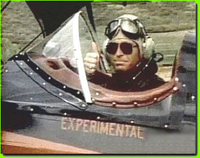
John Denver in his biplane - click to read an excerpt of his biographyMy friends are sometimes surprised to hear that I'm a John Denver fan. I disagree with some of - actually most of - his political views, but then again I like some of John Lennon's early 1970s music, even though the man was by then an even nuttier fruitcake than he was in the Beatles.

What I admire is Denver's adherence to his principles, and one of the first things I point out when talking about him is that while rock and pop oligarchs were recording their histrionic singles Do they Know it's Christmas? and We are the World, Denver was frequently in African countries with his sleeves rolled up. Denver had wanted to be on We are the World, but the single's producer, Ken Kragen, who also managed Harry Chapin and Kenny Rogers, commented that "several [un-named] people felt his image would hurt the credibility of the recording as a pop/rock anthem. I didn't agree".

Similarly, Earth Day 2010 - click to go to the homepagewhile Earth Day, instituted in 1970, is a once-a-year "awareness-raising exercise" for some, the title of Denver's 1990 song for the occasion summed up his typically uncompromising view: Celebrate Earth day (Every Day).

In other words, if you think that the activities of humankind are causing global warming, you can use your God-given free will to give up your car, stop flying in aeroplanes (admittedly not hard to do recently with the help of Icelandic volcanoes) and power your household entirely with wind-turbines. Every day.

My favourite Earth Day story was from Anthony Watts, stating that today Arctic sea-ice is at its hightest for 9 years, while Telegraph blogger James Delingpole lists the lunacy of Earth Day votaries:
  • "Between 75 and 85 percent of all the species of living animals will be extinct" by 1995 - Earth Day founder, the late Gaylord Nelson.James Delingpole - click to read the whole article

  • The world will be "…eleven degrees colder in the year 2000. This is about twice what it would take to put us into an ice age," Kenneth Watt, speaking at Swarthmore University, April 19, 1970.

  • "By 1985, air pollution will have reduced the amount of sunlight reaching earth by one half…" Life magazine, January 1970.
Gaylord Nelson, aside from founding Earth Day, is also famous for instituting hearings as a Senator on the safety of the contraceptive pill which required US manufacturers to place a statement as to the Pill's safety on its boxes, the first time in the country that an adverse effect had to be listed on a pharmaceutical product, and I can't fault him for that. But I think it gives an insight into the way his mind worked that no women were invited to testify, and this gave "reproductive rights" advocate Alice Wolfson a chance to stake her place in the dimming light.

Another peek into his psyche is given by his insistence that Earth Day should be held on April 22. This waMargaret Mead - click to read her article on Earth Days against the likes of, say, anthropologist Margaret Mead, who called Earth Day "the first holy day which transcends all national borders", that the feast should be held on the Spring Equinox, which falls around a month earlier. Students of history will note, therefore, the significance of the first Earth Day being held on 22 April 1970: it was, according to the Grergorian Calendar, the hundredth anniversary of the birth of Vladimir Ilyich Ulyanov - Lenin.

Sadly, in the aftermath of John Denver's last flight, I am not aware of eminent left-leaning figures who believe in showing what they think about the environment at least as much through how they live as what they say. I suspect they were sidelined from public life by the same sort of ideologues who decided Denver was not appropriate for We are the World.

So we are left with a holyday of obligation for a monster who murdered and oppressed his own people before directing his baleful gaze towards Russia's neighbours, thence to the rest of the world both in his own right and through his unintended heir Stalin, who muscled in on his legacy the same way that Alice Wolfson piggybacked on the unsuspecting Gaylord Nelson. Thus do each generation's self-elected prophets hand a Pandora's box to those who will empty its contents upon the silent majority of the next.

And that's before we get to Al Gore.

Related post: lights on: don't let earth hour usher in a dark age

Sunday, December 20, 2009

despite the thermofascists, French farce at Copenhagen

Writing about the Treaty of Versailles in his 1994 masterwork Diplomacy, Henry Kissinger summed up why the 2009 Copenhagen United Nations Climate Change Conference was flawed from the start:
Versailles: Lloyd George, Orlando, Clemenceau and Wilson - click to read moreit is almost always a mistake for heads of state to undertake the details of a negotiation. They are then obliged to master specifics normally handled bu their foreign offices and are deflected onto subjects more appropriate to their subordinates, while being kept from issues only heads of states can resolve. Since no one without a well-developed ego reaches the highest office, compromise is difficult and deadlocks are dangerous. With the domestic positions of the interlocutors so often dependent on at least the seDaryl Hannahmblance of success, negotiations more often concentrate on obscuring differences than they do on dealing with the essence of a problem.
Graced by the likes of Leonardo diCaprio, Daryl Hannah and Helena Christensen, Copenhagen 2009 has barely limped past the finishing tape despite the supporters of both Gordon Brown and Barack Obama claiming that their man struggled alone to achieve a comPolly Toynbee: click to go to her Guardian homepagepromise against the odds. Labour snob-for-hire Polly Toynbee captured the air of frustration with ordinary people whom the Establishment has gone out of its way to gag:
Most leaders in Copenhagen were out ahead of their people. Most understand the crisis better than those they represent, promising more sacrifice than their citizens are yet ready to accept – while no doubt praying for some miraculous technological escape.
Sudanese diplomat Lumumba Stanislaus Di-Aping spoke for the G77 group of the corrupt régimes of developing countries who had brought their begging-bowls to the Baltic when he asked what OLumumbia Di Aping - click to read about his remark at the Daily Mailbama would tell his daughters about his part in abandoning their Kenyan relatives, then developed the tired old theme comparing of climate-change "deniers" to scum who say that the Holocaust never happened by saying that Copenhagen spelled "incineration" for Africa and was comparable to the Nazis "sending six million Jews into the furnace". (Sweden's chief negotiator Anders Turesson called the reference "utterly despicable" - maybe the country's still ashamed of its politicians' initial apathy towards the Aftonbladet blood libel scandal.)

Shortly before the conference began, UK Prime Minister Gordon Brown had a swipe at people who believe the hard sciLord Christopher Monckton: click to read more on Watt's Up With Thatence showing that changes in climate are not predominantly due to the actions of humankind, calling us "flat earthers", and the attacks have not let up. In Lord Christopher Monckton's case the attack was not metaphorical; as reported in the tap, the anthropogenic climate-change sceptic had the correct paperwork to enter the conference but was excluded, then was assaulted by a Danish policeman despite having followed St John's Ambulance recommendations to keep his hands in his pockets; he had turned his back and was walking away when he was knocked unconscious.

Coline Covington - click to go to her home pageOther attacks are more insidious. The First Post's resident psychoanalyst, Coline Covington, spoke of Sarah Palin, as a typical climate change "denier", as having the sort of narcissism seen in small children; displaying her membership of the Richard Dawkins school of rhetoric, she sets up her straw man at the start of the article by talking about Nick Griffin, leader of the neo-nazi BNP. She says, referring to Palin and by implication to many of us, "Climate change threatens our narcissistic omnipotence. Deniers do not want anyone else telling them they cSarah Palinan't drive large cars or run two refrigerators...This is a mentality resembling the narcissism of small children who want to hold onto their illusion of omnipotence and control over mother."

What Covington is referring to is more than the sexually-deviant scribblings of Sigmund Freud that imprisoned many children in their abusers' houses by interpreting their reports as libidinous fantasies; she's talking about narcissistic personality disorder, in a disappointing confirmation of the hostility of many psychiatric professionals towards people with personality disorders, and their over-readiness to inflict the diagnostic sentence upon people of whom they disapprove.

Copenhagen has failed, and that's disappointing because, for opposition against the thermofascists to turn to an effective resistance movement, we need to know exactly what we're resisting. The reason it's failed is precisely as Kissinger identified, that there were too many powerful egos with long memories at the conference.

Case in point: there will be consequences for Obama's humiliating China for not meeting Kyoto targets in the presence of that country's Prime Minister: had he watched Li Yu's 2007 Dam Street Dr henry Kissinger - click to go to his homepage(Hong Yan) he would have learned the lesson you can find in the most basic internet guide for doing business with Chinese people - "Never allow your protagonist to lose face, and try not to lose face yourself." Heads of state like Britain's Gordon Brown, the US's Barack Obama and India's Manmohan Singh would have done better to send their foreign ministers or, even better, senior diplomats. Is Henry Kissinger still working?

Friday, November 6, 2009

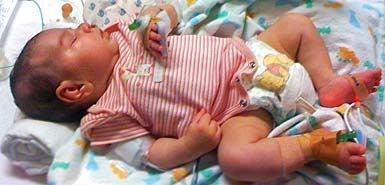
Baby RB and the misery of medics

click to read more at startrek.comBones stares at the grim scene lifted out of his memory by Spock's wayward brother Sybok: the young doctor reluctantly switches off his father's life support system at the latter's pleading. Now back in the present, he turns to his companions and informs them that a cure for his father's disease was discovered shortly afterwards.

Faith that the future will provide something we lack at present is a defining characteristic of our species. For example, this month's Reader's Digest tells the story of how Professor Graham Hughes, founder of the London Lupus Centre, noticed a biochemical similarity in patients suffering from an inexplicable paralysis in Kingston Hospital, Jamaica, and patiently tracked down the cause: an antibody that attacked phospholipids on an autoimmune basis, causing a coagulation disorder, which he called antiphospholipid syndrome but has been renamed Hughes' Syndrome by the medical profession.

click to read more about Prof Graham Hughes at the London Lupus Centre websiteWhen he first presented his findings, a surgeon sitting next to him, recognising the symptoms, whispered "my first wife died of this", then both listened to the testimony of a woman who, having been the first to be diagnosed with Hughes' Syndrome and treated, had given birth to her first child after nine miscarriages.

Sometimes miracles happen: in June, six-week-old Grace Vincent continued breathing after her life-support system was switched off to let her "incurable" meningitis take its course, and she defied odds of survival that doctors had put at less than one percent.

So it's sad to see a court battle over the future of Baby RB, who was born with congenital myasthenic syndrome which, explains the Muscular Dystrophy Campaign, is "a muscle weakness that limits the movement of his limbs and his ability to breathe on his own". His father wants his life-support to remain on, and his mother wants it to be switched off on the basis that she would rather cope with a mother’s grief of losing a child than to see her son’s "intolerable suffering".

Michael Mylonas, representing the NHS Hospital Trust representing Baby RB, stated "Clinicians at the hospital are against this because in their view even with a tracheostomy, the quality of Baby RB’s life will be such that in fact he has a miserable, sad and pitiful existence". He added the following astounding statement:
Michael Mylonas - click to read moreThe argument before you is the fact that he has normal cognitive function and normal brain would weigh in his favour.

But the Trust is concerned that his awareness will simply make his own plight all the more unbearable - not so much now, but as he gets older and catches glimpses of what others can do.
His reasoning puzzles me: is there anybody who hasn't looked jealously at others' abilities and compared them to their own? Failure, misery and pain are so bound in with the human condition that the above argument does not so much rationalise extinguishing a baby's life as provide grounds for genocide.

Baby RB is unable to move his limbs but can wiggle his body to indicate, his father asserts, pleasure, and has been filmed enjoying toys. The Muscular Dystrophy Campaign said in a statement,

"Baby RB's parents find themselves in and that unfortunately the resolution of this case will inevitably be devastating for all parties involved...The Muscular Dystrophy Campaign is here to provide support for all families affected by muscle disease through our freephone information support line and care team. We also continue to invest over £1million each year into pioneering research to find treatments and cures for muscle disease."
Martin BobrowIts rather ambivalent stance may be due to the chairmanship of Professor Martin Bobrow, non-executive director at Cambridge's Addenbrookes Hospital, Deputy Chairman of the Nuffield Council on Bioethics and a member of the Human Genetics Advisory Commission, who has declared himself in favour of pre-implantation genetic diagnoses. This would prevent such messy court cases by preventing the birth of babies with neuromuscular disorders, and would also render the many wonderful services provided by the Muscular Dystrophy Campaign unnecessary.
I don't wish to demonise Baby RB's mother with all this, Heaven knows she must be under enough pressure as it is, for example with a marital split whose "amicable" nature may be the good cop to the trial's bad cop. But she's not being helped by doctors who predicate "a miserable, sad and pitiful existence" of a 13-month-old child. Doctors are there to perform medical and surgical interventions, not to use their eminence in order to misrepresent their opinions as facts. (I'm reminded of the case of Baby OT, whose life support was switched off this March, in spite of legal protests by both parents, by doctors who spoke of "empathy" and "distress" instead of doing medicine.)

John Smeaton, Director of the Society for the Protection of Unborn Children, quotes the society's communications manager, Anthony Ozimic, on the matter:
Anthony Ozimic: click to read more
Whenever there is doubt about life-sustaining medical treatment, everyone should act with a presumption in favour of life. The value of a person's life, and the protection due to that life, should never be judged according to opinions about the person's quality of life. An ill or disabled person's life should never be regarded as not worth living. Doctors should not confuse the possible burdens of a medical intervention with the priceless worth of a person's life.
In fact, in a dramatic intervention, it's been announced that Baby RB's father has found a doctor willing to perform a tracheostomy on the child, but doctors have countered that this would necessitate "painful" surgery. If surgery's painful, fire the anaesthetist; I think I'd have more respect for them if they came out and honestly complained about "costly" surgery (in a research paper, Alison Davis of No Less Human refers to a British government publication that mentions that "caring for the handicapped can impose great burdens on our society").

It's not impossible that RB's condition may one day be treatable, perhaps even before the third birthday that doctors say he will struggle to reach, not stopping to think that for all of us there are times when it's a struggle to envisage getting up the following morning.

Thanks to the Monash Medical Centre for the pic of Baby Z: click to read moreTake Baby Z (above). The Telegraph's Bonnie Malkin reports that the newborn was cured of molybdenum cofactor deficiency, which usually kills in around three months, by a medicine Professor Günther Shwarz had been working on for 15 years. Contacted by the family, he sent his entire stock of the experimental compound.

Does something like this await Baby RB, should the medical establishment suffer him to live? I don't know, but we live in hope - it's what we do.

Related post - Sympathy and distress - bad medicine for Baby OT

Saturday, October 24, 2009

there's nothing British about Nick Griffin on Question Time

This week's Question Time on BBC 1, starring Nick Griffin of the white-supremacist British National Party, went off with all the brilliance of a damp squib.

James Bethell: click to go to Nothing British's initiative to bring centre-right policy-makers togetherProfessor Calculus and I usually don't watch TV (except for the odd snooker or cricket game) when we meet to put the world to rights over a glass of wine, but we watched QT to see the newly-elected MEP for Yorkshire and Humberside crumbling in the face of real politicians, only to see what Cranmer called "the Nick Griffin show". Griffin certainly faced some hard questions, but smirked through them - and at one point was challenged by host Jonathan Dimbleby for smiling when talking about Holocaust denial - and, in the words of James Bethell, founder of the blog There's Nothing British about the BNP, "retired wounded but on his feet, fit to fight another day".

The BNP leader is never on better form than when playing the victim for the mainstream media - for example, when protestors massed to raise awareness that Griffin was speaking at the Oxford Union with fellow Holocaust denier David Irving, they did their job so well that Griffin was able to grandstand on the national News about "people coming hundreds of miles" to be offended by him.

Having said that, the killer comment of the programme came from a young chap wearing a Kippah (skullcap worn by Jews), who stated, in response to Griffin's claim that Winston Churchill would have been a member of the BNP:
best point of the programme from the man in a KippahSir Winston Churchill put everything on the line so that my ancestors wouldn't get slaughtered in the concentration camps. But here sits a man who says that is a myth just like a flat world was a myth.
Griffin stated the law prevented him from disclosing why he had "changed his mind" on the Holocaust, at which Jack Straw, as Justice Secretary, said he wasn't aware of any law which would punish him from doing so.

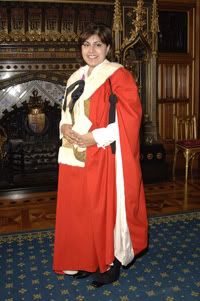
Baroness Warsi: click to read moreFor me, the best bit was Baroness Sayeeda Warsi stating that Britain needed a cap on numbers of immigrants coming into Great Britain, which echoed a Telegraph article written by Labour's Frank Field and the Conservatives' Nicholas Soames, co-founders of the Cross-Party Group on Balanced Migration which states in its title that Cowardice on immigration has allowed the BNP to Flourish and adds that the asylum system, designed to identify individuals in genuine danger of persecution or death should they return to their own countries, has "collapsed". The story defining its collapse has to be that of a Bolivian man whose appeal against deportation was upheld by Judge James Devittie because he'd bought an English cat. In a startling exclusive, the Telegraph's Tom Whitehead reports that Andrew Neather, who had been an advisor to Jack Straw, former Home Secretary David Blunkett and former Prime Minister Tony Blair claims that mass immigration - the Bête Noire of the BNP - was "partly due to a politically motivated attempt by ministers to radically change the country and rub the Right's nose in diversity". (Baroness Warsi's comments on immigration start at 2:38 in the video below.)


True to form, Griffin is again playing to the gallery with a complaint that he faced a "lynch-mob"in the Question Time audience, and that the programme's format had been changed so that it focussed almost entirely on him.

The BNP has a Hitleresque tendency to build a delusional system around a truth, and this is no different. Griffin has a valid complaint here, and Professor Calculus and I agreed that we would've liked to see him drawn out on issues like, for example, Lord Mandelson's manipulating the Post Office strike to soften up the organisation for privatisation, and British banks' reactions to the global financial crisis.

The other "lynch mob" that protested outside BBC Television Centre in London showed socialism's deep-seated ambivalence about fascism, in that they were protesting against a man elected to the European Parliament almost totally by Labour voters disaffected by the Government's ideological method of government that has turned their country into a place they no longer recognised. I wonder if any of them were related to the trade unionists who took to the streets in support of Enoch Powell's 1968 address to Conservative Party workers at Birmingham's Midland Hotel (mis-named the "Rivers of Blood speech"), in which he anticipated Labour's silence on immigration:

Above all, people are disposed to mistake predicting troubles for causing troubles and even for desiring troubles: "If only," they love to think, "if only people wouldn't talk about it, it probably wouldn't happen."

Perhaps this habit goes back to the primitive belief that the word and the thing, the name and the object, are identical.
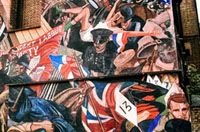
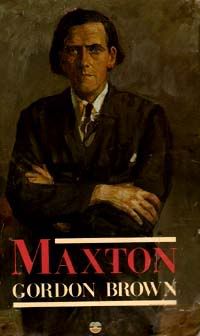
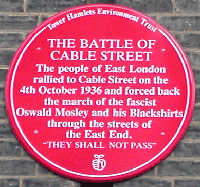
Battle of Cable Street mural, with Independent Labour Party flagOr, indeed, if they were descended from the freedom-fighters who fought at the Battle of Cable Street in London's East End against black-shirted fascists led by Oswald Moseley, the Independent Labour Party MP who, disappointed by his party's response to unemployment, left in 1930 to form the New Party. Gordon Brown, in Maxton, his biography of the hard-left Scottish MP, records that when Moseley left James Maxton said that "he ought not to be condemned but thanked [because] his actions sMaxton by Gordon Brownhowed a deeper sense of responsibility about the unemployed and might lead to a 'new direction' in government policy". And just as the Nazis' response to Germany's economic woes was nationalisation on a massive scale, the BNP's website (which describes the three main parties as "liars, buggers and thieves") proposes nationalisation as a panacea for Britain's. One gets a sense of the political spectrum not as a line but a circle, where "hard-left" and "far-right" occupy the same space.

So whither the BNP? I hope that former Labour voters in north-west England who sent Nick Griffin and Andrew Bron to the European Parliament will withdraw from the abyss come the General Election and vote for the non-fascist party of their choice. But what worries me is the party's attempts to woo the forces, some of whose members, under-resourced and viewed with suspicion by the Government, may seek solace in their empty promises. I finish with a video (sorry, Pam!) from the Nothing British Operation Stolen Valour. Please click the link and visit the site to view the fightback against fascism in Great Britain.


The episode of Question Time discussed can be accessed on the BBC's i-player on the Question Time Site. If you're unable to access it, it's available in parts on YouTube - click here for part 1.

Friday, October 16, 2009

mother earth: sometimes the eyes don't have it

Friends of the Earth?Through the week, I was coming back to find my cycle after giving a short talk in Cambridge when I was stopped by a young woman called Maria. She was carrying a fold-over clipboard that proclaimed "Friends of the Earth" on the front; she had a Mediterranean accent, and eyes to match.

Maria asked me what I thought about the world. I requested that she rephrase the question so, after a short break, she asked me what I was doing that I could change to make a lesser impact on the world.

I thought for a couple of seconds. "You mean like turning the central heating down a bit?" I asked. "Or using the tumble-dryer less? Or taking the bus instead of driving, or not flying so much?" She nodded so excitedly that I felt guilty telling her that we couldn't afford to switch on the central heating unless there was ice outside; neither could we afford a car or to fly. Her dark eyes dulled a little.

Lord Christopher Monckton: click to read moreMaria said she was there to raise awareness about the United Nations Climate Change Conference that was going to take place in Copenhagen in December. I thanked her and said I was already aware of it, and mentioned the lack of awareness about, at one end of the scale, the fire at the Littleport tyre recycling facility, near Ely in Cambridgeshire, that was spewing greenhouse gasses into the atmosphere like nothing on earth; and, on the other, the assertion that US president Barack Obama was so concerned about climate change that he was, in the words of Conservative peer Lord Christopher Monckton (right), willing to cede US sovereignty to a worldwide authority that resembled nothing so much as a government.

There is certainly a paragraph in the Copenhagen Draft that mentions a "dignity" penalty. Certainly the loss of dignity is poverty's most humiliating manifestation, but the clause in question seems to be nothing more than a stick to beat Western countries with, and bears no relation to the dignity of people in developing countries other than to turn it into a political football.

When I challenged Maria on whether the actions of humankind could have an effect on a climate that - as she agreed with me - has been changing for four billion years, she admitted (bravely, I thought) that she didn't know; but added that this was an opportunity to live in a way that took less of a toll on the earth.

On this point I both agreed with her wholeheartedly and parted company with her. It's probably a Celtic thing.

I agreed with her in that if we live more simply, we will have more money to give to those less fortunate than ourselves - but I'm disappointed to note that giving what we save to the poorer did not crop up in the Archbishop of Canterbury's speech on climate change.

Jesse Ausubel - click to read moreWhere I disagreed with her - and maybe I was being a bit previous as she hadn't mentioned population - was that an American economist, Jesse Ausubel, recently published an article in New Scientist saying that modern farming techniques could support a world population of 10 billion. I didn't actually go on to the United Nations Food and Agriculture Organisation (FAO) estimate in 1995 quoted by John Smeaton, Director of the Society for the Protection of Unborn Children, that agrictulture could support 30 billion people.

I suppose what was winding me up was that Jonathan Porritt, former head of Friends of the Earth, had signed off on the Optimum Population Trust's document Fewer Emitters, Less Emissions, Less Cost, which demands an 80% reduction in the global birth-rate. No matter where you are on the vexed spectrum of views about birth control, calling for an 80% reduction in the birth-rate isn't personal choice, it's genocide.

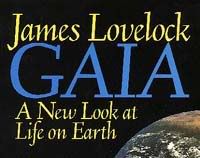
James Lovelock and GaiaWe went onto "Gaia", I have to admit, because I led the conversation there. Maria had never heard of it. So I took a deep breath and explained that according to the Gaian theory the earth was an organism with its own compensatory mechanisms. The reason I went there was because Maria had mentioned deforestation in the Amazon. I agreed this was a bad thing, and dropped in the suggestion of James Lovelock - originator of the Gaia hypothesis - that we bury nuclear waste in Amazonia in order to discourage people from settling there.

Maria's eyes blazed at this, and she said that we had no evidence about the effects of nuclear waste on people or animals over a lifgetime. I swallowed down a reply about Japan and about the lack of lifetime evidence about vaccines.

Just as we were about to go our separate ways she opened her clipboard and invited me to take out a direct debit in favour of Friends of the Earth. I thanked her but said I approach charities that I wish to donate to, not the other way round. She thanked me for listening to her then moved up the road. She was a deluded child but, I must admit, she had lovely eyes.

Thursday, October 1, 2009

international blasphemy day: behind the mask

The Telegraph's Tom Chivers reports that we've just had International Blasphemy Day. Chivers lists some of the milestones in British blasphemy law in his article.

John C Beyer, heir to Mary Whitehouse: click to go to Mediawatch websiteAmong these, he cites Denis Lemon, publisher of now-defunct Gay News, being given a suspended sentence in 1977 for publishing an obscene poem called The Love that Dares to Speak its Name about a centurion, whose homosexuality seems to be the least of his problems, desecrating Christ's dead body. The prosecution was brought by Mary Whitehouse, who formed The Viewers' and Listeners' Association; in a 2002 article for the Catholic Herald John C Beyer - former director of Mediawatch, successor to Whitehouse's organisation - mentions something that is ommitted in the Pink News' celebration of the court case: the poem's author, David Kirkup, disapproved of his travesty's being used for the campaigns of activists.

The insouciance of the Establishment towards Judaeo-Christian issues was displayed openly when BBC2 broadcast Jerry Springer: The Opera despite receiving its greatest number of complaints regarding a single broadcast before it was aired (it already existed in the public realm as a stage play).

If radical militant atheists/secularists believe they should have a day to celebrate, that's perhaps something to investigate, and the investigation should take account of the fact that just about every day is International Blasphemy Day - as regards the followers of some faiths, and blasphemy is by no means the preserve of secularists.

Censorship is practically absent if you wish to do down Christianity or Judaism these days, but is almost everywhere if you wish to merely indicate that you follow these faiths, as witness the discrimination faced by Nadia Eweida, Lilian Ladele and Caroline Petrie for witnessing to their faith at work.

Nadia Eweida, Lilian Ladele and Caroline Petrie, modern martyrs: click to read more

Ayatollah...?The first indication I had of this discrimination being exercised online was when virtual prelate Cranmer had his Facebook account disabled because he was not a real person, despite the social networking site having members called Kermit the Frog, Miss Piggy, King Henry VIII and Cardinal Wolseley. Having been told that he wasn't allowed to use a religious title in his name, he changed it: from Archbishop Cranmer to Ayatollah Cranmer.

click to go to the Jewish Internet Defence Force websiteI found the case of David Appletree more disturbing. The founder of the Jewish Internet Defense Force has consistently opposed organised Holocaust denialism on Facebook, and for his troubles faces having his Facebook account disabled on the same grounds as Cranmer, that "Jewish Internet Defense Force" isn't a real name, and provides a list of many other accounts threatened on that basis, among which words like "Rabbi" and "Israel" are prominent. (A sample letter on his behalf may prove to be of great use for people who use stage-names.)

Yasmin Alibhai Brown: click to read HonestReporting's critique of her Yom Kippur articleIt should be noted that Facebook launched a major campaign on Yom Kippur, the Day of Atonement (Spetember 28-29 this year), when Jewish communities close down as completely as Ireland used to do on the Feast of the Annunciation. The Independent's house antisemite, Yasmin Alibhai Brown, also used the feastday to launch an atrocious attack on Israel, despite (or because of) that country being lauded by the Washington Post as the new leader of the free world because of premier Benjamin Netanyahu's robust and unstinting critique of the UN's ideological blinkeredness and Iran for its sabre-rattling that may yet draw the world into its first nuclear exchange.

So: secularists who want to have a special day to celebrate blasphemy and the many predjudices that hide behind it should stop and think, wouldn't an international anti-blasphemy day be more revealing?

Thursday, May 21, 2009

Anne Frank

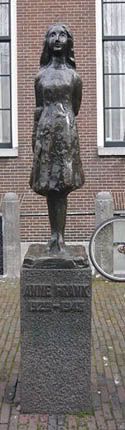
statue of Anne Frank outside the house where she hid: click to enter the Anne Frank house website
I don't often to to hospital for non-medical purposes, but today Maxima and I went to Cambridge's Addenbrookes Hospital to see an Anne Frank exhibit in the Treatment Centre. The hospital's now so big that it provides a rather large car called a "courtesy bus", which took us round the huge campus to the centre, aka Institute of Metabolic Science.

The exhibition was in the form of two sets of photos on screens, starting with the dire econimic situation in post-Versailles Treaty Germany, which bred resentment against the Allies, which Adolf Hitler took advantage of in the years following his outburst at a meeting of Anton Drexler's German Workers' Party (Deutsche Arbeiterpartei)persuading him to prefix Nazionalsozialistische: the Nazis had been born.

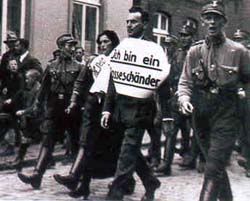
The presentation stressed that the majority of Germans were unaware of the true agenda of the Nazis until after their election in 1933. After this point, the exhibition grew ever darker, and you would see groups of nurses, physiotherapists etc gathering round words and pictures in silence. It related that 80,000 handicapped people were killed in order to prevent "enfeeblement of thJulius Wolff and Christine Reemann - note the boy with the bike joining in the condemnatione race"; another photo showed a Jewish man, Julius Wolff, being driven down the street by SS soldiers alongside his "Aryan" girlfriend Christine Reemann in Norden in 1935, each bearing signs that said "I am a defiler of the race".
Interspersed with the indications of mounting horrors were the lives of Anne and her family, who moved from Germany to the Netherlands in 1933. In 1940, their country of exile was occupied and they took to hiding in rooms behind the business where Anne's father had worked, which she called "the secret annexe" - which was the original title of the book. One of the families foremost helpers and concealers was Miep Gies, who said:
'It seemed perfectly natural to me. I could help these people. They were powerless, they didn't know where to turn. I always emphasize that we were not heroes. We did our duty as human beings: helping people in need.
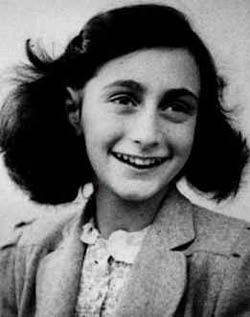
Anne FrankI stood looking at the quote underneath her picture for a couple of minutes, unable to speak. There were further details of how, even in the summer heat, Anne and her companions had to burn leftovers to destroy evidence of their clandestine existence. Another quote from the diary referred to the five books that Ms Gies, who recently achieved her century, brought them form the library every Saturday: "We long for Saturday because that means books". However, the quote that moved me most was underneath the world-famous picture of Anne gazing into a future that she would never see:
I long to ride a bike, dance, whistle, look at the world, feel young and know that I'm free, and yet I can't let it show.
The family was arrested in August 1944. Anne, her sister Margot, and her mother Edith were sent to Auschwitz, where their mother died, having starved herself to give her daughters extra rations. By the time she died, Anne and Margot had been sent to Bergen-Belsen, where they died in a Typhus epidemic less than a month before the camp was liberated by British soldiers in April 1945. Uanu Seshmi - click to read his story at the Anne Frank UK website

Anne reaches out to us beyond her death. The Government has placed Diary of a Young Girl on the English National Curriculum; and in the UK, the Anne Frank foundation awards people who make a change in their community. For example, Uanu Seshmi, a teacher in the Peckham area of London, received an Anne Frank award for his amazingNick Bennett: click to read Stephen Exley's coverage for the Cambridge News; thanks to the Anne Frank foundation for the pic work in getting young black boys, who had been excluded from school, back into mainstream education. In Cambridgeshire, a self-confessed "boy racer" called Nick Bennett, whose hobby had landed him in a wheelchair was honoured for his work in going round schools informing teenagers of the dangers of his former occupation.

Anne's story is one, I believe, that makes the Holocaust comprehensible by providing an antidote to Stalin's dictum that "one death is a tragedy; one million is a statistic" - although it was sobering to learn that before Hitler embarked on his dark project there were eleven million Jews in Europe - the Nazis got more than halfway in their obscene scramble towards the Final Solution. Many years ago I found another part of the story contextualised when, during my first placement as a student nurse - in a medical ward - I met one of the soldiers from the unit which had liberated Bergen-Belsen. Having been a member of the Church of Scotland, he described how he had looked around, and his faith had vanished like a snowflake in a furnace. When I met him in the late '80s, he was still an atheist.

The diary has been attacked as a fraud - notably by lawyer Edgar J Steele, who claimed in November 2003 that "It wasn’t Arabs who forged the Anne Frank “diary” - it was jews [sic]" in a bizarre rant which ends: "And, lest we forget:It wasn’t Arabs who had Jesus Christ crucified - it was jews."
heritage plaque celebrating the victory in Cable Street against Moseley's fascists
Professor Calculus has told me that he remembers from his boyhood slurs about the Jews being "Christ-killers"; and it is a troubling thought that, had the Hitler/Schickelgrueber family moved to, say, France or Britain when the children were young, Adolf might not have had much trouble starting a movement that resembled the Nazi Party in its anti-Semitism; certainly Oswald Moseley found people flocking to his New Party.

So perhaps it's a good thing that the Anne Frank Foundation will be delivering diversity training to Addenbrooke's staff, even though the concept of diversity has become so loaded with so much ideological baggage pertaining to unilateral multiculturalism that it is increasingly becoming a bad word among followers of many political creeds. Hopefully, the Foundation will be able to inject some reality into a troubled subject, in this corner of East Anglia anyway, before a backlash is unleashed that may snowball towards disaster.


thank you

Anne Frank
1929-1945
Thank you

Saturday, February 28, 2009

Harry Potter and the Deathly Hallows

It's hard to believe that the first Hary Potter book, Harry Potter and the Philosopher's Stone, was published in 1997. Over the years readers have followed the characters growing up, and since 2001 have watched the screen characters grow up - and indeed the actors, who have done so with considerably more dignity than other celebrity youngsters, like the Osbourne brood or Macauley Culkin.

The Character of Harry Potter famously popped into the mind of authoress JK Rowling while on a train in 1990, and spent a long gestation being fleshed out before Rowling put pen to paper.

There's been a lot of controversy over the magic depicted in the Potter series of books, with concerns expressed about occultism and pandering to those sectors of society which would see our Judaeo-Christian heritage cast away like a spoilt child's toy.

Not all of these objections, I feel, reap the benefits of knowing what one is talking about. For example, in Harry Potter and the Bible (subtitled The Menace behind the Magick), author Richard Abanes explains that "the word 'magic' refers to stage illusions by sleight-of-hand, whereas 'magick' refers to occult practices". He would have gained more of my respect had he shown an awareness of the origin of the word "magick". The unfortunately all-too-real Aleister Crowley (who had sinister tendencies even before he decided he was God) in his rush to befoul as many religious traditions as possible realised that in Jewish number theory (gematria) eleven represented unbalanced force, and therefore appended the eleventh letter of the alphabet to "magic".

But all of this is objectifying what was never intended to be anything more than an œvre of fiction, which I don't see containing more magic than, say, Disney's interpretation of Cinderella or Snow White - or, indeed, Sleeping Beauty, towards the end of which the Wicked Witch reveals herself as Satan. (My Mum took me to see this latter when I was a young'un - we both hid behind the cinema seats at that point.)

The central stream of fiction which runs through the Potter series is a battle between good and evil, the personification of which is Voldemort, who as a baddie has captured the public imagination in a way unknown since Darth Vader's first appearance. Voldemort has sought power and deference to such an extent that he has dehumanised himself, similar to the degradation wrought upon Gollum through his covetousness for the One Ring in Lord of the Rings, another work featuring magicians, spells etc which has not been demonised, and is one of Potter-buster Abanes' favourite books.

Through the series of books, Harry learns more about Voldemort's murder of his parents and about the similarities between himself and his enemy. Deathly Hallows is a perfect end to the series, drawing together themes which have been developing since Philosopher's Stone.

During this book we learn more than we ever have about the character of Dumbledore, headmaster of Hogwart's School of Witchcraft and Wizardry, who is killed at the end of the previous book, Harry Potter and the Half-Blood Prince. Dumbledore is a morally upright character and Harry's moral compass; like Odysseus, even Dumbledore is not immune to temptation, but while Odysseus has his ship's crew tie him to the mast of his ship then block their ears so that he can listen to the call of the Sirens and survive, we discover that Dumbledore took no precautions when he tested one of the Deathly Hallows - rumoured to provide protection from death - in Half-Blood Prince, which led to his downfall. Harry, on the other hand, does not seek the Deathly Hallows for himself, which leads him to the realisation that the only road to Voldemort's defeat is the one that brings Potter to present himself for destruction at his hands.

What caused me some consternation was JK Rowling's announcement after Deathly Hallows' publication that Dumbledore was gay. I'm on the same page as Townhall's Ben Shapiro when he says that "there is nothing in any of the books to suggest that Dumbledore is gay". Obviously Dumbledore is JK Rowling's creation and he can be of whatever disposition she decides, but with the announcement - which surprised even Peter Tatchell, arguably Britain's most militant gay-rights activist - she's coming over all deconstructionist and going off the margin of the page to explain something which is already well explained within the context of the story.

Blogger Jimmie of The Sundries Shack notes that although Rowling commented Dumbledore


was "blinded" by love for Gellert Grindelwald and that was his great flaw, but he could just have easily have been blinded by love for a great and lifelong friend. I suspect that very few folks even contemplated the sexual activities of Albus Dumbledore because they just weren’t all that important.
In fact, Deathly Hallows makes it clear that what seduced Dumbledore was the same thing that led Sauron, Vader and their real-life models to destruction: the prospect of accruing power. Gellert Grindelwald - who is allegedly the object of Dumbledore's "crush" - wishes to lead the magical community out of their self-imposed exile in plain sight under the slogan "for the greater good", which is carved over the entrance of the prison Grindelwald built for his enemies - echoes, I think, of arbeit macht frei, the assertion that "work will make you free" which featured in the architecture of many concentration camps and, famously, covered the gates of Auschwitz.

Just as the backstory of Lord of the Rings can be seen as an allegory of how the Allies stood by as Germany rattled sabres before and during the Chancellorship of Adolf Hitler, so in Deathly Hallows we see what all the agitation about pure-bloodedness in the previous six books has lead to. Gone is the Ministry of Magic's golden statue celebrating harmony between the races depicted on the back cover of Harry Potter and the Order of the Phoenix, to be replaced with one depicting two pure-blooded figures seated on thrones that are made of tiny "muggles" - non-magical folk.

It isn't difficult to see this sort of totalitarianism born of the arrogance of believing oneself naturally gifted to order the existence of "lesser beings" in our own lives. Ironically, given that Harry is a survivor of infanticide, the Telegraph reported recently that Anne Furedi, of major abortion provider the British Pregnancy Advisory Service welcomed the news that half of teenage pregnancies in Great Britain are now ending in abortion as "a positive sign" and "entirely a good thing". Even Children and Young People's Minister Beverley Hughes recoiled from such bloodlust in an unprecedented manner by calling this the abortion statistic "disappointing". Later this month, as Radagast explains, our children will be invited to contribute to the bloodshed as Comic Relief uses them to raise money that will be dispensed in part as "large grants to Brook Advisory, Marie Stopes International, the International Planned Parenthood Federation and organisations overseas involved in 'reproductive health'." John Smeaton, director of the Society for the Protection of Unborn Children, reveals that the last Comic Relief gave £1.5 ($2.15m) to the African Women's Development Fund, whose Charter of Feminist Principles for African Feminists (their title - honest) demands "Freedom of choice and autonomy regarding bodily integrity issues, including...abortion".

Deathly Hallows does indeed contain its dangers, notably in Dumbledore's rationale for having Snape kill him at the end of Half Blood Prince, to prevent a terrible reckoning falling upon the person Voldemort has commissioned with the murder. While it works in the context that having succumbed to the temptation of trying to unite the Hallows of the title so that he might have eternal deferment of death and paying the price for his hubris, it's easy to see how his explanation in chapter 33 is open to hijack: "I ask this one, great favour of you...because death is coming for me...I confess I should prefer a quick, painless exit".

Deathly Hallows is a well-paced novel accessible to people from teens upwards, containing horror, humour, action and an exploration of our darker places worthy of the ancients - in burying Dobby the House Elf, who was killed without conscience by members of Voldemort's forces because he was of a different magical race, Harry eschews magic and digs the grave by hand; the scene could have been penned by Virgil.

The whole series is one in which we see the reality of the soul affirmed, as well as life after death and even a hint of the resurrection of the body; it's well worth reading if you're interested. It may even, eventually, gain a following comparable to that of Lord of the Rings. We need to remember that what lies between a novels' cover is just fiction, but not let that blind us to the many insights into the human condition that wait for us to discover them.

Harry Potter and the Deathly Hallows
J. K. Rowling
pp 607
Bloomsbury 2007


Wednesday, January 21, 2009

Night Fighters

Night Fighters - Luftwaffe and RAF Air Combat over Europe 1939-1945
Colin D. Heaton and Anne-Marie Lewis
Naval Institute Press 2008
pp 188


Some wars are with us for a long time - campaigns by Julius Caesar and Constantine set the structure of modern Western Europe, the Third Battle of Lepanto consolidated it, and the American Revolutionary War saw the birth of a country which continues to challenge and change the world.

Others are with us still in less benign ways. The Battle of Kosovo Field erupts intermittently, and the Crusades leave a bad taste in many mouths.

Machinations started in the first half of the seventeenth century by Cardinal Richelieu to keep the Germanic principalities from uniting, which would threaten France's influence in Europe, came to an end after the Franco-Prussian War of 1870 when, on 18 January 1871, the Hohenzollerns proclaimed a German Empire in the Hall of Mirrors in Versailles. The rest, as they say, is history, and Night Fighters is the story of a fiercely-fought episode in that history, where "over a million men fought in the hostile skies from the British Isles to the steppes of Russia, and from the Arctic Circle to the Sahara", which gave us many advances in military and civilian technology, in a war whose conclusion bequeathed us the United Nations, the European Union, the Space Programme and the Cold War.

Night Fighters deals with combat between the Luftwaffe and the RAF (Nachtkrieg - "night war" - in German), principally Bomber Command, over German-occupied Europe. Each of the authors brings a special gift to its writing: Colin Heaton's accounts of battle and its outcome are all the more chilling for his matter-of-fact manner borne of combat experience, and meticulously-transcribed interviews with German, British and American officers and airmen, many unavailable elsewhere, add valuable insights; Anne-Marie Lewis is a researcher and co-ordinator of veterans' foundations, including the Celebrate Freedom Foundation. In the light of the traumas suffered by airmen involved in nocturnal aerial combat in WWII, it is nothing short of amazing that these two have managed to bring British, German and American airmen from the conflict together for reunions.

The authors point out that Bomber Command as an organisation was virtually synonymous with Sir Arthur "Bomber" Harris, the controversial figure blamed by many for bombing German cities indiscriminately, whose memory is proudly guarded by the veterans of RAF Bomber Command (formerly the Bomber Command Association).

Myths about Harris explode like ack-ack from the start - referring to successes by the neonatal RAF in bombing German airfields in France in 1918, Stanley Baldwin enunciated the doctrine that "the bomber will always get through". This was in 1932, a rather confused period of British political history: he was at the head of the Conservative Party, which was then in a coalition "national" government with Labour, in response to the international financial crisis. Labour had expelled Prime Minister Ramsay MacDonald from the party for consenting to the coalition in the first place, which meant that Baldwin effectively ran the country. He continued: "The only defence is an offence which means you have to kill more women and children more quickly than the enemy."

Chruchill's first choice to head Bomber Command was a founder member of the RAF and its first chief of staff, Air Vice Marshall Sir Hugh Montague Viscount Trenchard, who had envisaged "round-the-clock" bombing of enemy manufacturing centres in January 1918, with the caveat that there would be losses of British aircraft and crew from the outset.

The last piece of the puzzle would fall into place in the aftermath of the Coventry raids of November 1940, when ordnance meant for factories landed on residential areas and power and sanitation facilities. Hitler was not the only one to look at the result with interest. Oxford physics professor Dr Frederick Lindeman (1st Viscount Cherwell) interviewed survivors and found that losing one's home was more debilitating than losing friends and relatives. The die was cast: Churchill presented Harris with orders to "de-house" German factory workers.

There has been much discussion over these raids over the decades, and indeed on British TV there was a televised debate on the eve of the First Gulf War on how to prosecute the air campaign, which referred back to the bombing campaigns on Germany - the daytime "precision-bombing" raids by American bombers, certainly, but principally Harris' nocturnal campaign.

At the time there was vigorous debate on the night-bombing campaign in the US -having joined the war after the attacks on Pearl Harbour - whose polar opposites were represented by General James H. Doolittle, who wished to maintain the moral upper hand, and General Curtis E. LeMay, who differentiated between the moral high ground and the military-industrial lowlands. US President Franklin D. Roosevelt agreed with Churchill that alternating American daytime raids with British night-time ones would be the most effective option.

The British were up against formidable opponents. I sometimes wonder if people who disapprove of Harris' tactics are aware of the situation as it existed. In the first part of his memoirs of the Second World War, The Gathering Storm, Winston Churchill talks of preparations for a German invasion, which would constitute mass distribution of bayonets with a grim poster campaign on the theme "you can always take one with you". Until the US entered the War, an Allied victory - in essence a British one - was unlikely. The authors' meditations on how the war might have proceeded had the Luftwaffe defeated a lone Britain's RAF are both counterintuitive and compelling.

The German genius for organisation was represented in the air-war by the Kammhuber Line, an "intricate array of defensive relay and observation systems" which stretched over much of occupied Europe and was, in part, manned by two million schoolboys, who had been conscripted under Article 1 of the Law concerning the Hitler Youth of December 1, 1936: "The entire German youth within the borders of the Reich is organised in the Hitler Youth" (one - unwilling - member was Josef Ratzinger, who would spend time in an American Prisoner of War camp with Günther Grass, and later rise through the Roman Catholic Church to become Pope Benedict XVI). There would follow airborne co-ordinators, and "Dark Night Trains" where a team of radar-operators who were experienced as pilots would guide night-fighters within squadrons.

The Nachtjagdfliegern - Night Fighters - were headed by Wolfgang Falck, who immediately saw that the problem with research and development was that innovations were being created by engineers who had no flying experience. Many of the pilots he inherited had been blooded in the Spanish Civil War, while Harris' crews had to gain experience and confidence bombing "softer" targets such as Luebeck and Rostock, and the Renault factory at Billancourt.

Falck fought with those he commanded, through a desperate game of technological catch-up which saw each side improve its navigation and detection systems, only to see the other improve them more. One of Falck's innovations was Schraege Muzik (Jazz Music) - arrays of guns mounted at 60 or 70 degrees, enabling German fighters to come up on the bombers from below and fire along the weak-points of their wing-roots.

Another was the Wilde Sau (Wild Boar), which would attack bombers as they approached their target. With the addition of the Zahme Sau (Tame Boar), British aircrews would constantly be under threat from either flak or fighters virtually from the moment that they were picked up by the Kammhuber Line, and sometimes find that they had been followed home covertly by night-fighters, who would start firing as the crew started to relax in anticipation of a landing which might not happen.

The authors explore the resulting crises suffered by crews exposed to prolonged stress and sometimes repeated trauma with an admirable even-handedness, weighing the physical and mental attrition suffered by aircrew against what was at stake, but also taking into account the sometimes unrealistic demands put upon them by a hierarchy who might have minimal flying experience, and the power medics with none had over their lives. Heaton and Lewis tell of a man who was seriously injured three times and was awarded the DFC (Distinguished Flying Cross) and DSO (Distinguished Service Order), who after an especially heroic feat confided to his commanding officer that he didn't feel able to fly again, and found himself transferred to a job as a janitor. The authors quote Scottish Victoria Cross recipient Bill Reid speaking to Heaton in 1999:
[Our superiors in London] should have [held] their conferences on board a Lancaster flying through flak, searchlights and dodging German fighters, all the while being rocked and bumped by the concussions from the flak and the shrapnel flying through the thin aluminium fuselage; men screaming and others dead or dying. This is the forum in which I think more lucid planning would have been developed.
However, once it became obvious in Westminster that things were going badly wrong, the neuropsychiatrist became part of the airfield medical team: not only had occupational health as we know it been born, but, in the military realm, this would eventually lead not only to improved healthcare but to ways of identifying individuals suitable for advanced and even élite training.

As a former mental health worker, what I found interesting was that serious study of psychiatric presentation moved the RAF forward from a one-size-fits-all kneejerk judgement to identify two sorts of risks: not only people who were severely mentally fatigued and didn't want to go back into a game of chance with loaded dice, but others who were too eager to volunteer for duty, who refused to take leave and took unnecessary risks. This was a vital step in identifying the objective effects of different personality-types and looking for different modes of treatment, which would eventually supercede the career-ending diagnosis of "Lack of Moral Fibre", but unfortunately too late for the many men who left the RAF under a cloud and whose records are still sealed.

As the war progressed the German night-fighter pilots found themselves suffering also - from the long-range and hard-to-detect Mosquito, from knowledge that their country was turning into an inferno - and often at the hands of the two individuals who were also Britain's enemies. In Diplomacy, Henry Kissinger gives a nineteenth-century diplomat's assessment of Tsar Alexander I's absolute power - "What he dreams of at night he can carry out in the morning". However, one can predicate of Hitler a deeper pathology even than that inflicted by absolute power. Kissinger again:

Hitler always seemed strangely unfulfilled by his victories...Psychologists may find therein one explanation for his conduct in the war in a manner that seemed to lack a strategic or political rationale until Germany's resources had been squandered and Hitler could finally, and still unyieldingly, fulfil himself by defying the world in a bomb shelter in the encircled capital of his almost completely occupied country.
If Der Fuehrer was determined to tear down the structures of his own making, Heaton and Lewis show that Goering proved himself a willing helpmate. A lord of misrule like his master, he was happy to see his subordinates divided among themselves so that he would remain unassailable. He would lie to senior Luftwaffe officers that he had passed their reports on to Hitler, and helped spread Kammhuber's anti-aircraft guns and Falck's night-fighters too wide to work efficiently, in accordance with Hitler's "delusional" fantasies, which survived even D-Day, that Germany was winning. Falck's, (Generalleutnant) Adolf Galland's and Hans-Joachim (Hajo) Herrmann's interviews with Heaton provide invaluable insights into how a mighty military machine was dragged down into the madness of the last months of the Reich.

Nothing succeeds like success, though - No. 617 Squadron of Bomber Command earned its nickname "the Dambusters" because of the famous night-time raid of 16/17 May 1943 on the Moehne, Eder, Sorpe and Schwelme Dams in the Ruhr Valley, with the intention of killing and "de-housing" workers who, according to Harris' argument, were contributing to Germany's war effort. Squadron Leader Guy Gibson was given a Victoria Cross for this, just as Harris was given a Knighthood for his strategy, which included "Operation Millenium" on Cologne in 1942, carried out by over a thousand bombers. Given that Heaton has been honoured for his work on the role of ununiformed combatants in war, his analysis of Harris' methods is eye-opening. And neither do the authors run away from the question of why concentration camps and the railway lines supplying them weren't bombed - their conclusion, even 60-plus years after the fact, is shocking and controversial, and demands a re-examination of the extent to which the political masters of Allied commanders considered the end to justify the means.

One thing Churchill and Hitler agreed on was that the British would not tolerate a death rate of much more than ten percent in Bomber Command. This figure was not passed many times (although on one early raid it reached 22%), but cumulatively, by the end of the war a staggering 51% of active Bomber Command crews were dead - 46,268 men killed on operations, with a further 8,090 killed on non-operational and training missions. (Only 2,500 out of a total of 25,000 German fighter-pilots - of which 400 were night-fighters - survived.) While not doubting the bravery of the German pilots, I support the campaigns by the Daily Express and the Daily Telegraph to have a Bomber Command medal minted.

There's also a growing head of steam for the campaign to have a statue of Sir Arthur Harris erected on the empty fourth plinth in London's Trafalgar Square. After reading Night Fighters' delineation of impossible decisions that had to be made in a battle for national survival, that statue is long overdue.