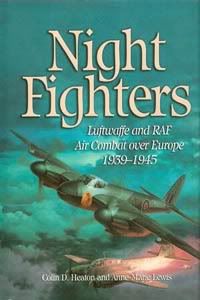
Night Fighters - Luftwaffe and RAF Air Combat over Europe 1939-1945Colin D. Heaton and Anne-Marie Lewis
Naval Institute Press 2008
pp 188
Some wars are with us for a long time - campaigns by Julius Caesar and Constantine set the structure of modern Western Europe, the Third Battle of Lepanto consolidated it, and the American Revolutionary War saw the birth of a country which continues to challenge and change the world.
Others are with us still in less benign ways. The Battle of Kosovo Field erupts intermittently, and the Crusades leave a bad taste in many mouths.
Machinations started in the first half of the seventeenth century by Cardinal Richelieu to keep the Germanic principalities from uniting, which would threaten France's influence in Europe, came to an end after the Franco-Prussian War of 1870 when, on 18 January 1871, the Hohenzollerns proclaimed a German Empire in the Hall of Mirrors in Versailles. The rest, as they say, is history, and
Night Fighters is the story of a fiercely-fought episode in that history, where "
over a million men fought in the hostile skies from the British Isles to the steppes of Russia, and from the Arctic Circle to the Sahara", which gave us many advances in military and civilian technology, in a war whose conclusion bequeathed us the United Nations, the European Union, the Space Programme and the Cold War.
Night Fighters deals with combat between the Luftwaffe and the RAF
(Nachtkrieg - "night war" - in German)
, principally Bomber Command, over German-occupied Europe. Each of the authors brings a special gift to its writing: Colin Heaton's accounts of battle and its outcome are all the more chilling for his matter-of-fact manner borne of combat experience, and meticulously-transcribed interviews with German, British and American officers and airmen, many unavailable elsewhere, add valuable insights; Anne-Marie Lewis is a researcher and co-ordinator of veterans' foundations, including the
Celebrate Freedom Foundation. In the light of the traumas suffered by airmen involved in nocturnal aerial combat in WWII, it is nothing short of amazing that these two have managed to bring British, German and American airmen from the conflict together for reunions.
The authors point out that Bomber Command as an organisation was virtually synonymous with Sir Arthur "Bomber" Harris, the controversial figure blamed by many for bombing German cities indiscriminately, whose memory is proudly guarded by the veterans of
RAF Bomber Command (formerly the Bomber Command Association).
Myths about Harris explode like ack-ack from the start - referring to successes by the neonatal RAF in bombing German airfields in France in 1918, Stanley Baldwin enunciated the doctrine that "
the bomber will always get through". This was in 1932, a rather confused period of British political history: he was at the head of the Conservative Party, which was then in a coalition "national" government with Labour, in response to the international financial crisis. Labour had expelled Prime Minister Ramsay MacDonald from the party for consenting to the coalition in the first place, which meant that Baldwin effectively ran the country. He continued: "
The only defence is an offence which means you have to kill more women and children more quickly than the enemy."
Chruchill's first choice to head Bomber Command was a founder member of the RAF and its first chief of staff, Air Vice Marshall Sir Hugh Montague Viscount Trenchard, who had envisaged "round-the-clock" bombing of enemy manufacturing centres in January 1918, with the caveat that there would be losses of British aircraft and crew from the outset.
The last piece of the puzzle would fall into place in the aftermath of the Coventry raids of November 1940, when ordnance meant for factories landed on residential areas and power and sanitation facilities. Hitler was not the only one to look at the result with interest. Oxford physics professor Dr Frederick Lindeman (1st Viscount Cherwell) interviewed survivors and found that losing one's home was more debilitating than losing friends and relatives. The die was cast: Churchill presented Harris with orders to "de-house" German factory workers.
There has been much discussion over these raids over the decades, and indeed on British TV there was a televised debate on the eve of the First Gulf War on how to prosecute the air campaign, which referred back to the bombing campaigns on Germany - the daytime "precision-bombing" raids by American bombers, certainly, but principally Harris' nocturnal campaign.
At the time there was vigorous debate on the night-bombing campaign in the US -having joined the war after the attacks on Pearl Harbour - whose polar opposites were represented by General James H. Doolittle, who wished to maintain the moral upper hand, and General Curtis E. LeMay, who differentiated between the moral high ground and the military-industrial lowlands. US President Franklin D. Roosevelt agreed with Churchill that alternating American daytime raids with British night-time ones would be the most effective option.
The British were up against formidable opponents. I sometimes wonder if people who disapprove of Harris' tactics are aware of the situation as it existed. In the first part of his memoirs of the Second World War,
The Gathering Storm, Winston Churchill talks of preparations for a German invasion, which would constitute mass distribution of bayonets with a grim poster campaign on the theme "
you can always take one with you". Until the US entered the War, an Allied victory - in essence a British one - was unlikely. The authors' meditations on how the war might have proceeded had the Luftwaffe defeated a lone Britain's RAF are both counterintuitive and compelling.
The German genius for organisation was represented in the air-war by the Kammhuber Line, an "
intricate array of defensive relay and observation systems" which stretched over much of occupied Europe and was, in part, manned by two million schoolboys, who had been conscripted under Article 1 of the
Law concerning the Hitler Youth of December 1, 1936: "
The entire German youth within the borders of the Reich is organised in the Hitler Youth" (one - unwilling - member was Josef Ratzinger, who would spend time in an American Prisoner of War camp with Günther Grass, and later rise through the Roman Catholic Church to become Pope Benedict XVI). There would follow airborne co-ordinators, and "Dark Night Trains" where a team of radar-operators who were experienced as pilots would guide night-fighters within squadrons.
The
Nachtjagdfliegern - Night Fighters - were headed by Wolfgang Falck, who immediately saw that the problem with research and development was that innovations were being created by engineers who had no flying experience. Many of the pilots he inherited had been blooded in the Spanish Civil War, while Harris' crews had to gain experience and confidence bombing "softer" targets such as Luebeck and Rostock, and the Renault factory at Billancourt.
Falck fought with those he commanded, through a desperate game of technological catch-up which saw each side improve its navigation and detection systems, only to see the other improve them more. One of Falck's innovations was
Schraege Muzik (Jazz Music) - arrays of guns mounted at 60 or 70 degrees, enabling German fighters to come up on the bombers from below and fire along the weak-points of their wing-roots.
Another was the
Wilde Sau (Wild Boar), which would attack bombers as they approached their target. With the addition of the
Zahme Sau (Tame Boar), British aircrews would constantly be under threat from either flak or fighters virtually from the moment that they were picked up by the Kammhuber Line, and sometimes find that they had been followed home covertly by night-fighters, who would start firing as the crew started to relax in anticipation of a landing which might not happen.
The authors explore the resulting crises suffered by crews exposed to prolonged stress and sometimes repeated trauma with an admirable even-handedness, weighing the physical and mental attrition suffered by aircrew against what was at stake, but also taking into account the sometimes unrealistic demands put upon them by a hierarchy who might have minimal flying experience, and the power medics with none had over their lives. Heaton and Lewis tell of a man who was seriously injured three times and was awarded the DFC (Distinguished Flying Cross) and DSO (Distinguished Service Order), who after an especially heroic feat confided to his commanding officer that he didn't feel able to fly again, and found himself transferred to a job as a janitor. The authors quote Scottish Victoria Cross recipient Bill Reid speaking to Heaton in 1999:
[Our superiors in London] should have [held] their conferences on board a Lancaster flying through flak, searchlights and dodging German fighters, all the while being rocked and bumped by the concussions from the flak and the shrapnel flying through the thin aluminium fuselage; men screaming and others dead or dying. This is the forum in which I think more lucid planning would have been developed.
However, once it became obvious in Westminster that things were going badly wrong, the neuropsychiatrist became part of the airfield medical team: not only had occupational health as we know it been born, but, in the military realm, this would eventually lead not only to improved healthcare but to ways of identifying individuals suitable for advanced and even élite training.
As a former mental health worker, what I found interesting was that serious study of psychiatric presentation moved the RAF forward from a one-size-fits-all kneejerk judgement to identify two sorts of risks: not only people who were severely mentally fatigued and didn't want to go back into a game of chance with loaded dice, but others who were
too eager to volunteer for duty, who refused to take leave and took unnecessary risks. This was a vital step in identifying the objective effects of different personality-types and looking for different modes of treatment, which would eventually supercede the career-ending diagnosis of "Lack of Moral Fibre", but unfortunately too late for the many men who left the RAF under a cloud and whose records are still sealed.
As the war progressed the German night-fighter pilots found themselves suffering also - from the long-range and hard-to-detect Mosquito, from knowledge that their country was turning into an inferno - and often at the hands of the two individuals who were also Britain's enemies. In
Diplomacy, Henry Kissinger gives a nineteenth-century diplomat's assessment of Tsar Alexander I's absolute power - "
What he dreams of at night he can carry out in the morning". However, one can predicate of Hitler a deeper pathology even than that inflicted by absolute power. Kissinger again:
Hitler always seemed strangely unfulfilled by his victories...Psychologists may find therein one explanation for his conduct in the war in a manner that seemed to lack a strategic or political rationale until Germany's resources had been squandered and Hitler could finally, and still unyieldingly, fulfil himself by defying the world in a bomb shelter in the encircled capital of his almost completely occupied country.
If Der Fuehrer was determined to tear down the structures of his own making, Heaton and Lewis show that Goering proved himself a willing helpmate. A lord of misrule like his master, he was happy to see his subordinates divided among themselves so that he would remain unassailable. He would lie to senior Luftwaffe officers that he had passed their reports on to Hitler, and helped spread Kammhuber's anti-aircraft guns and Falck's night-fighters too wide to work efficiently, in accordance with Hitler's "delusional" fantasies, which survived even D-Day, that Germany was winning. Falck's, (
Generalleutnant) Adolf Galland's and Hans-Joachim (Hajo) Herrmann's interviews with Heaton provide invaluable insights into how a mighty military machine was dragged down into the madness of the last months of the Reich.
Nothing succeeds like success, though - No. 617 Squadron of Bomber Command earned its nickname "the Dambusters" because of the famous night-time raid of 16/17 May 1943 on the Moehne, Eder, Sorpe and Schwelme Dams in the Ruhr Valley, with the intention of killing and "de-housing" workers who, according to Harris' argument, were contributing to Germany's war effort. Squadron Leader Guy Gibson was given a Victoria Cross for this, just as Harris was given a Knighthood for his strategy, which included "Operation Millenium" on Cologne in 1942, carried out by over a thousand bombers. Given that Heaton has been honoured for his work on the role of ununiformed combatants in war, his analysis of Harris' methods is eye-opening. And neither do the authors run away from the question of why concentration camps and the railway lines supplying them weren't bombed - their conclusion, even 60-plus years after the fact, is shocking and controversial, and demands a re-examination of the extent to which the political masters of Allied commanders considered the end to justify the means.
One thing Churchill and Hitler agreed on was that the British would not tolerate a death rate of much more than ten percent in Bomber Command. This figure was not passed many times (although on one early raid it reached 22%), but cumulatively, by the end of the war a staggering 51% of active Bomber Command crews were dead - 46,268 men killed on operations, with a further 8,090 killed on non-operational and training missions. (Only 2,500 out of a total of 25,000 German fighter-pilots - of which 400 were night-fighters - survived.) While not doubting the bravery of the German pilots, I support the campaigns by the
Daily Express and the
Daily Telegraph to have a Bomber Command medal minted.
There's also a growing head of steam for the campaign to have a statue of Sir Arthur Harris erected on the empty fourth plinth in London's Trafalgar Square. After reading
Night Fighters' delineation of impossible decisions that had to be made in a battle for national survival, that statue is long overdue.
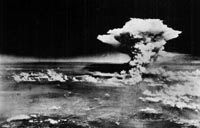

 ntaining the equation that would power atomic research: E=mc2.

 many, to a decision which will, in the light of his own troubled conscience, either redeem him or damn him.

 And in Japan, when abortion became legal in 1949 there were 246,000: the fateful day over three times over - things are so bad that older women are buying "healing dolls" to replace children who weren't born.