Showing posts with label tesco's. Show all posts

Sunday, March 7, 2010

street drinking: syrup and paint-stripper

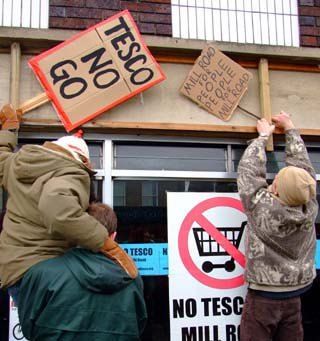
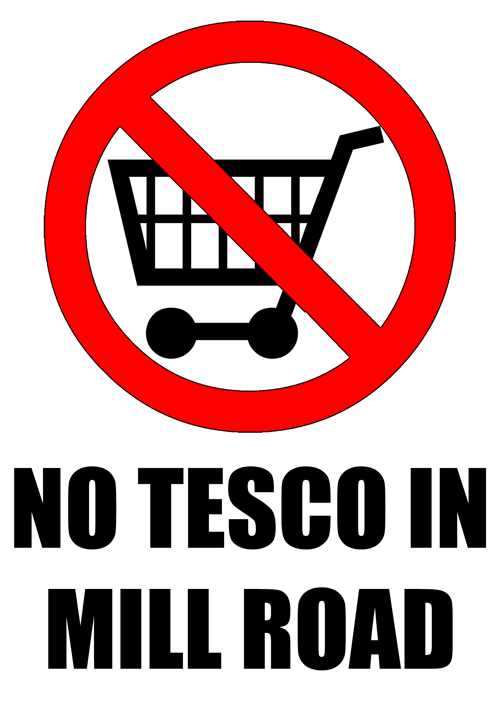
no mill road tesco poster: click to go to campaign homepageThe staff of Cambridge's Mill Road Tesco deserve an award for tenacity in the face of eejits, as in merely opening the store they scored a gruelling victory over vested interests mounting a predominantly anti-capitalist campaign under the name of the No Mill Road Tesco Campaign.

The store has recently had an application to sell alcohol turned down - see Cambridge resident (expected to stand as an Independent in the next election) Richard Taylor's helpful and exhaustive account - on account of its being in a cumulative alcohol impact zone, which creates an assumption against granting new licences to sell alcohol.

What got me thinking was how alcohol gets into the hands of people in Mill Road with problematic drinking patterns in the first place. So as soon I was able I went to the end of Mill Road nearest town and walked up the mile-odd length, paying attention to the shops that sell alcohol.

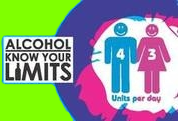
Like any other consumers of alcohol, street-drinkers are partial to their favourites - most commonly Carlsclick for more informationberg Special Brew or the other 9% lagers on sale. (The manufacturers observe the Memorandum of Understanding between the Department of Health and the Alcohol Industry on putting sensible drinking reminders on their cans, despite the fact that the contents of a single 500ml can of 9% lager, containing 4.5 units of alcohol, put the drinker above the government's recommendation of 2-4 units daily). Strong ciders also appeal to their palate, so I think it's significant - thanks again to Richard Taylor for his report - that Mill Roapresumptuous posters?d Tesco had pledged to sell no beers or cider above 5.5% alcohol - the equivalent of 11º proof in US measurements.
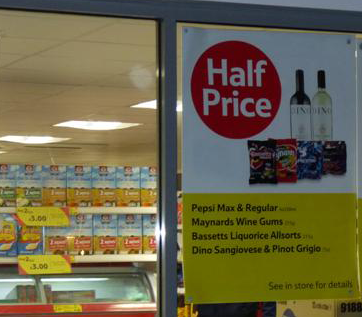
So No Mill Road were being rather disingenuous in making a noise about the local Tesco store's admittedly presumptious display of posters offering cheap wine: one doesn't often hear of pinot grigio-fuelled disorder.
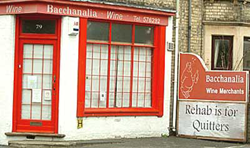
Which isn't to say that there hasn't been controversy with wine in Cambridge: in 2008, a wine-shop in the city's Victoria Road called Bacchanalia, which is opposite an Alcoholics Anonymous centre (and has a sister-store on Mill Road) displayed a sign proclaiming Rehab is for Quitters. Although one can appreciate the wordplay on one level, I think the fruit of the vine was more sinned against than sinning, not to mention people trying to piece their lives back together.

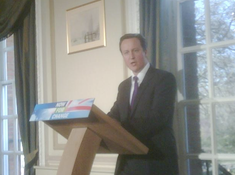
The first thing I noticed was that shops genuinely serving specific communities - eg Chinese, Afro-Carribean, Malaysian - sold little or even no alcohol. On the other hand, the cynically-named International Food Store was in reality a wallful of shelves stocked David Cameron - click to read about the whole press conferencewith wines and spirits facing a wall of beers and soft drinks, with two thin aisles of snacks in between, and in between those huge plastic bottles of strong cider on the floor. Another general store had not only three different brands of 9% lager but also a variety of strong, cheap ciders, of the chemically-derived sort that Conservative leader David Cameron once remarked had "never seen an apple".
In all, there were five small, independent stores of the kind, say No Mill Road Tesco, in need of protection against the supermarket giant which were selling drinks that specifically fuel the thoroughfare's alcohol problems. I say specifically advisedly - when's the last time you saw 9% syrup or paint-stripper cider at a dinner-party or while getting together to watch the football?

Capitalism is insensate and must needs be fenced in by legal frameworks to prevent abuses like, for example, the sale of alcohol to minors, directly or through adults. Both the Co-op and Tesco, as far as I'm aware, will not sell to adults who are known to pass on to underage street-drinkers; so why caclick to read a blog on binge-drinking by James Brokenshire MPn't smaller stores be leant upon to refuse to sell to people who are drunk, or who are known to drink in the street? Many people buy drinks from stores because pubs are forced to keep their prices high - releasing the legislative garotte strangling them wouldn't stop street drinking, but it could prevent people taking drinks home in a habit that has the potential to spiral dangerously, and would widen the cadre of social drinkers in pubs in whose self-interest it is not to let each other get out of control.

And while I'm on my wish-list, how about doubling the price of superstrong lagers and ciders?

Friday, August 28, 2009

Tesco: single-issue activists in tatters

The Tesco Express (small store) has only been in Cambridge's Mill Road for three days, yet it's starting to feel as if it's been there forever. It's bright, airy and affordable, and the staff are friendly.

So what was all the trouble about?

Richardc Normington, Prospective Parliamentary Candidate for the Conservative Party - click to go to website
Although resistance to Tesco's planning application for the store first came onto my radar last March, the cause of the confusion manipulated by a disaffected minority was summed up recently by Cambridge Conservative parliamentary candidate Richard Normington, who recently attended a planning meeting in the city convened to determine whether should the council enforce its own planning guidelines.
Why bother with rules if you do not plan on enforcing them? However, the City Council has overruled its own guidelines to the point that the council is treated with ridicule by many of those putting in applications. Did you know that two in every five appeals against the city are successful?
Indeed, in the planning meeting last March, "The recommendations from council officers and consultants in every case was that the Council should approve the proposed changes, usually with conditions. Arguments were backed up with reference to Central Government advice, history and the context of the Mill Road area in a 153-page agenda." All but one were refused.


The anti-TeDavid Howarth, Liberal Democrat MP for Cambridge City - click for webpagesco cmpaign has been backed up by the city's Liberal Democrat MP David Howarth, who was a witness to an assault on a 66-year-old woman collecting signatures for a petition in favour of Tesco's. To his merit he offered himself to the police as a witness; but although I realise MPs must immerse themselves in all aspects of life in their constituencies, I wonder why he was concentrating on keeping Tesco away from Mill Road while on the same thoroughfare you can buy cannabis seeds, second-hand firearms and hard core pornography, while elsewhere in the city there are problems with drug-taking, prostitution, benefit-ghettoes and drink-fuelled violence at chucking-out time. Tesco's, it seems, should be the least of his problems, and the whole situation reflects the risks of mixing with single-issue activists to the exclusion of people who are on the other side of that issue.David Howarth (far left) helping collect signatures for the No Mill Road Tesco campaign

There are those who say that Tesco's opening will herald shop closures and job losses. They will, of course, be proven right, because shops have been closing and jobs been lost for some time now - it's called a recession.

Something that may militate in Tesco's favour is the lack of an alcohol licence, in the context of accusations that the outlet - in reality a small shop among small shops - will become another source of cheap booze in an area plagued by problems related to the stuff. A dry Tesco's, I believe, will throw light onto the true source of inexpensive strong lagers and ciders whose brewers are well aware of their target market. They are sold in some of the very independent traders whom the No Mill Road Tesco Campaign affects to protect.

The campaign is, of course, in tatters, a fact recognised by judge Lord Carlisle of Berriew when he threw out Campaign member Richard Rippin's attempt to force a judicial review of the Council's decision-making process: "This application is in reality an attempt to revive the No Mill Road Tesco Campaign under the guise of a Judicial Review claim. It is a misuse of Judicial Review".

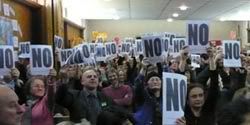
single-issue activism: anti-Tesco campaigners crowd out the opposition at a planning meetingOn Wednesday morning, Minora phoned me from outside Mill Road Tesco's to report that there were a few Campaign members outside the entrance, flanked by watchful police officers. While Campaign supporters had been quite vociferous when protesting in the Cambridge Folk Festival, these would only give a terse "I can't comment", presumably having been well-warned. It's a sign of the times that pragmatism has won out over ideologically-based censorship, and anybody who doesn't like Tesco's will be free to use any of the meny other shops in Mill Road. That's how free choice works.
Thursday, April 30, 2009

travails of the Jabberwock

In 1865, Lewis Carroll (Charles Lutwidge Dodgson) opened a new dimension for children of all ages with the publication of Alice's Adventures in Wonderland, which had to wait until 1871 for its sequel, Through the Looking Glass, and what Alice found there.

The latter contained a poem called Jabberwocky, concerning the hunt for and killing of the Jabberwock by an unnamed protagonist who is addressed by the poem's narrator as "my son". I was introduced to this poem in school and still remember the rather scary "snicker-snack" of the vorpal blade. I had actually met the titular creature before in a children's book called The Jabberwock in which it was presented as an altogether more friendly creature, although I've never been able to find it since. I must say, though, I do like the toves - creatures who are part badger, lizard and corkscrew, who live under sundials and eat cheese. That's my kind of wildlife.

The poor Jabberwock has since largely fallen out of the public consciousness, even though the first verse of the poem which gave him life appeared in a short story called "Mimsy were the Borogoves by husband-and-wife team Henry Cuttner and C.L. Moore under their pseudonym Lewis Padgett, in the classic American magazine whose time-worn issues I used to hunt in fairs in Glasgow, Astounding Science Fiction Magazine (later known as Analog):

'Twas brillig, and the slithy toves
Did gyre and gimble in the wabe;
All mimsy were the borogoves,
And the mome raths outgrabe.

The context is that a future multidimensional being called Unthahorsten, who is "childish in many respects", has sent boxes of toys back through time. One is found by seven-year-old Scott Paradine, who is attracted by the "tesseract" (hypercube) in the form of an abacus, while his two-tear-old sister Emma falls in love with a doll which can be taken apart in the manner of anatomically-correct models, but whose innards are not quite right. A similar doll is found in another box by Dodgson's (Carroll's) young muse, and teaches her Jabberwocky, which she makes the author promise to reproduce in his work verbatim.

It turns out that the first verse, taught to Alice Liddell by her "magic toys", is a set of instructions in how to connect flotsam so that it will conduct the Paradine children to Unthahorsten's dimension "in fragments, like thick smoke in a wind...in a direction Paradine [pater] could not understand". Paradine and his wife, as has been explained by child psychologist Holloway, have been "conditioned" to think in Euclidean geometry, while children's minds are so unconditioned as to be alien territory to adults.

I loved the story. My favourite period for American sci-fi is from the mid-fifties to the mid-seventies, but there were publications like Astounding Science Fiction who had been releasing intelligent output by writers conversant with science for more than a decade beforehand. What really impressed me about Mimsy were the Borogoves was that the authors drew upon Carroll's 1879 work Euclid and his Modern Rivals, written to defend Euclid against emerging theories of non-Euclidean geometry, and placed it in the context of the counterintuitive theories offered by 1940's quantum physics (whose seductive appeal remains to be consummated). The story's "crazy angles" certainly feel more comfortable than the "obscene angles" put to work upon the doubtful agendas of HP Lovecraft's corpus.

Where all this is leading is that today I watched The Last Mimzy with Minima. It was, supposedly, based on Mimsy were the Borogoves and so could be said to be related to the poor forgotten Jabberwock. In this version, however, the childish mutidimensional being is replaced by a desperate scientist from a future time when humanity's genes have become so poisoned that life in the open air is unimaginable without toxin-filtering exoskeletons.

The box sent back through time is spotted by five-year old Emma Wilder and recovered by her brother Noah, who is taught by a piece of perspex to speak in such a way as to make spiders alter the way in which they spin webs. His sister adopts the teddy-bear Mimzy (sic), but she is introduced to Jabberwocky by her babysitter, who flees when Emma makes some stones spin in mid-air then atomises her arm inside the circle formed inside them. If you're lost, then you're on the right track.

In the film, Holloway is replaced by Larry White, (eleven-year-old) Noah's science teacher, representing a dumbing down in every way. He is passionate about the abuses wrought upon nature by poisons created by humankind, which he summarises by displaying a two-headed snake preserved in formaldehyde. Call me reactionary, but I would have shown the kids the effects upon humans of, say, the Bhopal disaster, which would have given them much-needed nightmares while removing the risk of them being near formaldehyde.

A unique element in The Last Mimzy is the Mandala, which is a series of ornate patterns contained within a circle pioneered by Buddhists, but also used by Hindus. White's partner is seen chanting in a Buddhist fashion in front of Hindu icons, so presumably we are meant to assume that "it's all the same thing". As in Mimsy were the Borogoves, the toys instruct the children, but there's no knife-edged disappearance. It's all rounded corners and warm fuzzy assurances that everything will be okay. Okay, that is, as long as we stay away from major centres of population like Seattle and the big bad enforcer of the Patriot Act (the only major black character in the film).

In the film, Mimzy is not an anatomy-doll but is found to be an impossibly sophisticated artificial life-form with the legend Intel inscribed at a level only an electron microscope can detect. Having escaped from a high-security US installation, Emma's tear lands on Mimzy. Noah, who Emma describes as "my engineer", enables the toy to be returned to the future, and suddenly an industrial dystopia becomes the garden of eden redux, which allows a boy and girl to shed their exoskeletons and head outside, the light obliterating their near sides so that they look like two halves of the same person.

I was left feeling empty and unsatisfied by the film for the same reasons that I am left feeling insulted and patronised by much of what passes for modern science. I realise it might be mischevous of me to suggest that scientists started to sound like theologians some decades ago because they were merely occupying ground vacated by some theologians; but it seems strange to me that on the subject of whether climate change is predominantly due to the activities of humankind, for example, so-called scientists waste public money labelling freer thinkers than themselves as equivalent to holocaust deniers, people who deny the link between HIV and AIDS and irresponsible drivers.

If establishment scientists spent time doing science, they might have discovered that the oceans are rising faster than computer models before the free thinkers, because the latter spend at least as much time in the real world as sitting in front of computer models.

And if idealogues like Richard Dawkins, whose declamations upon religion from a strange dissociated place that makes ivory towers look pedestrian, would stop inficting their histrionic agendas upon the media, we'd be spared from having to examine our children's videos for ideas like that, expressed at the end of The Last Mimzy, that the genotype determines the soul. Get real, guys.

And let's have a cheer for the Jabberwock.

Sunday, October 5, 2008

Tesco: a different view always helps

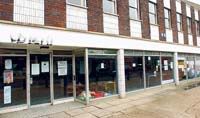
the Wilco shop which Tesco has permission to move into, with thanks to the 'Cambridge News'Yesterday's Cambridge News reported that a Cambridge City Council has finished hearing four days' of evidence regarding an appeal by Tesco's against decisions to refuse permission to the chain to install an extension and plant into a shop void which the Council has already given it permission to move into.

This story has been running all year in the face of a concerted anti-Tesco campaign which has included submissions to the Council from Germany and Australia. It has included a 600-strong protest march, a petition containing over 4,000 signatures, and a dedicated facebook group.

However, a related Facebook group called Let's turn Mill Road into chains free zone unintentionally puts my own argument into a nutshell:

Mill Road is an extraordinary street on which it is possible to drink Arabic coffee or fine wines; where you can worship in a Mosque, a Hindu shrine or a Baptist church; where you can eat foie gras or fish and chips, tom yum or chicken tikka lababda; where you can stock up on herbs and spices from aam to zedoary.
My argument, and that of many others who are too busy to march down Mill Road, is: which of the above is a Tesco Metro going to threaten? (Although I'm a bit doubtful about the claim for foie gras; the last mention of it in Cambridge I recall was when a restaurant selling the delicacy was vandalised by animal-rights protestors. The story made me feel tempted to develop a foie gras habit.)

As well as being able to access all of the above, there are more goods you can buy on Mill Road - cannabis seeds and the means to grow them, second-hand firearms and hard-core pornography. In this context, I was surprised to learn that Cambridge's MP David Howarth is supporting the campaign against Tesco's opening in Mill Road: there are more important issues affecting the thoroughfare.

Like, for example, Lib Dem Councillor Kilian Bourke's plan to make Mill Road a shared space. I'm not saying that removing signage and road markings would not make motorists think more carefully about what they were doing, but the No Mill Road Tesco campaign's own video shows how busy the road can get; I don't see the wisdom of removing demarcation between those parts of the road used by drivers and those by pedestrians. The Wikipedia article linked to above states: "Shared space zones are very frightening for the blind and partially sighted who cannot visually negotiate their way with other road users, as the lack of separation implicit in these schemes has also has removed their safe space".

I'm rather unhappy with the video as it gives no indication of the time of day it was taken - during term time, much of Cambridge is practically gridlocked, not just Mill Road, for the school runs. When I was in town the other day, I saw how vulnerable the road was to stoppages when a huge Co-op van blocked the whole road while maneuvring into the street running down the side of the supermarket.

Which brings me to the reason why the Mill Road situation has been in my mind recently. Last week I went to an event at Cambridge University facilitated by the Co-op; it had been planned for a previous date, but a delay held it back until the week before the Tesco hearing. One of the speakers, I see from my notes, brought up the subject of the chain's own farms, which might "mitigate the impact of [pause] larger retailers". She later said that schoolchildren she spoke to thought that milk originates from Tesco's, and to much hilarity an audience member shouted, "you're really in trouble if your milk comes from Tesco's!"

I'm not saying that this event had a hidden agenda to herd Cambridge's shopping intelligentsia against Tesco's, but it reminded me that if you didn't know the smaller ethnic stores in Mill Road very well, then if you wanted anti-Mill-Road Tesco's material you went to Mill Road Co-op; and that a Tesco's in Mill Road would threaten the Co-op much more than it would, say, the tearooms, the pagan bookshop, the nail-bar, etc...

In February, the anti-campaign published a shopping-basket comparison, according to which another Tesco Express's goods were slightly dearer than goods bought in various local shops. Ok, but shortly after this the Cambridge News printed a letter from an older person who said she'd be happy to pay the difference if it would save her from walking up and down going to various shops. There's always swings and roundabouts. (I'm a little puzzled as to why the campaign differentiates between the Co-op as a "local" shop and Tesco's as a chain, though.)

The anti's have got an advantage here, in that it's much easier to proclaim oneself anti-Tesco than pro-Tesco. Myself, I'm "pro" a relatively pleasant shopping experience with a short waiting time and reasonable prices. I might get that in Asda's, Sainsbury's etc, but I happen to go to Tesco's when it's handy.

Indeclick to read about Tesco's charity of the yeared, I've always said that I prefer Tesco's; and added that if I stopped preferring it, or it was busy, I'd go somewhere else, because I do not ascribe to an ideology which classifies human beings as economic automata. I believe Tesco's would sit well in Mill Road because, with shops as with people, it takes all sorts.

Related posts:

Do the shopping, stuff the skunk
Normal service will not shortly be resumed

Saturday, August 2, 2008

a trip to Tesco's

Maxima's brother Arietinum is visiting us. We needed to get some supplies, and got a bus out of the draughty old fen and ended up in one of Cambridgeshire's larger Tesco's. I filled him in about the ongoing saga unfolding in Cantabrigia's Mill Road, whereby a Tesco's store which had received basic planning permission was receiving a level of opposition unprecedented in Cambridge because it was...Tesco's.

After the planning meeting before last, when permission for air condithe no mill road tesco campaigntioning and refrigeration plant was refused, but the planning permission remained, the No Mill Road Tesco campaign threw a wobbly of epic proportions and sent in the squatters, who proclaimed that the shop area was now the Mill Road Social Centre. It ran events such as comedy nights, women's rollerskating sessions and tango classes; there was also talk of martial arts classes at one point, in order to prepare for "aggro when the police come", but that notice was soon removed. Anyway, the police raided it again yesterday, evicting five or six squatters. I imagine it'll soon become a cause célèbre after the fashion of the storming of the Bastille. I hope Tesco's moves in soon, if nothing else it might make the Co-op put its prices down a bit.

Arietinum brought over a bag of herbs and complained that he knew a shop in London where he could get six times the amount for a lower price. I invited him to take another bus journey into Mill Road to one of the shops that are supposedly endangered by Tesco's (like the Chinese/Korean/Malaysian/Afro-Carribean deli's and the head and wig shops, I suppose). He demurred. I asked him why he hadn't brought supplies up from the shop he mentioned if it was so great. He replied he'd first been attracted to it because it sold feta cheese in basins of salted water, then fell out of love when he saw the shop-owner filling up one of the basins with the contents of tins.
furred and feathered friends
We had a brief verbal tussle over the eggs, as Arietinum had once had nightmares after visiting a battery-farm. Personally, I'd debeak the buggers myself to make our budget stretch further, and give me time to concentrate on sink estates, knife crime and corrupt governments. (Professor Calculus, no animal welfare activist, disagrees: he says that if you can tolerate battery farms then you can tolerate anything.) But Arietinum won, and somewhere a hen is enjoying a better lifestyle than many British people.

And so we caught the bus back to the draughty old fen. I hope that by Arietinum's next visit Tesco's will have a store in Mill Road, so that Arietinum can buy herbs, lentils and overpriced eggs to his heart's content, and I can buy mince, tatties, the
papers, milk and a bottle of wine in the same store for a reasonable price. If Tesco's is busy, I'll go to the Co-op - that's how choice works in a free society. And everything on the one bus journey. click to read John Redwood's 'In Praise of Tesco'

Thursday, March 6, 2008

normal service will not shortly be resumed

There was a Cambridge City Council planning meeting tonight to determine whether a supermarket would become a tenant of a void shop-site in a busy street. In normal circumstances it would be a matter of whether porceedure was followed in the light of central government guidance and the local policies.

The East Area Committee meeting in St Philip's Church, Mill Road, was not about planning permission as such, which had already been given, but concerned three proposed changes - an extension to the building, a recessed autobank and illuminated signage. The recommendations from council officers and consultants in every case was that the Council should approve the proposed changes, usually with conditions. Arguments were backed up with reference to Central Government advice, history and the context of the Mill Road area in a 153-page agenda. Yet normal circumstances did not prevail.

As I chewed over earlier, Tesco's is applying to open an Express store in Mill Road. This is being hotly contested by a campaign which has whipped up support from traders in Mill Road, those who buy from them and others who live in the Mill Road area. The MRC Laboratory of Molecular Biology in Cambridge, Addenbrookes Hospital's Department of Clinical Biology, the Thomas Coram Research Unit in the University of London's Institute of Education and Fox Studios Australia were also mentioned in the Council agenda as having registered "general anti-Tesco objections".

One thing the anti-protesters and I agree on is that Mill Road is a cosmopolitan area. It's a pity, then, that the protest newsletter mentions only that the street has 13 grocery stores, and doesn't detail, for example, that one specialises in Chinese food (not to be mistaken with the Chinese/Malaysian specialist store), another in Korean, a polyglot one covers Asian, Arabic, Persian and Afro-Carribean provender and yet another specialises in "exotic vegetables".

There are many shops in Mill Road. Today I took a walk from the bottom end, nearest town, to St Philip's church over the railway bridge, passing 115 ground-floor businesses (I counted them), mainly shops. Of all the shops which we were warned face extinction were Tesco's to move in, only a greengrocer's, a newsagent's and one of the specialist grocery shops displayed anti-Tesco's fliers in such a way that they were visible to somebody on the street. The other fliers were displayed by a wig shop, an antiques emporium, an "alternative" bookshop, a nail-bar and a low-cost shop (the one where you can buy paraphernalia for smoking cannabis among the address-books and happy-birthday posters).

These were all on the same side of the railway bridge as the proposed Tesco's. The only one on the other side, where most of the food stores are concentrated, was almost a mile away near the city end of Mill Road, a health-food store that advertised itself as "100% vegetarian". With several outlets selling Halal meat in the vicinity, Tesco's seems a strange choice of windmill for an outfit that is so stridently 100% vegetarian to tilt at.

So what happened? The lack of proposed parking spaces seemed an advantage, strangely, because Government guidance states that


"Car parking also takes up a large amount of space in development, is costly to business and reduces densities. Reducing the amount of parking in new development
(and in the expansion and change of use in existing development) is essential, as part of a package of planning and transport measures, to promote sustainable travel choices."


PPG13 Transport (2001)

The warning that people might park illegally held no water with the advisors, who wrote that the Council could not grant or withhold permissions on the basis of whether people might break the law. The spokesman for the Cambridge Cycling Campaign warned of dangers for cyclists due to increased traffic. He made the remark that he would oppose these proposals "even if the applicant was the most ethical fairtrade shop of the same size." It was a perfectly fair remark for him to make, given his interest, but it was badly received: there was an angry hum and people looked at each other dismissively.

Perhaps we were getting close to the hub of things: the applicant wasn't "the most ethical fairtrade shop", it was Tesco's. It's not the sort of chain that is well-liked within the trendy white activist clique that was predominantly represented in the audience on behalf of this cosmopolitan community. Sonia Cooter, speaking for the No Mill Road Tesco's campaign, referred to the company's "global reach", perhaps not noticing that globalisation wasn't on the agenda of the Cambridge City Council East Area Committee that night. She tried to seem open-handed by saying the campaign would have taken place had any of the "big four" (Tesco's, Sainsbury's, Asda, Morrison) applied for the void property. Council officers anticipated this by quoting Circular 11/95, "The Use of Conditions in Planning Permissions":

92. Since planning controls are concerned with the use of land rather than the identity of the user, the question of who is to occupy premises for which permission is to be granted will normally be irrelevant. Conditions restricting occupancy to a particular occupier or class of occupier should only be used when special planning grounds can be demonstrated, and where the alternative would normally be refusal of permission.

Was it perhaps a failure of nerve in the light of so many voters displaying placards, including one which said "We will remember your decision on polling day?" Or an entry on the No Mill Road Tesco Site reminding councillors that "the crucial point is to avoid the danger of an appearance of bias"? I don't know. What seemed strange to me, however, was that two councillors who were members of the Cooperative Party, which has strong links with the Co-op, felt that their membership was not a conflict of interest. Strange, this, as the Mill Road Co-op has been a major displayer and supplier of anti-Tesco's material. An enthusiastic Cambridge Co-operative Party member maintains a blog and has participated in the Co-op/Tesco's debate; although he is not a Co-op employee, he's certainly fervent.

When I got home to the draughty old fen, the Council's decision was the first item on the BBC1 10.30 news. One scene was of a group of protesters showing the strength of their feeling outside St Philip's before the meeting.

This didn't just happen. When I was about to go into the church, a rather attractive woman from the BBC stopped me, seeming to think I was one of the protesters. When I said I wasn't she lost interest, story of my life. Then she found a genuine protester, and instructed him not to let the other protesters enter the church, so that her team could film a show of anger outside for the night's news.

So what was tonight about? It certainly wasn't about the various ethnic minorities who live, move and have their being on Mill Road, as they just got on with things, going into their respective stores to buy what they needed to make a cold English night seem a little more like home. Nor was it about solicitude for the road-users of the area; as it is, if you want to drive or cycle down Mill Road, you have to navigate half-blind around a series of vans and lorries supplying the shop (including the behemoth that was at the side of the Co-op before the meeting tonight).

Perhaps it was, at least, partly, about power: about white liberals being seen to protect the tenure of shops catering for Chinese, Malaysian, Korean, Arabic, Persian and Afro-Caribbean food-stores, safe in the knowledge that they can't lose because those shops need no protecting in the first place. And about identity: not ring-fenced ethnic identity, but that of working-class Brits (regardless of the amount of melanin present in their skin) who just want to pop into a store that will sell bacon, eggs, black pudding, Lincolnshire sausages, crisps, a bag of tatties and the Express for a reasonable price, all in the same place.

Or perhaps it was about Britishness or, more precisely, the absence of Britishness that trendy white liberal Brits think is the crucial requirement for multiculturalism, whatever they think that is. Me, I'm not on a crusade - I just want black pudding, tatties and the paper, in a road where normal circumstances prevail.

Related posts:

Do the shopping, stuff the skunk
Tesco - a different view always helps

Tuesday, January 15, 2008

do the shopping, stuff the skunk

Having been born with the disability of XY chromosomes, I find shopping traumatic. It's an activity I dread. So it may be no surprise that, although purveyors of things that Maxima decrees we need are generally not of much interest to me, I find it easier to shop in establishments whose layouts and staff let people with better things to do get in there, get the job done and head back home.

Talking of which, not a million miles from the draughty old fen, there has been a hullabulloo about the proposed building of a small Tesco's store in Mill road in Cantabrigia.

The main thrust of the case against Tesco's is that it would threaten the livelihood of the other traders in Mill Road. This is a very diverse area, it is true. But surely ipso facto this is an argument against any shop opening up in the space left by the old Wilco shop, in that it will threaten the livelihood of at least one other shop in the road. It's called competition.

We are told by the people who run the "No Mill Road Tesco" campaign that it is not its remit to make anybody feel threatened, but makes a lot of the fact that it once managed to marshal 600 people to join a march down the road. Even though 110,400 Cantabrigians elected not to march, the presence of 600 angry people outside the window of a small outlet - and the proposed convenience store will be an "Express", a small shop among small shops - would leave me feeling threatened.

Tesco's is a successful enterprise, and I think this is what the ringleaders of this confused campaign are really protesting about: capitalism. That being so, they should extend their protest to include every shop in Mill Road, because they're all there to make money. Sonia Cooter, the co-ordinator of the No Mill Road Tesco campaign, states that people who want to shop at Tesco's are "misguided", and that "independent stores on Mill Road are cheaper." Those would be the charity shops, Sonia. And even they exist to raise money for their respective causes, thank God, showing that capitalism has a heart. One might also wonder why Miss Cooter protests against one shop opening in Mill Road, when the neighbourhood of Romsey, which she represented for last year's Mill Road Winter Fair has been decimated.

Another moan is that the presence of a small Tesco's will endanger pedestrians and cyclists. Much of the danger in Mill Road is caused by precisely these two groups. There are also cars and motorbikes that drive on the wrong side of the road at high speed to try to overtake the traffic creeping into or from town, depending on the time of day.

Still, if the protesters find themselves confused by the facts, they can indulge in the last refuge of the liberal by crossing the road to buy paraphernalia for using cannabis (at best) in a discount store. In case their ideologically sound hand-wringing leaves them tired and emotional, the relevant items are marked with pictures of cannabis leaves or Mephitis mephitis. I don't see Tesco's putting that particular shop out of business, and even less the head-shop up the road.

In fact, unless Tesco's Express starts providing rosaries, wigs, acupuncture, betting facilities, hard-core pornography or second-hand firearms, I think even the shops in the immediate vicinity are safe.

I plan to use Mill Road Tesco's. If I should change my mind, I'm going to dare defy the received wisdom of the comrades that everybody within two miles will march into the store like automata, and choose to shop somewhere else. In the draughty old fen, we call that thinking for ourselves.

Related posts:

normal service will not shortly be resumed
Tesco: a different view always helps