Showing posts with label women clergy. Show all posts

Monday, May 24, 2010

first TV abortion ad: new medium, old agendas

I've just seen Marie Stopes' advert on John Smeaton's site and, although I should be doing an application form right now, had to get blogging. First, have a look at the advert.


It starts pretty unremarkably with "Jenny Evans" standing at a bus-stop, and the graphics telling us that she is late, ie has not had her period when expected.

Then the interesting stuff starts. We go to "Katie Simmons", who is also late. She is propelling a baby in a pram with one hane and trying to control a toddler with the other. Marie click to read about 'Madame Sterilisation' on Tibet-TruthStopes' message, you might think is that two is enough; three would be too many. However, when you see the difficulty she's having with two children, the subliminal message becomes clear: one child is enough, two are too many. Fittingly, Father Tim Finnegan of The Hermeneutic of Continuity reports the visit last week of Ms Li Bin, called "read more about Li-Bin's visit to Marie Stopes in LondonMadame Sterilisation" (she heads China's forced sterilisation policy) to Marie Stopes' London headquarters. He links to Tibet-Truth, which says of Marie Stopes International that it is "an organization which by its silence, and open support of the Chinese population program, surely merits criticism and challenge".

The last lady we see is "Shareen Butler", a black lady who is in a pottery class. Here we come to the rotten core of the population control movement, as is witnessed to by Arnold Culbreath, Urban Outreach Director of US organisation Protecting Black Life. In asking why abortion providers are particularly interested in building sites in poor black areas of the US, we get a glimpse of their ugly agenda.

In today's Telegraph, trainee consultant Max Pemberton cries for less heat, more light on abortion, protesting that he sat in on a Marie Stopes counselling session with a patient who had been abandoned by the father of her unborn child. The session ended with the patient, contrary to what Pemberton would have wanted, deciding to keep the child. Personally, if I was a Marie Stopes counsellor and a columnist for the Daily Telegraph - known to be friendly to Judaeo-Christian traditions and the pro-life cause - was sitting in, I would have made sure that the pregnancy was continued as well. Tellingly, Pemberton reveals that the woman had a mental illness, in another confirmation of the pro-choice/anti-life eugenics agenda of the abortion industry.

If abortion services are going to advertise their wares on TV, why are pro-life organisations still barred from using this medium to raise awareness of the possible and proven side-effects of abortion? I can only hope that the Coalition Government will do what it can to level the playing-field which has been skewed in favour of the eugenics lobby for the best part of a century. All I can say to strengthen their resolve in this project is: your voters are watching you.

Friday, April 10, 2009

Maundy Thursday - beyond the comfort zone

I'm trying to get over a period of not having gone to church. I'm it sure how it happened, but I realised recently that suddenly not going to church had become as normal to me as going had quite recently been.

I went to morning prayer at St Gallicus the other day and admitted this, whereupon Revd Cantiana deftly defused a potentially difficult situation with on of Christendom's best weapons - hilarity. She remarked that I'd been to church twice on two consecutive days and, given that they wanted to hold on to me, proposed chaining me to a pew.

For me the Maundy Thursday Eucharist has always been the most powerful of the church's year, because it celebrates Jesus's kingship over all things, including the most elusive and unforgiving - time: it is a memorial of the first Eucharist, where Jesus offered himself as paschal victim on the Cross to the Father the day before he was crucified.

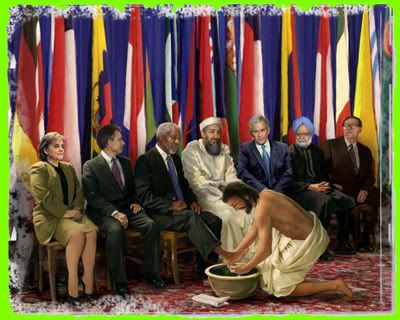
Cantiana had indicated that she wanted to wash my feet beforehand, so I scraped out the mushrooms between my toes (a shame: it looked like being a bumper crop this year). She spoke about her first experience of washing feet, which had taken her out of her "comfort zone". I have to admit I was also out of my own, because I've never had my feet washed by a woman before. I'm pathologically Glaswegian in that I'm not all that much into being touched.

Her touch was loving, soft and gentle, and, I think, gave me an insight into the discomfort the Apostles must have felt when Jesus - the Son of God who united all humankind (read Luke 1:26-38 alongside a basic genetics textbook) - washed their feet. Cantiana's leaving us soon. I'm not quite sure where she's going, but I think it'll be a better place soon.


beynd the comfort zone - what would Jesus do? - click to read Greg Boyd's reflection on Lars justinen's painting

Sunday, February 15, 2009

Saint Valentine's night


I don't always have the sunniest disposition, but excelled myself this morning, not having slept well for several nights. I growled through a shift at XV, the draughty old fen's charity shop, then went home for some kip. Awaking a bit more refreshed, I was still a bit unsure about going to a Valentine's night dinner at a place in another old fen I'd never been to before.

When she'd dressed up, Maxima looked amazing, and indeed looks better on a daily basis than I think of giving her credit for. An older friend of ours had laid down the law to me that I was NOT to have her cycling through the country in her good frock, so some friends called to pick us up.

Our destination was a barn that's functional around harvest time, but for the rest of the year it has flooring put down and gets hired out for weddings, dances and general events. It was high-roofed, with an intricate array of beams supporting the roofing, and tables waited on by a mixture of professional staff and local clergy.

I'm told that Cambridge and its environs has the highest concentration of choirs per square mile in the world. I don't know if that's true, but the local old fens have their fair share of singers. A group of four of them sang Grace in Latin before we started eating. I calmed down - food tends to do this for me. The dinner was exquisite beyond my descriptive skills. But the night was composed of far more than food: candles burnt on every table, with a little wooden heart, painted red, for everybody and a rose for every woman. I initially had a headache looking at Maxima through a candle-flame, but once some of the wax had melted I realised she looked amazing by candle-light, her eyes glittering like Loch Lomond under the full moon.

There was a "silent auction" whereby guests could submit bids for a list of promises, from an hour's conversation with a French-tutor to the whole works for a dinner-party for eight. In many of the old the fens, poverty and riches live cheek-by-jowl, as they have done for centuries, and even now ideologues of a certain political hue haven't managed to set the relatively poor and the relatively rich at each others' throats - but that's for another time.

I believe there were some pretty good bids made, by people who make a reasonable living out of doing jobs that need to be done, and doing them well. And amidst the bolting of stable doors almost a decade too late because of the actions of a few madmen, some are upping sticks and heading for foreign climes where they aren't treated as pariahs, and all the best to them. Settings like tonight's are where payouts and bonuses are recycled quietly - the auction, and indeed the whole night, was set up by Rector Pellegrina to help build a primary school in the diocese of Vellore in India, which is the twin diocese to that of Ely.

Our singers treated us to madrigals from different ages, starting from Hélas Madame by Henry VIII; I hope they were singing it because of the serial widower's facility with a bon mot, and not through any insights he might have had into keeping a partner. They took us, in several sessions alternated with a local girl playing music from Bach to the Bee-Gees on the piano, through Victorian times to the roaring twenties, then left us with what they (rightly, in my opinion) described as the best love-song ever: Robert Burns' My Love is like a Red Red Rose. I can't find it in madrigal form, but here's Scots songstress Eddie Reader singing it:


I am never in any doubt about how good Maxima looks in my eyes, but it was good to see her light up when other people told her she was looking lovely. Note to self: tell her how good she looks more often.

Wednesday, July 9, 2008

women bishops - Y not?

Some time ago I sent an email to Fr Colombus, parish priest of St Quadraginta. I wrote that I considered him as one of the most morally and intellectually courageous people I've ever met, but that I had doubts about the wider Roman Catholic Church that prevented me from remaining a communicant thereof. He replied with a very nice email thanking me for all my work.

For some time I've been attending services at St Gallicus' in the draughty old fen, ably presided over by Rector Peregrina and her curate, Revd Cantiana. Somewhat appropriate, as one of the reasons I found it impossible to remain within the RC church was the unwillingness to contemplate, let alone officially discuss, the ordination of women to priesthood in its three degrees - deacon, priest and bishop.

In its 1976 "Declaration on the Ordination of Women to the Ministerial Priesthood (Inter Insigniores), the Congregation of the Doctrine of the Faith (later headed by Cardinal Ratzinger, now Pope Benedict XVI), states: "by calling only men to the priestly Order and ministry in its true sense, the Church intends to remain faithful to the type of ordained ministry willed by the Lord Jesus Christ and carefully maintained by the Apostles." In Pope John Paul II's Apostolic Letter Ordinatio Sacerdotalis On Reserving Priestly Ordination to Men Alone, he recalls that Pope Paul VI

reminded Anglicans of the position of the Catholic Church: "She holds that it is not admissible to ordain women to the priesthood, for very fundamental reasons. These reasons include: the example recorded in the Sacred Scriptures of Christ choosing his Apostles only from among men; the constant practice of the Church, which has imitated Christ in choosing only men; and her living teaching authority which has consistently held that the exclusion of women from the priesthood is in accordance with God's plan for his Church."
The passage is a quote from a reply to Archbishop Donald Coggan in an exchange of letters between the leaders of the two churches on the Anglican Communion's plans to ordain women, in which Lord Coggan stated:

It is with this in mind that we write now to inform Your Holiness of the slow but steady growth of a consensus of opinion within the Anglican Communion that there are no fundamental objections in principle to the ordination of women to the priesthood.
In the RC church there are indeed objections to ordination of women, but none are fundamental. Inter Insigniores seeks to sideline the issue by stating that female ordination was restricted to "A few heretical sects...especially Gnostic ones" which were condemned by Church Fathers. It wasn't just the Fathers who were ambivalent about women - St Thomas Aquinas (1225-1274) was of the opinion that:

The reason...for woman's being less persevering and constant than man is the weakness of her bodily complexion and the frailty of her temperament: "...ex naturali dispositione: quia videlicet habent animum minus constantem, propter fragilitatem complexionis. Et hoc modo comparantur feminae ad masculos..." Effeminacy is the name given to the vice which opposes by deficiency the virtue of constancy or perseverence, since women are generally lacking in this virtue. That is why some men are called effeminate, because they are soft and womanish, because like women they yield readily instead of persevering against difficulties.
It seems that in seeking ordination, women are facing a sort of institutionalised mysogyny that has never gone away. Pope John Paul II concludes Mulieris Dignitatem (On the Dignity and Vocation of Women, 1988), alludes to 1 Pt 2:9 in saying that "Christ looks to them [women] for the accomplishment of the 'royal priesthood'", but finds himself unable to invite women to join the ministerial priesthood - to the extent that he briefy joins the ranks of Gnostics marginalised by Inter Insigniores when he explains, in para. 26, relationship between "what is 'feminine' and what is 'masculine' when a priest celebrates Mass".

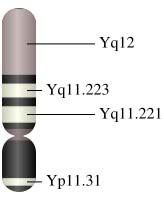
The first could it be magic?blow against mysogyny in the churches came not from religion but from science when, in 1953, Watson and Crick published the structure of DNA. Through time it was discovered that the main difference, genetically, between the genders is that women have two X chromosomes, and men have an X and a Y chromosome (left). I have never seen any evidence around what is so magical about this length of 58 million base-pairs forming 86 genes which code for 23 proteins that should restrict the priesthood to men alone.

Genetics, in fact, becomes very interesting when combined with the Gospel story, and perhaps gives us an insight into the identity of the first woman priest in Christian history. Matthew and Luke tell us that Mary conceived by the power of the Holy Spirit, as a virgin. Jesus' genetic makeup would have been the same as Mary's. Fr Columbus, in training lay Eucharistic ministers, went as far as to say that part of Mary's agony in watching her son on the cross was that the blood falling from him was her own blood. Poet Frances Croake Frank takes this one step further in her poem, "Did the Woman Say:

Did the woman say, When she held him for the last time in the dark rain on a hilltop,
After the pain and the bleeding and the dying,
‘This is my body, this is my blood’?

The RC Church has always maintained that it's position is not that it won't ordain women to the priesthood, but rather that it has no right to - for example Cardinal Walter Kaspar's (President of the Pontifical Council for the Promotion of Christian Unity) speech to the Church of England House of Bishops in 2006. The sticking point is that Christ chose men to be Apostles - but note that the title Apostola Apostolorum was given to Mary Magdalen by the Roman martyr and bishop Hippolytus in the 3rd Century. Did he have access to some information no longer available?

As Kaspar noted, ordination is one sacrament, and admission of women to the priesthood opens up admission to the episcopate. He also states that the Roman Catholic Church sees ordination of women as invalid - which seems a puzzling thing to say to the Church of England's House of Bishops, as Pope Leo XIII declared all Anglican orders invalid in 1896.

Personally, I'm glad that the Church of England Synod voted today to open up the path for women to become bishops, because surely the point is overseeing the clergy and people of God, not the chromosomal makeup of the incumbent.

Jesus' attitude to women showed St Paul up to be the man of his time that he was. Pope John Paul appeared to be of the opinion that Mary may have been present at the Last Supper as a participant - a comment that cannot be found now - and stated in the Angelus of 5 June 1983 that "every Mass puts us into intimate communion with her, the Mother, whose sacrifice ‘becomes present’ just as the sacrifice of her Son ‘becomes present’ at the words of consecration of the bread and wine pronounced by the priest".

I look forward to worshipping in a more integrated church which has a commitment towards tackling the stained-glass ceiling, and in which the priest celebrates in persona Christi regardless of gender, celebrating the sacrifice and victory of the Man who had all of humanity engraved within the very building blocks of his body and blood. The RC Church has obviously decided it doesn't have enough gender issues to be going on with, because dark comments are being made about Anglicans who can't accept women bishops swimming the Tiber. The point about that particular river, however, is that it's swimmable in both directions.

Saturday, January 26, 2008

may they be one

Last springtime, I walked into the Anglican parish church in the draughty old fen. It was the first time since my early teens that I'd attended a liturgy that wasn't Roman Catholic (the term non-Catholic annoys me, its exclusion is so inclusive).

The last time had been for a nephew's Baptism at the local Church of Scotland. I'd never seen an altar without candles before, or experienced a Service made up forthe most part of preaching - to which the congregation listened raptly! In a typical RC church, if the priest dare preach a homily (sermon) that lasts more than 7-8 minutes then people start shuffling, bulletins are conspicuously read, and cases of acute bronchitis spring up all over the place.

Anyway, as I walked through the old wooden doors, all at once several things didn't happen: there was no lightning-storm, the floor didn't swallow me up, angels failed to weep, and nobody ran about in a panic because a left-footer had entered their midst. I found - just as I find in my RC church in Cantabrigia - a gentle, well-paced liturgy with an intelligent sermon and pauses just long enough to let the gravity and joy of what the celebration is about sink in.

The disagreement between the Anglican and Roman Catholic churches on the validity or otherwise of Anglican orders was brought to a head in 1896 when Pope Leo XIII published Apostolicae Curae "derecognising" Anglican orders; the penultimate paragraph states that the contents of the encyclical "are and shall be always valid and in force and shall be inviolably observed". The reply from Canterbury, prepared under Archbishop Edward Benson and published by his successor, Archbishop Frederick Temple, all but ends no less thunderously: "that error, which is inveterate in the Roman communion, of substituting the visible head for the invisible Christ, will rob his [Pope Leo's] good works of any fruit of peace."

Arguably, there may have been a perception in Rome that the fallout of the ritualist controversy that troubled Victorian Anglicanism may have caused more to follow in the steps of John Henry Newman, and that Apostolicae Curae might be both the stick and the carrot that would aid individuals to "cross the Tiber". So we then had the curiously-shaped triangle whereby the Roman Catholic Church recognised the orders of most of the Eastern churches (despite the split of 1054 not being due to political and other relations but to a fundamental difference regarding the nature of the Holy Trinity Itself), the Eastern churches recognised the orders of the Anglican Communion, but the Roman Catholic church did not recognisethe orders of the Anglican Communion. Convert the terms into x, y and z, and the resulting equation would give an algebraist apoplexy.

Things have not stayed so, thank God. In the RC church we had the Second Vatican Council, which today is unfortunately infamous for changes in the church which many see as not for the best, but blame for which cannot be fairly laid at its door...but that's another story. Para 13 of 1964's Unitatis Redintegratio (Decree on Ecumenism) states that "among those [Communions separated from the Holy See] in which Catholic traditions and institutions in part continue to exist, the Anglican Communion occupies a special place". Shortly after the Council was closed, Archbishop Michael Ramsey visited Pope Paul VI and they composed a joint declaration, summarised by one particular passage:

This encounter of 23 March 1966 marks a new stage in the development of fraternal relations, based upon Christian charity, and of sincere efforts to remove the causes of conflict and re-establish unity.

The favour was returned when Pope John Paul II knelt in prayer with Archbishop Runcie in Canterbury Cathedral.

A continuing dialogue between the Anglican Communion and and the Roman Catholic church has been maintained bu ARCIC (Anglican-Roman Catholic International Commission) I and II and IARCCUM.

Unfortunately, this dialogue has slowed almost to a stall because of Rome's opposition to the ordination of women. Since many of those Catholics who still hold Apostolicae Curae as infallible are also against the ordination of women in the Anglican Communion this opposition is unusual, as by their lights Anglican orders are invalid anyway. But an interesting footnote occurred in 1994 when the Anglican Bishop Graham Leonard converted to Catholicism and was "conditionally ordained" following a statement by Cardinal Hume voicing "prudent doubt concerning the invalidity of priestly ordination received by an individual Anglican minister".

Like many Anglican priests, Fr Graham was converting in protest at the ordination of women. As the point where the case against female bishops becomes unanswerable, perhaps Rome sees the Tiber as swimmable once more. So we have the situation where male clerics who are opposed to female ordinations become Roman Catholics, sometimes on that single issue alone, which sets back the cause for the ordination of women and married cradle Catholics, but strengthens the supporters of the ordination of women in the Anglican Communion and weakens them in the RC church.

Personally, I hope to see a day in the Roman Catholic Church when gender or marital status will not be a barrier to ordination. I do not say this lightly, because the Pope says otherwise: and if you're a Roman Catholic, then it's a basic tenet of how you practice your faith that you try to be obedient to the Pope.

On the other hand, supporters of the Priestly Society of [Pope] St Pius X (SSPX), who hear Mass according to the Tridentine Rite, have an interesting take on obedience. They say obedience (an evangelical counsel) to Papal authority must be at the service of faith (a theological virtue).

Someday, maybe Rome will listen to the many of us who yearn for equality of all sorts in the Church. It has always been a listening and responding organization - for example, the Council of Trent, first convened in 1545, addressed the challenges raised by the Reformation; Pope Leo XIII (of Apostolicae Curae fame) wrote Rerum Novarum in 1891 to propose a middle way between communism and unbridled capitalism - and, of course, the Apostles found a middle way between the differing evangelical needs of Jewish and Gentile converts to the incipient Christian church in the Council of Jerusalem of Acts 15.

Late last year, I went to an Advent Fair in the draughty old fen in the village centre. Both the Rector, who voluntarily lives as a single person, and her Curate, who attended with her young family, were present. I am sure that the gift each of them gives to the community, which is not fixed to their priesthood as a necessary condition of it, is all the more valuable for having been freely chosen.

Perhaps the last word, for now, belongs to the final paragraph of the Benson/Temple reply to Leo XIII:

God grant that, even from this controversy, may grow fuller knowledge of the truth, greater patience, and a broader desire for peace, in the Church of Christ the Savior of the world.