Showing posts with label terrorism. Show all posts

Sunday, February 7, 2010

start something: a cry for prayer

I've been compiling pubicity material for St Gallicus for much of the day and had resolved to have a night off blogging. Then I got an email from ChinaAid to the effect that Gulinuer, wife of imprisoned Uyghur Christian Alimujiang Yimiti from Xinjiang Province, has made a request.

Yimiti was jailed for revealing state secrets. Former British diplomat Tim Collard, who has worked in China, put this in context last year:
"revealing State secrets"...that’s pretty serious. It’s hardly a sign of tyranny – you get prosecuted for that over here. The problem is that, under Chinese law, any information which has not been specifically released by the government’s information office is a state secret. The great dissident Wei Jingsheng got 15 years in 1979 for revealing that China was fighting a war with Vietnam, although many Chinese families had already found this out the hard way.
Gulinuer's request is simple: pray. Click her photo to see a video of her request, oclick to see a video of Gulinuer's petition for prayerr click here to read the text of her petition for prayer. (And click on the photo of Alimujiang at the bottom to read about governmental persecution of Chinese house churches in general.)

Nothing's ever simple - for example, Collard suggests that one of the reasons Yimiti was put on trial was to stave of Al Qaeda sabre rattling; he had converted to Christianity from Islam in 1995. Prayer might not always bring injustice to an end in and of itself, but its always a good place to start from. Let's start something.


Related posts:

Christians in Xinjiang are suffering too

Sport isn't worth that much - Yimiti's Olympic struggle


click to read ChinaAid's latest Annual Report of Persecution of House Churches in China

Friday, September 11, 2009

9/11 2009

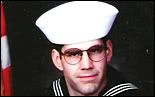
Robert John Hemenway:click to read Isramom's post
On Twitter today, I came across a post by Isramom about Ronald John Hemenway, a US sailor who died eight years ago today.

Her post was part of Project 2,996, which aims to turn Stalin's dictum that the death of an individual is a tragedy while that of a multitude is a statistic on its head by having each victim remembered individually. I quote from her bio of the sailor and father of a young family:
The decision to join the Navy eventually led him to Italy where he met and married Marinell in March 1977.
Ronald and Marinella’s first child, Stefan, was born on November 6, 1998 and for the first time in his Navy career Ronald was sent out to sea for six months to refurbish the US La Salle. His previous sea duty was no longer than five weeks. He decided to seek a position that wouldn’t take him from his new family, and went to work at the Pentagon in March 2000 assigned to the Office of the Chief of Navy Operations. Ronald and Marinella’s second child, a daughter, Desiree was born on November 12, 2000.

On September 11, 2001, a Tuesday morning just before 10:00 a.m., a commercial jetliner struck the west side of the Pentagon. Ronald was officially declared missing. On September 17, 2001 a flag was flown over the United States Capitol at the request of Senator Sam Brownback in memory of Petty Officer Ronald J. Hemenway for his dedicated service in the United States Armed Forces. Ronald was honored with others lost at the Pentagon in a Memorial Service attended by President George W. Bush, held on October 11, 2001 at the Pentagon River Parade Field. A Christian Memorial Service in memory of Ronald was held at Hope Lutheran Church in Shawnee, Kansas, on January 12, 2002. The flag that was flown at the Capitol building was presented to the Hemenway family and raised at a ceremony on Bob and Shirley’s property in Shawnee.
The majority of the 9/11 victims were, of course, Americans, but countries from Argentina to Venezuala also lost nationals (including 67 Brits).

It's not long been 9/11 in the Draughty Old Fen, and I know this will be a day of remembering and prayer for the dead and for those left behind: loved ones, of course, but in a sense everybody now alive has been left behind by the acts of terrorists whose names are now curses. Peace and safety have fled and will not be back for some time.

Remembering, too, of what happened and who did it. Who did it in the sense that it wasn't Seventh-Day Adventists, but also remembering that not every Muslim was at the joystick, and that moderate Muslims need to be given the space in which to reclaim their religion from madmen.

And remembering that some things are objectively right or wrong. For example, John Gray argues in his curiously-named Black Mass - Apocalyptic Religion and the Death of Utopia that Osama Bin Laden's goal was never anything other than supplanting the House of Saud. Personally, I don't think that when we face our Creator he'll be in the mood to discuss deconstructionalist ethics.

Please take some time to remember. To whisper a prayer, certainly; to wear a black armband if you wish; to arrange a minute's silence if you can.

But most of all, please remember.

Arms of Project 2,996: click to go to website

Tuesday, August 25, 2009

the curious case of the compassionate politician

I come from what was called, in less politically days, a "cancer family". In fact, in one of the branches of my family tree - which included my Dad - the males tended to die young, so when I woke up alive on my 40th birthday the shock nearly killed me.

For me it's a good memento mori, but it seems that the Scottish Executive's Justice Minister, Kenny MacAskill, has leapt overexcitedly out of the bath with the realisation that death invariably terminates life. He shared this with the world in part of the statement wherein he justified the release of Abdelbaset Ali Mohmed Al Megrahi, better known as the terrorist who blew up Maid Clipper of the Seas over the Scottish village of Lockerbie. There's a transcript of MacAskill's statement to an emergency session of the Scottish Executive on the Scotsman newspaper website and a video of the four-minute speech on the BBC site. The whole speech is worth listening to - if just for MacAskill's allegation that Megrahi's release is due to the actions of UK Secretary of State Jack Straw - but given my family history I was interested in this short segment:
Mr Al Megrahi now faces a sentence imposed by a higher power. It is one that no court, in any jurisdiction, in any land, could revoke or overrule. It is terminal, final and irrevocable. He is going to die.
don't make it worse than it already is
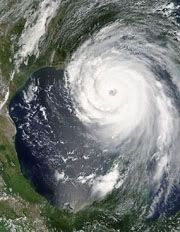
Perhaps a theologian might make a case for death indeed being a sentence imposed for the sin of Adam, but Great Britain is not a theocracy, and Megrahi's prostate cancer is no more a judgement upon him - as vile as he may be - than Hurricane Katrina was upon the populations in its path, HIV upon its 40 million sufferers, or the prospect of death upon every member of the human race.

I think this clip of MacAskill speaking about compassion in the context of Megrahi is very informative:


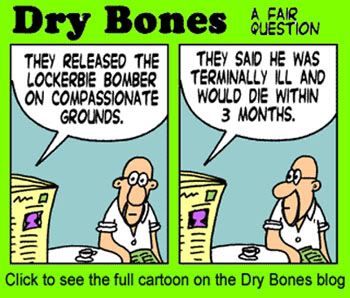
The Justice Secretary of the Scottish Executive does mention justice as well as compassion/mercy, but justice seems to lose out to a compassion that is curiously lacking for the victims of Megrahi's outrage. I don't mean to say that mercy should be gagged, merely that MacAskill is arrogating to himself the power to work out the implications of any sentence the Higher Power may or may not have delivered upon Megrahi. The shockwaves have travelled as far as Israel, where cartoonist Yaakov Kirschen drew the following conclusion:


click to go to the Dry Bones blog and read the rest of the cartoon!

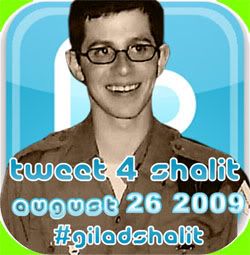
Staying in Israel, it's interesting to note that Corporal Gilad Shalit of the Israeli Defence Forces (IDF), who was abducted by Hamas militants on a raid from Palestinian territoryTweet-power: click to go to the Jewish Internet Defence Forum's tweet4shalit campaign and is being held in captivity (where the IDF promoted him in absentia to Sergeant) is being refused access to the International Red Cross, whereas Megrahi was never refused medical or other attention, and indeed had former South African premier Nelson Mandela as a prison visitor. While an exchange of 450 prisoners is being demanded for Shalit - who is the subject of a Twitter campaign (please click the pic to the right) - all that the Scottish administration and British Government asked was that Megrahi not be given a triumphal entry into Libya, which undertaking the latter's senior politicians gave then dismissed, adding insult to injury by flying the Scottish flag alongside the Libyan - prompting Middle East and terrorism expert Con Coughlin, writing for the Telegraph, to comment I cannot think of a more humiliating day for the Scottish people.


An appeal to the better instincts of politicians in reference to the health of prisoners seems to be literally a "get out of jaia postmodern solution to the jails overcrowding crisis?l free" card. First, in the UK, we had Ronnie Biggs, released from prison on compassionate grounds despite never having expressed remorse for the Great Train Robbery or compassion for the family of driver Jack Mills, who never worked again after being coshed with an iron bar until his death seven years afterwards. Bernie Madoff, no fool, is now telling his fellow inmates in prison at Butner, North Carolina, that he's "dying of cancer".

Perhaps members of the Scottish and Westminster parliaments should treat as a wake-up call the Boycott Scotland campaign, which is gaining a head of steam on a Facebook Group. I've joined this because the more pressure that is exerted to identify and punish guilty parties, the better. I don't relish the prospect of British businesses losing money, but neither do I want to see any more wrong-headed decisions release terrorists able to pass on the deadly skills that Megrahi obviously excels in. And an apology to cancer-sufferers and their families might not go amiss.

Related post: Lockerbie and the moral limits of diplomacy

Friday, August 21, 2009

Lockerbie and the moral limits of diplomacy

click to read Scottish Justice Secretary Kenny MacAskill's statement on the release of the Lockerbie bomber
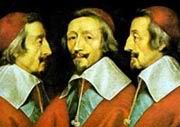
Cardinal RIchelieu - click for a biography from the Open Door websiteDiplomacy is famously fickle, something best summed up by Cardinal Richelieu's apologia for raison d'état: "man is immortal, his salvation is hereafter; the state has no immortality, its salvation is now or never". And in that line I can accept that there needs to be a way back for a rogue state willing to turn its back on terrorism, especially if there are mutual benefits to be reaped - for example, business and security interests - and this may require certain things to be smoothed over.

The release of the man accused of bringing down a jumbo jet - Clipper Maid of the Seas, Pan Am Flight 103, on a journey from London to New York - on Lockerbie in the south of Scotland has understandably caused the release of more heat than light. So much so that an important fact is being missed in the gloom.

The Lockerbie Memorial: click for a roll-call of the victims of Flight 103On December 21 1988, I was living in Glasgow with my Mum. Returning from my shift, I didn't believe the news she greeted me with as I tried to get in the door; or rather, I thought she was describing the plot of one of the cheesy disaster movies she enjoyed in what, even so recently, was perhaps a more innocent time. Coming into the living room, it took a couple of minutes for me to realise that newsflash pictures of roads glutted with ambulances, most of which would return empty, were no fiction.

To cut a long story short, an arrest warrant was released for Libyan intelligence agent Abdelbaset Ali Mohmed Al Megrahi in 1991; after being given into Scottish custody by Colonel Gaddafi in 1999, he was sentenced to 27 years' imprisonment in 2001 following a trial in the Netherlands. On 20 August 2009 - eight years later - he was released by the Scottish authorities on compassionate grounds, as he has prostate cancer.

The next day, the Telegraph reported on US President Barack Obama's fury at the move, and quoted him as saying that "We have been in contact with the Scottish government, indicating that we objected to this and we thought it was a mistake"; and commenting on the "curious silence" of British Prime Minister Gordon Brown, the paper's James Kirkup quoted Foreign Secretary David Milliband as saying that the situation was a matter for the Scottish government". Continuing the theme, Gaddafi filius, Saif Islam, has praised "the British and Scottish governments", and in a move that turned my stomach, Megrahi was welcomed back to Libya by ecstatic crowds waving Scottish flags.

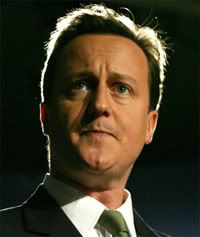
The only high-profile personality not to buy into the suppression of this one important fact is Conservative Party leader David Cameron, who wrote in a letter to Gordon Brown:
David Cameron, leader of the Conservative Party: click to read his letter to Gordon Brown in fullAs I said yesterday, I believe that the decision to release Megrahi was wrong. He was convicted of murdering 270 people, and I do not believe he deserved to be released on compassionate grounds, or returned to Libya.

The scenes of him receiving a rapturous welcome at Tripoli airport on his return will have distressed many people. I note that Colonel Gaddafi's son has now publicly thanked not just the Scottish authorities but the British Government for its stance, raising questions about the British Government's role.

You have not commented on the decision since it was announced yesterday. This morning your Foreign Secretary refused several requests to say what he thought of the Scottish Justice Secretary's decision.

The fact that the decision to release was taken by the Scottish Justice Secretary does not preclude you, as the Prime Minister of the United Kingdom, from now expressing your opinion on a subject that is of great public concern, and which affects Britain's international reputation and our relations with our allies.
The italics are mine - illustrating Cameron's control of the dog that isn't barking here: despite the Scottish Executive's arrogating to itself the style "The Scottish Government", the Scottish Government remains where it has been since 1707 - in Westminster. The only change that Scottish devolution has made to the post of Prime Minister of the United Kingdom is that the post-holder is now also known as Prime Minister of Scotland.

This is more than a minutia: Gordon Brown's senior people are colluding with Libyan authorities in attempting to devolve the blame for a diplomatic disaster onto the shoulders of subordinates - like Scotland's First Minister Alex Salmond and his Justice Secretary Kenny MacAskill - for whose conduct he is responsible.

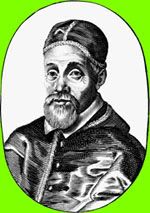
Pope Urban VIIIMoral absolutes exist and limit what we can reasonably do, even in the sphere of diplomacy. What is quoted less often than Richelieu's dictum is Pope Urban VIII's reaction to his death in 1642: "if there is a God, the Cardinal de Richelieu will have much to answer for". Last December, Gordon Brown promised that he would "throw UK diplomatic power behind Ulster's IRA victims in their search for compensation from Libya" for Gaddafi's relentless support for the terrorist organisation with money and materièl. I am not aware of any statement rescinding this support.

As Prime Minister of Scotland (amongst other responsibilities) Gordon Brown owes an explanation to the people of Scotland, the US and the two-score other countries whose nationals died at Lockerbie as to why the only individual to be convicted of the atrocity has been sent to a hero's welcome, while his victims were denied even the luxury of dying in a prison bed.

And what of Richelieu? His power-plays arguably provided Otto von Bismarck, the Iron Chancellor, with a political and diplomatic template in his struggle to unite the Teutonic states that the former had devoted his life to keeping apart. In a chilling secular endorsement of Urban's words, France was humiliatingly forced to recognise the birth of the Germanic Empire (the second Reich) in the Hall of Mirrors at Versailles at the conclusion of the Franco-Prussian War in 1871, and the rest is history.

The release of a convicted terrorist on any grounds apart from new evidence gives a discomforting message to terrorists worldwide that the members of the Scottish Executive and the British Government need to think about carefully. In an age where communications can cross continents in a second, who knows to what conflagration we will be led by the Prime Minister - skilled in neither raison d'ètat nor Realpolitik - turning his back not only on America but on his own people in Scotland and Northern Ireland in order to present Britain in surrender mode to, as Neville Chamberlain said, a faraway land of which we know little?

Related post: The curious case of the compassionate politician

Saturday, July 11, 2009

how I learnt to stop worrying and love the bomb

Gordon Brown, it seems, is considering scaling down Great Britain's nuclear arsenal in order to provide an exampe to rogue nations such as North Korea and Iran that it isn't necessary to maintain a nuclear arsenal.

Campaign for nuclear disarmament: but what if the other side doesn't disarm?I was somewhat nonplussed by this. I'm aware that CND (the Campaign for Nuclear Disarmament), founded in 1957 by - among others - Michael Foot, later to be leader of the Labour Party, proposed unilateral disarmament on the grounds that potential aggressors might be nice to us if we divest ourselves of the means to defend ourselves against them. I hadn't realised that the madness continued until today.

How many countries possess nuclear weapons? It's difficult to tell. We have, of course, the US, Great Britain, France, China, India and Pakistan. North Korea is strongly hinting that it has the beast. Both Israel and Switzerland would be mad not to have nuclear weapons. It would be surprising if South Africa didn't have the bomb, given the proliferation of uranium in and around the country.

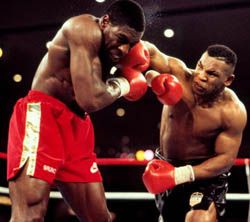
Tyson versus BrunoSo it would be interesting to see if any other countries than the US and the UK are volunteering to downgrade their defence systems. I note that on the same day that the proposal to downsize UK and US nuclear arsenals happened, we have the 20th anniversary of boxer Mike Tyson's winning the world heavyweight championship (against Brit Frank Bruno). So how did he win - by keeping his arms at his side and hoping that his example would encourage Frank not to hit him; or did he fight?

I'm not making Great Britain out to be a Great Power; I'm merely saying that we need the means to defend ourselves, and if that includes having a nuclear deterrant, so be it. The whole point about the bomb is hopefully not to use it - but should matters deteriorate, we need to have the option to use it first.

To look at a worked example, take 9/11. I remember that on the day after it was reported that the attacks on the World Trade Center should be treated as use of weapons of mass destruction.

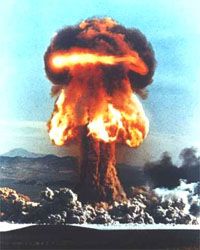
we can't undo itSo, imagine that the Afghan government had been given, say, 48 hours' notice that a low-yield nuclear warhead would land on a sparsely-populated area. They would have done one of two things: evacuate the area, or bus people into it on the point of a gun. But, if the threat had been carried through, one thing would have been certain: that the free world was prepared to defend its freedom with all the resources available to it.

I hope, and I pray, that nuclear weapons are never used. But if there is any chance of their being used against us, we need to be in a position to assure potential aggressors that what is received will be given back.

Lord, we are broken people: if it be your will, bring us to a time when we need study war no more.

Monday, March 30, 2009

G20 - all fools' day for protestors?

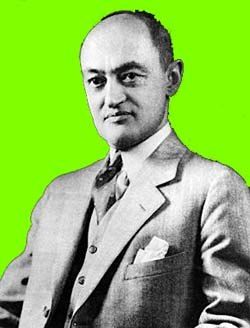
Joseph Schumpeter - click to read moreclick here to go to update
Tomorrow, April 1st, is being called by some "Financial Fools' Day", as activists get ready to protest against the G20 gathering in London by marching in four columns representing the "four horsefolk [sic] of the apocalypse" to meet at the Bank of England at noon.

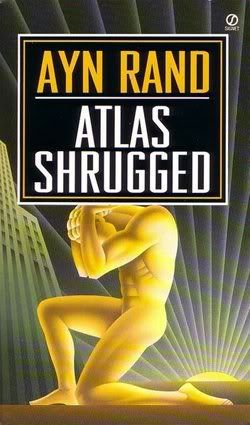
One of these is a former Playmate of the Month called Marina Pepper, who now writes books, including Spells for Teenage Witches: Get your way with Magical Power. Another is Chris Knight, a "radical anthropologist" who teaches at the University of East London, one of whose books is Blood Relations: Menstruation and the Origins of Culture. I am reminded of Capitalism, Socialism and Democracy, wherein economist Joseph Schumpeter (above) states that capitalism is ultimately doomed because it "would spawn a large intellectual class that made its living bAtlas Shrugged - click to read a reviewy attacking the very bourgeois system of private property and freedom so necessary for the intellectual class’s existence". (Lawyers for Ms Pepper please note - I am not accusing her of being an intellectual.) This theory was bleakly and believably novelised by Ayn Rand in her classic Atlas Shrugged.

The main thesis of the protestors seems to be that through the capitalist phenomenon of globalisation, people in charge of investing other folks' money, chiefly bankers, have gotten out of control and led much of the world into a financial crisis which we, the people now have to pay for. So far so good, but the relatively few bankers who precipitated this crisis appear to have done so without the help (or indeed knowledge) of world leaders, and it is hubristic of those leaders to think they can cobble together a solution in a matter of hours when it took allied leaders and expert economists 22 days to put a shape to post-war finances in 1944's Bretton Woods conference.
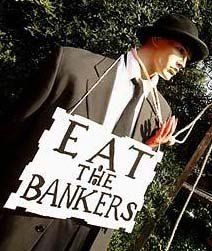
ominous: a dummy in a noose hung by Professor Chris Smith of East London University
If the leaders are hubristic, then the protests' arrangers are living in la-la land in thinking that they can bring off a peaceful protest, given the inflammatory language used by Prof Knight et al, urging people to "take our protests to the belly of the beast", "burn the banks" and "eat the bankers" (no thanks, I get terrible heartburn). What do they expect?

If violence should occur, activists of this sort always have a convenient whipping boy. The first stroke was lashed last week when The First Post's Matthew Carr opined that levels of policing at this gathering of leaders representing "90% of global gross national product, 80% of world trade and two-thirds of the world's population" was asking for trouble.

What is, in fact, asking for trouble, is the financial situation which is neither going to be alleviated by any amount of horsefolk of the apocalypse in London, nor resolved by a big meeting of bigger egos that will last, at the very most, for less time than a police officer's shift.

Outside ofYulia Tymoshenko, Prime Minister of Ukraine - thanks to AFP/Getty for the pic the G20, Ukraine, which has signed a deal tying European Union to invest billions in the gas pipelines it depends on and aroused the ire of the behemoth to the north-east in doing so, looks to be heading towards bankruptcy amid a bitter struggle between its president and prime-minister that is benefiting ultra-nationalist parties; Pakistan, of course a nuclear power, is also cruising towards ruin as it half-heartedly struggles with the terrorists osmosing across the line on the map separating it from Afghanistan.

Within the G20, from China - vying with Russia for the title of the world's biggest rogue state - has come a book calling for French president Nicholas Sarkozy to be "punished" for meeting the Dalai Lama, and outlining its wish to do to the world what it is presently doing to much of Africa; and Argentina is also heading for the financial crash barrier.

But I get the idea America'll still end up getting blamed...
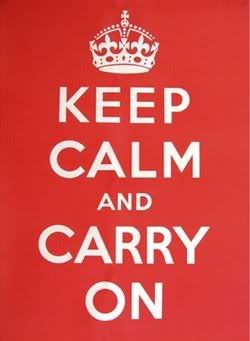
keep calm and carry on: Winston Churchill's government intended the poster for a post-democratic Britain should we lose WWII, but it has now become very popular
In short, things are bad. But then again, they've been bad before, and they'll be bad again. It's the good bits in between that make it worth it; the little graces that often have little to do with money. I don't know if we'll have to take the advice of the unreleased World War II poster to keep calm and carry on, but one thing that possibly even Schumpeter failed to appreciate is capitalism's ability to make accomodations - that's how it survived the attritions of well-meaning liberal-socialist new beginnings all over the globe.

There's an old curse that I've heard attributed both to the Jews and the Chinese - "may you live through interesting times". I hope April 1 in London is as boring as it can be. But if there are casualties or worse, Professor Chris Knight can blame the traditional enemies of democracy all he wants, but he may have to answer to the University of East London, Great Britain and even abroad for his troublemaking.

I pray that the police have as uninteresting a day as possible on April 1.


UPDATE:

On Wednesday, 1 April, a newsagent called Ian Tomlinson collapsed and died of a heart attack while making his way home close to where the riots were going on, but not taking part in them. An inquest has returned a verdict of natural death. Three witnesses say he was attacked by riot police. This is contested, but the witnesses appear to have forgotten the reason the police were there, being their own aspiration to "storm the banks" and "burn the bankers". Mr Tomlinson is survived by a wife and children, who have not blamed the police.

go back to top

Thursday, March 26, 2009

cctv - putting human wrongs in the picture


BREAKING NEWS: I published this post yesterday on the misuse of rules intended to combat terrorism: this morning, the Government has demanded that social Networking site Facebook hand over records of British citizens accessing it - click here to read why Gordon Brown's no friend of Cambridge Conservative Parliamentary Candidate Richard Normington.
I get the Adam Smith Institute e-bulletin, and was interested in the quote at the bottom of this week's:
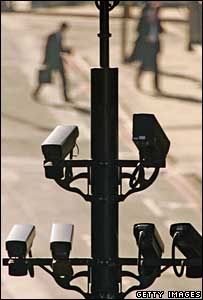
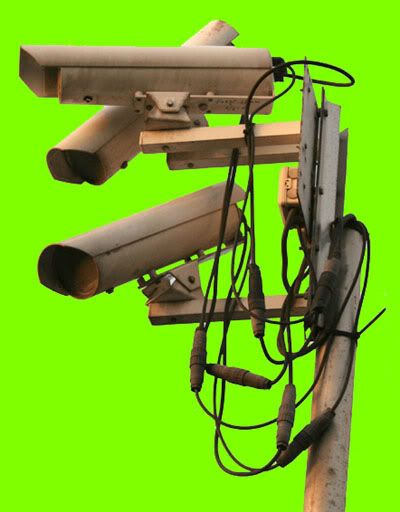
CCTV in LondonWe are rapidly entering the age of no privacy, where everyone is open to surveillance at all times; where there are no secrets from government.
William O Douglas (1898-1980), America's longest-serving Supreme Court Justice
How true, I thought: especially in Great Britain, where, among all the other intrusions into our privacy, we have four million CCTV cameras - one for ever four people on the island.

Glasgow is Scotland's largest city, and had 400 of the damn things in 2006. I remember, when I lived there, a consso sue me: this is the Kensington conwoman caught on one business's cctvultation process concerning where to place them in one particular area, not too salubrious, where the councillors were extensively lobbied by individuals who turned out to be working for drug-dealers keen to protect the places where they did business. But that's nothing compared to the 40,000 cameras estimated to have been in place in London the next year.

You might say that the need for maintaining law and order over-rides our right not to have our images examined by overt and covert cameras, and that would be a fair point: but iOliver Wheen - thanks to the Argus for the pict doesn't work in practice. There was an outcry when jewellers in London's Kensington district were prevented from distributing the image of a conwoman who had stolen thousands of pounds worth of goods taken on CCTV, on the grounds that it would contravene her human rights. When 16-year-old Oliver Wheen jumped through hoops to get access to CCTV footage that would identify the thief who had stolen his iPod from a school changing room, going so far as to make a freedom-of-information (FOI) request to Brighton and Hove Local Authority to see the footage, he was frustrated at every stage - because his viewing the pictures "would infringe the rights of the thief."

As annoying as this is (an iPod costs more than anything I possessed as a teenager), Manchester band The Get Out Clause demonstrated a cool take on surveillance when they performed their single Paper in front of CCTV cameras in the city and requested the footage under FOI rules - successfully, surprisingly, although guitarist Tony Churnside noted that some firms merely procrastinated until they could legally destroy the images.


But all this becomes small meat compared to the human wrongs perpetrated by authorities and lawyers around CCTV images. For example, the Telegraph's Martin Beckford reports that a social work department placed a camera in the bedroom of a couple with learning difficulties to monitor how well they looked after their child - who slept in a different room. Unusually, the department found itself on the wrong side of the Human Rights Act, not having observed Government guidelines on maintaining the couple's privacy.

I say unusually, because privacy is an ever-rarer commodity. Beckford continues:


Recent figures show three-quarters of local authorities have used powers granted under the [anti-terrorist] Regulation of Investigatory Powers Act to spy on residents suspected of putting their bins out on the wrong day, allowing pet dogs to foul the pavement or breaking school catchment area rules.
Here's another one for the list: last December, Raymond Brown reported in the Cambridge News that Cambridgeshire County Council had used surveillance techniques intended to investigate terrorism against Rashmi and Dips Solanki, who were suspected of employing paper-boys without permits in Melbourn, a village south of Cambridge.

Alex Dolan - thanks to PA for the pic; click to read the BBC's accountSo you would think that a little bit of private enterprise in the field of CCTV would not go amiss. But no: news broke today that Alex Dolan, a science teacher who captured shocking footage of misbehaviour by school authorites while filming undercover for a Channel 4 Dispatches documentary in 2005, has been banned from the classroom for a year. Despite the fact that she found abuses like the worst-behaved kids being sent away on a trip on the day of a scheduled OFSTED school inspection, the General Teaching Council did not accept that what she had found justified undercover filming of pupils (who could be captured on the street by a Google Streetview car), and it possibly revealed more than it intended to when it said that there were no "exceptional circumstances".


So what does the future hold for a society in which we have no control over our image except if we can get human rights lawyers excited; where we can appear on Google but we can't access images of people who have stolen our property; where, in Great Britain, we have one-fifth of the world's CCTV cameras, but they only solve 3% of crimes? The only answer I can think of is that if the rights of the state continue increasing at the rate its responsibilities to its subjects wither, the future holds a widening sense of revulsion leading to the current disaffection reaching tipping-point, which I hope can be contained by the ballot-box.


cameras at sunset

Thursday, February 19, 2009

why we need to talk about the Muslim Problem

In Lionel Shriver's literary thriller We need to talk about Kevin, we are presented with a series of letters from the mother of a deeply disturbed boy, who goes on to massacre other children in a school, to his father.

That section of the press which is free of ideological blinkers is increasingly sending us warnings - letters, if you will - about a problem we have in Western society, an elephant in the room which will soon crush those who delight in pretending it isn't there.

The sustained Muslim surge towards hegemony in our civilisation is revealed in the pedestrian as well as the horrific, in footnotes and appendices as well as screaming headlines.

For example, the Telegraph's Nick Britten reported recently that in Birmingham's "mixed-race area of Hall Green", it is no longer possible to buy ham on the produce of Domino's Pizza, although Halal options are available - an honour whose equivalent has never been extended to the city's 3000-strong Jewish comunity. The Halal Food Authority's president, Masood Khawaja, commented sinisterly: "This is only the beginning".

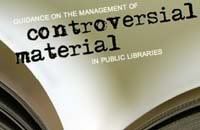
This week, it was reported that Leicester City Council's libraries department has decided to put the Koran on upper shelves, as Muslims believe that their sacred text should be "placed on a high shelf above commonplace things". The news that this was happening was broken by the Museums, Libraries and Archives Council in their publication Guidance on the management of cotroversial material in Public Libraries in section 5.1 of Appendix C, on page 41 of a 42-page document.

Although the city's Federation of Muslim Organisations advised the council, who sought it's advice, that all sacred books should be put high up so that the major religions' texts are seen to be equal, it remains to be seen whether the Muslims of Leicester, who have been repositioning the Koran unilaterally, will tolerate their book being placed alongside the Jewish and Christian Bibles.

What I find somewhat concerning is the use of the word "appeasement" in these stories and many like them, no doubt meant to evoke images of Neville Chamberlain flapping his piece of paper on which was Hitler's guarantee, gained at the 1938 Munich Conference, not to go to war with Great Britain in return for a promise of non-agression upon Germany's imminent annexation of Sudetenland, the German-speaking part of Czechoslovakia. The point about this story is often missed: Hitler had wanted negotiations at Munich to break down as a pretext to start a war, because he knew Britain's air defenses were inadequate, and some trade-unionists were agitating to slow down the already hesitant process of producing Spitfires, preparing to make their opposition to production of war matériel overt when the secret non-agression pact between Hitler and Stalin would be made formal with the Molotov-Ribbentrop pact of 1939.

Hitler was furious with Mussolini for crowing about his role in bringing about the agreement on Chamberlain's piece of paper, for in deferring a war the victory was Chamberlain's. I think a much more appropriate comparison for the present situation comes from the First World War, when the German High Command arranged for Lenin to be transported in a sealed train from Switzerland to Russia, where the disorder caused by his agitation would take Russia out of the war and let Germany concentrate on its western front. The Soviet empire that resulted from German strategy displayed the law of unintended consequences in spades.

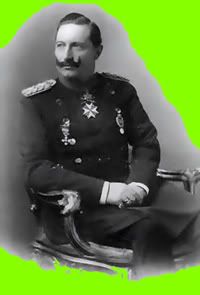
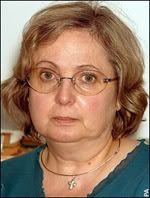
Similarly, Labour has encouraged the growth of a militant atheist clerisy that favours Islamism at every turn in order to oppress our long-standing Judaeo-Christian culture. Gone are the days when socialism owed more to Methodism than Marx, a point Gordon Brown was at pains to demonstrate in his biography of the left-wing Scottish MP, James Maxton. Just as Kaiser Wilhelm INadia Eweida - victim of political correctness.  Thanks to the Daily Telegraph and the PA for the pic.I's recruitment of communism as a weapon of war eventually led to the fracturing of his country for 45 years, so corporatist fawning to radical Islamism in the self-declared fight against traditional British values has cloven Britain into effectively untouchable radical militant preachers of hate and terrorism, their cannon-fodder, and the rest of us. And political correctness, a concept formed upon the orders of Lenin, is the favoured armament.

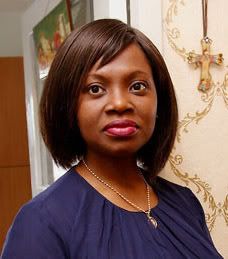
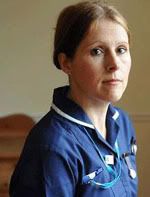
The attrition is visible all over the place. Nadia Eweida, banned by British Airways for wearing a cross visibly at work; Lilian Ladele, the registrar who had to resort to litigation against London's Islington Council because she felt that "marrying" gay people was contrary to her Christian beliefs; Caroline Petrie, a district nurse suspended by the NHS because she offered to pray for a Lilian Ladele - victim of political correctness.  Thanks to the Daily Telegraph for the pic.patient; and, most recently, Jennie Cain, sho was suspended from the school where she works as a secretary, her crime being having emailed friends from her home asking for prayers when her five-year-old daughter was reprimanded for talking about Jesus to a classmate.

On the other side, as Archbishop Cranmer explains, militant Labour peer Lord Ahmed recently bullied the House of Lords into banning democratically-elected Dutch MP Geert Wilders with the threat that he would mobilize a private army of 10,000 Muslims against Parliament if he were to arrive to give a talk and show his film, Fitna. Given that Wajid Shamsul Hasan, Pakistan's high commissioner to Great Britain, has made a thinly-veiled threat about emotions running high among the million-strong Pakistani diaspora in the UK over allCaroline Petrie - victim of political correctness.  Thanks to the Daily Telegraph for the pic.ied actions in the war upon terror, I can easily believe that Ahmed's figure of 10,000 stormtroopers under his command is realistic figure.

Breaking news today is that the preacher of hate Abu Qatada has been awarded compensation by European Human Rights judges because he was imprisoned without trial. Qatada is fighting deportation to Jordan for fear that he might be tortured there. If he was truly Osama bin Laden's right-hand man, why isn't he being encouraged by all necessary means to provode intelligence here that might protect British and US civilians and troops? I'm sure Allah would reunite him with his fingernails before deciding what to do with him and his associates for trampling the reputation of a fine religion into the mud.

And there's the rub. Islam once had a wonderful reputation for scholarship and tolerance that is fading fast. This is affecting me as well. For example, when lawyer Saleca Faisal Parkar won a discrimination case against her employers for egregious abuse on the grounds of race and gender, I was left feeling cold because of the actions of her co-religionists.

Anyway, here's something for you that the House of Lords was never allowed to see: the first part of Geert Wilders' film Fitna. I don't link to it, containing as is does disturbing images, out of any desire to cause offence, but because the elephant in the room has grown to such mammoth proportions that it threatens to trample us all, and this is why we need to talk about what I can find no name for other than the Muslim Problem. If watching it makes you feel a bit overwhelmed, try singing a hymn afterwards. How about Onward Christian Soldiers?

Monday, January 12, 2009

epithets and officers

There's been a big debate in Great Britain right now about a three-year-old video made by Prince Harry (the Queen's younger grandson) in which he refers to a colleague from Pakistan, Ahmed Raza Khan, as "our little Paki friend".

Things are getting out of hand. For example, one agitated caller to today's Jeremy Vine Show, who said he was a Pakistani living in the UK, said that the term "Paki" was charged with much more negative emotion than the term "Brit" or "Yank".

That's where the fellow lost my sympathy. I suspect he's never been in a quondam Glasgow to watch columns of IRA supporters marching down the street shouting "Brits out!" and, British citizens (mostly) themselves, baying for the blood of "Brits" in the Army stationed in Northern Ireland. As for the term "Yank", if he addressed this to somebody from the Southern States of the US - as I once did out of ignorance many years ago - he might not get the response he expected.

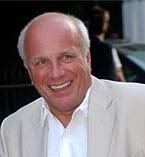
When "Paki" and other terms based on unalterable characteristics are used aggressively as insults or abuse, there's no excuse. But having watched the News of the World video embedded in the Telegraph report linked to in the first paragraph, the term doesn't come across as Greg Dyke - pot calling the kettle blackinsulting or abusive. Certainly the reaction in this country to a friendly gibe made in an Army environment doesn't bear any resemblance to the "British tolerance" which Gordon Brown assured the Indian people of when he visited to the sound of riots over the prolonged racist treatment of Shilpa Shetty in Celebrity Big Brother; and I certainly don't recall any Pakistani voice raised in protest when Greg Dyke, former Director General of the BBC, called the corporation "hideously white". I wouldn't be surprised if much of the present furore is coming from Brits who are as hideous and as white as the IRA supporters.

The then-cadet, who received the élite award of the Sword of Honour from the Queen at his passing-out parade and is now a Captain in the Pakistani army, has not made any complaint in the three years since the home-video was made. But his father, also an officer in the Pakistani army, has complained bitterly.

I rather think the father is more culturally Pakistani than the son, in the sense of being closer to the concept of Pakistan as an ethnocentric theocracy. One of Pakistan's founding fathers was Mawlana Abul A'la Mawdudi (1903-1979), who stated that Islam is

a revolutionary concept and ideology which seeks to change and revolutionise the world social order and reshape it according to its own concept and ideals.
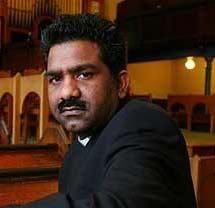
I qReverend Mahboob Masih - victim of Islamic ethnocentricity (with thanks to the Telegraph and epicscotland)uote the above because of another story involving somebody born in Pakistan that broke on Sunday - and in my home town - showing that people from that country can definitely be genuine victims of discrimination. Reverend Mahboob Masih of Awaz FM, which serves the Asian communities of Glasgow, was debating the views of Zakir Naik, who states that Jesus is not the only person who is the "way, the truth and the life".

This may be a fair comment for a Muslim to make in the context of Islam, but Naik, who has been criticized by Muslims in his native India for issuing fatwas (sharia rulings) with no authority to do so, demands that Christians recognise Mohammed with the equal reverence that they afford to Jesus. Rev'd Masih defended Christianity, and found himself sacked by Awaz FM, which claims in its mission statement to be "the voice of Glasgow’s ethnic communities and their respective faiths" (my italics). The Telegraph's Andrew Alderson reports that the minister has "reluctantly" apologised in order to calm things down, but has refused the station's demands that he apologise in person at the city's Central Mosque, on the reasonable grounds of fears for his safety.

I don't think those fears are overstated. The Pakistani caller to Jeremy Vine's show atrequiescat in pace - Shabana (with thanks to the Telegraph)tempted to show how downtrodden Muslims were in Britain by stating that it was unacceptable to insult Georgina Bailley, but not to insult a Pakistani. I think he said more than he realised - namely, that in Islam, women are viewed as being worth something less than men. Case in point: today's Telegraph reports the murder of one of Pakistan's famous dancing girls called Shabana by the Taliban because the terrorist organisation considered her dance too erotic. Given that Georgina Baillie is a burlesque dancer, I hope the remark wasn't meant to be as sinister as it sounded.

I hope also that Prince Harry gets what he deserves - a bollocking directed at stopping him from putting daft remarks on tape, especially when that tape might fall into the hands of papers owned by the anti-monarchist Rupert Murdoch.

You can take that as the authentic ethnic view of an honest Jock. (I changed a washer today...does that make me Jock the Plumber?)

jock the plumber?

The Jeremy Vine show referred to in the second paragraph can be accessed until Sunday 18 January 2009 - click here

Tuesday, January 6, 2009

a hero is honoured

Detective Constable Stephen Oake RIP Detective Constable Stephen Oake was a brave man. On an operation to arrest a relatively lowly Al-Qaeda associate, he was faced instead with failed asylum-seeker Kamel Bourgass, whom the Telegraph's Nigel Bunyan describes as "a trained assassin and one of Osama bin Laden's most ruthless followers". Protecting his colleagues, he received eight knife wounds, three of which were enough to kill him individually.

Shortly after his death in January 2003, he was nominated for the Queen's Gallantry Medal. And he got it - in January 2009.

So what happened? Basically the George Cross Committee, composed largely of senior civil servants, decided that DC Oake didn't meet the "extremely high" criteria for this award. Basically they were saying that, in taking on a senior member of the organisation which was happy to fly aircraft into the Twin Towers of New York and bomb public transport in London, he wasn't brave enough - directly the opposite of what was written by former Labour Prime Minister Tony Blair when he closed the online petition, signed by 8000 people, to have the medal awarded.

It seems twho cries for Israel? Click and have a readhat liberal-socialist control of means of communication is an attempt to cut a democracy off from the very stuff of its life - access to the truth. Case in point - in Cambridge, Liberal Democrat MP David Howarth attended a rally to highlight the "siege on Gaza for the last 18 months", without any mention of the approximately 5,000 rockets which former Foreign Secretary Sir Malcolm Rifkind states have been fired at civilian targets in Israel from Gaza over the last 3 years, many smuggled from Egypt. (Backspin is currently liveblogging the ferocious media war surrounding the Gaza campaign.)

DC Oake died a martyr to the cause of preserving our democratic heritage against many-faced dark forces who hate tolerance, peace and, above all, freedom. The fact that the campaign to honour him has not only pierced the most politicised civil service ever but troubled Government at the highest levels shows that his sacrifice was not in vain. But the question remains, how many terrorists are still living illegally in the UK as failed asylum seekers, waiting to create more martyrs?

read the eulogy from Stephen Oake's funeral service

Thursday, December 4, 2008

memo to parliament: it's Martin or you

In early 1979, I went to a Labour political meeting in Glasgow with my Mum. She would never say how she voted, a discretion perhaps developed as part of growing up with one parent voting Conservative and the other the Independent Labour Party.

She felt the occasion merited attendance, though, because the serving MP, Richard Buchanan, was handing the baton to his successor, Michael Martin. Buchanan had been a well-loved MP, and Martin was to become one, because they understood one key thing: the conservative values that non-Marxist Labour voters of a certain vintage demanded from their politicians as regards, among other things, right and wrong.

I'm sure I don't need to go over the story of how Damian Green, Conservative MP for Ashford and Shadow Minister for Immigration, was arrested a week ago today (November 27) for expressing concerns that Government policy on immigration was out of control, these concerns - voiced in emails between Government figures and civil servants - having been leaked to him by a Home Office civil servant.

MP's are arrested now and again, for various things; but this case is crucially different because Mr Green was arrested for acting in three capacities: as a Member of Her Majesty's Loyal Opposition, as a Conservative MP and as a Shadow Minister carrying a portfolio on immigration. In other words, for doing his job.

The last attempt to arrest MP's for doing their job was by King Charles I in 1642 (he was rather miffed, they had tried to impeach his Queen over Irish affairs; you might say he lost his head). The then Speaker, William Lenthall, famously replied:
May it please your Majesty, I have neither eyes to see nor tongue to speak in this place but as the House is pleased to direct me, whose servant I am here.
Martin has not showed the same selflessness. As the Telegraph's Andrew Pierce reports, he seems to have been separated from his sense of right and wrong since his accession to the post of Speaker shortly after his accession to the post in 2000. For instance, in 2001, his diary secretary Charlotte Every departed amid Martin's suspicions (despite his occupying a non-political post) that she was a Conservative; shortly after, Standards Commissioner Elizabeth Filkin departed at the end of a lengthy Labour hate campaign, accusing Martin of downgrading her post; and in a chilling insight into how Labour really plans to manage ID cards, Martin's wife objected to her friends being asked to show security passes in order to enter the Houses of Parliament.

As opposed to the situation in Washington, the Speaker of the House of Commons, in his or her position of "First Commoner", is required to break all party-political links in order to represent the interests of MP's of all parties and see to the good running of the House. Martin has showed nothing but partisanship, which is a disappointing fall from grace for somebody who'd had a reputation as a damn good constituency MP.

Despite predictions - mostly from left-wingers - that this is all going to die down and soon, I suspect that if education recovers from Labour's dumbing-down then schoolchildren will still be reading about the Damian Green affair in a century's time. It wouldn't be so bad if it were only Labour who were damaged by this, but Parliament as a whole has been damaged, and the police don't come out too well either.

The police were considered to have been politicised by Margaret Thatcher to crush the miner's strike (in reality, although many individual miners were striking over pay and conditions, NUM leader Arthur Scargill's intention was to start a conflict that would see the Government overthrown). Unless very senior officers move very quickly to assert the political independence of the force, the police will become very unpopular and even irrelevant among their traditional supporters, especially if they have to enforce measures like carrying ID cards. They may also have to answer to the individual police officers who were ordered to carry out the politically-motivated raids, and who will almost certainly find that their career prospects have been damaged.

Labour has broken the schools, the penal system, the immigration service, and indeed the spine of Merlin's dragon is starting to crack under the strain of the party's desparate mission to prove that every marriage is a untenable, every single mother unable to cope, every child in a religious household a victim. At this make-or-break point for Parliament, I hope that Opposition MP's are able to make common cause with cooler heads in the Labour Party like Harriet Harman and Tony Benn. Because once a critical mass of the people of Great Britain start to think the unthinkable, the Government may not find itself as much in control as it deludes itself to be.

Tuesday, October 21, 2008

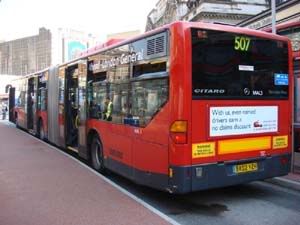
don't go down the road to hell, it's jammed with bendy-buses

one blogger's suggestion for the campaignIn order to survive, any extremist organisation has to turn public opinion against the group from which it recruits in order that some individuals in this group will become radicalised and provide the extremists with an intake.

A case in point was the methods of nationalist and loyalist paramilitary organisations emanating from Northern Ireland, which would carry out operations in such a way as to cause feelings of revulsion in the target community and polarise the non-aligned, often by using twisted logic to classify innocents as enemies and act accordingly. For example, attacks on peace-loving Irish people in London following IRA bombs weren't a side-effect of the campaign, they were one of the desired outcomes, to cause radicalisation.

A similar process can be seen in the 2004 murder of film-maker Theo van Gogh in Amsterdam. Local government, in introducing its action plan to counter radicalisation, stated: "Although we were prepared for the possibility of an attack in Amsterdam, we were totally unprepared for the abhorrent way in which this attack took place. It put an enormous strain on relations in the city."

I wouldn't want to accuse Professor Richard Dawkins of wishing to radicalise those atheists who don't accept that being so doesn't mean they have to be anti-religion in a violent way, but he is involved in an attempt to radicalise them nonetheless.

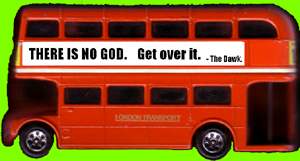
On June 20 this year, Guardian blogger Ariane Sherine reported seeing a poster posingAriane Sherine the question that Luke 18:8 tells us Jesus asked his disciples during a discourse in the house of the Pharisee where he cured the man with the dropsical hand (starting 14:1) - "when the Son of Man comes, will he find any faith on earth?". She went on to write a rather amusing article which she ended by proposing that thousands of atheists club together to buy an advert on a bus that would say, "There's probably no God. Now stop worrying and get on with your life." She states the Guardian's Comment is Free editor contacted the head of the National Secular Society for her to check out the feasibility of such a scheme. He appeared not to be very impressed, and suggested people donate to the NSS.

That same day, however, Jon Worth, who in his other life designs websites for Labour politicians, came by the post and changed it from some slightly controversial fun into something else in his blog, in which he states "you can’t spend a day in central London without being confronted by some sign that religion should be your only salvation", adding "what I really loathe is people somehow judging that those with religious belief are somehow superior beings".

He set up a pledgebank page devoted to the cause, and - despite the support of a campaign of bloggers - by the time the pledge had run out, the Telegraph's Matthew Moore reported that only 877 of the 4,678 people required had made a pledge, and the whole thing appeared "dead in the water".

Enter Richard Dawkins, who appended his name to the campaign by pledging to match funds donated up to £5500 ($9350). He seems to have somehow negotiated a deal whereby the message will be carried by as many as 60 London bendybuses for a month for £11,000 ($18,700). But a combination of Dawkins' name and a serious networking campaign (look at the messages at the bottom of Sherine's blog on the issue) led, as Martin Beckford reports, to £31,000 ($52,900) being raised.

I've been to London many times in the course of visiting family, and journeys related to my former job as a drugs-worker, and don't share Jon Worth's experience that you can't escape being "confronted" by religion. Away from the centre, I've seen a lot of hope, but also the sort of sights that drove Ralph McTell to write "Streets of London". But that's ok, seemingly, because bendy-buses will be going round telling people that "probably there's no God" (the first word is there to avoid litigation).

Perhaps wisely, some religious groups and figures have contributed to the campaign, which hopefully will draw some of the poison from it and eventually help indicate the ridiculous nature of the whole venture.

I say ridiculous advisedly - it's time to look at the website which prompted Ms Sherine's musings. (Although what seems to have exercised Jon Worth, who really started the ball rolling, was "a 40 minute sermon" from somebody who from his description may have been suffering from a mental illness.)

The jesussaid.org website opens with a welcome page and has 12 bars down the side indicating different pages. I had to open 11 of them before I came across the mention of hell that Sherine mentioned - she had obviously put a lot of work into being offended. Still, I'm sure it's had a lot of hits through all this, which is obviously a good thing.

But who is the campaign aimed at? I imagine it will offend a lot of people of many faiths or none, and am worried that the poor bus-drivers might get a bit of hassle. But the target of the campaign, I think, is atheists. Specifically, those atheists who lack the visceral fear of religion that pervades The God Delusion, and do not subscribe to the view that lack of faith presupposes hatred of faith. I've known many atheists who have no problem with religion or religionists. And the Second Vatican Council document Gaudium et Spes reminds people of faith that, regarding those who shut out God and try to dodge religious questions, "believers themselves frequently bear some responsibility for this situation". The object of the campaign is for "non-aligned" atheists to be given grief in the hope that some of them will become radicalised.

Pace Cardinal Murphy O' Connor, Archbishop Williams et al, I won't be donating to this scheme, as there's better ways I can use my donations. I can only finish by referring to the 4 pages near the start of The God Delusion that Dawkins devotes to the cartoons of Mohammed that appeared in Jyllands-Posten in September 2005, which led to riots in February 2006. Similarly, some time has elapsed from Ariane Sherine's throwaway remarks in the Guardian to the near-culmination of the campaign to put anti-religion posters on London buses; and if Dawkins thinks the cartoon outcry was a set-up, then this is no less so.

London's bendy bus: bringing a hate campaign to a stop near you

NB: I was not being facetious in comparing the bendybus campaign to those of terrorists; I believe the basic process as regards radicalisation and recruitment is the same. For those interested in the progress of Amsterdam's campaign against radicalisation I recommend a page from Muhammad Haniff, who links to a very interesting (but long) report on the process of radicalisation in the context of Amsterdam.

Wednesday, August 27, 2008

the sum of our fears

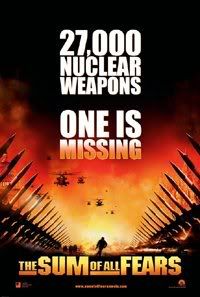
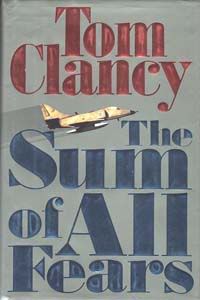
click to read Wikipedia's summary of the filmclick to read Wikipedia's summary of the bookThe Sum of all Fears
by Tom Clancy
GP Putnam's Sons 1991 (US)
HarperCollinsPublishers 1991 (UK)
pp 1030


Why, you may take the most gallant sailor, the most intrepid airman or the most audacious soldier, put them at a table together - what do you get? The sum of their fears.
- Winston Churchill

This is one of the quotes with which authour Tom Clancy opens his 1991 thriller The Sum of all Fears. I recently snapped up the DVD when it was on sale at XV, the draughty old fen's charity shop. Directed by Phil Alden Robinson and released in 2002 - it was held back when 9/11 occurred just as they were putting it to bed - it differed somewhat from the book, which inspired me to pick it out of my shelf-ful of Tom Clancy books and read it again.

In one of the DVD's special features, director Phil Alden speaks of the difficulty of rendering such a large book into a film of just over two hours. I can't argue with that - my dogeared copy of The Sum of all Fears, at 1030 pages, is around a third again as long as Harry Potter and the Deathly Hallows, which Warner Bros have found themselves having to split into two films.
Ciarán Hinds, Russian president in the film, playing Shakespeare - click for bio
The film of TSAF opens with a pilot in the 1973 Yom Kippur War between Israel and Syria over the Golan Heights flying into an anti-aircraft-missile through a fatal error. His cargo, a nuclear warhead, is buried without detonating and lies there for many years, having been covered by the Druse farmer who needs every square inch of land to eke out a living.

The book and film share this plot-point in common. They also have a stand-off between the American and Russian presidents over an atomic device that has exploded at a football stadium, made from uranium which the US stole from one of its own reactors and gave to the Israelis. The similarities just about end there.

In my opinion, The Sum of All Fears is Tom Clancy's darkest book, and, like many works which explore our shadows, his most profound. After the prologue referred to above, at the start of the book we see Jack Ryan in the midst of a physical and mental breakdown. He is smoking and drinking too much, and is experiencing problems in his relationships with his wife and son - which drive his mood lower - mostly due to overwork and "carrying" people who are senior to him but are not as good at their jobs as he is at his - and theirs.

As the screw tightens, the group whom President Bob Fowler has promoted to high office through an old-boy's network starts to break down, the chief buckler under pressure being Fowler himself. "Old boys" is the operative term - the only woman in this inner circle has attained her position through sexual favours.

It surprised me that Liz Elliott doesn't pop up in the film, because she is central to moving forward much of the American part of the plot before the bomb goes off. Those parts of the novel dealing with the downward spiral overlapping Jack Ryan's work and home life seem to comprise a meditation upon Othello (Clancy has a degree in English). In particular, how Elliott, the scheming National Security Advisor, latches on to the insecurities of the flawed ruler, but overstretches herself and finds that Cathy Ryan cannot be forced into the role and the fate of the credulous wife, suggests a recontextualisation of the play with a twist. The key difference is that Clancy has the grizzled old warrior John Clark communicate important information to Cathy about Jack’s relationship with the widow of a former comrade: Desdemona's swapping notes is the one thing that could have undone Iago in Othello. The showdown between Cathy Ryan and Elliott is a masterpiece of observation about women's cultured brutality towards each other in the theatre of manners: the sort of scene that strikes a room quiet - ostensibly through shock, in reality so the audience doesn't miss a thing.

In criticizing the film for not following the book, I realize it’s unfair to ask Alden transfer Clancy’s prose in the prologue to celluloid. He compares Israel’s challenge in the Yom Kippur war to the Greeks’ hill 235 todayvictory over the Persians at Thermopylae, the Allies pushing back Nazi lines at the Bastogne section of the Battle of the Bulge, and the Gloucesters and other regiments facing the Red Army at Korea’s Hill 235. The story arising from a solution to the middle-east crisis, TC’s references to heroic struggles against vastly superior numbers presents us with an idea of Israel’s everyday position. There are also references to Tsar Nicholas II, who is blamed by many Russians for hastening the October revolution by entering World War I while the country was in a state of military unpreparedness, and to Moedred (Mordred), the Arthurian traitor who helped bring down the original Camelot.

The crisis comes to boiling point not through military action, but when a group of students stops throwing stones at soldiers and commences on a course of civil disobedience, after the manner of Mahatma Gandhi or Martin Luther King. Footage of an Israeli policeman killing a non-violent protester with rubber bullets is beamed around the world. Ryan comes up with a possible solution to the resulting international situation: it is a brilliant vision which Liz Elliott assures is not credited to him, his crime having been to speak to her robustly. The book is the story of how that vision is attacked by a cabal of those for whom that vision would leave reasons for living, and indeed pockets, empty.

In the film, as in the book, the object of the terrorists' actions is to create a war between the US and Russia. Alden uses a special feature in the DVD to defend himself from charges of political correctness by changing the villains to a neo-Nazi group, although it appears that there was extensive lobbying by the Council on American-Islamic Relations to effect this result. One of the characters we are therefore presented with is a neo-Nazi Russian air-force officer, which frankly I find hard to swallow. Robinson could have exploited far greater opportunities for stereotype-busting by exploring the motivation of the pacifist Palestinian students. (It should be noted that Clancy defended Islam before the sun had set on 9/11.)

Thankfully, Clancy has no need to defend himself from any such accusation - he simply writes his books, and leaves it up to readers as to whether or not to spend money and time on them. We are happy to invest both.

His original villains are Palestinian terrorists who recruit a disaffected Native American as they refashion the bomb's original fissile material into a new, improved bomb. The only reference to Nazis of any vintage that I could make out was that the East German nuclear physicist Manfredd Fromm's father had been a member of the anti-Nazi resistance in Germany who was executed by the Reich, and is willingly recruited by the terrorists because he sees the Deutsche Democratische Republik's return of material and research to Russia redux as a betrayal of both his life and his father's sacrifice.

Clancy's villains are no two-dimensional baddies: they love, feel loss, and often regret those of their actions which entail the murder of innocents. He anticipates, and provides a foil to, the click for Michelle Malkin's homepagephenomenon manifested in modern politics whereby, as Michelle Malkin notes, politicians assume that educating terrorists will kindle empathy in their hearts and turn them away to a less destructive way of living. (Tony Blair's Opposition soundbite "education, education, education" seems to have been an early manifestation of this.) But TC's terrorists dismantle an atomic warhead and build a hydrogen bomb; and in the real world, terrorists learn how to fly aeroplanes, design missiles that can carry goodness knows what in the head, and manufacture chemical and biological weapons - even if they lack a heart-warming frisson, they're quite brainy. The only baddie without an emotional dimension - Marvin Russell, the Native American - is executed by his masters precisely because of this lack: he kills without it having any effect whatsoever on him, a manifestation of extreme antisocial/sociopathic personality disorder. As Clancy states succinctly, "there was something missing".

As always, Clancy tells of high intrigue through personal stories in such a way as to hold up a mirror to each of his readers. We might not understand the Washington insider or the subsistence farmer, but we understand loss and human weakness and the love for one's family that keeps you muddling on when other hopes seem fled. Jack Ryan, snowed in at his office while the bomb goes off in Denver, manifests a calm in the face of seeming hopelessness that we all have felt, that perversely helps us get through the sum of our fears in the hospital waiting room or the mortuary and back to better times. The story of how Jack achieves this, an impossible feat without the support of those who love him, is - among many other things - a story of personal redemption within a fragmented, hostile world where our enemies are not necessarily those towards whom our defences are directed, and friendship often hides under one's radar to surface at the most unexpected times. The east-west emergency having been fuelled not just by malicious design but by a spiral of errors worthy of the Bard, Jack will need to draw on all his reserves of will, refilled by his friends as, after he has declared that Fowler has disappeared into his own contradictions, he faces his greatest temptation ever.

The Sum of all Fears was written as the Soviet Union was disintegrating and was released as Russia rose from the former's ashes, and is possibly more relevant today than when it was published. I have revisited this Thucydidean epic many times, like an old friend, and each time seen something I had previously missed about the human condition, realpolitik and often both. If you are under 30 and value exquisitely-written thrillers, I heartily recommend this book. If you are over 30, read it - whether it's for the first time or the fifth - and you will see echoes of your life and your country, wherever that may be.
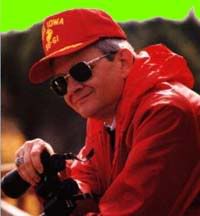
click for Tom Clancy interviews with Don Swaim

Monday, July 7, 2008

The Third Way gasps for oxygen

Via Media it ain't
Leaving St Gallicus' after a concert tonight, I picked up a copy of a magazine that I'd never seen before, called Third Way.

Much of it seemed to be a middle-class intellectualist meditation on the vagaries of life, and therefore relatively harmless.

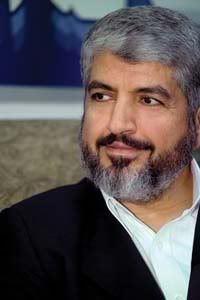
However, I was concerned to see an interview with Khalid Mish'al, who is regarded as the most senior figure in Hamas, which won a landslide victory in the Palestinian Authority elections of Wednesday 25 January 2006.

I was initially interested in the article, and looked forward to reading a neutral view of the situation between Israel and the Palestinian Authority. But my expectations were shattered, not by one of Mish'al's answers, but by one of the questions:


"Nelson Mandela famously said, 'The struggle is my life', and for many people that sums up the heroism of the man. It occurs to me that if he had been speaking Arabic, he would have used the word jihad. Can you explain what jihad means to Hamas, and in particular to you?"


If Khalid Mish'al were to choose to compare himself to Nelson Mandela that would be one thing, happy?but it is in fact the interviewer, Huw Spanner, who suggests the comparison first. This allows Mish'al to continue the metaphor at a later point in the interview:

"the Palestinians, like Nelson Mandela, feel that their life is struggle and resistance. When you live every day under occupation, your natural behaviour - This is what people in the West should understand: every day, we suffer aggression, killing and siege, with houses destroyed and families homeless."

Spanner, does have form, however: on his website, he claims to have interviewed Richard Dawkins, Philip Pullman, Yasmin Alibhai-Brown, Yusuf al-Qaradawi, Gerry Adams and Martin McGuinness. This is, of course, a highly selective list, but the devil's in the detail.

I think his sympathies come through in asking whether he clarifies whether Mish'al classifies what al-Qa'ida does as jihad, to which the answer comes:

"I don't want to talk about others, but if anybody is in doubt about Hamas they need only answer the questions: Has Hamas ever fought outside Palestine? And has it ever resisted anyone other than the Israeli occupation? Any fair-minded person will see the difference."
While wondering what was the question that Mish'al thought he was answering, I can see a parallel between this outlook and that of the last two members on the above list, Messrs Adams and McGuinness. Their original organisation, the IRA, tended to act within the confines of the United Kingdom, but the operatives were no less terrorists for that.

During the 1980's, in the context of the IRA's bombing campaigns, Margaret Thatcher spoke of the necessity of starving terrorists of the oxygen of publicity, perhaps not fully realising the degree to which terrorism would become an anaerobic beast - it is the yeast that makes the circulation and viewing figures of certain media outlets rise.

So what's the answer to the problem of magazines like Third Way giving a sympathetic platform to terrorists wishing to present themselves as oppressed freedom-fighters? The answer, I think is twofold:

Firstly - it's obviously up to the magazine what they publish, but for the sake of a balanced viewpoint I would liked to have seen an opposing viewopoint in the same issue - from Anglican Friends of Israel, for instance.

Secondly, if it's impossible to starve terrorists of the oxygen of publicity - and this appeared to be the case even in the days before the internet - then, with due deference to Mrs Thatcher, let's blast them with the stuff. Make every published sermon and piece of propaganda by Islamic extremists available to every household in Great Britain, so that those who are interested can see the agenda for themselves, without having to peer round the edges of liberal-tinted glasses of pet reporters determined to present themselves and their country in surrender mode.
click to read Margaret Thatcher's 'oxygen of publicity' speech