Saturday, June 13, 2009

education: a cover for state oppression?

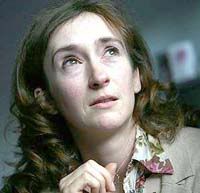
I recently accompanied a young lady to her school, a secondary faith school in the region, where she's not been doing too well academically for various health reasons that demand her absence frequently. A meeting had been arranged with her teachers.

I'd arrived slightly stressed, being aware of the extent to which governance of institutions has been infested by a managerial compulsion to ensure compliance has been achieved by conforming to governmental targets and dicta on such things as diversity and anti-discriminatory laws used to oppress people from a Judaeo-Christian faith background. Case in point: Jennie Jennie CainCain, secretary at Landscore Primary School in Devon, was told by her headmaster not to return to work after she asked for prayers for her daughter (who'd been disciplined for talking to a classmate about Jesus) in emails that never reached a school computer.

On the other hand, there are still many headmasters in the mould of the legendary Felix Porter from Glasgow, whose sometimes thunderous solicitousness for his charges pointed many a tearaway towards the right tracks. (One of the many ways in which he lives on is in an award named after him.) Working in social housing, I remember one of his successors striding into the office to inform us that we were now part of the truancy reporting scheme. We didn't argue.

It's no metaphor to call education a war-zone. For example, Radagast, a senior teacher in a Catholic school, writes of "the police visiting schools to 'interrogate' students about their beliefs".

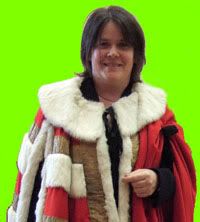
One of the major fronts in the war is home education. I wrote earlier this year aBaroness Morgan: click to read the last paragraph of George Orwell's 'Animal Farm'bout Baroness Morgan's assertion that homeschooling "could be used as a 'cover' for child abuse such as neglect, forced marriage, sexual exploitation or domestic servitude."

I find this rather strange. The man known as the "British Fritzl", who made his daughters pregnant 19 times, did not emulate his vile Austrian namesake by imprisoning the girls in a cellar: rather, he moved them around the country so that they would not make attachments who might have raised the alarm, but - crucially - sent them to schools. In a scenario that is becoming depressingly familiar, social services and police were alerted but took no further action - indeed, police told the girls' worried grandmother that "slander is a criminal offence".

Likewise, a harrowing case involving a woman accused of taking obscene pictures of young children is emerging in the south of England. But she's not a homeschooling Mum - she works in a nursery which operates from an adjoining school.

Education Otherwise, the Education Otherwise, the charity for home-schooling families: click to go to homepagecharity for families with children being educated at home, provides a laminated card for children to carry if they are picked up by police on a "sweep" for truants. I find it quite surprising that a need for them to print the information that home education is legal in the UK, given that the 2007 guidance from the Department of Schools, Children and Families on these sweeps mentions homeschooling several times. The online version links to a 2006 document from the Department of Education and Skills called What to do if you're worried a child is being abused, which lays down powers already possessed by the relevant authorities to take allegedly abused children to places of safety.

As above in the House of Commons with MPs' expenses, so below with the safety of ordinary folks' children: what is needed is not new laws, powers and regulatory bodies, but for existing ones to be used effectively and with ideological blinkers removed.

Questions remain, however, about what to do when the child abuse is state-sponsored - for example in an assembly in Bromstone Primary School in Kent, when a video of two men canoodling on a bed was shown to children as young as four as part of a drive against homophobia, leaving girls afraid to be friends with each other. Or when the state abets the abuse by rendering certain groups with "alternative" lifestyles effectively untouchable, which led to the debacle surrounding the stepfather of Baby P.

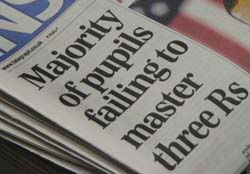
And the young lady I chaperoned to the meeting at her school? I needn't have wMaking headlines: click to go to Brian Mickelthwait's Education Blogorried. Her teachers took a blue pencil to her timetable so that she's now concentrating on three subjects, including English and Maths. They did this in the face of Government targets steamrollering teachers into fixing five good GCSE's for pupils. Had she been homeschooled, of course, this would have already been done - one good thing coming out of this farce is that more people are learning about home education than would have even considered it not so long ago.

But to my young friend's teachers, as to Radagast and all those who labour endlessly to try to get a good education for their charges in the face of government oppression, I owe something I don't think those teachers hear often enough:

Well done!


Related post: Home schooling - next in the crosshairs

Friday, June 12, 2009

I'm trying, honest...

In fact, some would say I'm very trying, not least those who live with me! Windows has a cough, and Minora's on the case, in between important things like soap operas, music and wierd Japanese cartoons. Watch this space...

Sunday, June 7, 2009

the resignations crisis - Shakespeare's view

In the hiatus between County County Election results (the Conservatives held on to Cambridgeshire and Labour saw its four members reduced to two) and finding out which parties have won in European seats - I fear the vile BNP have won in Yorkshire and Humberside - there is much struggling to find suitable metaphors for the unprecedented position Brown finds himself in.

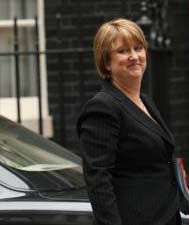
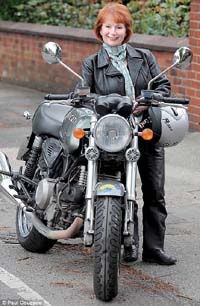
The TelegrapJacqui Smith, pic by UPI: click to see Andrew Porter's coverage of her resignation in the Tlelgraphh's Anne McElvoy compares him to King Lear, and there is certainly more than a hint of the ailing king in the Prime Minister, alluded to early in Tony Blair's premiership when an "unnamed source" referred to the then Chancellor of the Exchequer as "psychologically flawed". Former Daily Mirror executive David Seymour later identified this to have been the odious spin doctor Alistair Campbell, the same who advised reporters on behalf of BlHazel Blears, pic by Paul Cousans - click to read Andrew Porter's coverage of her resignationair that "we don't do God". (This was, of course, long before Blair joined the Roman Catholic Church and proceeded to lecture the Pope on his "entrenched" attitude on homosexuality.)

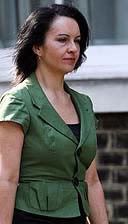
A trio of female ministers have resigned from Brown's Government in recent days: Home Secretary Jacqui Smith, Communities Secretary Hazel Blears and Europe Minister Caroline Flint. The first two resigned because of implications of the Telegraph's revelations about MPs' expenses for their integrity. Flint, however, did not have to resign, so one might position her as Cordelia, who out of Lear's daughters spoke plainly out of loyalty and filial devotion. Indeed, Cordelia says in Act One, Scene One of Lear,

But yet, alas, stood I within his grace,
I would prefer him to a better place.

Flint's letter of resignation, on the other hand, has been called "the most brutal ever delivered to a sitting Prime Minister", and contains the text

I am extremely disappointed at your failure to have an inclusive Government...I am not willing to attend Cabinet in a peripheral capacity any longer.

In my current role, you advised that I would attend Cabinet when Europe was on the agenda. I have only been invited once since October and not to a single political Cabinet – not even the one held a few weeks before the European elections.
She also objected to being treated as "female window dressing", which personally I found strange coming from somebody who had posed for glamorous pics for a Sunday magazine. Flint's no Cordelia, then.

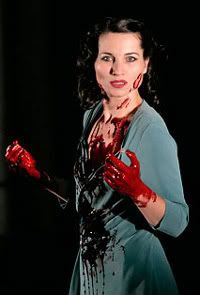
Preofessor Calculus compares Brown to Banquo, friend of his fellow general MacbeLady Macbeth, pic by BAM; unfortunately I can't find the name of the actressth, who was later killed by the latter and his wife. Not that I'm comparing any of our three worthy ladies to Lady Macbeth, who at least bolsters her husband in his conviction that "'twere well/It were done quickly" (Scene VII/Act 1). It would be hypocritical of me to say that I feel sorry for Brown, who is completing Blair's work of taking decision-making out of the hands of the House of Commons and putting it into the hands of senior executives who do nothing but set targets based on the last set of ticked boxes. But I take no pleasure in seeing him lurch from crisis to crisis, stuck in a rut of believing that he is doing the right thing.

Near the start of Macbeth, the three witches prophesy that he will be a king, but also that doomed Banquo will beget a line of them. The resignations of Jacqui Smith, Hazel Blears and Caroline Flint were timed to do maximum damage to Brown, which will ensure that any candidate for leader they endorse will receive astronomical publicity - they are, effectively, kingmakers.

But Shakespeare doesn't tell us one thing - what happened to the witches? Orson Welles, in his production of the unlucky play, adds a line to the end in which one witch says to the others "Peace, the charm's wound up"; on the other hand, Roman Polanski's bloody production ends with Duncan's son Donalbain entering the witches' hovel, indicating that he wishes to drink from the poisoned chalice of power, his older brother being king after their father's regicide at the hands of the Macbeths: the cycle begins again.

So what will become of our ladies? I think that, should they decide to become kingmakers, the one they put on the throne, fearful of Polanski's interpretation, will always bear it in mind that they turned on their leader before. They could do worse than listen to Lady Macbeth:

'Tis safer to be that which we destroy
Than by destruction dwell in doubtful joy.


Three ladies walking towards the future?  Jacqui Smith, Hazel Blears and Caroline Flint

Tuesday, June 2, 2009

please don't waste your vote on the BNP

I was delivering leaflets for the Conservative Party over the weekend on behalf of our representative on Cambridgeshire County Council, which is Conservative-run and hopefully will stay so. I met a couple who are friends of ours, who invest more unpied time in building up the community than anybody I know. I've never heard either of them make a political comment in the years I've known them, and so was pleasantly surprised to hear that they are lifelong Conservative voters.

There is, of course, a different texture to Thursday's elections, which coincide with elections to the European parliament. The all-consuming public passion at the moment is the widespread abuse of expenses by MPs of all parties; the prospect of some voters staying at home, coupled with that of others registering a protest vote, means that there are no sure things, no shoo-in cases.

And here be dragons: the economic downturn, coupled with such governmental negligence towards immigration policy that even Donna Covey (left), the Refugee Council's chief executive, wrote to the Telegraph to admit that "that there are serious failings within the asylum system", have delivered an unprecendented audience to the British National Party.

These are not under-rated truth-sayers. They are, as Norman (Lord) Tebbit says, socialists with racism, and with this aphorism he captures a key truth: a party that wants to nationalise everything in sight and micro-manage the lives of its citizens does not belong to any part of the right-wing spectrum. In this they ape their heroes in the Nazionalsozialistiche Deutsche Arbeiterpartei, which was Marxism wrapped in a flag.

But while that abberation was led by another who was so bad a manager that he had the thousand-year Reich dead in the water within twelve years, the éminences grises of the BNP, fascists as they are, are not as disordered as Hitler. The cynical manipulators at the helm have straitjacketed their public image in the iconography of victimhood, but if elected the ties will come off; and the people of Britain will relearn the lesson of their German cousins in 1933, that sometimes that which glisters is poison in a shiny bottle.

Lord Tebbit pulled a masterstroke when he advised voters of all parties to register their disaffection at the European elections by voting for smaller parties, as the primary winners would be the United Kingdom Independence Party (UKIP), who would then have to explain to their electorate why they had a surfeit of representatives in the European Parliament they so detest but none in Westminster.

However, please be aware that the BNP stand on the sidelines jealously eyeing protest votes. In this crossroads of British history all votes will count, not least those that are not cast. Vote as you will; but no matter how angry you feel - and heaven knows we all have every right to our rage - please do not abuse your suffrage in a game of Russian roulette with the BNP as the bullet pointing at everybody's head.


Monday, June 1, 2009

booze-buses from Aotearoa - an idea for England?

The Cambridge News reports that a blitz on drink-driving is starting up in Cambridgeshire - as Casualty Reduction Officer PC Barrios says, to target the "increase in the number of people going out and drinking".
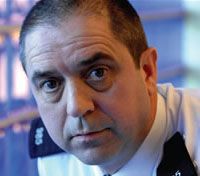
Tony Barrios, Cambridgeshire Constabulary Casualty Reduction Officer: click to read the Cambridge News article
I think it's a very good idea: there are crackdowns on drink-driving all over the world at Christmas-time, but it's easy to forget this season of barbecues and country pub gardens in bloom.

I'm reminded of a road-safety conference, I attended in London, which was addressed by Superintendent Paula Rose of New Zealand Police, who studied at the Henley Management College and worked with the Thames Valley Police, both in the UK, as part ot the Foreign and Commonwealth Aotearoa Fellowship, of which she was the 2006 recipient (Aotearoa is Māori for New Zealand).

Supt Rose told us about the country's robust system for dealing with drink-drivers (New Zealand, I gather, makes the rural parts of East Anglia look like central London). Over half of the 4.3 million inhabitants have driving licences, which can be applied for at the age of 15. There are about 400 community police stations, with 10,000-plus staff.

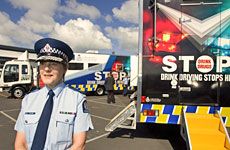
It was very interesting to hear her talk intelligently and humourously buSupt Paula Rose, with Booze Buses in the background, thanks to Paul Estcourt for the pic - click to read the New Zealand Herald storyt robustly about keeping on top of drink-driving on 91,000km (56,500 miles) of roads of varying standards. Ears pricked up at the mention of "booze buses" - mobile laboratories to process drivers who had failed a roadside breath test for alcohol, where a breath sample could be taken in a location where chain of evidence could be attested to, and , should the subject so choose, a blood sample could also be taken. They're staffed by officers who had trained to be part of tactical alcohol teams that would shut down a stretch of road and test every driver using it: up to 20,000 in a night.

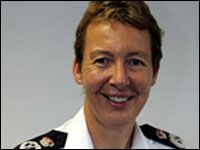
CamJulie Spence, Chief Constable, Cambridgeshire Constabulary - click for bio & podcastsbridgeshire Constabulary Chief Constable Julie Spence has been robust in demanding Govenment give her the means to recruit more police officers to help combat the effects of an increasing population upon the region, including drink-driving, and has made her points in the highest places more forthrightly than anybody who joined any organisation solely for advancement would dare to.

The results of such measures can be amazing: in 1973, the New Zealand road toll was 800 and should have been 1,500 last year but was actually 350, due in no small part to alert and uncompromising traffic policing, led by Supt. Rose. I hope that over the next year the Treasury listens to the evidence that strategies such as "booze-buses" play a major role in reducing carnage on our roads. Supt Rose quoted a Māori saying that lays out the major priority in policing that I am sure is shared by officers everywhere: he tangata, he tangata, he tangata - "our people, our people, our people".


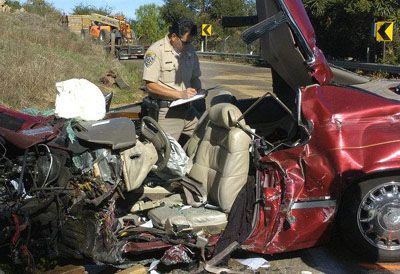
click to go to a YouTube video with very graphic images of the results of drink driving


Related post: drink-driving campaigns - a worked-out example

Saturday, May 30, 2009

hypergarlic megapizza

Maxima and the kids went away to the other side of the fens recently to visit relatives, so I decided I'd try my hand at cookery. I thought I'd share my creation with you - the hypergarlic megapizza.

Get a pizPilgrim's choice - the Led Zeppelin of cheddarza base - preferably one that's got mushrooms already on it, as this will save you the effort of preparing them. Also buy three large blocks of strong cheddar - I chose Pilgrim's Choice; and some blue cheese, with parmesan as well. Add to your basket a bowl of pitted olives, a large jar of tomato pesto and some Lazy Garlic. (Note - it's not the garlic that's lazy, it's the cook. There's a theme coming through here.)
tomato pesto - beware people who say you can have too much
Spread the entire contents of the jar of tomato pesto over the pizza base. There are still people who say you can have too much pesto: they're dangerous and shouldn't be approached. They may go away if you throw peas at them, especially if they're still in the cans.

Don't bother grating the cheddar, it'll all end up a blob however you prepare it. Slice the first lot of cheddar and put it over the pesto, remembering to intercept liberal amounts as your reward for taking the bin the kitchen, work must be seen to have been doneother to cook. Then add the olives - all of them - and the second lot of cheddar over this.

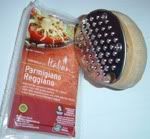
This is important: grate the parmesan, then judiciously forget to wash up the grater, so your other half will know how hard you've worked. Put the parmesan over the second layer of cheddar, the lazy garlic (again all of it) over the parmesan, the blue cheese over the garlic, then the last lot of cheddar over this. Spend some time in amazed contemplation of your creation - a thing of beauty is a joy indeed, and there's nothing more beautiful or indeed joyous than your first hypergarlic megapizza.

Turn the cooker on. Put the pizza in the oven. After closing it, turn the oven on. Go watch somethinsurrender is not an option: the king of pot noodlesg important, like football, a heavy metal concert or Lord of the Rings, but don't have the volume too loud so that when the cheese starts to spit you'll remember you forgot the pizza.

Enjoy. For several days.

NB: this is a health-promotion blog. If you find all the cheese too salty, go have a kebab or a pot noodle instead.

Related post: Haute cuizine

Friday, May 29, 2009

when agendas come together

This post contains a discussion of suicide. If you are feeling very down, please either navigate away or click here to go to the end.

When I started training as a psychiatric nurse in the late 1980s, we had a class on death in the initial module before we were let loose on unsupecting wards, and I was surprised by how many people had to take advantage of prior permission to step outside for a while should one feel the need.

Later on, we were introduced to psychiatric nursing proper, and we all did the training; those were the days when heads of nursing schools were more involved in working with hospitals than now, and it was realised that sometimes people with mental illnesses or learning difficulties need to come to hospital, or conversely staff in mental-health institutions might need general-nursing skills should one of their charges, say, become ill or have an accident.

In this module, we were introduced to suicide as a subject for clinical study, and everybody was expected to stay within the lecture hall: everybody did.

First came an anecdote of a man who said every day that he was going to kill himself, how, and where: and one day, after several years, as people paid less and less notice, he did. The moral: never take a threat or prediction of suicide anything other than seriously. On the other hand, there were also people who would be admitted having injured themselves in ways which self-evidently cchoose life - click here to go to the Samaritans' websiteould not be life-threatening - but navigating around the large intersect between the two approaches the best definition of psychiatry I've ever heard: "a blind man in a dark room looking for a black cat that isn't there".

Over the years I lost several clients to suicide, which was quite hard at the time. But then I lost a friend, and experienced first-hand the raw nerves slicing across one's consciousness as emotional evisceration accompanies an endless round of "what-ifs". I still ask the girls to help me pray for "Dad's friend who died sad and alone", and I think Minora's guessed what that means.

So my antennae twitched upon reading a story on the matter in the Cambridge News.

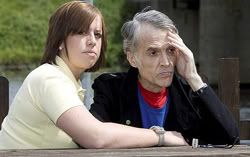
In December 2006, 56-year-old David Woods was admitted to AddenbroNadine and David Woods - thanks to the Telegraph and MASONS for the picoke's Hospital in Cambridge after a suicide attempt. His daughter and son were alerted. By the time they arrived in Cambridge, Mr Woods had been given a liver transplant as an urgent life-saving measure. Neither of his children had been consulted.

Mr Woods was in a coma for six weeks after the incident (it's not mentioned whether it was medically induced), and came to with, we are told, "the mental age of a child" who needs round the clock care. So, given that the attempt that landed Mr Woods in hospital came at the end of a rapid succession of tries that day, why was a liver transplanted; and why is this three-year-old incident hitting the news big-time now?
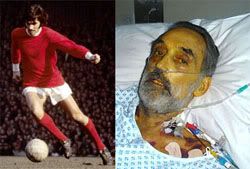
George Best, in better days and on his deathbed in the pic he asked the News of the World to publish with the legend 'don't end up like me' - click to go the George Best Foundation
Looking at the first question yields clouds within clouds. Professor Roger Williams of University College's Institute of Hepatology in London was involved in Great Britain's first liver transplant in 1968, and was also involved in the care of George Best towards the end of his life, imploring every pub and off-licence in the country not to serve alcohol to the addicted footballer. He told the Telegraph's Celia Walden:


"What is surprising is that the family do not appear to have been consulted," he tells me. "When we first started conducting liver transplants in paracetamol overdose cases, most were young people without a history of psychiatric illness. Very few would be given a transplant within 24 hours without agreement from the family...I find it puzzling that these things weren't picked up on when the clinician reviewed David Woods' notes. It is very unusual for someone to be given a transplant when they have tried to commit suicide several times in the past.
Williams was speaking about the effect this affair might have on potential liver-donProfessor Roger Williamsors; but I do't think I would be straying from the pro-life fold by suggesting that a liver transplant, with the attendant risk of major damage to organs - including the brain - through buildup of toxins should not be undertaken until the family's view has been taken into account. I'm not saying for a minute that anybody who is critically ill following a suicide attempt shouldn't be treated, merely that in this particular instance a unilateral decision to insert a donor liver may have been something of an unreasonably heroic measure.

Professor Williams adds: "I would say that the psychiatric assessor is the person one might point a finger at"; it's not clear that the psychiatrist who examined David Woods while he was semi-conscious at best was employed by Addenbrooke's or the local mental health trust, but it would be instructive to look at the latter, who would have treated him for his manic-depression.

In November 2006, the Cambridgeshire and Peterborough NHS Foundation Trust's board meeting minutes announced that "performance targets" for its annual health check by the Healthcare Commission (now the Care Quality Commission) included an "Audit of suicide prevention". This was a month before Woods' last attempt, but five months after an earler attempt, we are told, was assessed as a "cry for help". (The suicide prevention audit is first mentioned in board minutes of March 2006.) In March 2008's minutes we learn that the annual healthcheck has been passed except for a waste-management target, and "A re-audit of the National Suicide Strategy in 2007 identified clear improvements in clinical practice" and that "
the electronic system for investigating and completing serious untoward incidents (SUIs), was reviewed and further improved during the year and now incorporates the national standards for suicide prevention."

An annual healthcheck is a byzantine proceedure looking at a trust's "performance indicators"; in the "frequently asked questions" document, on page 12 (of 15), we learn in the answers to questions 24 and 25 that "It is the responsibility of every healthcare organisation to ensure that they submit all necessary data for our assessment purposes by the deadline date for each data collection...It is the responsibility of the primary data collector to communicate these data quality checks and ensure that they are applied prior to submission to the Care Quality Commission."

So there we haveCynthia Bower - click to read about her involvement in the Stafford General Hospital situation it: two levels of deniability between the Care Quality Commission's examining whether boxes are ticked and conditions endured by patients (and staff) on the ground. It comes as no surprise that the Care Quality Commission is headed by Cynthia Bower, former chief executive of the West Midlands Strategic Health Authority when it failed to pick up the egregious abuses visited upon patients in Stafford General Hospital. She wouldn't have been in place at the time we're talking about, but she has obviously been parachuted into a job where her talents will ensure the continuation of the prevailing ethos.

Cambridgeshire and Peterborough NHS Foundation Trust's medical director, Dr Tom Denning, told the Cambridge News in the article linked to above that "you always have to give life the benefit of the doubt". The Trust has just published a statement on the "latest news" section of its website:
We are sorry to hear that the family have concerns about whether in retrospect it was the right thing to undertake a life saving liver transplant operation in 2006. We would like to hear from the family so that we can discuss their concerns in more detail.

Decisions to undertake emergency life-saving liver transplantation are made by the transplant consultants with advice from other medical specialists, including psychiatrists, when appropriate.
Personally, I think this bit of get-outery is of doubtful value, and I would suggest that David Woods was given a liver transplant - whatever the result - without reference to the family in order to improve Cambridgeshire and Peterborough NHS Foundation Trust's appearance of compliance with suicide-prevention targets.

You'll be glad to know that the answer to the question of why this is an item now is much simpler. But I should first note that I am not implying that David Woods' children have any sort of double agenda. To paraphrase a wise family doctor's counsel to my wife when I was first diagnosed with manic depression, they've been hit by the train, and it keeps on hitting.

On 27 May, the story broke in the Cambridge News and it was mentioned that Nadine Woods was "torn" about taking her father "to a euthanasia clinic in Switzerland".

The next day (the same day that the Telegraph picked up the story), Lord Alderdice tabled an amendment to the Coroners and Justice Bill, which is due to be debated in a House of Lords Committee on 9-10 June. The amendment reads:
Insert the following new Clause—
"Exceptions to offence of assisting suicide"
Notwithstanding sections 49 to 51, no offence shall have been committed if assistance is given to a person to commit suicide who is suffering from a confirmed, incurable and disabling illness which prevents him from carrying through his own wish to bring his life to a close, if the person has received certification from a coroner who has investigated the circumstances, and satisfied himself that it is indeed the free and settled wish of the person that he brings his life to a close."
Although SPUC director John Smeaton states the amendment is not likely to be added to the bill, it's important that it be opposed vigorously to show that people who value life are alert to the drip-drip-drip of bringing legalised euthanasia onto the statute books against the will of the British people - and the Members of the House of Lords might want to look in the direction of the Commons to see the effects of continually acting against the interests of the people one is supposed to serve.

If you live in Great Britain, please read and act upon this alert from the Society for the Protection of Unborn Children. If you from elsewhere, please pray for us.

And for the Woods family, who find themselves buffeted by agendas more highly-powered than most express trains.


Depression's a queer thing to deal with - everybody has their own way to deal with the Black Dog, as Churchill called it. There's always the Samaritans, of course, or a doctor, friend, counsellor, or the local mental health helpline. Myself, if I'm too down to read a book, I turn on the radio, preferably a station with some MOR music and light banter. The mood-lifting effects of exercise have long been noted, but if I embark on some hard-training plan I end up beating up on myself when, inevitably, I fail: walking is good. REM has some good advice in their song Everybody Hurts - "take comfort in your friends". I find it incredibly difficult to tell people face-to-face when I'm down, but I hae to because I hide it when I am; and my friends give me time when I manage to tell them, whether that be time spent with me or time I need to take to reforge connections after a period not really saying much. And as a very wise man I knew once said, if the abyss looks into you when you look into it, look the other way.