Friday, June 19, 2009

abortion advertising: how about a level playing field?

Today, there was a silent vigil outside the offices of the Advertising Standards Authority in London. The reason was a planed change in rules on standards for adverts relating to sexual health that will allow adverts for abortion clinics to be aired on TV.

I say "silent" at the earliest opportunity because other sites are markedly omitting the word. Here's how the Marketing Week website presented the protest two days before:
The Advertising Standards Authority is bracing itself for an eight-hour demonstration by anti-abortion campaigners as its consultation on changes to the advertising code of practice draws to a close.
I've made my position clear in the past: advertising abortion clinics is fine by me, if the field is level - ie, if the side-effects of abortion are allowed equivalent publicity. But although many pro-life sites will ably demonstrate that this is not so, I would go to source, and refer you to the Marie Stopes publication abortion your questions answered [sic]. This is a 12-page document claiming to lay out a woman's options regarding pregnancy, but only on page 3 do we see the options of continuing with the pregnancy in order to keep the child, or to adopt out. After this point, it's all about abortion - which, to me, seems a little dodgy given that Marie Stopes makes a lot of money around the world by providing abortions.

So - why am I against abortion? Isn't it a woman's right to choose what she does with her body?

I would answer the second question with a definite yes. But I remember, in the 1980's, when pro-abortion politicians were asked the status of unborn babies, they would reply that they were "tumours". (I remember - then - London councillor Linda Bellos saying exactly this on a political programme called Question Time.) How can allegedly intelligent people fall at the first hurdle of Science 101? Once spermatozoon and ovum have fused, you have a genetically discrete entity which cannot be equated with mother or father. Kill a human being at this stage and you can kill him or her at...well, just keep an eye on the news.

As to the first question - I am against abortion because of the attrition it inflicts upon human beings, not least mothers. Through Radagast I found a site called Teen Breaks, and saw the frst entry:
I was pressured to have sex, and did it, and got pregnant, and I’m only 13. Well, I just turned 13!! And I got an abortion.

It was sad and very scary, and I haven’t been the same since. I hated it so damn bad...and I used to be the head cheerleader, and I loved it, but now I’m quiet, and I don’t talk very much or anything
I believe these testimonies are invaluable, because they are the antidote to Stalin's dictum that when one person dies it's a tragedy, but the death of thousands is a statistic. So let me add another tragedy:

My friend Kathy (not her real name) had been delighted to find she was pregnant; I'm still not sure, all this time after, why she had an abortion. She seemed ok with it initially, but as the years passed and the chances of having another child receeded, she gravitated ever more towards groups formed of mothers in order to try to become one of the group: she was desperate to be called a mother. The thing is, had she, God forbid, committed suicide, would it have been registered as having been due to her abortion, which was so many years ago?

At the end of the day, should the ASA decide that adverts for abortion services be allowed, the test of democracy will be twofold: firstly, will adverts for pro-life organisations that give women some time to breathe be allowed; and secondly, given that abortions are predominantly funded by the state, will abortion adverts be forced to carry warnings about the many side-effects that have been proved to accompany this procedure, whether immediate or long-term?

Tuesday, June 16, 2009

top ten songs about ghost stories

We are a narrative species. Storytelling forms as much of the human experience as eating, breathing and sleeping, and ghost stories are an intrinsic part of this. What lies beyond? What if...? What comes after? It's a way of weaving a skein of fables which, when told with the greatest skill, forms a mirror that reflects back not just the facts of our existence but also the hopes and fears we're sometimes circumspect about speaking out loud. For example, when Jesus - a master storyteller - answered the Sadducees' question about what might happen to a widow who had been married to seven brothers in the afterlife, I bet you couldn't have heard a pin drop among his audience.

Without further ado, please let me share my own top ten ghost story genres in song with you.

10 - Obsession

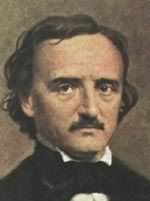
Edgar Allan Poe - click to go to the website of the Edgar Allan Poe Museum of Richmond, VirginiaThe song is from the Alan Parson Project's seminal 1976 album Tales of Mystery and Imagination, named after a collection of Edgar Allan Poe's short stories and poems. The poem of the same name concerns a young man who is morbidly devoted to his lost love Lenore, who the poem implies has died, and is seeking occult ways to have her returned to him. The video matches the mood of the poem exactly, and I would thoroughly recommend reading Poe's original poem.


9 - Love


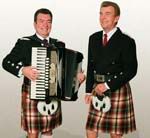
Tom and Jack Alexander: click to go to the Alexander Brothers' websiteScottish piano-accordian duo The Alexander Brothers had a huge hit with a sentimental ballad called "A Daisy a Day". In many ways the story behind the song, of a man who uses a simple gesture to demonstrate that he still loves his woman who's passed away and whom he's known since childhood, is the opposite of The Raven. It is devotion looking upwards, without the obsession that turns everything it touches sinister.

I'd thought that the brothers had written this song, and so was surprised to learn that it was penned by Jud Strunk, the song having been so popular that it was taken to the Moon by the astronauts of Apollo 17.


8 - Possession

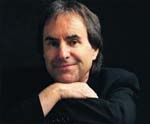
Chris de Burgh: click to go to his official website
Chris de Burgh's The Tower is a classic parable of knowing somebody's value only once they've gone. From his concept album Spanish Train and other Stories, it merges warnings against encroaching upon God's creation too much originating from medioeval times with his own story about a nobleman who wanted to possess a beautiful, mysterious woman so much that he only realised too late that he had been in love with her.


7 - Generosity

Here we have Uriah Heep in their incarnation as 1972 fashion victims, singing one of a spate of songs at the time based on imagined meetings with Gandalf/Merlin etc. It's a plea for healing and looking at one another's similarities instead of difficulties. It's a nice thought, and possibly came true for a bright shining moment with the release and presidency in South Africa of Nelson Mandela, who - a friend of mine from the country reminds me - could have initiated a bloodbath with a wave of his hand.


6 - Horror

Blue Öyster Cult released Nosferatu to close their 1977 Spectres album, and is based on the film of the same name. Faithful to the film, which was based on the novel Dracula in 1922 and remade by Werner Herzog in 1979, it contains the risk to the vampire from a woman who is "pure in heart".


5 - Wonder

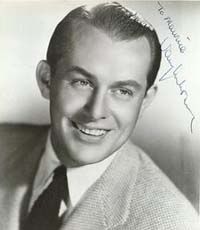
click here to go to the Vaughn Monroe appreciation Society webpage to see the breadth of his achievements
More played as an instrumental than a song, this is the tale of an old cowboy who sees a posse of cowherds chasing the devil's herd in the sky, finishing with instructions to the old boy to change his ways in order to earn a different fate. Enjoy this wonderful video to Vaughn Monroe's 1948 recording of the Stan Jones song.


4 - Payback


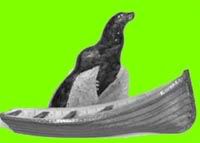
The Great Silkie [seal] of Sule Skerry is a story that originated among the Norsclick to read about the song on Roger McGuinn's (ex-Byrds) sitee people which they took further afield to, for example, the Orkneys and Newfoundland, and is now a staple in the folklore of many communities that depend upon the sea. The story goes that one night, a seal came ashore and became a man, and fell in love with a beautiful, mysterious woman. Soon afterwards, as he was returning to the sea and his natural state and leaving her pregnant, he has a vision that his child will be a boy who will gow up to be a seal-gunner, and his first kill will be his father. The video posted reflects the tale's international nature, with American Judy Collins singing and Irishman Tommy Makem on the penny-whistle. The story she sings is very slightly different, but you'll still get the point.


3 - Reward

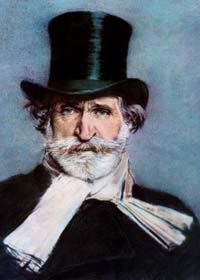
Giuseppi Verdi - click to read a biography
During the state funeral procession of composer Giuseppi Verdi in 1901, the crowds spontaneously broke into what is still his best-known piece - Chorus of the Hebrew Slaves, better known by its opening two words, Va, pensiero (fly, thought, on golden wings...). It's a meditation on Psalm 137, in which the slaves in Exile sing their children to sleep with tales of Israel. I bottled out of posting the partly-translated version by Italian guitarist and vocalist Zucchero with Luciano Pavarotti, but couldn't find an orchestral/choral version with sound quality that did it justice. So here's a compromise: a partly-translated version by Russell Watson, backed by orchestra and choir, telling the story of ghosts who are gone but by no means forgotten, and whose reward we all reap.


2 - A community of ghosts

click to visit Jim Willsher's page on Runrig's 'Heartlands' album, from which the song is taken (pic: Ava Gardner and James Mason in the Flying Dutchman)
There's a breadth of tales about the ghost city, ship or train which is apparent for a while, then disappears - for example Brigadoon, Pandora and the Flying Dutchman or indeed Chris de Burgh's Spanish Train. This one, about a ghost market, is by Runrig and is in Scots Gaelic. You can see both Gaelic and English lyrics here - scroll down until you come to "The Hill at the Market Stance", which is the translation of the title. (The only decent video I could find aboutthe song is prefaced by an explanation by songwriters the MacDonald brothers about the ghost-story behind the song, and segues into another song which, in a sense, is about our ghosts.)


10 - What comes after?

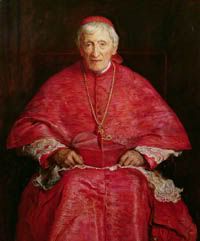
portrait of Cardinal Newman: click to go to the website of the Cardinal Neman SocietyThe Dream of Gerontius is assumed by many to be "by" Edward Elgar - he wrote the score, which is achievement enough, to the poem written by John Cardinal Newman in 1865, 20 years after he had converted to the Roman Catholic Church from the Anglican Communion; some say he's due to be canonised next year - talk about upward mobility!

Gerontius, very (too) briefly, follows an old man through the gates of death and to the throne of the Most High, whereupon he realises that God's goodness is so great that to stand in His presence in unpurified form will be destruction, and is taken to the soothing lake of Purgatory, where the Angel who has accompanied him tells him: "Angels, to whom the willing task is given,/Shall tend, and nurse, and lull thee, as thou liest;/And Masses on the earth and prayers in heaven,/Shall aid thee at the Throne of the most Highest." This is a very excerpt sung by Janet Baker:


Related posts: click here for more top ten songs about...

Saturday, June 13, 2009

education: a cover for state oppression?

I recently accompanied a young lady to her school, a secondary faith school in the region, where she's not been doing too well academically for various health reasons that demand her absence frequently. A meeting had been arranged with her teachers.

I'd arrived slightly stressed, being aware of the extent to which governance of institutions has been infested by a managerial compulsion to ensure compliance has been achieved by conforming to governmental targets and dicta on such things as diversity and anti-discriminatory laws used to oppress people from a Judaeo-Christian faith background. Case in point: Jennie Jennie CainCain, secretary at Landscore Primary School in Devon, was told by her headmaster not to return to work after she asked for prayers for her daughter (who'd been disciplined for talking to a classmate about Jesus) in emails that never reached a school computer.

On the other hand, there are still many headmasters in the mould of the legendary Felix Porter from Glasgow, whose sometimes thunderous solicitousness for his charges pointed many a tearaway towards the right tracks. (One of the many ways in which he lives on is in an award named after him.) Working in social housing, I remember one of his successors striding into the office to inform us that we were now part of the truancy reporting scheme. We didn't argue.

It's no metaphor to call education a war-zone. For example, Radagast, a senior teacher in a Catholic school, writes of "the police visiting schools to 'interrogate' students about their beliefs".

One of the major fronts in the war is home education. I wrote earlier this year aBaroness Morgan: click to read the last paragraph of George Orwell's 'Animal Farm'bout Baroness Morgan's assertion that homeschooling "could be used as a 'cover' for child abuse such as neglect, forced marriage, sexual exploitation or domestic servitude."

I find this rather strange. The man known as the "British Fritzl", who made his daughters pregnant 19 times, did not emulate his vile Austrian namesake by imprisoning the girls in a cellar: rather, he moved them around the country so that they would not make attachments who might have raised the alarm, but - crucially - sent them to schools. In a scenario that is becoming depressingly familiar, social services and police were alerted but took no further action - indeed, police told the girls' worried grandmother that "slander is a criminal offence".

Likewise, a harrowing case involving a woman accused of taking obscene pictures of young children is emerging in the south of England. But she's not a homeschooling Mum - she works in a nursery which operates from an adjoining school.

Education Otherwise, the Education Otherwise, the charity for home-schooling families: click to go to homepagecharity for families with children being educated at home, provides a laminated card for children to carry if they are picked up by police on a "sweep" for truants. I find it quite surprising that a need for them to print the information that home education is legal in the UK, given that the 2007 guidance from the Department of Schools, Children and Families on these sweeps mentions homeschooling several times. The online version links to a 2006 document from the Department of Education and Skills called What to do if you're worried a child is being abused, which lays down powers already possessed by the relevant authorities to take allegedly abused children to places of safety.

As above in the House of Commons with MPs' expenses, so below with the safety of ordinary folks' children: what is needed is not new laws, powers and regulatory bodies, but for existing ones to be used effectively and with ideological blinkers removed.

Questions remain, however, about what to do when the child abuse is state-sponsored - for example in an assembly in Bromstone Primary School in Kent, when a video of two men canoodling on a bed was shown to children as young as four as part of a drive against homophobia, leaving girls afraid to be friends with each other. Or when the state abets the abuse by rendering certain groups with "alternative" lifestyles effectively untouchable, which led to the debacle surrounding the stepfather of Baby P.

And the young lady I chaperoned to the meeting at her school? I needn't have wMaking headlines: click to go to Brian Mickelthwait's Education Blogorried. Her teachers took a blue pencil to her timetable so that she's now concentrating on three subjects, including English and Maths. They did this in the face of Government targets steamrollering teachers into fixing five good GCSE's for pupils. Had she been homeschooled, of course, this would have already been done - one good thing coming out of this farce is that more people are learning about home education than would have even considered it not so long ago.

But to my young friend's teachers, as to Radagast and all those who labour endlessly to try to get a good education for their charges in the face of government oppression, I owe something I don't think those teachers hear often enough:

Well done!


Related post: Home schooling - next in the crosshairs

Friday, June 12, 2009

I'm trying, honest...

In fact, some would say I'm very trying, not least those who live with me! Windows has a cough, and Minora's on the case, in between important things like soap operas, music and wierd Japanese cartoons. Watch this space...

Sunday, June 7, 2009

the resignations crisis - Shakespeare's view

In the hiatus between County County Election results (the Conservatives held on to Cambridgeshire and Labour saw its four members reduced to two) and finding out which parties have won in European seats - I fear the vile BNP have won in Yorkshire and Humberside - there is much struggling to find suitable metaphors for the unprecedented position Brown finds himself in.

The TelegrapJacqui Smith, pic by UPI: click to see Andrew Porter's coverage of her resignation in the Tlelgraphh's Anne McElvoy compares him to King Lear, and there is certainly more than a hint of the ailing king in the Prime Minister, alluded to early in Tony Blair's premiership when an "unnamed source" referred to the then Chancellor of the Exchequer as "psychologically flawed". Former Daily Mirror executive David Seymour later identified this to have been the odious spin doctor Alistair Campbell, the same who advised reporters on behalf of BlHazel Blears, pic by Paul Cousans - click to read Andrew Porter's coverage of her resignationair that "we don't do God". (This was, of course, long before Blair joined the Roman Catholic Church and proceeded to lecture the Pope on his "entrenched" attitude on homosexuality.)

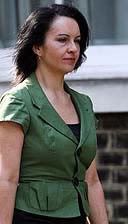
A trio of female ministers have resigned from Brown's Government in recent days: Home Secretary Jacqui Smith, Communities Secretary Hazel Blears and Europe Minister Caroline Flint. The first two resigned because of implications of the Telegraph's revelations about MPs' expenses for their integrity. Flint, however, did not have to resign, so one might position her as Cordelia, who out of Lear's daughters spoke plainly out of loyalty and filial devotion. Indeed, Cordelia says in Act One, Scene One of Lear,

But yet, alas, stood I within his grace,
I would prefer him to a better place.

Flint's letter of resignation, on the other hand, has been called "the most brutal ever delivered to a sitting Prime Minister", and contains the text

I am extremely disappointed at your failure to have an inclusive Government...I am not willing to attend Cabinet in a peripheral capacity any longer.

In my current role, you advised that I would attend Cabinet when Europe was on the agenda. I have only been invited once since October and not to a single political Cabinet – not even the one held a few weeks before the European elections.
She also objected to being treated as "female window dressing", which personally I found strange coming from somebody who had posed for glamorous pics for a Sunday magazine. Flint's no Cordelia, then.

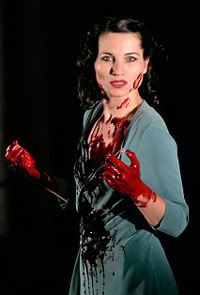
Preofessor Calculus compares Brown to Banquo, friend of his fellow general MacbeLady Macbeth, pic by BAM; unfortunately I can't find the name of the actressth, who was later killed by the latter and his wife. Not that I'm comparing any of our three worthy ladies to Lady Macbeth, who at least bolsters her husband in his conviction that "'twere well/It were done quickly" (Scene VII/Act 1). It would be hypocritical of me to say that I feel sorry for Brown, who is completing Blair's work of taking decision-making out of the hands of the House of Commons and putting it into the hands of senior executives who do nothing but set targets based on the last set of ticked boxes. But I take no pleasure in seeing him lurch from crisis to crisis, stuck in a rut of believing that he is doing the right thing.

Near the start of Macbeth, the three witches prophesy that he will be a king, but also that doomed Banquo will beget a line of them. The resignations of Jacqui Smith, Hazel Blears and Caroline Flint were timed to do maximum damage to Brown, which will ensure that any candidate for leader they endorse will receive astronomical publicity - they are, effectively, kingmakers.

But Shakespeare doesn't tell us one thing - what happened to the witches? Orson Welles, in his production of the unlucky play, adds a line to the end in which one witch says to the others "Peace, the charm's wound up"; on the other hand, Roman Polanski's bloody production ends with Duncan's son Donalbain entering the witches' hovel, indicating that he wishes to drink from the poisoned chalice of power, his older brother being king after their father's regicide at the hands of the Macbeths: the cycle begins again.

So what will become of our ladies? I think that, should they decide to become kingmakers, the one they put on the throne, fearful of Polanski's interpretation, will always bear it in mind that they turned on their leader before. They could do worse than listen to Lady Macbeth:

'Tis safer to be that which we destroy
Than by destruction dwell in doubtful joy.


Three ladies walking towards the future?  Jacqui Smith, Hazel Blears and Caroline Flint

Tuesday, June 2, 2009

please don't waste your vote on the BNP

I was delivering leaflets for the Conservative Party over the weekend on behalf of our representative on Cambridgeshire County Council, which is Conservative-run and hopefully will stay so. I met a couple who are friends of ours, who invest more unpied time in building up the community than anybody I know. I've never heard either of them make a political comment in the years I've known them, and so was pleasantly surprised to hear that they are lifelong Conservative voters.

There is, of course, a different texture to Thursday's elections, which coincide with elections to the European parliament. The all-consuming public passion at the moment is the widespread abuse of expenses by MPs of all parties; the prospect of some voters staying at home, coupled with that of others registering a protest vote, means that there are no sure things, no shoo-in cases.

And here be dragons: the economic downturn, coupled with such governmental negligence towards immigration policy that even Donna Covey (left), the Refugee Council's chief executive, wrote to the Telegraph to admit that "that there are serious failings within the asylum system", have delivered an unprecendented audience to the British National Party.

These are not under-rated truth-sayers. They are, as Norman (Lord) Tebbit says, socialists with racism, and with this aphorism he captures a key truth: a party that wants to nationalise everything in sight and micro-manage the lives of its citizens does not belong to any part of the right-wing spectrum. In this they ape their heroes in the Nazionalsozialistiche Deutsche Arbeiterpartei, which was Marxism wrapped in a flag.

But while that abberation was led by another who was so bad a manager that he had the thousand-year Reich dead in the water within twelve years, the éminences grises of the BNP, fascists as they are, are not as disordered as Hitler. The cynical manipulators at the helm have straitjacketed their public image in the iconography of victimhood, but if elected the ties will come off; and the people of Britain will relearn the lesson of their German cousins in 1933, that sometimes that which glisters is poison in a shiny bottle.

Lord Tebbit pulled a masterstroke when he advised voters of all parties to register their disaffection at the European elections by voting for smaller parties, as the primary winners would be the United Kingdom Independence Party (UKIP), who would then have to explain to their electorate why they had a surfeit of representatives in the European Parliament they so detest but none in Westminster.

However, please be aware that the BNP stand on the sidelines jealously eyeing protest votes. In this crossroads of British history all votes will count, not least those that are not cast. Vote as you will; but no matter how angry you feel - and heaven knows we all have every right to our rage - please do not abuse your suffrage in a game of Russian roulette with the BNP as the bullet pointing at everybody's head.


Monday, June 1, 2009

booze-buses from Aotearoa - an idea for England?

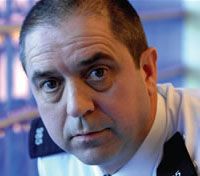
The Cambridge News reports that a blitz on drink-driving is starting up in Cambridgeshire - as Casualty Reduction Officer PC Barrios says, to target the "increase in the number of people going out and drinking".
Tony Barrios, Cambridgeshire Constabulary Casualty Reduction Officer: click to read the Cambridge News article
I think it's a very good idea: there are crackdowns on drink-driving all over the world at Christmas-time, but it's easy to forget this season of barbecues and country pub gardens in bloom.

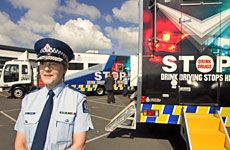
I'm reminded of a road-safety conference, I attended in London, which was addressed by Superintendent Paula Rose of New Zealand Police, who studied at the Henley Management College and worked with the Thames Valley Police, both in the UK, as part ot the Foreign and Commonwealth Aotearoa Fellowship, of which she was the 2006 recipient (Aotearoa is Māori for New Zealand).

Supt Rose told us about the country's robust system for dealing with drink-drivers (New Zealand, I gather, makes the rural parts of East Anglia look like central London). Over half of the 4.3 million inhabitants have driving licences, which can be applied for at the age of 15. There are about 400 community police stations, with 10,000-plus staff.

It was very interesting to hear her talk intelligently and humourously buSupt Paula Rose, with Booze Buses in the background, thanks to Paul Estcourt for the pic - click to read the New Zealand Herald storyt robustly about keeping on top of drink-driving on 91,000km (56,500 miles) of roads of varying standards. Ears pricked up at the mention of "booze buses" - mobile laboratories to process drivers who had failed a roadside breath test for alcohol, where a breath sample could be taken in a location where chain of evidence could be attested to, and , should the subject so choose, a blood sample could also be taken. They're staffed by officers who had trained to be part of tactical alcohol teams that would shut down a stretch of road and test every driver using it: up to 20,000 in a night.

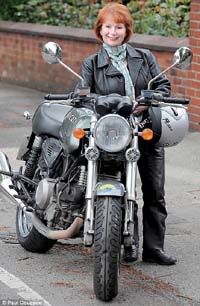
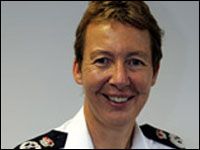
CamJulie Spence, Chief Constable, Cambridgeshire Constabulary - click for bio & podcastsbridgeshire Constabulary Chief Constable Julie Spence has been robust in demanding Govenment give her the means to recruit more police officers to help combat the effects of an increasing population upon the region, including drink-driving, and has made her points in the highest places more forthrightly than anybody who joined any organisation solely for advancement would dare to.

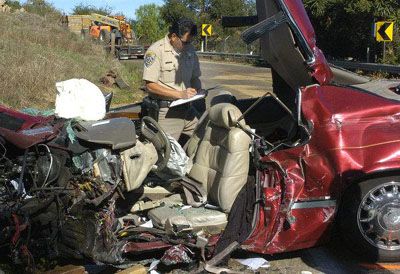
The results of such measures can be amazing: in 1973, the New Zealand road toll was 800 and should have been 1,500 last year but was actually 350, due in no small part to alert and uncompromising traffic policing, led by Supt. Rose. I hope that over the next year the Treasury listens to the evidence that strategies such as "booze-buses" play a major role in reducing carnage on our roads. Supt Rose quoted a Māori saying that lays out the major priority in policing that I am sure is shared by officers everywhere: he tangata, he tangata, he tangata - "our people, our people, our people".


click to go to a YouTube video with very graphic images of the results of drink driving


Related post: drink-driving campaigns - a worked-out example