Wednesday, May 27, 2009

propaganda in words and pictures

Exams season is on us again - and boy do I mean again: secondary schoolkids seem to have so many exams they talk like a multiple choice test ("what pizza do you want: a)Margherita...").

I've come into the posession of a couple of science past-papers that caused me concern, both from the Foundation element of "Twenty-first Century Science". I've scanned in some exerpts and posted them - apologies if parts are slightly blurred, they're a bit creased.

In one, from January 15 2008, there was a complicated scenario about a family united to ensure that an infertile sister could have a baby:
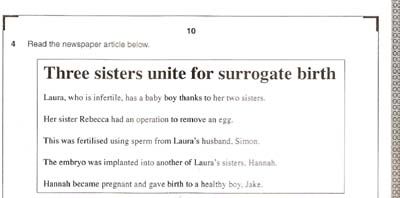

three sisters unite for surrogate birth - but what about the health of the egg-donor, or the discarded embryos?

Three things bothered me. The first was the phrase at the bottom of the above scenario, informing examinees that "Hannah...gave birth to a healthy son, Jake." Genetically, at least, the embryo's being "healthy" (if that means without detectable deformity) is a slam-dunk job, because under the terms of the Human Fertilisation and Embryology Act (HFEA), it is illegal to choose a disabled embryo for implantation at the expense of an able-bodied one.

Secondly, teenagers sitting the exam are informed that "Rebecca had an operation to remove an egg". I grant that the search is on to identify a method whereby a single egg can be extracted for the purposes of in-vitro fertilisation and implantation, but at present the only means to do this is for a woman to take medication to cause hyperovulation so that a bumper crop of ova can be harvested. This might result in a baby without overt disabilities, but hyperovulation not only results in unborn human beings being discarded, but is by no means unsafe for mothers.

And lastly, look at the question at the bottom of this cartoon vignette:
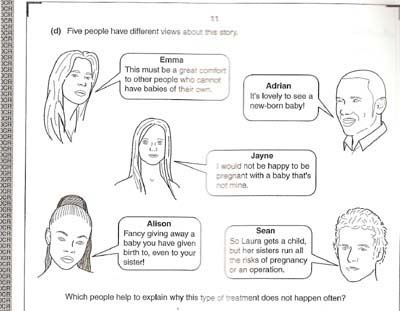
a range of views on surrogacy: but look at the loaded question at the bottom
So where has this politically-motivated exam questioning come from? It certainly didn't spring fully-formed from the board of OCR, the examinations syndicate which boasts that it works in "close consultation with...government to ensure [qualifications] are relevant for learners today".

I would answer that it is the endgame of a process of cultural colonialism by radical left-wing intellectualists, who see complex concrete problems as abstract diversions to be resolved by methods that are judged according to their propinquity to liberal-socialist praxis instead of relevance to real life. Case in point: Harriet Harman's loudly-trumpeted plan for employers to be given the power to choose a female applicant over an equally-qualified male one. A good plan, but the Minister for Equality forgot one thing: employers have always had this power.

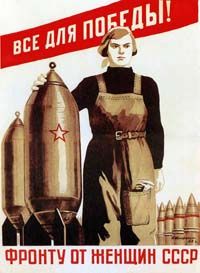
As Townhall.com's Sandy Rios shows, key academic and political posts in civilised societies have been occupied by the ideologically beautiful, who are more interested in promoting propaganda to young p'Everything for Victory - Women of the USSR for the Front'eople than resolving problems up to and including preserving life. They have jumped through the appropriate hoops (or, as Rios says, "gamed the system") until theirs is the dominant clamour to the exclusion of more reality-based voices.

Once in position, the ideologues need to spread their message - to reproduce their memes, if you want - by propaganda. The best way to do this is, as the Soviet Government found, by means of pictures. Although pictures are a great way to educate in general, hence the success of the "For Beginners" series, one group of people loves to learn through pictures: children.

Sophie Grillet is a cartoonist born in Cambridge who is now resident in the US. Her 1997 Feminism for Teenagers is available in libraries as far apart as Stornoway in Scotland's Western Isles (Outer Hebrides) and the Waimakariri District of New Zealand's South Island.

The book makes many complex points with the aid of cartoons, for example that gender-based wage parity is to the benefit of all in that men do not find themselves undercut in the labour market, and that "reproductive rights" campaigns in third-world countries serve interests which "want to prevent people in poor countries from 'breeding' too much".

On abortion, however, Grillet tows the establishment line:

in propaganda, a picture is worth and often subverts a thousand words
We still don't have control of our own bodies, our own wombs. The Government, the Church and various extremists fight for control over my internal organs. As long as women can be forced to bear an unwanted child - we can never be equal.
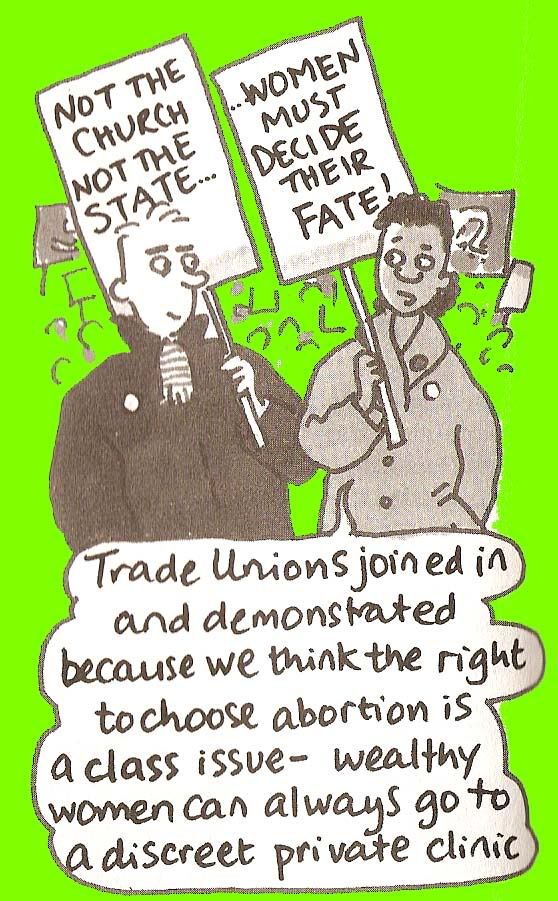
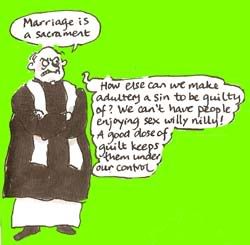
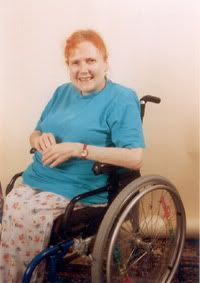
With this, Grillet sidelines all the many women - like Don't Poke the Alison Davis - click to go to No Less HumanBaby's Linda or Alison Davis (left)of the Society for the Protection of Unborn Children's group for disabled people No Less Human - who are not "on-message" with her. Needless to say, there's a strong anti-religion element, as indicated by the cartoon below right. If she'd done her homework she'd have found that the pro-life movement is almost totally composed of people who follow a religion and are without doubt pro-family, but part of our job is to make it easier for women who are single because they are unmarried or have been abandoned to choose life for their children.
The book is ostensibly aimed at teenagers, but while even Letterbox Library ("celebrating equality and diversity in the best children's books...Our expert selection process means only books of the highest quality are chosen") says it is aimed at young people aged 12+, the London Borough of Waltham Forest advertises it on its libraries site as "feminism - children's literature".

Meanwhile, pictorial education goes on, even in the exams. In the Twenty-First Century Science past-paper from 14 June 2007, we are given the following reactions to genetic testing for genes for breast-cancer - with no clarification as to what post-screening advice to affected adults might consist of, eg have an abortion; or deny yourself children because, presumably, never to exist is preferable to have one's life terminated by that which cuts short every life:
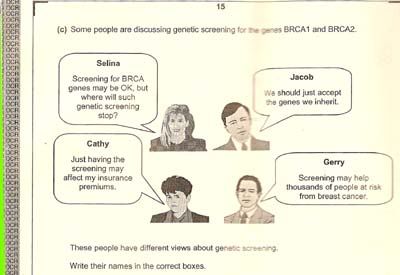
a rounded range of views for genetic screening for breast cancer - but check below for what came jsut before

OK, there are two voices against and two for, which is vastly better odds than we usually face, but context is everything: here is what the students have been exposed to on the previous page:
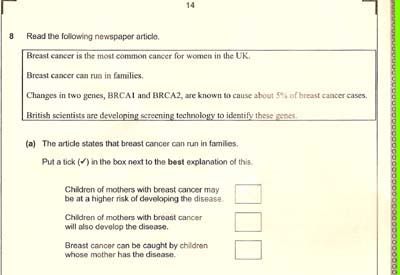
repetition is a key tool for brainwashing - look at the above pic to see just what came after this
Last year Dr Jessica Ringrose (left), Senior Lecturer in the Sociology of Gender and Education at the University of London's Institute of Education - who lists her interests as "postfeminist, neo-liberal educational discourses of gender equality and feminine 'success', feminist and critical pedagogical theories of power and privilege (i.e. race, 'whiteness', class)" - called for feminism to be taught in the classroom. She would like to see girls empowered against the pressure to define themselves with pejorative sexual epithets as objects of male desire.

All the best to her; but - as her interests indicate - she will know as well as any of us that when the parts of the different shcools of feminist thought that seek to empower and enable women clash with the destructive, hegemonic pro-abortion agenda of established power, the latter will win every time. So you won't see any indication in Sophie Grillet's book that when women have maternity leave or career-breaks to raise families, the biggest losers are anti-family money-worshippers to whose music feminists dance. Which is why you won't find the whole truth in Feminism for Teenagers any more than you will in modern educational policy abuses for which works like Grillet's provide the Sitz-im-Leben. As, to finish, Radagast explains:

When gifted writers...abandon the notion that moral truth is objective and that the development of the human person is deeply related to truth, they contribute to a culture that has also abandoned the idea that the child needs truth to flourish.

Friday, May 22, 2009

Master of Space and Time

Master of Space and Time
Rudy Rucker
pp 229

1984 is a little outside "my period" for science fiction - I remember having a conversation with the fellow at the till about it: as good as the Star Wars and Star Trek films were (and in the case of the latter, the series and original books), the tie-ins that started appearing, in Britain at least, flooded the market with fiction that wasn't as cerebral as one would like sci-fi to be. But when I looked at the list of chapters and saw titles like This is the Name of this Chapter, Godzilla meets the Toad Man and 100,000,000,000,000,000,000,000,000,000,000,000, I knew I had to read it. James Warhola's cover art also intrigued me.

Rucker is a great-great-great grandson of the German philosopher GF Hegel. According to the author's online autobiography, his grandfather "could sense the gathering storm" in 1937, and sent Rucker's mother to America - "the land of the future" identified by the great philosopher in The Philosophy of History, "where, in the ages that lie before us, the burden of the World's History shall reveal itself".

Rucker is the originator of the literary art of transrealism, and has written a manifesto in which he sets out his stall, perhaps a trifle hubristically, but then the mathematician and computer scientist turned author displays his ability to dissect the makeup of a novel in his Writer's Toolkit. Here in his manifesto he explains the relation between SF and other forms of fiction:


The familiar tools of SF — time travel, antigravity, alternate worlds, telepathy, etc. — are in fact symbolic of archetypal modes of perception. Time travel is memory, flight is enlightenment, alternate worlds symbolize the great variety of individual world-views, and telepathy stands for the ability to communicate fully. This is the “Trans” aspect. The “realism” aspect has to do with the fact that a valid work of art should deal with the world the way it actually is. Transrealism tries to treat not only immediate reality, but also the higher reality in which life is embedded.
Drs Harry Gerber and Joe Fletcher used to build fantastic machines together - for example, for the military, to make the enemy's water supply radioactive - but couldn't get patents for their inventions because they couldn't explain how they worked.

The machine at the centre of this novel is a "blunzer", a machine that works by altering the value of Planck's measurement in a flow of gluons (which hold quarks together in subatomic particles) which is then injected into the brain of the blunzee, giving him or her godlike powers for a limited period of time.

But time, as Einstein found, is the joker of the pack. Harry Gerber builds the machine first (before he forgets how he did it), but Fletcher sends him back the instructions upon being blunzed. Then...but that would be telling.

Herein lies one of the themes of the novel: as one reviewer stated, "Rucker is bewitched by the absurdities of the universe implied by quantum theory".

And boy, is the quantum universe absurd, as are its architects. Even as certain scientists fight tooth-and-nail to remove any trace of God from their universe, the "god-particle", the elusive Higgs boson, is sought by the Large Hadron Collider at Cern - the underground basilica of physics to which preposterous sums of money are sacrificed (although Austria has had enough of haemmorhaging shrinking resources, and may be the first of many). Even other scientists, including Cambridge's eminent Stephen Hawking, are sidelined: Hawking was publicly subjected to the astounding charge of his work being not good enough by Professor Stephen Higgs, who proposed the eponymous particle's existence in 1964, who had not read the paper in which Hawking stated that the universe would be "more exciting" if it were not found than if it were.

However, the novel transcends mere science, and is also a meditation on the traditional Hungarian folk-tale of "the peasant and the sausage" - a peasant catches a fish, which promises him three wishes in return for its release. Going home and telling his wife of his good fortune, he unthinkingly wishes for a sausage, and one appears; his wife, cursing his stupidity for wasting a wish, cries that the sausage should grow on his nose; and the third wish has to be used to remove the sausage. So, remembering that there are three sorts of gluons...anyway, the tale can be seen in only slightly altered form at the start of MGM's 1958 version of Tom Thumb.

Religion of a sort is present: the Church of Scientific Mysticism has "grown out of the mystical teachings of Albert Einstein and Kurt Gödel", and has a minister with the surname Bitter - Rucker's mother's maiden name (his father became an Episcopal minister). Fletcher's wife finds some comfort here, being worried about world hunger, but feeling angry and offended at Gerber's indication of an answer typical of those scientists who set the western agenda - that "there are too many people".

I don't think Rucker's being facetious here. Born in 1946, he would have been in his senior years at St Xavier's High School in Kentucky at a time when some theologians started to speak more and more like social workers, leaving scientists to pick up the discarded mantle and sew their own cloth thereon. For, as much as scientists try to obliterate God from the world they present for the consumption of the masses, all they succede in doing is effacing religious language. They are still left with some form of intentionality, or at the most basic level the question of the goldilocks universe, "why us?" Rucker deals with this question in a way that I found totally unexpected; his solution is far from an orthodox Judaeo-Christian one, but he nevertheless points, in his own way, towards "the higher reality in which life is embedded.

As both a modern take on the dangers of getting what you wish for and a fun read, I thoroughly recommend this cynical and witty working-out of quantum science in action as an antidote to theoreticians who take themselves a little too seriously.

Thursday, May 21, 2009

Anne Frank

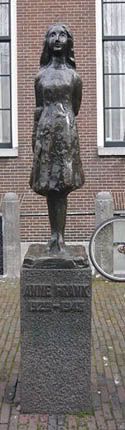
statue of Anne Frank outside the house where she hid: click to enter the Anne Frank house website
I don't often to to hospital for non-medical purposes, but today Maxima and I went to Cambridge's Addenbrookes Hospital to see an Anne Frank exhibit in the Treatment Centre. The hospital's now so big that it provides a rather large car called a "courtesy bus", which took us round the huge campus to the centre, aka Institute of Metabolic Science.

The exhibition was in the form of two sets of photos on screens, starting with the dire econimic situation in post-Versailles Treaty Germany, which bred resentment against the Allies, which Adolf Hitler took advantage of in the years following his outburst at a meeting of Anton Drexler's German Workers' Party (Deutsche Arbeiterpartei)persuading him to prefix Nazionalsozialistische: the Nazis had been born.

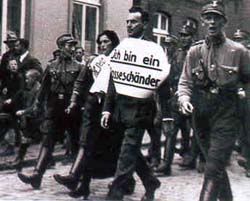
The presentation stressed that the majority of Germans were unaware of the true agenda of the Nazis until after their election in 1933. After this point, the exhibition grew ever darker, and you would see groups of nurses, physiotherapists etc gathering round words and pictures in silence. It related that 80,000 handicapped people were killed in order to prevent "enfeeblement of thJulius Wolff and Christine Reemann - note the boy with the bike joining in the condemnatione race"; another photo showed a Jewish man, Julius Wolff, being driven down the street by SS soldiers alongside his "Aryan" girlfriend Christine Reemann in Norden in 1935, each bearing signs that said "I am a defiler of the race".
Interspersed with the indications of mounting horrors were the lives of Anne and her family, who moved from Germany to the Netherlands in 1933. In 1940, their country of exile was occupied and they took to hiding in rooms behind the business where Anne's father had worked, which she called "the secret annexe" - which was the original title of the book. One of the families foremost helpers and concealers was Miep Gies, who said:
'It seemed perfectly natural to me. I could help these people. They were powerless, they didn't know where to turn. I always emphasize that we were not heroes. We did our duty as human beings: helping people in need.
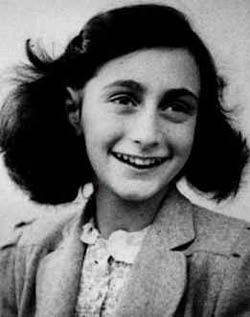
Anne FrankI stood looking at the quote underneath her picture for a couple of minutes, unable to speak. There were further details of how, even in the summer heat, Anne and her companions had to burn leftovers to destroy evidence of their clandestine existence. Another quote from the diary referred to the five books that Ms Gies, who recently achieved her century, brought them form the library every Saturday: "We long for Saturday because that means books". However, the quote that moved me most was underneath the world-famous picture of Anne gazing into a future that she would never see:
I long to ride a bike, dance, whistle, look at the world, feel young and know that I'm free, and yet I can't let it show.
The family was arrested in August 1944. Anne, her sister Margot, and her mother Edith were sent to Auschwitz, where their mother died, having starved herself to give her daughters extra rations. By the time she died, Anne and Margot had been sent to Bergen-Belsen, where they died in a Typhus epidemic less than a month before the camp was liberated by British soldiers in April 1945. Uanu Seshmi - click to read his story at the Anne Frank UK website

Anne reaches out to us beyond her death. The Government has placed Diary of a Young Girl on the English National Curriculum; and in the UK, the Anne Frank foundation awards people who make a change in their community. For example, Uanu Seshmi, a teacher in the Peckham area of London, received an Anne Frank award for his amazingNick Bennett: click to read Stephen Exley's coverage for the Cambridge News; thanks to the Anne Frank foundation for the pic work in getting young black boys, who had been excluded from school, back into mainstream education. In Cambridgeshire, a self-confessed "boy racer" called Nick Bennett, whose hobby had landed him in a wheelchair was honoured for his work in going round schools informing teenagers of the dangers of his former occupation.

Anne's story is one, I believe, that makes the Holocaust comprehensible by providing an antidote to Stalin's dictum that "one death is a tragedy; one million is a statistic" - although it was sobering to learn that before Hitler embarked on his dark project there were eleven million Jews in Europe - the Nazis got more than halfway in their obscene scramble towards the Final Solution. Many years ago I found another part of the story contextualised when, during my first placement as a student nurse - in a medical ward - I met one of the soldiers from the unit which had liberated Bergen-Belsen. Having been a member of the Church of Scotland, he described how he had looked around, and his faith had vanished like a snowflake in a furnace. When I met him in the late '80s, he was still an atheist.

The diary has been attacked as a fraud - notably by lawyer Edgar J Steele, who claimed in November 2003 that "It wasn’t Arabs who forged the Anne Frank “diary” - it was jews [sic]" in a bizarre rant which ends: "And, lest we forget:It wasn’t Arabs who had Jesus Christ crucified - it was jews."
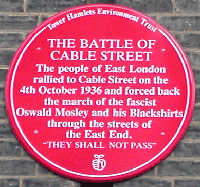
heritage plaque celebrating the victory in Cable Street against Moseley's fascists
Professor Calculus has told me that he remembers from his boyhood slurs about the Jews being "Christ-killers"; and it is a troubling thought that, had the Hitler/Schickelgrueber family moved to, say, France or Britain when the children were young, Adolf might not have had much trouble starting a movement that resembled the Nazi Party in its anti-Semitism; certainly Oswald Moseley found people flocking to his New Party.

So perhaps it's a good thing that the Anne Frank Foundation will be delivering diversity training to Addenbrooke's staff, even though the concept of diversity has become so loaded with so much ideological baggage pertaining to unilateral multiculturalism that it is increasingly becoming a bad word among followers of many political creeds. Hopefully, the Foundation will be able to inject some reality into a troubled subject, in this corner of East Anglia anyway, before a backlash is unleashed that may snowball towards disaster.


thank you

Anne Frank
1929-1945
Thank you

Monday, May 18, 2009

the chief bully and his accomplices face retribution

Speaker resigns: click to go to update


Minima was a bit upset today and told me, after I asked the reason, that another child had called her a "retard" at school. I sighed - some of us parents been expecting something like this to start.

The story is that an outcry has forced the British Association for Adoption and Fostering to remove a homosexist phrase from its latest book, The Pink Guide to Adoption for Lesbians and Gay Men:
"Children need good parents much more than retarded homophobes need an excuse to whinge, so don't let your worries about society's reaction hinder your desire and ability to give a child a loving caring home."
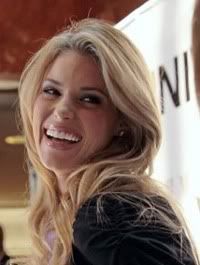
To give you an idea of the pressure that children who want nothing more than education come under from politically-correct bullies, Minora was once excoriated by a supply teacher for calling a failing pen "gay" (seCarrie Prejean - thanks to the First Post for the pic - click to read Casey Chance's coverage of her vindicationmantic drift having carried the meaning of the word to "uncooperative") because, said the stand-in, chances were that a quarter of the pre-teens in the class were gay.

As Miss California Carrie Prejean found out, even to give an intelligent and thought-out response to a question concerning the rights of powerful interests can result in a prolonged period of bullying. Columnist and commentator Ann Coulter describes how Hedda Hopper wannabe Perez Hilton ordered the dogs on the beauty queen when she declined to give an unconditional endorsement of homosexual marriage in favour of a nuanced appreciation of homosexual and heterosexual union ending with her faith-based preference for the latter.

In Great Britain, we are Michael Martin, current Speaker of the House of Commonsseeing powerful interests defied as rarely before, with the MPs' expenses scandal compounded by the refusal of Michael Martin, Speaker of the House of Commons, to resign as the degree of his complicity in trying to keep expense abuse hidden is unmasked by the daily and Sunday Telegraph magazines.
This started in January 2005 when, three months after the introduction of the Freedom of Information Act (FoI), journalists Ben Leapman, Heather Brooke and Michael Thomas applied to see a number of MPs' expenses. Through a long process which was fiercely fought by MPs of all major parties and whose attritions are undoubtedly yet to be recounted, Parliament fought and over-ruled not just the journalists but the courts and tribunals finding in their favour. Although an Information Tribunal ruled that some documents were not to be passed to the public, Leapman was passed unedited bills, and the Telegraph newspapers have been publishing details pertaining to MPs of many parties for over a week now, in a devastating campaign which may yet change British politics to a previously unimaginable extent within three months. (It should be noted that the Telegraph is also publishing details of "saints".)

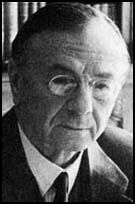
Just as the silent majority of British people are now expressing their anger, so MPs are unburdening themselves in regard of the Speaker, who has been accused by his foLeo Amery - click to read more on Spartacus Educationalrmer senior advisor John Stonborough of jealously guarding control over information in a "reign of terror". Labour MP David Winnick informed this most party-political of Speakers that "your early retirement sir, would help the reputation of the House", while Conservative Sir Patrick Cormack MP has referred to the 1940 Norway Debate, when, referring to the failure of Neville Chamberlain's Norway Campaign and the necessity for fresh hands at the rudder, Leo Amery quoted Oliver Cromwell's address to the Long Parliament when disbanding it in 1648: "You have sat too long here for any good you have been doing. Depart, I say, and let us have done with you. In the name of God, go." Conservative leader David Cameron has called for a general election. Rightly so: corrupt MPs have ridden roughshot over their decent, hard-working peers under the protection of chief bully Martin until Parliament itself is one big rotten borough.

And Miss Prejean? DDonald Trumponald Trump, Miss Universe mogul, supported her in a press conference, noting that her reply to Perez Hilton's question was almost identical to one given by Barack Obama shortly before his election, and gave her the opportunity to protest against the "hateful attacks, despicable rumours and false allegations" visited upon her by Hilton's minions. Trump is a businessman and recognises the bullying of Prejean as a distraction aimed at furthering the aggressive agenda of politically-correct ideologues.
I asked Minora how she reacted when called a "retard". When she replied she hit the girl, I patted her on the head - I have a relative with special needs and am tired of terms relating to people with learning difficulties being used as insults. And at the end of the day, the only sanction bullies recognise is retribution.

UPDATE: Michael Martin has announced his resignation on Sunday June 21,, so that a new Speaker can be elected on Monday June 22. Gordon Brown is said to have played a part in the reluctant decision. Coming from a working-class background in the East End of Glasgow, I'm glad he's gone to reinforce stereotypes about the city in pastures new and hopefully far away from anywhere. Keep an eye out for repercussions...

click to go back to top

Sunday, May 17, 2009

Eurovision Song Contest 2009 - the music won

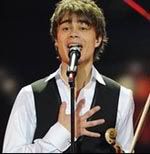
Alexander Rybak
The Eurovision Song Contest finished an hour or so ago with a conclusion that we haven't seen for some years: the best song won. Alexander Rybak (right), an actor, singer-songwriter and classically-trained musician who was born in Belarus during the oucntry's last days as a member of the Soviet Union, won the prize competing for Norway where he's lived from the age of four, with a dramatic tale of obsession with a former lover from a stormy relationship called Fairytale.


The once-revered Song Contest changed its voting system from excusively professional juries to public voting by telephone in 1998 because of cynicism about countries voting not for songs but for other countries that they were allied to or even feared; and the Telegraph's Chris Hastings reported allegations that Spanish dictator General Franco bribed juries to vote for Spain in 1968, resulting in British superstar Cliff Richard coming second with Congratulations.

However, the voting change resulted in the situation whereby votes were allocated for almost every reason other than the song worsening. Terry Wogan, who had presented British TV coverage for the Contest from 1980 and is known Europe-wide as a song contest institution, decided he'd had Dr Death and the Tooth Fairy: Soren Pilmark and Natasja Crone-Backenough in 2008 when Russia won through politically-skewed voting by countries that were, as he indicated, placating "the biggest boy in the playground". He moved after Eurovision boss Bjorn Erichsen labelled his famously acerbic commentary as the problem with Eurovision rather than the voting. (Erichsen is a Dane: when his country hosted the Contest in 2001, there were comlaints at a diplomatic level for his referring to hosts Soren Pilmark and Natasja Crone-Back as "Doctor Death and the tooth fairy".) But Wogan has a talent for puncturing egos which exist at rarefied levels where ordinary people are rarely given a voice, and his falling on his sword was undoubtedly a factor in the voting change.

Cirque de Soleil's surreal opening act upheld Eurovision's legendary reputation for strangeness, but once the music started, it was clear - with only a few exceptions, like Lithuania's Sasha Son, who dressed like Frank Sinatra but sang like Gareth Gates - that the song and its performance were the priorities.

When Sweden's Malena Erman came on I groaned something like "here comes rentablonde", but she sang like an angel whose high-notes threatened to crack the TV screen. I was hooked.


Israel had two vocalists, one Jewish and the other Arab, sing There Must be Another Way which, though worthy, expressed the sort of fuzzy sentiment that things will all work out well if we think nice thoughts that can sometimes infest Eurovision; Malta and Denmark sung on similar themes, although perhaps Israelis have more impetus to reflect on what they were singing.

A couple of stars who were well-known in Britain turned up: Lord Andrew LloyBritain's Jade Ewand Webber, of Jesus Christ Superstar, Evita and Cats fame played piano on the song he wrote for the UK's Jade Ewen, and on Gemany's entry, which could have been lifted from a 1930's Berlin nightclub and was performed by Alex Swings! Oscar Sings! (honest), Ditta von Teese did a short burlesque routine, characteristically blending the sensual with the cerebral in a way that showed up Ukraine's Svetlana Loboda as a tacky stag-night artiste, performing moves that I think should have been reviewed in the light of the fact that children (like ours) are traditionally allowed to stay up for Eurovision. (I refute claims that I brightened up when von Teese appeared on stage.)

Russia's entry was a well-written and intelligently-staged song about how a mother's advice to her daughter is found to be true after it's ignored. As Ken Bruce, commentating for BBC Radio ", observed, Anastasiya Prikhodko sin't a proponent of the "leave 'em laughing" school, but the ballad's huge in the host country, where artists can raise the recounting of misery to the level of high art. It was good to see some traditional outfits, for example in Moldova's entry, traditional-style folk music, as in Portugal's, and the odd bit of reassuring vintage Eurovision cheese - like the Blue Man dancing in Albania's entry. On the other hand, all that was missing from Romania's entry "The Balkan Girls like to party..." was Lembit Opik. Turkey produced belly-dancers, as usual, which was a salutory reminder that not all women living in Islamic countries have yet been stitched into burqas.


The voting was expemplary, something that wouldn't have happened without Terry Wogan's sacrifice. New presenter Graham Norton proved himself equal to the job, considering that he was running to stand still in the first place through merely not being Wogan. But I was nonplussed that, while Wogan felt no need to refer to his sexual orientation in 30 Eurovisions, Norton professed himself taken with Ukraine's backing dancers, sub-Chippendales headbanging in Roman helmets.

If certain elected British members had taken note of how wide disaffection with Eurovision had forced changes in voting at the highest levels, they might have considered the effects abuse of expenses would have on the electorate once the evidence inevitably appeared in the public domain. Perhaps the effect of dissatisfaction on this European institution indicates that public demands on their representatives will not be limited by British shores.

But, on the night, it was good to see several sets of laughing-gear in their natural state, unhomogenised orthodontically; and also what Maxima refers to as "real women", not the stick-people belched out by diet boot-camps. And another bonus - nobody got nul points.

Friday, May 15, 2009

how The Simpsons made my day

The Simpsons: the family that stays together...er...
Yesterday, as my faith in my ability to stand against politically correct fascism faltered, I little suspected that The Simpsons would come to my rescue.

Having a day off after my foray into London, I got a call from Minora, who'd just completed a Foundation Exam, saying that one of the questions had asked her whether it was right to use human/animal embryos in the search for a cure for Alzheimer's disease. She hadn't answered the question. I commiserated with her, trying to reassure her that I would either have left the question myself, or answered it with the contempt it deserved.

Science doesn't happen in a moral void. It always happens in an ethical framework, the question merely being which one. For example, animal testing, although not perfect, has a definite part to play in maintaining human health, a vivid example of this being when Baxter International, which is working on a vaccine for swine flu, sent avian flu vaccine containing live bird flu virus to Czechoslovakia. On taking the routine step of administering vaccine to ferrets, a subcontractor noticed that the vaccine killed the animals, and a disaster was averted. But when animal liberation fanatics get so tied up with non-human rights that they would gladly unravel the hem of the cloak of creation to salve their fevered consciences, we see big-hearted adolescents served up leading questions by exam boards in an attempt to stunt their moral and intellectual growth, thereby to reduce the ranks of free-thinking individuals who might see through their snake-oil salesmanship.

Then, I read Stephen Exley's exclusive in the Cambridge News about Cambridge University's Newnham College dropping its traditional range of Latin graces referring to Jesum Christum dominum nostrum, and substituting pro cibo inter esurientes, pro comitate inter desolatos, pro pace inter bellantes, gratias agimus - "For food in a hungry world, for companionship in a world of loneliness, for peace in an age of violence, we give thanks". My first reaction was to hope their food isn't as bland, then I realised what they were saying. A suitable paraphrase would be: for being fed and not going without, for being popular and not lacking friends, for being priveleged enough to live without fear of mixing with the uncouth, we worship here at the altar of our own worthiness. It's a fitting epitaph for a society which tries to plug the God-shaped hole in our hearts with that which comes from ourselves.

Lastly, I came upon a report about Hilary Clinton's visit to Brazil over at Don't Poke the Baby, recounting how Hilary Clinton had claimed that a hospital she visited had been packeHilary Clinton - click to read about her struggles to justify her Brazil abortions remarkd with a disproportionate amount of women recovering from botched abortions. It appears the poor women suffered from the same condition as the snipers who fired at Clinton when she landed in Tuzla, Boznia in 1996 - an acute lack of reality. However, Baby blogger Linda deftly teases out the pertinent point in the story of a Brazilian woman who had had an abortion as her relationship with an abusive husband ended: "My sympathy is for her living in a situation where she is raped...Where are the defenders of her freedom before the pregnancy? [my italics]"

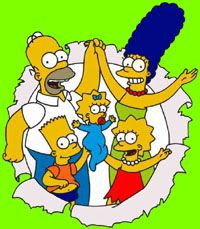
So I was feeling somewhat beaten down by the time I settled down to watch The Simpsons with my family. I like this show, and it's been praised by many Christian publications - for example the Scottish Catholic Observer - for providing a view of a nuclear, churchgoing family. But you could have knocked me over with a feather when the episode on C4 (#8, 15th season) turned out to have a pro-life lesson.

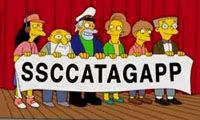
The episode was entitled "Marge vs. Singles, Seniors, Childless Couples and Teens, and Gays", and inThe Simpsons and SSCCATAGAPPvolves the blue-haired matron's fight against members of the above society when they sideline families with children as pariahs. Their ringleader, Lindsay Naegle, affirms her belief in abortion; and when Marge tries to get her daughter Lisa to win her heart over, Naegle replies, "I hope one of my eggs I sold turns out like you".
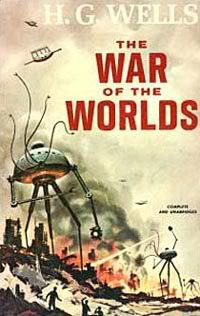

After refusing a (literally) Satanic temptation to give up the campaign, Marge founds her own society - "Proud Parents Against Singles, Seniors, Childless Couples and Teens and Gays". After a media campaign almost sunk by her husband's best-intentioned efforts, which are often his most destructive, the denouément occurs in the school playgound, as the anti-family activistclick to read War of the Worlds on Project Gutenbergs prepare to tear the school down. In a charm offensive,the children hug the adults, who are stricken with hellish ailments because they have lost their immunity to the germs that kids harbour.

As Lisa says, the protestors have been defeated by "the humblest things that God in his wisdom has put upon the earth - children". It is, of course, a send up of HG Wells' The War of the Worlds, which was to be released in a modernised version by Stephen Spielberg later in 2005. But it touches on a truth which would be sobering, were not anti-lifers so intoxicated with their own rhetoric: a society lacking sufficient respect for children to suffer them to be born is its own Nemesis. Praise God for hiding these things from the wise and the learned and revealing them to children and Matt Groening.

Thursday, May 14, 2009

drink-driving campaigns - a worked-out example

worthy cause: click to go to the Brake homepageOn the way to an international conference in London about drink/drug driving, I had my first lesson on the journey down. The train from Cambridge to London lived up to its nickname as "the sardine express". Although there were eight carriages all seats were taken, and the lack of vetilation made the experience feel like standing in a mobile sauna for an hour. I now know why some of those who are able to commute to big cities by car sometimes choose to do so.

The conference, hosted by the road charity Brake in the grand surroundings of thclick to go to Safer Scotland's websitee Royal College of Physicians, featured academics, police officers and advertising-campaign organisers from England, Belgium, Germany and New Zealand.

And Scotland. When Caroline Thomas, Senior Marketing Manager with the Scottish Government, started a presentation of a worked-out example of a road-safety campaign with an anti-drink-drive campaign, her Ayrshire accent was as clear as a bell; on the other hand, I'm told in my country of choice that my accent is really broad, and in my country of birth that I sound half-English.

She started with a history lesson: the first recorded death related to driving was that of Bridget Driscoll in London. A contemporary newspaper account reads:

click to read the story of Bridget Driscoll's accident on Blue Ocean Strategy Resources' websiteOn August 17, 1896, in London, Bridget Driscoll, age 45, became an early car accident fatality as crossed the grounds of the Crystal Palace (London), an automobile struck her at a speed witnesses described as "a reckless pace, in fact, like a fire engine."
The coroner concluded that the car that hit her had been driving at 4mph (6.5kph) and added his hope that there would be no further deaths due to driving. We're currently averaging an estimated 1,000,000 deaths worldwide related to driving per year.

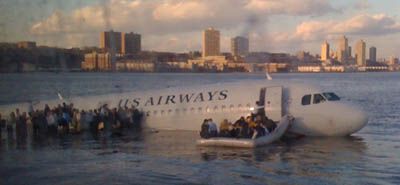
From newspapers we went to other media. While it took radio 38 years to reach an audience of 50 million and TV 13 years, by the time mobile phones were in the ascendancy they had reached this mark within 2 years. Caroline drew our attention to the famous Miracle on the Hudson picture of US Airways Flight 1549, which had just ditched in the New York river, posted from a mobile phone on Twitter by rescuer Janis Krums as he went out on the ferry as part of the rescue team, with the microblog "There's a plane on the Hudson. I'm on the ferry going to pick up the people. Crazy." The city's own paper, the New York Times, had the story online in 10 minutes. But it had been well and truly scooped: Krums' picture had gone round the world at a speed that made swine fever look as lazy as a fed dog.


click to go to Janis Krums' famous Miracle of the Hudson' picture and message on Twitter
So where was all this going? As Ms Thomas explained, the object for Safer Scotland was to reach the relatively small amount of young people who were responsible for a disproportionate amount of failed breath tests and indeed accidents. Not pathological drinkers, people who have a beer then, having been disinhibited a little by the first pint, make the decision to have a second before they get into their car. They would then be more vulnerable to distraction, which was the theme ofthe campaign, starting with a cinema advert where a driver is distracted for a moment on a rural road, and, swerving out to avoid the car in front of him, crahes head-on with the car in front. There followed a wave of mobile-phone picture messages, starting with a ic of a car windscreeen at night, then a "new text" message, culminated in a pic of a broken windscreen. There was also an online campaign orchestrated around the "morning after", which in the UK accounts for 80% of drink-drive convictions.

the morning after online campaign
The last phase of the campaign was, I believe, a stroke of genius: a Facebook page, now taken off, called "The Loneliest Man in Scotland", which achieved 400 friends as videos were posted about how the man, having failed a breathalyser test and been convicted of drink-driving, progressively becomes isolated from the people around him. There was aThe loneliest man in Scotland - click to go to the Don't Risk It place degree of risk-taking here, as Facebookers are an independent lot, but what sponaneously happened was that abusive comments were taken care of by those many who wanted a serious debate on the matter. "Don't risk it" (the theme of the campaign) posters also appeared on X-box Live games.

The cinema ads were the workhorse of the campaign in reaching 17-19 year olds, which is perhaps a sad reflection of the cost to a family of going to the flicks. Surprisingly, use of new media like internet and mobile phones widened the age-range exposed to the advertising.

Scotland's safer driving pushes have to take into account that the country has a lot of rural roads that are often assumed to be quite empty, which is where I think Caroline's presentation was an important contribution to the conference. Should the Congestion Charge proposed for Cambridge be implemented, for example, then the Draughty Old Fen and other beads in the necklace of villages around the village will be exposed to even more rat-running than usual, as motorists whose destination is beyond Cambridge but who might usually run through it find ways to avoid the charge boundary. This, coupled with house-building schemes embarked upon to accomodate augmented populations, will fill up roads previously assumed to be emptier.

Another aspect I found impressive was that the campaign married embracing new media and technology with the age-old skill of identifying what a problem is, who is causing it, and how to reach them with which message. And all without the behinderment of ideological blinkers.

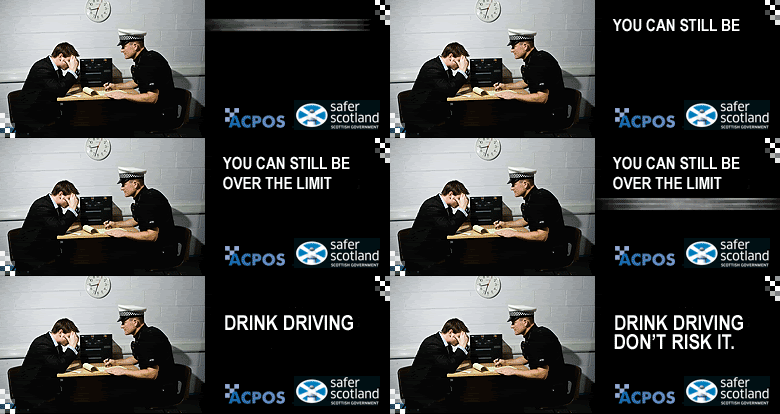
Lasly, the campaign demonstrates that, at a time when dismemberment and gore are daily bread for many younger cinema-goers and gamers, tactics have to be cerebral rather than visceral - more Psycho than Saw. As another speaker demonstrated, resolving tension halps people relax - "don't shock 'em and drop 'em, shake 'em and wake 'em". The latest Scottish advert on drink-driving demonstrates a firm grasp of this principle:


Related post: Booze-buses from Aotearoa - an idea for England?