Tuesday, May 12, 2009

Norman Tebbit and the art of risk

danger: cardboard boxes

When I met Maxima in XV, the Draughty Old Fen's charity shop, she and Vecta were looking worriedly at a load of boxes filled with fairly-traded produce which the chap delivering had dumped in front of the counter instead of taking them behind, as Vecta had asked. Maxima asked me to help her carry boxes over one-by-one, and this is where my qoundam training as a moving and handling facilitator came in.

I explained that, if possible, it's better for one person to carry a heavy box because when two people carry, either both are walking like crabs, with spines out of alignment all over the place, or one is walking ahead with a textbook posture, and the other is walking backwards. There ended the lesson. I didn't add that the last moving and handling training I was forced to attend involved sitting imagining how our backs would swivel were we on skateboards - the car-park hadn't been risk-assessed for us to stand in.

Much - indeed most - health and safety management today is "risk-led", ie possible risks are identified, with a view to devising strategies to prevent the putative hazards. I'm not saying these are totally divorced from reality: in a medium-sized office I know where people feed numbers into computers, at the back of the accident book there's a chart to help one calculate possible risk, which ranges from "low-risk" to "multiple deaths".

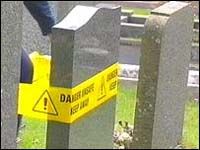
You could say, for example, that Britain is full of graveyards with municipalcordoned-off graves - more offensive than dangerously-desecrated headstones because of the risk of the latter, as Government figures cite seven deaths and 21 injuries due to falling headstones. So insurance companies are refusing to cover cemeteries with graves which have even the least risk of falling, even if no injuries (or indeed falls) have occurred for centuries. Likewise, some schools have banned conkers because of the possible risk, taking no account of what injuries have occurred and in what circumstances. (Although the Daily Mail article linked to recounts the story of a poor boy killed by a gravestone while collecting conkers, so I wonder if the number-crunchers got confused in a frenzy of probabilities.)

In the furore Norman (Lord) Tebbitsurrounding MPs' abuses of expenses allowances, former Conservative Party Chairman Norman (now Lord) Tebbit displayed a magisterial grasp of the anticipation and management of risk when he encouraged voters to vote for smaller parties in the forthcoming European elections, a move which Telegraph blogger Benedict Brogan states has led to the threat of his expulsion.

Tebbit would have learnt more about risk-management working as a military and civilian pilot than insurers and inspectors could grasp in a month of Sundays. And he's playing a risky but canny game here - just as he was part of the Tory Opposition team which forced the Labour Government to reduce tax prior to Margaret Thatcher's 1979 victory, he is now indicating to voters that the Conservative Party will stand or fall by its reaction to the scandal, while Labour Prime Minister Gordon Brown dithers and his pet Speaker makes the sort of hollow threats (about police investigations) that the playground bully does when he meets somebody who doesn't run away.

I hope we don't lose any seats in Brussels - but should that happen, I predict that Conservative MPs' expenses will become very clean very soon. And Britain - and the world - will see that not everybody here has been so cowed by the threat of litigation and action by police who would rather do police-work that they keep their heads under the parapet.

And come the next election, we might see kids looking for conkers to play with at school again. Just not under gravestones.
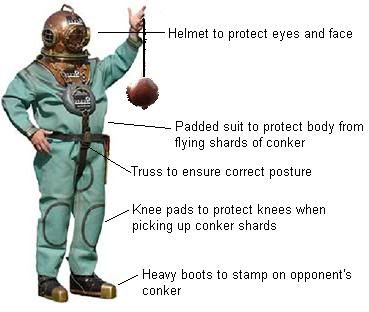
Gestapo Conker Suit: click to read more on Ken Frosts's 'Nanny Knows Best' blog

Sunday, May 10, 2009

expenses

"It's like Africa!"

So spoke Professor Calculus's son Scandens, who is visiting him from southern Africa.

We were, of course, discussing the scandal involving MPs' fees that has been evolving into a car-crash over the last week. What Scandens was getting at was that while foreign observers coming to monitor political procedure in Africa - eg elections - was so usual it wasn't even worth remarking on, the level of corruption in Westminster had shaken the faith of many people in the Mother of Parliaments, in his corner of the continent, at least.

I don't see the point of posting links that evidence MPs' disingenuous profligacy, because if you manage to avoid news of it you're doing a good job.

It's hard to know what is worse: the claims upon taxpayers for bath-plugs and sponges, or the "flipping" of designation of one residence, where ministerial-rank MPs live so far from London that they have to maintain a second home in the capital's vicinity, so that both homes can be redecorated and sometimes sold at a large profit at the taxpayers' expense.

Tory (Conservative) MP John Redwood refers to a campaign designed to throw blame for the exposition of Labour spending onto a "Tory dirty tricks" campaign, and there certainly does seem to be a concerted effort in e-media to disseminate this impression, presumably in the hope that the Mainstream Media will pick up on it. However, as Redwood says:
Why would any wellwisher of the Tories leak these documents, when doubtless they include some claims from Conservatives which will also prove to be embarrassing, reflecting claims for items which may well be within the rules but will be thought wrong by the electorate?
There will indeed be revelations in tomorrow's Daily Telegraph about expenses claimed by Conservative MPs. And I sincerely hope that those who have violated ethical practice will get a monumental bollocking, to restore faith that the Conservative Party operates on lines that are informed by what is right and what is wrong, not merely what is legitimate within the rules and what one had hoped could be covered up or even protest was "stolen" (like Immigration Minister Phil Woolas' claim for nail polish and feminine hygeine products).

Something positive has actually come out of all this. It had been suspected that civil servants who were in charge of deciding upon MPs' expenses had been handpicked by the Labour Party. Perhaps they had been - but they are taxpayers too, and the documents that have been leaked to the Telegraph show frustration at the mendacity of their masters. But you don't need to go to such exalted levels as the high reaches of the service to see how exasperated people are - the Telegraph's political correspondent, Rosa Prince, reports that the gardener for David Miliband, Secretary of State for Foreign and Commonwealth Affairs, left him a note saying "Please let me know if you would like pots making up at front and back this year, given the relatively short time you’ll be here".

I will find some uncomfortable reading in tomorrow's Telegraph. But if Labour Party MPs attempt to defend their prodigality in terms of "we do it because the people we defeated in three elections do it", then I pity them, because their biggest threat will not be from us but from the members of their own party who are aware of why the Labour Party adopted socialism in 1919, in an experiment which now lies butchered on Government benches.

Saturday, May 9, 2009

how diverse is diversity?

I'm just back from some mandatory diversity training. I was somewhat apprehensive on the way to Huntingdon (birthplace of Oliver Cromwell), where it was held, but my fears were mostly groundless.

I am worried by the lipservice given to diversity by many organisations today, which I think is summed up by a hymn pointed to by the Church Times blog, spotted by the Guardian (so it must be true) blogger Andrew Brown:


Lord of our diversity,
unite us all, we pray;
welcome us to fellowship
in your inclusive way.

If this isHarriet Harman true, it indeed rivals the previous nadir of hymnody, If I was a fuzzy wuzzy teddy bear, I'd thank you Lord, for my fuzzy wuzzy hair. (Or was that a parody with shades of the Golliwog? We may never know...)

My initial apprehension was due to the shibboleth-like nature of the mere word "diversity" in self-styled progressive society, which is such that Harriet Harman - Deputy Leader and Chair of the Labour Party, Leader of the House of Commons, Secretary of State for Equalities, Minister for Women and Lord Privy Seal - called confusedly for "positive action" to boost staff diversity. As the Telegraph's Richard Tyler reports,
Ugly Betty, played by the rather attractive America Ferreira
employers will be allowed to favour a person from an under-represented group where there are two 'equally suitable' candidates...But positive discrimination, seen in TV show Ugly Betty, where someone is employed regardless of merit, will remain illegal.
However, I was impressed when a left-leaning friend who attended the course pointed out that "diversity", interpreted as awareness and acceptance of differences between human beings in terms of race, gender, sexual orientation etc has of itself no moral value, and pointed to Adolf Hitler as one of the most diversity-aware leaders of modern times. I'm working on putting my friend in touch with his inner Conservative.

We worked through several scenarios, of which I'd like to share three with you.

Firstly: a twentysomething graduate on accelerated promotion takes charge of a hospital department over the heads of several people who express their unhappiness that their decades of experience has been overlooked.

This was a clear case of ageism towards the younger person, which the scenario's writer designed to be easily found. But it was also clear that ageism was also flowing the other way here: is it right that people who have worked their way through almost every job in a department should have their experience comprehensively undervalued in favour of graduates at a time when degrees in certain British universities are being egregiously dumbed down? I wouldn't want to minimise the gains that can be harvested from the discipline of studying for several years, but the other side of the coin is that if people who have proved their worth time and again were allowed to ascend past the glass ceiling that is a hangover from a bygone age, then we might not have the situation in Stafford General Hospital and elsewhere whereby 400-1200 preventable deaths occurred with the board of directors possibly revelling in glorious ignorance of the fact.

Secondly: a woman in a self-help group for drug users refers to her partner, at which the facilitator asks aout her boyfriend, and the woman, after an uncomfortable silence, explains her partner is another woman; afterwards, the facilitator explains to colleagues that the lady hadn't looked like a lesbian, wondered whether she was the "butch" or "femme" of the relationship, and said "I think she fancied me".

There was, of course, discrimination on the ground of sexual orientation going on, something condemned by the Catechism of the Catholic Church when it says that "Every sign of unjust discrimination in [homosexuals'] regard should be avoided" (para 2358). However, it was noted that many stereotypes about homosexuals come from the gay community itself, and not a little buJames/Lauren Harries - click to see evidence of continuing bullying by the gay pressllying: witness child antiques prodigy (and Oprah veteran) James Harries, whose outrageous treatment by the gay community, to whom he tried to reach out in search of an identity that would make him feel whole, on account of his relatively high voice may have fuelled James' emotional and surgical transformation to Lauren. It was telling that one was tempted to assume that the group facilitator was a man, whereas the facilitator's gender wasn't mentioned.

Lastly: a Muslim arranges with his employer to move his shift back an hour during Ramadan, and also to take an hour's annual leave each Friday during the month so that he can go to the Mosque to pray - during a business meeting, there are comments made about his arrangements.

There was a consensus that an annual leave request is precisely that - a request, and that anybody unhappy with another person's arrangement with their employer should be invited to mind their own business. I had tried to start a conversation about how moderaabuse of freedom: click to read Thomas Harding and Richard Edwards' account in the Telegraph - thanks to the South Beds News for the picte Muslims are victims of the bad feeling generated by Islamists - for example, the Muslim community in Luton has lost its Islamic Centre to arson as a reprisal for a handful of Islamist protestors branding returning soldiers as "butchers", "cowards", "killers" and "extremists" - but there was no great enthusiasm for going down that route. A pity: it would have demonstrated that the recipients of our diversity policies do not always feel a need to respect diversity themselves. It would also have been good, I thought, to discuss outfits that go into apoplexy at the prospect of offending minorities like gay people or Muslims (who are actually quite good at offending each other), but are happy to tighten the screw on people from a Judaeo-Christian tradition.

What made the sesssion was that the facilitator was no ideologue but an experienced former managclick to go to the whistleblowing charity Public Concern at Work, which was awarded damages for 'botheration' for time-wasting and maladministration on the part of the Department of Trade and Industryer in the probation and drugs-services area who had worked his way to that position through a variety of jobs in many areas of those services. He was the first to agree that whistleblowing abut oppressive practices, which the Government pays lip-service to but in reality militates against, can leave you ostracised, isolated and vulnerable. The only point where I detected olitically-sensitive sensibility was when he referred to a joke made by actor David Jason ("what do you call an Asian cloakroom attendant?", but feKrazy - click to go to Toonhound's page on the 1970's comiclt unable to verbalise the punchline "Mahatma Coat". I was surprised by this, and informed him that a character called "Mahatma Coat" once popped up in the late 70s British comic Krazy, and was also the name of an instrumental by rock group Slade in their 1981 album, Till Deaf do us Part. Personally, I laughted when I read the joke, which sounded like more of the "laughing with" type than the "laughing at", and saw it as a measure of how sections of Asian communities had become integrated into British society.

On the way back to Huntingdon bus station I passed the Oliver Cromwell museum, but unfortunately, being late in the day, it was shut. Although seen by some as a divisive figure because of his admittedly indefensible actions towards (especially Irish) Catholics, I believe he did show some awareness of "diversity" through the blinkers of his day by encouraging Jews to return to Britain. I wonder if members of all of the groups named in diversity policies would agree with me?

Tuesday, May 5, 2009

top ten songs about hope

Sometimes the news seems to wrap me in darkness, and at these times I think it's good to reflect, among other things, on those parts of popular culture that point towards another place - upstairs, as it were. I'd like to share with you - with apologies to Pam H - ten songs that remind me there's still hope.


10 - Beautiful Sunday

I always smile when this comes on the radio (not often enough), as it carries memories of how a song, a smile and a skip can vanquish hard times under iron skies. In Scotland, this feel-good song was so popular that a dance was created specially for it called the slosh. You can see it here, but at a Scottish wedding or other sort of celebration, when the opening bars of Beautiful Sunday come on the men clear off and let the women get on with it - facing columns of women moving with military precision, we know our place. Actually it's quite fun to see your Great Aunt Aggie co-ordinating with all the rest in this simple dance:

1 - Take three steps to the left and kick right foot over to the left
2 - Take three steps to the right and kick left foot over to the right
3 - Take three steps to the left and kick right foot over to the left
4 - Take three steps back to the right, lift your left foot behind your right leg and touch your left foot with your right hand.
5 - Raise right leg and slap your thigh with your right hand.
6 - Raise left leg and clap both hands together under the raised left leg.
Turn and repeat.

A male friend and I were once persuaded (dragged) onto the dance-floor to do the slosh to Beautiful Sunday. We were hardly fit for any more dancing for the rest of the night. But enjoy the song.


9 - Shine Silently

I love this song by Nils Lofgren - it always used to be on Terry Wogan's breakfast show, but you don't hear it so often these days. It just captures the way sometimes all you need from the one you love is for them to be there.


8 - Through the Barricades

Spandau Ballet's 1986 song about two people from opposed communities falling in love could apply to many situations, but Northern Ireland was on the band's minds as extremist leaders from both sides struggled desperately too keep alive the hatred that was key to their survival. There are still problems, but broadly hate lost.


7 - Love comes to everyone

George Harrison's cotemporaries once christened him "the Preacher" because he tended to bend their ear about the "Krishna consciousness" variant of Hinduism he was devoted to. Like the religion itself, Harrison could be somewhat syncretic, which did not always produce a jarring effect: in this song, "got to go through that door" in the first verse links with "knock and it will open wide" in the last, indicating that he's not talking solely about romantic love.


6 - Hallelujah

This song is one of the best in the history of Eurovision, I reckon, possibly second only to I treni di Tozeur. I've posted the version sung by Gali Atari and Milk & Honey on the night, because it has an English translation of the Hebrew that gets closer to what the writers were saying in that beautifully expressive language.


5 - Hymn

It's ironic that at a time when many hymnwriters were concentrating on the horizontal to the virtual exclusion of the vertical, Barclay James Harvest brought out a single called Hymn which did exactly what it said on the tin, with a story of the birth, life, death and resurrection of Jesus. Hymn came from the 1977 album Gone to Earth - this clip's from the 1980 Concert for the People performed next to the Berlin Wall.


4 - The Cutter

This Runrig song is the true story of a lorry-driver called Johnny Morrison who, at a time when people who moved from the north of Scotland to the south were still seen as emigrants, went to live in Canada. He made his fortune there but, at the time the song was written in 1987, still came home every year to cut peat on his mother's land. Even though I'm quite happily exiled in England, for me this song describes in literal form the link that ties us to the very land of our origin.


3 - Superbird

I love this song - performed by Tommy Steele on Terry Wogan's TV show - about the sort of God-given innocent childhood imagination that risks being "educated" to perdition. With the Superbird go green cheese on the moon and, a big target for many secularists right now, Santa Claus. As the song says, "there's time enough to wreck your dreams".


2 - Deliver us from evil

I love the setting for A night on Bald Mountain (sometimes referred to as A Night on the Bare Mountain) by Modest Mussorgsky, orchestrated for Walt Disney's 1940 film Fantasia by Leopold Stokowski. The manifold versions and stories behind this piece easily rival any Beatles minutiae. What strikes me is that the animation could have sprung from the imagination of Clive Barker, although the film was given a U (Universal) certificate in the UK. Some say the original tone poem was about a witches' sabbat, others that it represented disturbing images dreamt by St John the Evangelist on Patmos prior to the visions he recounted in the Book of Revelation - the composition's history is so tortuous we'll probably never know. Whatever, this powerful mix of sound and vision calms down when the Stokowski's simple toll of the Angelus bell gives way to a segment of Bach's Ave Maria. Whether you prefer the translation of Mt 6:13 and Lk 11:4 as "deliver us from evil" or the lesser-used "deliver us from the evil one", this fits the bill.


1 - Sweetest Feeling

I was exceptionally down some time ago when I heard Jackie Wilson's celebration of life and love for the first time in a while. It reminded me of what was best in my life, and things started to turn round. Every time I hear it since then I send a "thank you" upstairs.


Related posts: click here for more top ten songs about...

Monday, May 4, 2009

it was 30 years ago today...

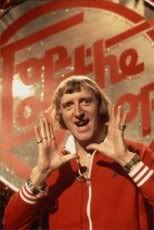
pop idol with the X factor: Sir Jimmy SavilleBeing in my early teens when Margaret Thatcher was elected Prime Minister on Friday 4 May 1979, I was more interested in music than anything else; Jimmy Saville had presented Top of the Pops the night before, announcing, I think, Blondie at number 1 with Sunday Girl, which even my Mum, no rock fan, preferred to the previous incumbent Mike Batt's funereal Bright Eyes, sung by Art Garfunkel. Eurovision Song Contest winner Hallelujah, by Gali Atari and Milk & Honey, remained in the top ten, and I still think it beats the two number ones hands down. Gary Moore - in mid-divorce from Thin Lizzy - had made the top 30 with his genre-changing Parisienne Walkways. The Shadows, on their way to the top ten, had just gotten to number 40 with Cavatina, theme from The Deer Hunter.

I also remember - they're hard to forget - the strikes. Taken collectively, strikes in the winter of 1978-79 saw the largest withdrawal of labour in the country since 1926's General Strike. Gravediggers in the Liverpool area struck for higher pay for a fortnight, sparking fears that the area's dead might be buried at sea. It was one of the shorter strikes - ironic, since it became the cause célèbre of the period, and one of the reasons British scandal-rag The Sun christened the season the "winter of discontent". Many folk thought it a very cleverly-coined phrase, not realising it came from the opening line of Shakespeare's Richard III, where Gloucester is actually proclaiming the passing of said winter:

Now is the winter of our discontent
Made glorious summer by this sun of York;
And all the clouds that lour'd upon our house
In the deep bosom of the ocean buried.
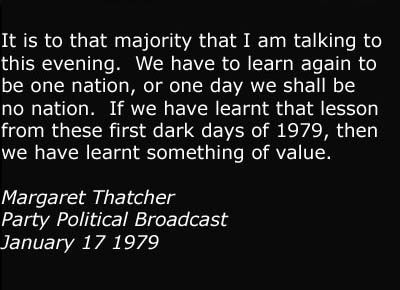
Mrs (now Baroness) Thatcher took advantage of Shakespeare's original theme of winter turning to "glorious summer" in her Party Political Broadcast of January 1979, which was subtitled "Winter of Discontent" (although she never used the misquote in her speech) and which the Margaret Thatcher Foundation archive of her speeches rates as "key".

There were far fewer strikes during the following Conservative administrations, for the simple reason that the Conservative Party did not and does not mortgage its agenda to false and dangerous proRonald Reagan - click to go to the Ronald Reagan Foundation websitemises - something even the Socialist Workers' Party recognised in a 2002 article laying out the Labour Party's many failures in 1974-79, entitled "We struck because Labour betrayed us."

Anybody who lived through the 1980s in Great Britain knows it was no tea party, but Margaret Thatcher, among many other things, reformed union voting procedure to bring it in line with democratic best practice and lessen the possibility of coercion; faced down the illegal, year-long miners' strike, which was ostensibly about pay and conditions but which National Union of Mineworkers leader Arthur Scargill intended as a precursor to violent regime change;Pope John Paul II - click to go to the John Paul II Foundation and formed a triumvirate with Ronald Reagan and Pope John Paul II whose steadfast action and resistence to bullying was the sine qua non of Soviet communism's downfall.

In 1979, commercial punk having already burnt itself out, Abba had two albums in the year's top ten. It still has an album - Abba Gold - in this week's Top of the Pops top 40. Whereas in 1979 there was little evidence of the various forms of electronica which would feed upon the ashes of punk, it seems now that every innovation possible to popular music has been mined dry, and not only do we see bands that could stand proudly beside Blondie and her comrades-in-arms in the charts - like the Killers, the Kaiser Chiefs and Fleet Foxes - but old friends too: Chris de Burgh's album Footsteps is at no. 13, Carole King's Tapestry at 20 and Dusty Springfield at 30. And, of course, Bob Dylan, who released his first album in 1962, has just seen Together Through Life hit #1 in both the UK and the US.

Just so, we witness once more a sovietisation of British politics, with more quangos and committees than you can shake a stick at, and decisions that will have the greatest impact on British people taken away from the House of Commons. It didn't work before and it's not working now.

In the Winter of Discontent, rubbish was uncollected because of strikes; now it's not collected if it's the wrong kind of rubbish. Then, many NHS hospitals were only treating emergencies because of strikes; now, it's not unknown for people to come out of hospital sicker than when they went in because there is a surfeit of administrators and managers and a shortage of clinical staff on the ground.

Then, the actions of Labour, be it in exacerbating financial crises or personal feuding, led millions to vote Conservative who would never have thought of doing so before...funny how some things don't change, isn't it?

Margaret Thatcher's political legacy is alive and well and has changed politics, I believe, for many years to come. I believe that, when Gordon Brown (or his successor) finally suffers the British people to have an election, David Cameron will lead from the front, and return the House of Commons to it pre-eminent place that the respect the Conservative Party has for the British people demands it have.

Add in some good songs, and we might once more see the ice melting.

click to enter the Margaret Thatcher Foundation

Saturday, May 2, 2009

Pilate's question remains unanswered

"Did you make it up?"

"Whose idea was it?"

"Did you think it up by yourself?"

"I have to wait until I get your answer. He didn't touch you, did he?"

"Do you remember that you said to me, that you didn’t tell fibs? Is that true or a fib?"

"What is truth?"

ThBernard Richmond QCe above questions were asked in court last week of a four-year old girl, who had been raped at the age of two, by Bernard Richmond QC (left), who was representing the accused. The thing that initially jumped out at me about the aggravated interrogation above was that I'd heard the last question before, which Jesus declined to answer Pilate. So Richmond was possibly being overoptimistic if he realistically expected an answer from a violated toddler. (Photos can't be taken in British courts; the picture below, linked to Caroline Gammell's account of the trial, was drawn by court artist Julia Quelzler.)
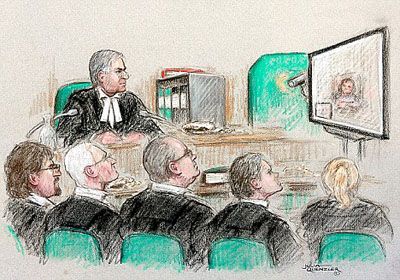
click to hear Caroline Gammell's account of the trial

If. As Richmond told the Times in a 2008 feature entitled Actually, crime does pay, and it's fun, [the consequences of] "underperforming...can be horrendous".

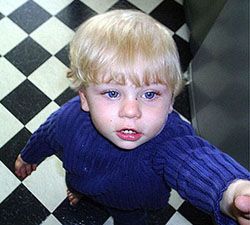
And Bernard Richmond was certainly under pressure to perform. The man who rapBaby Petered the girl was not new to allegations of child abuse, having been found guilty in November 2008 of "causing or allowing the death" of Baby P (now known as Peter), who had been on the London Borough of Haringey Social Services Department's books as a child in need, having been seen by social workers, police and medical personnel on 60 occasions, sustaining 50 injuries in that period. However, Baby Peter was not categorised as a child at risk of immediate/ongoing harm, which is a step up from being noted as a child in need.

Having been involved in drugs-work in various places, it depressed me to observe that the objective needs of a child are only one side of the coin as regards a decision whether to upgrade a child's need of observation and/or intervention: the other factor is the number of social workers and their caseloads, which causes the threshold for upgrading to rise (usually) or fall.

The head oSharon Shoesmithf Haringey Social Services Department, Sharon Shoesmith (left), not only refused to resign after the catalogue of professional abrogations of duty leading to Baby P's death, but proceeded to lead the official investigation into what had gone wrong - a course of action lambasted as "totally unacceptable" by David Cameron at Prime Minister's Questions in the House of Commons. Shades, indeed, of Cynthia Bower, who failed to pick up hundreds of unneccessary deaths in Stafford General Hospital when she headed the body charged with monitoring it, taking the top post at the Care Quality Commission to be responsible for the enquiry for...deaths at Stafford Hospital.

The reason, at root, for the madness gripping Britain today lies in a high-level dissociation of consequences for one's career from the consequences of one's performance in the real world. As historian David Starkey put it, even the 16th-century machiavellian English king Henry VIII led a culture where success was rewarded andHenry VIII failure punished, and governed Britain better than Gordon Brown. In true form, Ofsted - the Government office for, among other things, children's services - gave Haringey Council a glowing report which included an apotheosis of Sharon Shoesmith written by an ex-colleague weeks after Peter's death (but before it had become public knowledge); in other words, a whitewash.

And after the fashion of a whitewash, the Secretary of State for Children, Schools and Families, Ed Balls, has announced that managers will be sent on a "new training regime". That is unnecessary. What is needed is for senior managers to be forced to implement reforms demanded by Lord Laming's enquiry, published 2003, into the death in 2000 of Victoria Climbié (below left), who was known to be a child in need by social services - in Haringey. Method of force: reward success (bonuses or promotion), punish failure (demotion or the Victoria Climbie - click to read of the failure of reforms promised after her torture and murdersack).

The culture whereby a tome of ticked boxes is enough to guarantee praise and promotion must be brought to an end. This would, of course, entail a shake-up of trees that would send figures plunging from their pedestals right up to Government level. That indicates the sort of pressure Bernard Richmond QC was under to perform, including asking a question of a four-year-old that Jesus left unanswered.


Related post: Human rights: a done deal for some, torture for others

State marriage? It never worked the first time

Søren KierkegaarddeIt seems very easy to lapse into what Søren Kierkegaarde called "existential slumber", and something jarring is needed to spur one to wakefulness.

Having this bug that's going round I felt quite disconnected while reading the Telegraph yesterday morning, something I admit with guilt, given the attrition flu and fear are visiting upon Mexico and Texas.

Then I hit upon an article by John Bingham entitled (in the print edition) Couples with children 'should be married by the state'. The proposition, by Professor Julian Le Grand - "the architect of a clutch of New Labour Policies" - would change the status of an unmarried couple without children to married "by default" once the first child arrived.

I was somewhat torn - for there no longer to be illegitimate children would of course be a wonderful thing, and seems to approach the medioeval European position on marriage when, we are informed by Guy Brandon, author of Just Sex, "a marriage could be contracted without a ceremony or witnesses, if they simply promised to each other that they were married." But Brandon continues - and here, I suspect, he starts to deviate from Legrand's worthy musings - "the community enforced the man's responsibilities, particularly in the case of pregnancy".
Anne Widdecombe
That last part is key: the article finishes with a quote from Catholic MP Anne Widdecombe: "if the state comes along and says 'we will marry you anyway', all you will get is that men won't accept paternity of children".

Prof Le Grand coined the term "libertarian paternalism" to describe his position. The Telegraph leader described this as "not just nannying [but] frantic micro-management by a nanny who has been at the sherry bottle". Or, as Tim Worstall puts it, "can we just accept that...certain of those proposing libertarian paternalism are proposing a nasty subset of social facism?"

I don't quote either of the above lightly. A recent post of Radagast's invites us to consider, with the Telegraph blogger Ed West, "Is Britain the world's first politically correct totalitarian state?" A journalist for The Australian, among all the stories of oppression of non-politically-correct views, chooses an enlightening centrepiece:

In September 2006, a 14-year-old schoolgirl, Codie Stott, asked a teacher if she could sit with another group to do a science project as all the girls with her spoke only Urdu. The teacher's first response, according to Stott, was to scream at her: "It's racist, you're going to get done by the police!" Upset and terrified, the schoolgirl went outside to calm down. The teacher called the police and a few days later, presumably after officialdom had thought the matter over, she was arrested and taken to a police station, where she was fingerprinted and photographed. According to her mother, she was placed in a bare cell for 3½ hours. She was questioned on suspicion of committing a racial public order offence and then released without charge. The school was said to be investigating what further action to take, not against the teacher, but against Stott. Headmaster Anthony Edkins reportedly said: "An allegation of a serious nature was made concerning a racially motivated remark. We aim to ensure a caring and tolerant attitude towards pupils of all ethnic backgrounds and will not stand for racism in any form."
However racist the grounds for much persecution, the major campaigns, both on the part of Government and organisations who have percieved a gain in pandering to governmental prejudices, are on grounds of religion. Consider Nadia Eweida, banned by British Airways for wearing a cross at work; Lilian Ladele, threatened with the sack from her job as a registrar because it was against her Christian religion to "marry" homosexuals; Caroline Petrie, threatened with loss of both her job and nursing registration for offering to pray for a patient; or a secretary, currently faced with the sack from the school where she works after asking for prayers in an email that never reached a school computer.


victims of state prejudice: Nadia Aweida, Lillian Ladele, Caroline Petrie.  Thanks to the Telegraph for the pics
Worse still, another post that Radagast links to starts by informing us that "A UK Catholic bishop has condemned a plan by Oxfordshire health officials to allow girls as young as eleven to order the abortifacient morning after pill by text message from their school nurse".

This is concerning for more than one reason. The one that isn't immediately visible is that in the UK there are various ages at which one is judged competent to do things - sixteen to legally have sex or join the armed forces, seventeen to get a driving license, eighteen to vote, etc...

Howeveclick to go to the IVP site for 'Just Sex'r, there is a minimum age in each costituent country of the UK beneath which consent for absolutely anything is meaningless, and where asessments of competency are by no means guaranteed to protect professionals supplying goods or services inappropriately. In Scotland this age is indeed 11, but in English Common Law it is 13. It was, however, depressing to discover that this is so little thought about in England that I had to go to a Scottish document to confirm its existence (The Evangelical Alliance Scotland's response to the Scottish Law Commission Report of Rape and Other Sexual Offences) - "We recognise that 13 is the age...used within similar offences within English law" - p5.

In Just Sex, Brandon quotes a 1926 article from The Atlantic, written by "A Woman Resident in Russia" and entitled The Russian Effort to Abolish Marriage. The author informs us that when Lenin's Bolsheviks took power in 1917, "they regarded the family, like every other 'bourgeois' institution, with fierce hatred, and set out with a will to destroy it":
So one of the first decrees of the Soviet Government abolished the term 'illegitimate children'. This was done simply by equalizing the status of all children, whether born in wedlock or out of it...At the same time a law as passed which made divorce a matter of a few minutes, to be obtained at the request of either partner in a marriage.
Let me be clear, I'd rather children be born into cohabiting relationships than not be given the chance to be born any day. But given Anne Widdecombe's prediction of the whole scheme of cohabiting parents being married by the state resulting in the situation of men not accepting the paternity of children, possibly exacerbated by couples getting divorced before the child's head has been wet, then how would this whole scheme of the state assuming the functions of a church as regards marriage play out?

It is not a rhetorical question: it's happened before. Here's our "Woman Resident in Russia", in a continuation of the quote in Brandon:
click to read the Daily Mail story
Men took to changing wives with the same zest which they displayed in the consumption of the newly restored forty-per-cent vodka..."[Men] have children with all of [their wives], and these children are thrown on the street for lack of support!"...It was not an unusual occurrence for a boy of twenty to have had three or four wives, or for a girl of the same age to have had three or four abortions.
Sounds familiar - have we all been asleep?