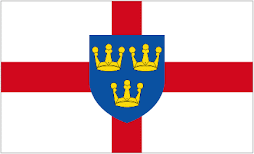
Recently, I found myself alone in the draughty old fen as Maxima took Minora and Minima across the marshes to visit her parents.
Having to cook for myself - infamy! - I stumbled across a recipe so stunning in its simplicity I felt compelled to share it.
The core ingredient is Heinz beans, which, Heinz having taken spelling lessons from Slade, are now marketed as Beanz.
Without further ado, I present to you:
Beanz à la crème frugaloise
Ingredients
2 large cans of Heinz Beanz
Tiptree East Anglian Hot Mustard
Saclà Classic Pesto
Processed cheese
Chili left over from a kebab
Method
Buy a slab of processed cheese about the size of your hand. Grate half of it. Deposit the other half in the hinterland of the fridge where you're unlikely to come across it in the near future, as it tastes better when it goes mouldy.
Empty the Beanz into a pan and turn up the heat pretty damn high. Add the grated cheese, and stir until you get bored. Add an imperial dollop of mustard.
Add the pesto. All of it. Don't get distracted by the calumny that this might be too much pesto, there's no such thing.
Get that tub of chili you couldn't add to your kebab the other night because your mouth felt like Death Valley with extra global warming on the side, and add just less than you might think. If you've no chili sauce left over, fish the kebab box out of the bin, and scrape some sauce from the vegetation therein into the pan.
Continue stirring. When it starts to look as if the whole thing's going to go belly-up, you can turn the heat down a little if you want. Remember, though, your success lies not just in the taste, but in the mixture's being heated up enough for the burnt bits at the bottom to be welded into the molecular structure of your beloved's best pan.*
Get two slices of white bread and cut the crusts off. Break the bread into little bits and add them to the pan, to soak up excess tomato sauce.
Enjoy for the next couple of days, on toast, jacket potatoes, or straight from the pan in front of the sports event/episode of QI/Lord of the Rings film of your choice.
When your beloved returns expecting the worst, you can regale her with tales of your gourmet adventures, and watch the pursed uxorial lip soften into a smile. And, if nothing else, the Beanz will ensure that she comes back to all she ever wanted in the first place: a regular guy.
*Other pans are available.
Related post: hypergarlic megapizza
Monday, March 31, 2008


Saturday, March 29, 2008
Solaris - the boson delusion
Solaris (12)
Directed by Steven Soderbergh (2002)
94 mins
20th Century Fox
One of Maxima's roles in a local charity shop called XV is to phone round volunteers to fill shifts when required. When she realised I had a day off work today, she looked at the rota, saw that both shifts needed covering, and that put paid to my plans to spend a quiet day chewing things over in the draughty old fen.
In a bid to get people to buy some videos and DVDs that have been there so long they may soon be absorbed into the fabric of the building, they've been arranged in a tabletop display, and have been there so long that they seem to be part of the table. We'd happily give them away, but they're not moving. So I took one home.
Having once been a fan of science fiction books - by many authors, including Niven and Pournelle, Frank Herbert and John Brunner - my eye alighted on Solaris starring George Clooney. The cover showed Clooney astronaut-helmed and a space-station orbiting the planet of the title, shown in a soft-focus from which it never escapes during the film.
Suicide features strongly in the screenplay. Psychologist Chris Kelvin, Clooney's character, is grieving after that of his wife when he receives a distress call from a friend on a space station orbiting the planet Solaris, only to find that his friend, too, has committed suicide by the time he gets there.
The two crew left on the station are uncommunicative in different ways: Dr Helen Gordon (Viola Davis) just wants to go home, and Snow (Jeremy Davies) looks as if he's ingested too much hallucinogens, either by mouth or by ear (à la Sgt Pepper, acid's aural form).
Asleep, Kelvin dreams, understandably, of his wife, and times that they have shared are shown in flashbacks throughout the film. For example, there's a love scene - which, while not actually pornographic, is filmed with the actors naked, and sits uncomfortably with the film's "12" certification. Kelvin is shown in a rage in a scene that appears to be the immediate aftermath of his wife, Rheya, confessing to an abortion.
Kelvin awakes to find his neck being caressed - by his wife. Having assured himself he's awake, he tricks her into an escape pod then ejects it, turning away as it drifts into space so he doesn't have to look at her face: she does look rather miffed. In space, there are no sheds to retreat to when a man gets that look from his wife.
It turns out that people from the crewmembers' pasts - who have died - have returned to, er, haunt them. Gordon, however, has found a way to be rid of them - by aiming a beam generated from a "Higgs field" at them. After Rheya's shade attempts suicide by drinking liquid oxygen but is frustrated by immortality, she begs Gordon to kill her - which Gordon, we are led to believe, does gladly, for she doesn't believe the shades are human, and states "I want people to win".
The plot promises to mine fascinating seams of meaning, then declares them unworthy of excavation. An interesting theme about the ontological status of our memories starts to develop, then crashes and burns as the "memory", left alone, looks back on memories of her own. Again, Kelvin has a conversation with another apparition about precisely who is hallucinating whom, but that goes nowhere as well.
We are shown a short clip of a dinner-party where Rheya debates the existence of God - that debate never resurfaces, either, but the subject is not entirely dropped; it's a theme, but not as we know it.
It's said by some that the god(s) of the former prevalent religion feed the demonology of the next. Thus, the horned god of the pre-Christian pagan religions - which were eventually given the coup de grâce not by Christianity but by Enlightenment thinkers - is said to have inspired depictions of Satan. You could say that radical militant atheists are trying to do the same job with God - note that the title of Christopher Hitchens' tome is not God does not exist, but God is not great. The still-undiscovered Higgs boson (some sources capitalise both initial letters) is breathlessly referred to by some scientists as the "God particle." A massive underground basilica has been built at CERN to welcome the putative quark at a price which makes St Peter's look as if it was funded from the petty-cash box. I think it's significant that the beam which "kills" the shades comes from a Higgs field. The god particle undoes the existence of those made in God's image.
Except it doesn't. Kelvin and Rheya - whose name was changed from Hari in Andrea Tarkovski's 1972 film of Stanisław Lem's classic 1961 science fiction novel to be homophonic with the Greeks' great mother goddess - return, one presumes, on Solaris, where Rheya indulgently informs Kelvin that "all is forgiven". It would certainly be irresponsible for me to suggest that suicide is unforgiveable, because that's not the case, but we are not treated to any explanation as to who or what has done the forgiving. As the Higgs boson, if it exists, is estimated to last a fraction of a fraction of a second, it would not be a great candidate for this disposition, as it's difficult to imagine it getting up to a lot of forgiving in its lifespan. Assuming the absence of God - who, thankfully, survives all his many obituaries - I can't see the next candidate for apotheosis. Mother Earth, perhaps - almost certainly with a much reduced population of humanity, possibly totally without one; which would be to completely miss the point of Creation: us.
There's a coda. Finally, we see Kelvin back on earth, but he feels "wrong". He has a memory of holding back from entering the escape pod piloted by Gordon to remain on the space station, and one presumes that this earthly version of Kelvin is a shade.
It's the sort of turnaround that was pioneered televisually in Quatermass and the Pit, where an investigation into alien artefacts throws up the conclusion that it is mankind who is in fact the alien. However, whereas the phenomenon of workers running home in the late '50's to catch the latest episode of Quatermass has become the stuff of legend, Solaris's underwhelming ending finishes off a long list of reasons why a charity shop couldn't give it away.
Related post - why the large hadron collider will find the Higgs boson
Directed by Steven Soderbergh (2002)
94 mins
20th Century Fox
One of Maxima's roles in a local charity shop called XV is to phone round volunteers to fill shifts when required. When she realised I had a day off work today, she looked at the rota, saw that both shifts needed covering, and that put paid to my plans to spend a quiet day chewing things over in the draughty old fen.
In a bid to get people to buy some videos and DVDs that have been there so long they may soon be absorbed into the fabric of the building, they've been arranged in a tabletop display, and have been there so long that they seem to be part of the table. We'd happily give them away, but they're not moving. So I took one home.
Having once been a fan of science fiction books - by many authors, including Niven and Pournelle, Frank Herbert and John Brunner - my eye alighted on Solaris starring George Clooney. The cover showed Clooney astronaut-helmed and a space-station orbiting the planet of the title, shown in a soft-focus from which it never escapes during the film.
Suicide features strongly in the screenplay. Psychologist Chris Kelvin, Clooney's character, is grieving after that of his wife when he receives a distress call from a friend on a space station orbiting the planet Solaris, only to find that his friend, too, has committed suicide by the time he gets there.
The two crew left on the station are uncommunicative in different ways: Dr Helen Gordon (Viola Davis) just wants to go home, and Snow (Jeremy Davies) looks as if he's ingested too much hallucinogens, either by mouth or by ear (à la Sgt Pepper, acid's aural form).
Asleep, Kelvin dreams, understandably, of his wife, and times that they have shared are shown in flashbacks throughout the film. For example, there's a love scene - which, while not actually pornographic, is filmed with the actors naked, and sits uncomfortably with the film's "12" certification. Kelvin is shown in a rage in a scene that appears to be the immediate aftermath of his wife, Rheya, confessing to an abortion.
Kelvin awakes to find his neck being caressed - by his wife. Having assured himself he's awake, he tricks her into an escape pod then ejects it, turning away as it drifts into space so he doesn't have to look at her face: she does look rather miffed. In space, there are no sheds to retreat to when a man gets that look from his wife.
It turns out that people from the crewmembers' pasts - who have died - have returned to, er, haunt them. Gordon, however, has found a way to be rid of them - by aiming a beam generated from a "Higgs field" at them. After Rheya's shade attempts suicide by drinking liquid oxygen but is frustrated by immortality, she begs Gordon to kill her - which Gordon, we are led to believe, does gladly, for she doesn't believe the shades are human, and states "I want people to win".
The plot promises to mine fascinating seams of meaning, then declares them unworthy of excavation. An interesting theme about the ontological status of our memories starts to develop, then crashes and burns as the "memory", left alone, looks back on memories of her own. Again, Kelvin has a conversation with another apparition about precisely who is hallucinating whom, but that goes nowhere as well.
We are shown a short clip of a dinner-party where Rheya debates the existence of God - that debate never resurfaces, either, but the subject is not entirely dropped; it's a theme, but not as we know it.
It's said by some that the god(s) of the former prevalent religion feed the demonology of the next. Thus, the horned god of the pre-Christian pagan religions - which were eventually given the coup de grâce not by Christianity but by Enlightenment thinkers - is said to have inspired depictions of Satan. You could say that radical militant atheists are trying to do the same job with God - note that the title of Christopher Hitchens' tome is not God does not exist, but God is not great. The still-undiscovered Higgs boson (some sources capitalise both initial letters) is breathlessly referred to by some scientists as the "God particle." A massive underground basilica has been built at CERN to welcome the putative quark at a price which makes St Peter's look as if it was funded from the petty-cash box. I think it's significant that the beam which "kills" the shades comes from a Higgs field. The god particle undoes the existence of those made in God's image.
Except it doesn't. Kelvin and Rheya - whose name was changed from Hari in Andrea Tarkovski's 1972 film of Stanisław Lem's classic 1961 science fiction novel to be homophonic with the Greeks' great mother goddess - return, one presumes, on Solaris, where Rheya indulgently informs Kelvin that "all is forgiven". It would certainly be irresponsible for me to suggest that suicide is unforgiveable, because that's not the case, but we are not treated to any explanation as to who or what has done the forgiving. As the Higgs boson, if it exists, is estimated to last a fraction of a fraction of a second, it would not be a great candidate for this disposition, as it's difficult to imagine it getting up to a lot of forgiving in its lifespan. Assuming the absence of God - who, thankfully, survives all his many obituaries - I can't see the next candidate for apotheosis. Mother Earth, perhaps - almost certainly with a much reduced population of humanity, possibly totally without one; which would be to completely miss the point of Creation: us.
There's a coda. Finally, we see Kelvin back on earth, but he feels "wrong". He has a memory of holding back from entering the escape pod piloted by Gordon to remain on the space station, and one presumes that this earthly version of Kelvin is a shade.
It's the sort of turnaround that was pioneered televisually in Quatermass and the Pit, where an investigation into alien artefacts throws up the conclusion that it is mankind who is in fact the alien. However, whereas the phenomenon of workers running home in the late '50's to catch the latest episode of Quatermass has become the stuff of legend, Solaris's underwhelming ending finishes off a long list of reasons why a charity shop couldn't give it away.
Related post - why the large hadron collider will find the Higgs boson
Wednesday, March 26, 2008
cohesion with nutty ban, collusion with oppression
CAVETE - contains discussion of and links to material concerning female genital mutilation
The National Union of Teachers (NUT) wants to ban religious schools. At the same time, they want imams, rabbis and priests to offer religious instruction in all state schools. Being able to hold both these positions simultaneously seems indicative of having had a tad too much therapy.
The key to trying to understand their position appears to be the concept of community cohesion. The government describes this as comprising:
The National Union of Teachers (NUT) wants to ban religious schools. At the same time, they want imams, rabbis and priests to offer religious instruction in all state schools. Being able to hold both these positions simultaneously seems indicative of having had a tad too much therapy.
The key to trying to understand their position appears to be the concept of community cohesion. The government describes this as comprising:
- a common vision and a sense of belonging for all communities;
the valuing of diversity; - similar life opportunities for all and;
- strong and positive relationships are being developed between people from different backgrounds and circumstances in the workplace, in the school and within neighbourhoods.
A worthy vision, produced by politicians who live aloof from the communities they represent, and can therefore afflict their worthy visions on those communities with impunity.
Roll up your sleeves and we'll go through them.
Number one: I fail to see how a common vision and a sense of belonging for all communities go along with the valuing of diversity, opposites separated solely by a semicolon and the grateful smiles with which the often racist competitors for the Safer and Stronger Communities Fund's largesse tick their paymaster's boxes. For example, a preacher with the UK Islamic Mission, which has been praised by Tony Blair, paraded his inclusive, democratic credentials, not knowing he was being clandestinely recorded for a documentary:
Another speaker says Muslims cannot accept the rule of non-Muslims. 'You cannot accept the rule of the kaffir [non-Muslim],' a preacher, Dr Ijaz Mian, tells a meeting held within the mosque. 'We have to rule ourselves and we have to rule the others.'
This is a minority occupation, of course. Terrorism is a minority pastime almost by definition. In a military band event in Glasgow in 1997, I remember a minority of the Indian contingent and a minority of the Pakistani contingent taunting each other. It was a decade before they became nuclear powers, so luckily all they had to lob was insults. I'm a peaceful Christian chap (except when Minora puts on her thump-thump-thump music), and most Christians are, I would hope, peaceful; but I am totally in favour of the British and responsible American (ie excluding regulars at Irish bars in New York) campaign to curtail the murderous pleasures of the minority of inhabitants of Northern Ireland who were Christian terrorists. Which is a case in point: if it's taken from 1798 until the present time to persuade the gangsters of that obscure corner of Europe that peace is more fun than paranoia, how does the Labour Government expect to see much of the world's conflicts solved in microcosm within this small island?
Multiculturalism also touches the draughty old fen. While Captain Malcolm Farrow of the Flag Institute commented on the relaxation of restrictions on flying the Union Jack by saying that "Any nation that doesn't fly the national flag from its government buildings every day of the week needs its head examined," Jenny Bailey, mayor of neighbouring Cantabrigia, stated it was a "nice idea...but we have such a diverse country that lots of people would have different opinions on this". Thus British patriotism is reduced to an "opinion", which is presumably floating in a sea of opinions - but will soon sink under the weight of the firmly-held beliefs of those groups who attach to their patriotism more value than that of a mere lifestyle choice. Ms Bailey is not alone in making the error that the recipients of multiculturalism are themselves multiculturalists.
Number two: similar life-opportunities for all.
What does this mean? The opportunity to have a life? Don't even get me started on that one! There's enough potential in that phrase to fuel a jeremiad of bloggers, keep daytime TV presenters in clover for a career, and inspire the celebrity chef of your choice to open a restaurant employing telegenic underachievers.
So, if we have to focus down, let's look at something I've chewed over before: sexual health.
According to the Department of Health publication Recommended Standards for Sexual Health Services,
The recommended standards for sexual health services are presented as a means for service improvement to support more people to enjoy healthy and happy sex lives.
So far so soporific. But what, for instance, about women and girls who have been subjected to the egregious practice of female genital mutilation? I hate to say it, but this awful assault on the person, dignity and future of girls is practiced in Great Britain:
During the past three or four decades ethnic groups who practise female genital mutilation have immigrated to Britain, mainly as refugees. The main groups are from Eritrea, Ethiopia, Somalia, and the Yemen. It has been estimated that in their own countries over 80 per cent of women have had the operation...which is invariably infibulation. There is evidence that the operation is being performed illegally in Britain...by medically qualified or unqualified practitioners and that children are being sent abroad for a "holiday" to have it done. In Britain the procedure is usually performed between the ages of 7 and 9 years.
In a couple where one party has been subjected to this infamous amputation of innocence, how does the Department of Health intend to "support people to enjoy healthy and happy sex lives"? Or do men's assurances of their partners' rapturous joy resulting from being thus violated suffice - ie do women's rights stop at the poles of the liberal-socialist axis?
On to the third one, about strong and positive relationships between people from differerent backgrounds in workplaces and neighbourhoods. And schools. Which is where the NUT comes back in - they (still) want to ban religious schools. I find this rather puzzling: Minora knows more about Judaism, Hinduism, Buddhism and Islam than many people twice her age because she learns about them in the Christian school she attends.
At her school, and at Minima's, I have not met any teacher who was not of the good, solid, head-on-shoulders, feet-on-the-ground type. Teachers seem to have got rid of the eejits by the same method that has been employed by the UN, the NHS, Social Services and Sadie McGlumphur's Tartan Emporium - by kicking them upwards to get them out of their hair. This is how whole industries come to be managed by the asinine, the effete and the incompetent.
Perhaps the answer, if there is one, lies - paradoxically - in the NUT's other whipping-boy. They appear to think that the subliminal message to pupils in talks by forces personnel is "Join the Army and we will send you to bomb, shoot and possibly torture fellow human beings in other countries." Strange - I didn't think we had any barracks in Tibet.
Whatever the NUT's views on faith-schools, social cohesion and multiculturalism, the solution to their problems of prosecuting illegal wars in the middle east will be as simple to them as it will be bitterly ironic. Vote the Labour Government out at the next election. Alternatively, relocate to a country where they need not be troubled by crusty old right-wingers: I hear North Korea's quite sunny at this time of year.
Saturday, March 22, 2008
rizla - a smoke or a toke?
 As reported in the March-April 2008 edition of Druglink, Rizla, the major manufacturer of cigarette papers, seems rather annoyed. Mental health charity Rethink has called for it to put health warnings concerning the dangers of cannabis on its king-size papers, on the basis that "more people think king-size Rizla papers are used for cannabis than for tobacco".
A Rizla spokesman objected: "Rizla as a brand was singled out for the total focus of a campaign about cannabis use. There was no justification for picking on a single brand."
One justification may be that the Association of Nurses in Substance Abuse guide to Good clinical practice identified in 1997 that the presence of Rizla papers could indicate, in the presence of other signs, that cannabis was being used. In 1993, an advert for Rizla with the caption "twist and burn" was banned by the Advertising Standards Authority because it was seen to promote cannabis use - a twist to close the paper at the end of a fatter than usual cigarette being the sign of a spliff within all the toking subcultures - despite Rizla's protestations that it was a motorcycling phrase (it's actually associated with making your own CD's). The same year, the ASA resisted complaints about another Rizla campaign, filled with what could be interpreted as cannabis references, fronted by the slogan "It's what you make it".
The trouble with cannabis is that it's not what it used to be. Progressive politicians push each other out of the way to disclose solemnly that they inhaled once upon a time - with the implied message that "it didn't do me any harm, so..." However, it's a circular argument: people who are in a position to disseminate the message that cannabis didn't do them any harm, are in a position to do so because cannabis didn't do them any harm.
But cannabis does do harm, and here's the rub: it has gotten more harmful from the 1980's onwards through selective breeding to increase the amount of psychoactive compounds - mainly tetrahydrocannabinol (plus around 60 other cannabinoids) - in the plant. In the 1970's, cannabis could contain as low as 1-2% tetrahydrocannabinol (THC); it can contain over ten times as much now.
Not only that, but the amount of home-grown cannabis is increasing, rendering border controls (such as they are) useless. Ten years ago, 11% of cannabis sold in Great Britain was grown here; now, that figure has risen to 60%, possibly due in part due to Moroccan authorities cracking down on the drug. Home growing is also cheaper; with "gardeners" often paid in cannabis instead of money, once the cost of a rented house - with almost every square foot devoted to agriculture - is subtracted, the rest is profit. With crops maturing every month, it is not unknown for a street value of over £20,000 to be raised twelve times a year. It seems that the Nuntii Cantabrigienses carries a story about a cannabis factory discovered every week.
Gone are the days when cannabis was associated with relaxed people listening intently to jazz, Led Zeppelin or sub-Pink-Floyd psychodelia. Or Revolution Number 9, but anybody with any affection for The Beatles doesn't talk about that. With increasing strength, phenomena such as tolerance and even a cannabis withdrawal syndrome have been identified, as well as a link with the development of psychosis.
Certain components of cannabis may have important roles to play in pain relief, it is true; but that is no more an argument for its general acceptability than the pain-relieving qualities of diamorphine justify abuse of street heroin. In terms of harm done, moreover, much of the harm suffered by users of street heroin is inflicted by additives with which the drug is "cut" to make it last longer; the significant amounts of harm done by cannabis, on the other hand, can be ascribed purely and simply to its endogenous components.
What has all of this got to do with Rizla? I would say a lot, because Rizla is often assumed to be the cigarette-paper of choice to smoke tobacco, surely, but is also inextricably bound up with the consumption of cannabis. For example, an opinion-piece concerning a garage (written by customers, not owners) speaks of it "providing the youth of Bourne End with an endless supply of Rizlas and munchies". Man does not live by cigarette papers alone, it's true, but "munchies" is a word that cannabis-users employ to indicate the stimulation of appetite engendered by the weed's consumption.
There are plenty of examples of Rizla being used within direct reference to drugs, even to the preparation of joints. But Rizla cannot be held responsible for the acts of eejits - however, the cross-motif is so universally associated with cannabis use that there is a brand of cigarette papers called "cannabis" which uses the Rizla cross motif. I realise that the company cannot be expected to keep an eye on every pirate outfit which steals its motif, but in this case I call on Rizla to identify the makers of this brand of papers and publically denounce it because of cannabis use. I'd hoped to get one of these packs from the low-cost store in Cantabrigia's Mill Road that was selling them, but both the papers and the bongs with the pictures of cannabis leaves on them are gone - maybe some eejit's been blogging about them. (The bloke in the head-shop was puzzled about "cannabis" cigarette papers, he said you wouldn't want to advertise you were smoking it. He seemed to know something about odour-free cannabis that I didn't.)
In the meantime, if Rizla doesn't want to put a health-warning on its papers regarding cannabis, perhaps it might consider starting to distance itself from the illicit drugs trade by putting another legend on its papers: "not to be used with cannabis."
Friday, March 21, 2008
let's all have the same amount of rights
In my home country of Scotia, a married couple, both with employed by Strathclyde Police, have won the first round in their fight against discrimination by their employer.
What they are objecting to is that their status has been changed from "married" to "married/civil partnership".
To get a reasonable picture of the case, I thought I would have to link to a Christian site, but the Pink News captures the essence of the affair succinctly and, in my view, in a non-partisan manner:
"The couple added that the change to their "true legal and religious status" amounted to sex discrimination and religious discrimination.
"Mr McQuade, 49, a communications officer with the force, that [sic] no slur
was intended on the gay community.
"Strathclyde police claim that if they were to separate the 'married' and 'civil partnership' options on the employees records then they would be 'outing an individual's sexual orientation against their wishes or without their clear permission, which is inappropriate
and a breach of privacy.'"
What I find difficult to understand is why listing a partnership as either "marriage" or "civil partnership" is tantamount to "outing" anybody; surely names like "Lucille and Frank" or "James and John" tell you all you need to know.
I too have no wish to slur the gay community. What worries me is that, say, in the field of criminal justice, more weight is given to the sentence of a criminal if their victim was gay. For example, in the US, a judge ruled that three men who killed a man who happened to be gay - a heinous crime, of course - were to be punished as if it were a "hate crime", no matter whether hatred of the gay community were involved.
The offensive against "discrimination" isn't limited to sexual orientation. Recently, as Anne Widdecombe notes, an Anglican priest ended up in hospital because a small group of Muslim youths thought his church should in fact be a mosque.
In Scotia, the Offences Aggravated by Prejudice (Scotland) Act looks as if it will pass with minimal resistance. But, one has to ask, offences against whom? Imagine that I was set upon by two thugs, one a Muslim and the other gay: would I be able, if I still lived in Caledonia, to ask for justice under that bill? It seems more likely that, once functionaries had ascertained that I am a British heterosexual Christian, the case would be thrown out. If that isn't bad enough, imagine what might happen if I was Jewish: I'd probably find myself on trial for being Hebraic in a public place.
If equality is what gay people and non-Judaeo-Christians desire, I'm all in favour of that: I'd love to live in a society where I had as many rights as them.
What they are objecting to is that their status has been changed from "married" to "married/civil partnership".
To get a reasonable picture of the case, I thought I would have to link to a Christian site, but the Pink News captures the essence of the affair succinctly and, in my view, in a non-partisan manner:
"The couple added that the change to their "true legal and religious status" amounted to sex discrimination and religious discrimination.
"Mr McQuade, 49, a communications officer with the force, that [sic] no slur
was intended on the gay community.
"Strathclyde police claim that if they were to separate the 'married' and 'civil partnership' options on the employees records then they would be 'outing an individual's sexual orientation against their wishes or without their clear permission, which is inappropriate
and a breach of privacy.'"
What I find difficult to understand is why listing a partnership as either "marriage" or "civil partnership" is tantamount to "outing" anybody; surely names like "Lucille and Frank" or "James and John" tell you all you need to know.
I too have no wish to slur the gay community. What worries me is that, say, in the field of criminal justice, more weight is given to the sentence of a criminal if their victim was gay. For example, in the US, a judge ruled that three men who killed a man who happened to be gay - a heinous crime, of course - were to be punished as if it were a "hate crime", no matter whether hatred of the gay community were involved.
The offensive against "discrimination" isn't limited to sexual orientation. Recently, as Anne Widdecombe notes, an Anglican priest ended up in hospital because a small group of Muslim youths thought his church should in fact be a mosque.
In Scotia, the Offences Aggravated by Prejudice (Scotland) Act looks as if it will pass with minimal resistance. But, one has to ask, offences against whom? Imagine that I was set upon by two thugs, one a Muslim and the other gay: would I be able, if I still lived in Caledonia, to ask for justice under that bill? It seems more likely that, once functionaries had ascertained that I am a British heterosexual Christian, the case would be thrown out. If that isn't bad enough, imagine what might happen if I was Jewish: I'd probably find myself on trial for being Hebraic in a public place.
If equality is what gay people and non-Judaeo-Christians desire, I'm all in favour of that: I'd love to live in a society where I had as many rights as them.
Sunday, March 16, 2008
the rhythms of lives
Recently, Paul Johnstone wrote an article in The Spectator about his ten favourite poems. I liked it so much I bought the company...no, just kidding, and if you didn't understand that last crack ask your teacher. I liked it so much I posted links to Johnstone's favourite poems in a side panel.
I'm not very good at poetry. Growing up in a working-class area in the 1970's and early '80's that was inexorably sinking was a prosaic experience in every sense. But I was priveleged to have a sense of the poetic - although unfortunately not a poetic sensibility - injected into my life by my Mum.
Her favourite poem was Trees by Joyce Kilmer, which she learnt at school in the '30's, and which popped up briefly in Superman II. It was also recorded in song form by Arthur Tracy, the "Street Singer", in the 1930's; in the next decade, Tracy stole a march on the likes of Led Zeppelin by distancing himself from the music industry because he was unhappy with the compromises that fame entailed.
Mum lived in New York in the early '60's, where she became acquainted with the works of Longfellow. In his 1841 poem Excelsior, he tells the story of a noble youth who feels compelled to climb an Alpine mountain in spite of an old man's warning and a maiden's offer of comfort. As is the unfortunate lot of noble youths in poetry he dies, but by his ascent above fear and comfort he transcends also the bleak lot of the übermann to be propounded by Nietsche, who was born in 1844:
There in the twilight cold and gray,
Lifeless, but beautiful he lay,
And from the sky, serene and far,
A voice fell, like a falling star,
Excelsior!
There is much dross in modern music, but much poetry also hides in plain sight there. I have always been struck by the subtletly of The Beatles' In My Life, particularly as it seems to be predeminantly a Lennon composition. I think he must have been still talking to Paul at that stage. Dire Straits' Brothers in Arms paints a poignant portrait of a fighting man, far from home, who knows he must wage war but yearns for peace.
A hero of mine, Enoch Powell, started the Second World War as a Private in the Royal Warwickshire Regiment, and and ended it a Brigadier. He wrote a little-known poem during WWII about the experience of feeling trapped under fire called The Net. I would make it required reading for all politicians who play a part in putting Forces personnel in harm's way.
The output of Scotland's national poet, Rabbie (Robert) Burns, was so prolific that no one label, eg romantic, political, comic, can capture his essence. My favourite Burns love poem is My Luve is like a Red Red Rose, which has been interpreted in song in different ways, for example by Eddi Reader and Andy M Stewart. My favourite Burns poem of all, which contains the lines "the best-laid schemes o' mice and men gang aft agley" - story of my life! - is To a Mouse or, to give it its full title, To a Mouse on Turning Her Up in her Nest with the Plough, November 1785. Sometimes, as the mouse found, we're not as in control of our lives as we'd like to think.
Another of my favourite poems is one that Johnstone rejects for the purpose of his essay, Milton's On My Blindness. Written long before political correctness made being "differently able" a lifestyle option, this work lays out the dignity of those many of us who struggle with a disability to make a decent fist of a normal life.
My favourite poem of all is that which was chosen by the British people in the BBC poll of 1996,when Auntie lapsed in her programme of force-feeding us her dross to let us choose our own dross. Except we didn't choose dross. Despite commissioners' fears - or perhaps even hopes - that Pam Ayres' I wish I'd looked after my Teeth would top the poll, the British people in fact chose a quintessentially British piece as their favourite poem: Rudyard Kipling's If.
My last poem is again a song. Working as a secretary in the Sacred Heart Church in New York, Mum was dating a German man when Breakfast at Tiffany's came out. She had been wandering, Dvořák-like, on the shores of the Atlantic, wondering if she should stay and marry her beau, or return to Glasgow, where her mother's health was declining. I'm not sure what exactly about the film changed her mind, but after seeing the bittersweet saga of lost souls she broke her boyfriend's heart and came back home. She married my Dad, who had pursued her fruitlessly for many years. After eight years of marriage he died of cancer, and as one of a long string of low-paid jobs she took on to support herself and me, Mum got a job as a receptionist using one of the earliest mass-produced computers. She saw that these were the future but, unable to teach me to type due to the mounting pain of rheumatoid arthritis, bought me a metal Underwood typewriter from the Barras - it felt heavier and heavier as I carried it home: being dearer than she had expected, she spent our bus fares on it. She also got me a teach-yourself-to-type book, and told me to get on with it. I think of all this every time I hear Moon River, and present this touch-typed offering to you as the fruit of that long line of twists and turns that started with a little girl learning Trees.
Thanks, Ma.
Related posts: Top ten songs about literature
Pictures from my mother
I'm not very good at poetry. Growing up in a working-class area in the 1970's and early '80's that was inexorably sinking was a prosaic experience in every sense. But I was priveleged to have a sense of the poetic - although unfortunately not a poetic sensibility - injected into my life by my Mum.
Her favourite poem was Trees by Joyce Kilmer, which she learnt at school in the '30's, and which popped up briefly in Superman II. It was also recorded in song form by Arthur Tracy, the "Street Singer", in the 1930's; in the next decade, Tracy stole a march on the likes of Led Zeppelin by distancing himself from the music industry because he was unhappy with the compromises that fame entailed.
Mum lived in New York in the early '60's, where she became acquainted with the works of Longfellow. In his 1841 poem Excelsior, he tells the story of a noble youth who feels compelled to climb an Alpine mountain in spite of an old man's warning and a maiden's offer of comfort. As is the unfortunate lot of noble youths in poetry he dies, but by his ascent above fear and comfort he transcends also the bleak lot of the übermann to be propounded by Nietsche, who was born in 1844:
There in the twilight cold and gray,
Lifeless, but beautiful he lay,
And from the sky, serene and far,
A voice fell, like a falling star,
Excelsior!
There is much dross in modern music, but much poetry also hides in plain sight there. I have always been struck by the subtletly of The Beatles' In My Life, particularly as it seems to be predeminantly a Lennon composition. I think he must have been still talking to Paul at that stage. Dire Straits' Brothers in Arms paints a poignant portrait of a fighting man, far from home, who knows he must wage war but yearns for peace.
A hero of mine, Enoch Powell, started the Second World War as a Private in the Royal Warwickshire Regiment, and and ended it a Brigadier. He wrote a little-known poem during WWII about the experience of feeling trapped under fire called The Net. I would make it required reading for all politicians who play a part in putting Forces personnel in harm's way.
The output of Scotland's national poet, Rabbie (Robert) Burns, was so prolific that no one label, eg romantic, political, comic, can capture his essence. My favourite Burns love poem is My Luve is like a Red Red Rose, which has been interpreted in song in different ways, for example by Eddi Reader and Andy M Stewart. My favourite Burns poem of all, which contains the lines "the best-laid schemes o' mice and men gang aft agley" - story of my life! - is To a Mouse or, to give it its full title, To a Mouse on Turning Her Up in her Nest with the Plough, November 1785. Sometimes, as the mouse found, we're not as in control of our lives as we'd like to think.
Another of my favourite poems is one that Johnstone rejects for the purpose of his essay, Milton's On My Blindness. Written long before political correctness made being "differently able" a lifestyle option, this work lays out the dignity of those many of us who struggle with a disability to make a decent fist of a normal life.
My favourite poem of all is that which was chosen by the British people in the BBC poll of 1996,when Auntie lapsed in her programme of force-feeding us her dross to let us choose our own dross. Except we didn't choose dross. Despite commissioners' fears - or perhaps even hopes - that Pam Ayres' I wish I'd looked after my Teeth would top the poll, the British people in fact chose a quintessentially British piece as their favourite poem: Rudyard Kipling's If.
My last poem is again a song. Working as a secretary in the Sacred Heart Church in New York, Mum was dating a German man when Breakfast at Tiffany's came out. She had been wandering, Dvořák-like, on the shores of the Atlantic, wondering if she should stay and marry her beau, or return to Glasgow, where her mother's health was declining. I'm not sure what exactly about the film changed her mind, but after seeing the bittersweet saga of lost souls she broke her boyfriend's heart and came back home. She married my Dad, who had pursued her fruitlessly for many years. After eight years of marriage he died of cancer, and as one of a long string of low-paid jobs she took on to support herself and me, Mum got a job as a receptionist using one of the earliest mass-produced computers. She saw that these were the future but, unable to teach me to type due to the mounting pain of rheumatoid arthritis, bought me a metal Underwood typewriter from the Barras - it felt heavier and heavier as I carried it home: being dearer than she had expected, she spent our bus fares on it. She also got me a teach-yourself-to-type book, and told me to get on with it. I think of all this every time I hear Moon River, and present this touch-typed offering to you as the fruit of that long line of twists and turns that started with a little girl learning Trees.
Thanks, Ma.
Related posts: Top ten songs about literature
Pictures from my mother
Friday, March 14, 2008
The Budget: panem et circenses and Special Brew
This year's spring Budget, which no sane person doubts is at least as much the Prime Minister's as Alistair Darling's, will be fodder for psychoanalysts and psephologists alike for many elections to come. In Diplomacy, Henry Kissinger predicates of Hitler's character the quality of doing everything possible to bring the house of cards of his own creation crashing down around his ears; in a similar way, the Prime Minister seems determined to go the extra mile to destroy himself, his party and his country.
There's not enough time or blogs to chew over the slings and arrows of outrageous farce aimed across the whole spectrum of social class that Darling Brown is determined to systematically alienate. So I'd like to concentrate on one aspect - alcohol.
Government apparatchiks appear to have noticed that alcohol prices are going down in real terms, but not to have clicked that this observation pertains to supermarket-sold alcohol. So, in an effort to stop binge-drinking, which is in principle - rightly - applauded by doctors, the Budget has piled above-inflation tax hikes on beer bought in pubs: the very places where it's not too easy to binge-drink, because the licensee faces prosecution and loss of license should a serious incident result from binge-drinking on their premises.
So, with the smoking-ban, rising beer and wine prices and competition from supermarkets selling cheap booze, our pubs are facing mounting pressure just to stay open, with worrying consequences. For one thing, rather than smoke out in the streets of our draughty old fens, people are smoking at home in front of their children; now, with the double-whammy of the rising price of a pint while off-license drink gets relatively cheaper, they are taking booze home to drink in front of their children as well. Another victory for the received wisdom of the liberal-socialist axis in the face of common sense.
I can understand the rationale behind the move on alcohol taxes. But it's difficult to envisage gangs of yobs getting tanked up on Cabernet Sauvignon before having a sophisticated night out headbutting all the right people then doing a Damien Hirst on the pavement. If the government wants to put the pressure on problematic drinking, it should target certain brands of alcoholic drink with the precision of a cruise missile instead of blanket-bombing the whole industry. Specifically, superstrength lager, strong cider and spirit-based alcopops.
However, it would be unfair to tar all of these drinks with the same brush. Bacardi, for example, has a website that can only be accessed after the surfer has entered their date of birth and country of domicile. There's also a facility to enter your postcode and find a taxi-firm.
Carlsberg has the same sort of setup. It also has a responsible drinking page, which informs us that a 500ml can of Special Brew contains 4.5 units of alcohol. On the page dedicated to Special Brew, the street-drinker's tipple of choice, we are told that "the Department of Health advises that men should now drink no more than 3-4 units of alcohol per day, and women should drink no more than 2-3 units of alcohol per day." In other words, drink one can of the product and, in the light of Carlsberg's own responsible drinking policy, you're drinking irresponsibly. The concoction, we are told, was "first brewed in 1950 to satisfy the refined tastes of Winston Churchill himself". Sounds impressive, but I'm not aware of the old war-horse having had a taste for paint-stripper saturated with syrup; and I think it's unfair to project an image of fighting them on the beaches and never surrendering which is simply setting up the average consumers of strong lagers which their brewers knowingly target to be objects of derision at best,and of fear at worst.
If this government wants to stop binge-drinking, wine and pints of beer are the wrong things to target. Put higher tax on superstrength lager and cider, and alcopops, if you dare, Darling Gordon. The disadvantage for you is that this may nudge some people struggling to end their addictions to become free of drugs and alcohol, and they would soon be looking for employment which is no longer there because immigrants have arrived unimpeded to reap what they have not sown.
While we will argue for a long time over whether the Minister for children shouted "So What?" in reply to David Cameron's delineation of the increasing tax burden, the sight of Housing Minister Caroline Flint in full Blair Babe fatigues was certainly an eye-opener: I hadn't realised how easy it was to disguise jackboots as heels.
There's not enough time or blogs to chew over the slings and arrows of outrageous farce aimed across the whole spectrum of social class that Darling Brown is determined to systematically alienate. So I'd like to concentrate on one aspect - alcohol.
Government apparatchiks appear to have noticed that alcohol prices are going down in real terms, but not to have clicked that this observation pertains to supermarket-sold alcohol. So, in an effort to stop binge-drinking, which is in principle - rightly - applauded by doctors, the Budget has piled above-inflation tax hikes on beer bought in pubs: the very places where it's not too easy to binge-drink, because the licensee faces prosecution and loss of license should a serious incident result from binge-drinking on their premises.
So, with the smoking-ban, rising beer and wine prices and competition from supermarkets selling cheap booze, our pubs are facing mounting pressure just to stay open, with worrying consequences. For one thing, rather than smoke out in the streets of our draughty old fens, people are smoking at home in front of their children; now, with the double-whammy of the rising price of a pint while off-license drink gets relatively cheaper, they are taking booze home to drink in front of their children as well. Another victory for the received wisdom of the liberal-socialist axis in the face of common sense.
I can understand the rationale behind the move on alcohol taxes. But it's difficult to envisage gangs of yobs getting tanked up on Cabernet Sauvignon before having a sophisticated night out headbutting all the right people then doing a Damien Hirst on the pavement. If the government wants to put the pressure on problematic drinking, it should target certain brands of alcoholic drink with the precision of a cruise missile instead of blanket-bombing the whole industry. Specifically, superstrength lager, strong cider and spirit-based alcopops.
However, it would be unfair to tar all of these drinks with the same brush. Bacardi, for example, has a website that can only be accessed after the surfer has entered their date of birth and country of domicile. There's also a facility to enter your postcode and find a taxi-firm.
Carlsberg has the same sort of setup. It also has a responsible drinking page, which informs us that a 500ml can of Special Brew contains 4.5 units of alcohol. On the page dedicated to Special Brew, the street-drinker's tipple of choice, we are told that "the Department of Health advises that men should now drink no more than 3-4 units of alcohol per day, and women should drink no more than 2-3 units of alcohol per day." In other words, drink one can of the product and, in the light of Carlsberg's own responsible drinking policy, you're drinking irresponsibly. The concoction, we are told, was "first brewed in 1950 to satisfy the refined tastes of Winston Churchill himself". Sounds impressive, but I'm not aware of the old war-horse having had a taste for paint-stripper saturated with syrup; and I think it's unfair to project an image of fighting them on the beaches and never surrendering which is simply setting up the average consumers of strong lagers which their brewers knowingly target to be objects of derision at best,and of fear at worst.
If this government wants to stop binge-drinking, wine and pints of beer are the wrong things to target. Put higher tax on superstrength lager and cider, and alcopops, if you dare, Darling Gordon. The disadvantage for you is that this may nudge some people struggling to end their addictions to become free of drugs and alcohol, and they would soon be looking for employment which is no longer there because immigrants have arrived unimpeded to reap what they have not sown.
While we will argue for a long time over whether the Minister for children shouted "So What?" in reply to David Cameron's delineation of the increasing tax burden, the sight of Housing Minister Caroline Flint in full Blair Babe fatigues was certainly an eye-opener: I hadn't realised how easy it was to disguise jackboots as heels.
Subscribe to:
Posts (Atom)